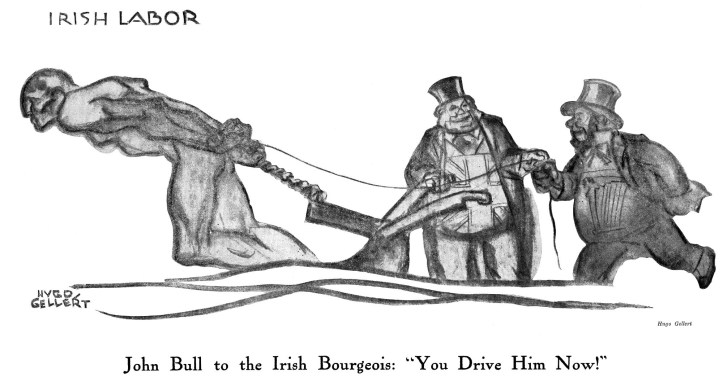
A fine essay from O’Flaherty on the politics of hunger in Ireland as the country, this time under the new Free State government, faced yet another famine in the mid-1920s.
‘The Bishop and the Famine’ by T.J. O’Flaherty from Workers Monthly. Vol. 4 No. 6. April, 1925.
THE clergyman who is unable to explain a mystery is as little entitled to wear the priestly robes as a labor faker who cannot count himself into office deserves to rank among the bonafide bureaucrats of labor. The writer has never heard of a priest who threw up his hands in despair in front of a mystery. His business is to make mysteries more mysterious and to turn quite matter-of-fact occurrences into insoluble riddles. Take the famine in Ireland for example.
Anybody but a bishop would look to the earth, sea and sky for a solution, and perhaps to the existing social conditions and the government which prescribes the rules and regulations for that system. Not so a bishop. Once the people begin to probe for causes in an effort to solve their problems; the priest business is in a bad way. When the great famine caused by the drought, the civil war and the allied blockade hit Russia in 1921, the Irish priests told the peasants that God was visiting his wrath on those people for denying his existence and chopping the Czar’s head off.
The Irish peasants devoutly blessed themselves and perhaps cursed the Czar, for whom they had no earthly use, having heard that he was related to the king of England. An Irish peasant would rather shoot a king than a hare any day, but the priests and the bishops were under contract to the British government to boost them to their parishioners. Perhaps the Irish peasants believed that the famine in Russia was due to a deity’s wrath. And perhaps they did not.
Famine “Conceived in Sin”
But what caused the present famine in Ireland? A conspiracy of earth, sea and sky, plus the criminal negligence of a capitalist government, declare those who have not had their brains extracted by religious superstition or their honesty raped by the capitalist government and its myriad agencies. Not so the bishop. “The Lord is punishing the Irish people for the guerrilla war that raged since the Easter Week rebellion and the civil war that followed the Black and Tan days.” This is the answer of Bishop Fogarty of Killaloe.
Famines are no new phenomena in Ireland. Along the entire west coast from Donegal in the north to Cork in the south, the land is very poor and though the population is not large, the barren soil is barely able to support the inhabitants. When the noted English revolutionist, Oliver Cromwell, overran Ireland with his god-loving Convenanters, he drove the peasants off the fertile plains and sent them to the bleak and desolate west coast. “To Hell or to Connaught” was the ultimatum. They went to Connaught as they thought. But it was the nearest thing to hell they ever experienced, though they did not realize it. Their descendants have been on speaking terms with famines ever since.
When the Potato Crop Fails
The staple food of the peasants on the west coast is the potato. When the potato crop fails they are out of luck. That was the cause of the terrible famine in 1847, of which James Connolly writes’ so powerfully in his “Labor In Irish History.”
It began on a small scale in 1845 and lasted until 1849. Its peak was reached in “Black ‘47” The money value of the potato crop was estimated at $100,000,000 yet the agricultural crop of Ireland in the year 1848 was valued at 1250,000,000, which proves that even though the potato crop failed, there was enough agricultural produce to feed twice the population, if as Connolly says, “the laws of capitalist society were set aside and human rights elevated to their proper position.”
In those awful years, shiploads of grain left Irish harbors for the markets of the world, while Irish mothers were dying in thousands by the roadsides with starving babies drawing on their shrunken breasts. “England made the famine by a rigid application of the principles that lie at the base of capitalist society “declared Connolly. And it can be as truthfully said today that the Irish Free State government is responsible for the hunger agonies of the thousands of men, women and children, who see the wolf of hunger moving relentlessly on their homes
Worst of Four Crop Failures
In many respects the present famine in Ireland is worse than the one that raged through four frightful years in the middle of the nineteenth century. Then, only the potato crop was a failure. Today all the crops have failed and in addition the fishing industry was ruined through the activities of a syndicate of British steam trawlers. At least 750,000 peasants are involved. As the case in the former famine this year’s harvest was only the worst of four successively bad ones.
The Free State government which has a lot of dignity to uphold is doing everything possible to suppress news of the famine, just as the government of Queen Victoria of England did when news of the disaster of 1847 reached the outside world. A donation sent by the Turkish government to the famine sufferers, through the British government was returned by order of Queen Victoria, with the informative tip that England would take care of any little unpleasantness that might exist.
Cosgrave Emulates the Queen
President Cosgrave of the Irish Free State has taken a leaf out of Queen Victoria’s book. When a New York newspaper cabled him for facts about the famine, he replied that though there was abnormal want on the west coast, it was nothing to get excited about. The resources of the Free State could cope with the situation. He was joined by the archbishops and bishops who are strong bulwarks of the Free State government. The Free State government needs another loan and the bankers are not usually anxious to throw their coin into a famine-stricken country.

As a result of this policy of suppression, very little news of the famine has sneaked into the American press. But the Irish Times of January 17 writes: “In this Free State, within a few hours journey from the capital, exists physical and mental distress as great as may be found anywhere in Europe, yet our people are curiously indifferent to it. Hundreds of people cower miserably in fireless cabins and women and children are dying of slow starvation.”
The headquarters of the International Workers Aid in Dublin received a pitiful appeal for help from the staff of the school at Moenacross in County Donegal. “We the teachers of the above school, beg to place before you the very pressing needs of the children in our charge. The parents of the children are unable to provide food, much less clothing or boots. It is pathetic to watch the poor pinched faces watching the few fortunate children who have lunch—fresh bread without butter or jam.”
Peat Bogs Affected by Rains.
Another investigator into the famine situation, not a radical, writes: “I can honestly say I have not seen a proper fire in any house I have visited since Christmas.”
An officer of the Board of Guardians in Fermanagh sums up the situation: “No crop, no seed, no means, and in some cases the children have no clothing.”
In 1847, the Irish nationalist “patriots” could attribute all their sufferings to the British government. Today the governmental apparatus is at least in the hands of native Irishmen, no matter how much they move in accord with the desires of the wire pullers across the channel or perhaps the Wall Street bankers. Queen Victoria returned the donation of the “Terrible Turk” in 1847. President Cosgrave advises the American bourgeois press, that the Free State can take care of the famine without any outside help.
Eamon De Valera, leader of the bourgeois anti-treaty on the ears of the world, the machinery of working class relief was set in motion and tyrannized, landlord-infested, priest-ridden Ireland, will for the first time in her painful history feel the warm touch of international friendship that will alleviate the distress of the famished workers and peasants and draw them closer into the great movement that is rapidly forging the weapons of steel, to sweep aside the obstacles that prevent the useful classes from enjoying the good things of life, while the parasites revel in luxury.
When that time comes, the bishop will have to do some real explaining.
The Workers Monthly began publishing in 1924 as a merger of the ‘Liberator’, the Trade Union Educational League magazine ‘Labor Herald’, and Friends of Soviet Russia’s monthly ‘Soviet Russia Pictorial’ as an explicitly Party publication. In 1927 Workers Monthly ceased and the Communist Party began publishing The Communist as its theoretical magazine. Editors included Earl Browder and Max Bedacht as the magazine continued the Liberator’s use of graphics and art.
PDF of full issue: https://www.marxists.org/history/usa/culture/pubs/wm/1925/v4n06-apr-1925.pdf

