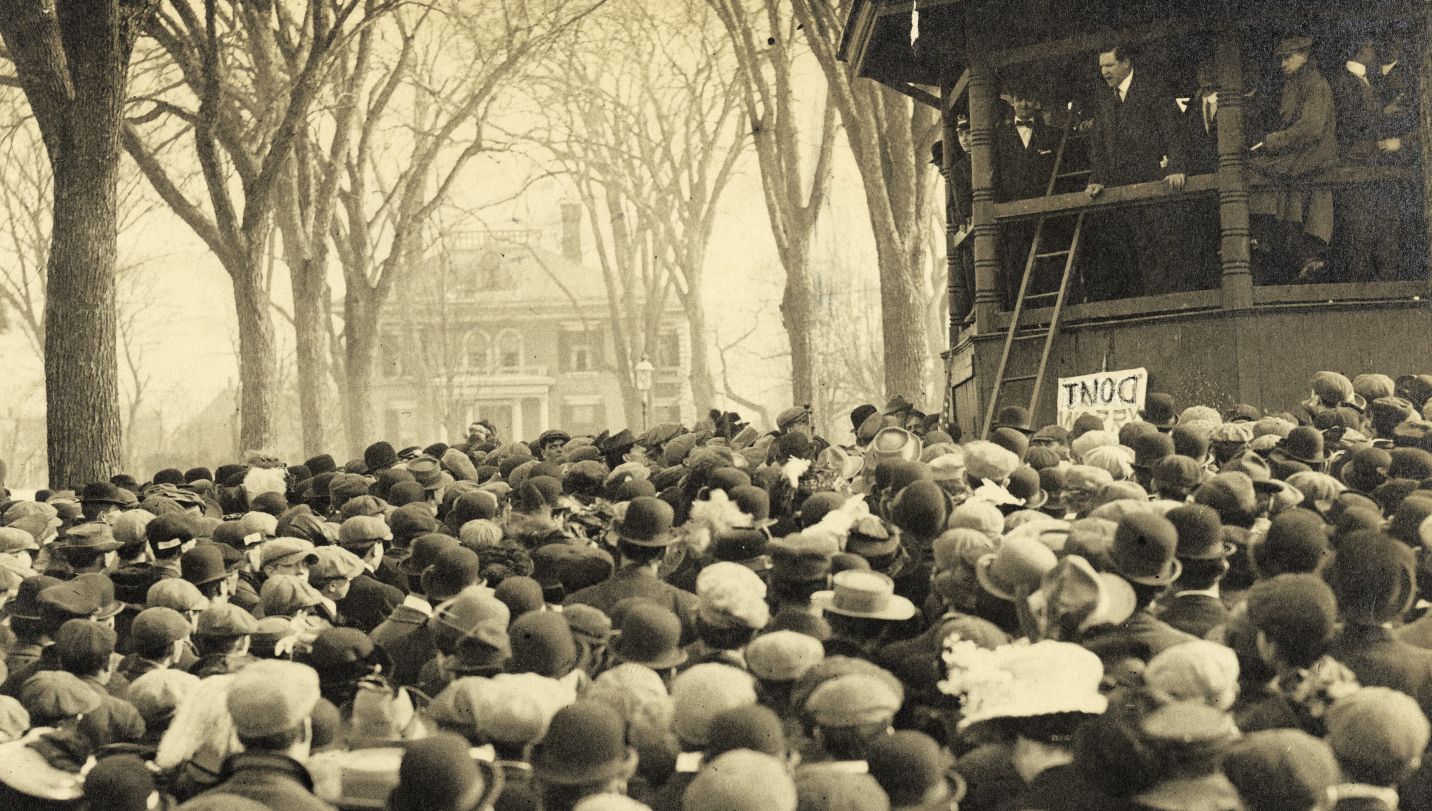
Banners to the breeze in Boston as what here is reported to be the largest labor demonstration ever held in the city marches in solidarity with Lawrence’s ‘Bread and Roses’ strike leaders Ettor and Giovannitti, with contingents from every element of Boston labor, including the 3000 hotel workers then on strike.
‘Haywood Arrested at Big Boston Demonstration’ from Industrial Worker. Vol. 4 No. 27. September 26, 1912.
Boston, Mass., Sept. 15. In the opinion of many well-informed local observers, the Ettor-Giovannitti general strike demonstration on the Commons today was the biggest labor demonstration ever witnessed in New England. No event of either recent or more ancient times has surpassed it in size, in enthusiasm or significance. The “L” strike demonstration of last June, though unprecedented, wasn’t to be compared to it; nor was the Labor Day demonstration, which was considerably smaller than the “L” demonstration. According to conservative estimates there were at least 40,000 persons present on the big Commons, which was jammed to the limit.
Not only do local observers agree in pronouncing the demonstration an unsurpassing one, but so also do men from out of the city, who have been eye witnesses of many big labor demonstrations in both New York City and Chicago. They all say that they never saw anything like it before; and old timers though they are, in their attendance at affairs of this kind, they simply were taken aback at the extraordinary size of the gathering. It certainly was large, and then some.
Next in size, the thing most impressive was the solidarity displayed. Every phase of the labor movement was represented in the parade leading to the Commons, and in the sweltering mass of humanity, on the Commons, for the day was a humid one. There were present trades unionists, socialist party members, anarchists, sick and death benefit society members, I.W.W. men and women–in fact, every tendency under the proletarian sun.
They marched behind their various flags–the conservatives behind the national flag–of which there was only one in the parade; the anarchists behind the black flag, with red borders and streamers; and the I.W.W. behind big crimson flag, on which were inscribed its Initials in white. This flag, bright and crisp, carried and waved aloft by a vigorous young Italian, provoked rounds upon rounds of applause all along the line of march. It was also the most conspicuous adornment of the principal stand for speakers.
One feature of the parade most worthy of note, was the presence of Local 728, United Textile Workers of America, John Golden’s organization. These men and women were big and brave enough to recognize that their place was with the I.W.W. and not with the textile capitalists of New England, despite all differences of forms and ideals of organization. All honor to them, for their clear-sightedness and courage on this momentous occasion!
In the line of march was also the striking hotel workers of Boston, over 3,000 in number. They carried placards, describing their slavery and their demands such as “We work 77 hours a week. We want a 54 hour week.” Other equally pointed mottoes were in their division. The United Brotherhood of Carpenters and Joiners were in line; so also were the United Garment Workers of America; so also was the most conservative bricklayers’ union in town.
The Socialist party turned out strong. They did much to make the demonstration a success, as they did to make the Lawrence strike a success. They don’t blow about it; they help and are glad to do it. They were represented by clubs from Boston, Malden, Chelsea, Lynn, Haverhill and other cities.
There were other societies, too, like the Workmen’s Circle, the Workmen’s Sick and Death Benefit society, and the Anarchist groups; but why specify them all when space is so small? Every phase of the labor movement was there, to its great credit be it said. Of course, the place of honor was given to the I.W.W.
These various tendencies were led by inspiring music, and with placards mounted on sticks, expressive of their sentiments. These placards read as follows: “Undesirable citizens–District Attorney Atwill, Judge Mahoney, Wm. Wood, Governor Foes”, “How about equality before the law?,” “Is Ettor getting a square deal?” “Who are the anarchists, the Woods or the Ettors?” “Remember, they planted the dynamite to ‘get’ Ettor!” “This fight is between Capital and Labor. Where do you stand?” “Watch Socialism Grow!” “One big union, for all the workers!” “Open the jail doors by closing the factory gates!” “Don’t petition, don’t beg, don’t pray–go on general strike!” “Christ died on the cross,” “Bruno was burned at the stake,” “Ferrer was shot in the ditch,” “Emmett was hanged in Dublin,” “Are Ettor and Giovannitti to be murdered in the electric chair?”
The parade formed in Castle Square and marched through the principal streets of the city. The I.W.W. contingent from Lawrence, over 3,000 strong, arrived on Boston Commons at about half-past eleven. It had speeches and music galore before joining the Boston parade at one p.m., and created an impression all its own. When the Boston parade reached the Commons, it was welcomed by many thousands of waiting spectators. All hands repaired to the speakers’ stands at once.
There Big Bill Haywood was the main speaker. He was brought to Boston in an auto, and thus enabled to evade the police. He was arrested after his speech.
Haywood’s slogan was: “Open the jail doors or we will close the factory gates!”
He declared the times are ripe for a general strike. Everywhere the workers are “discontented and in sympathy with Ettor and Giovannitti. Money is good, resolutions are good, demonstrations are good, but we must also act. We must open the jail doors by closing the mill gates. We must go on a general strike.”
Haywood called on his hearers to hold themselves in readiness for a general strike. He declared that any sacrifice made for Ettor and Giovannitti was a good investment. They had already secured $15,000,000 more wages annually for the textile workers. With liberty once more theirs, they could devote their ability to secure more gains for labor and to bring about the inauguration of the Industrial democracy, aimed at by the I.W.W.
Haywood urged his hearers to get into the ONE BIG UNION, the I.W.W. He declared that there was no other union worthy of the name; that the I.W.W. controlled the social situation in this country; that it was a fighting organization; that to join it meant to fight, fight and fight. He declared that labor can beat capital by solidarity. With ONE BIG UNION ready to shut down the mills, the capitalists would not dare to arrest and imprison your leaders. With labor united Into ONE BIG UNION capitalism is doomed.
Haywood’s speech was received with great applause.
Speeches were also made by Fred W. Hesslewood, John J. Daley, J.S. Biscay of Oregon, organizer of the I.W.W.; Abbo Michael, district organizer of the I.W.W.; J. Sandler of Chelsea. Frank Vennesi in Italian; Edward Blochlinger, organizer for the International Hotel Workers’ Union; John J. Ballam and Wm. Yates, who acted as chairman.
Credit is due to John J. Ballam, secretary of the Boston Ettor-Giovannitti Defense Committee, for the success of this, the biggest labor demonstration in America.
Ballam modestly declines any credit what ever. He says it belongs to the workers of Massachusetts, who answered the call in a spontaneous manner; hence the big outpouring.
One speaker, a socialist party member, addressing an auxiliary meeting, sized up the general outlook in connection with Ettor Giovannitti case well. Said he: “The politicians and capitalists have got a hold of a situation that they don’t know how to let go of.”
The Industrial Union Bulletin, and the Industrial Worker were newspapers published by the Industrial Workers of the World (IWW) from 1907 until 1913. First printed in Joliet, Illinois, IUB incorporated The Voice of Labor, the newspaper of the American Labor Union which had joined the IWW, and another IWW affiliate, International Metal Worker.The Trautmann-DeLeon faction issued its weekly from March 1907. Soon after, De Leon would be expelled and Trautmann would continue IUB until March 1909. It was edited by A. S. Edwards. 1909, production moved to Spokane, Washington and became The Industrial Worker, “the voice of revolutionary industrial unionism.”
PDF of full issue: https://www.marxists.org/history/usa/pubs/industrialworker/iw/v4n27-w183-sep-26-1912-IW.pdf


Thanx for keeping Haywood’s legacy alive. chuq
LikeLike
He’s emerged as the central figure of that who era for me.
LikeLiked by 1 person
Me as well….and he was a fellow IWW member…..chuq
LikeLike