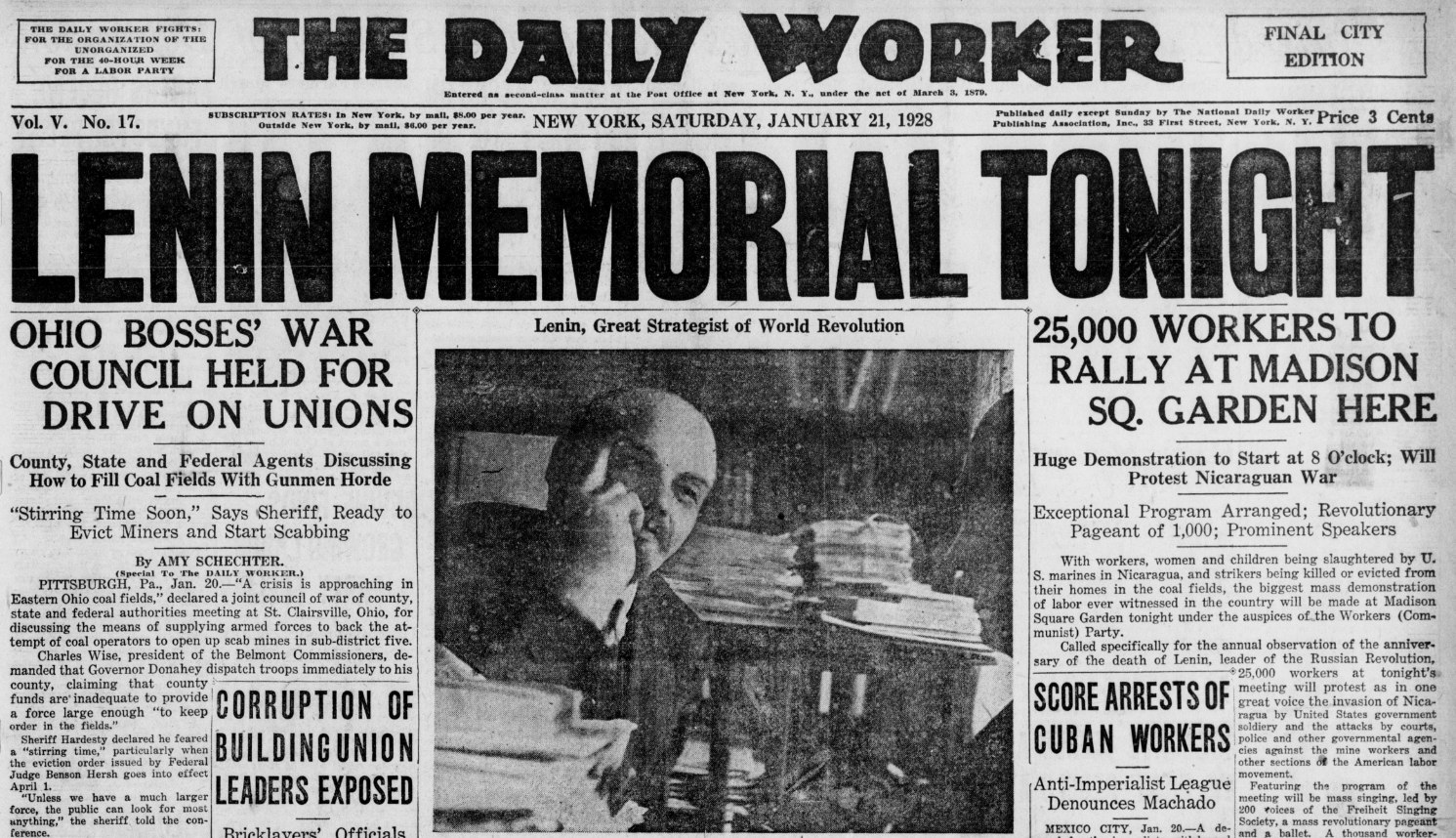
What must have been a remarkable sight. Olgin praises the mass-pageant commemorating Lenin at New York City’s Madison Square Garden on January 21, 1928.
‘The Lenin Pageant’s Collectivist Spirit’ by Moissaye J. Olgin from The Daily Worker. Vol. 5 No. 21. January 26, 1928.
The Lenin memorial meeting held at Madison Square Garden on Saturday, January 21, was more than a political demons ration. It was an extraordinary mass expression of collectivist spirit. It was a vista opened by class conscious proletarians into the future.
There will come a time when the class struggle with its waste of its precious human energy will be no more. The exploiters having been wiped off the face of the earth, classless mankind will, in Communism, attain tremendous heights of mass culture and mass spirituality, with creative energy let loose. There will be no more sordid elemental struggle for a bite of bread. There will be no brutality and no fear. Mankind then, will know the joy of collective work which will be like play, and of collective play which will be the outgrowth and the background of creative work. Mankind will have holidays chosen to mark significant turns in the colorful flow of its existence, and the sign of its mass celebrations will be the white fire of the mass spirit.
Glimpse of Future.
This future of which only a bare idea can be formed at present, of which even the outlines can only be conjectured, touched the “Garden” gathering last Saturday night, and transformed it into proletarian beauty. A realization, at once hoped for and thrilling, of what life might be under a new system, suddenly came to these twenty-odd thousands to make them vastly more than just listeners to political speeches or spectators at a mass performance. It was as if all of them were suddenly transplanted into a new land, with new skies overhead.
A Leninist Spirit.
Yet there was nothing dreamy or sentimental about the affair. The speeches were sober, pointed addresses devoted not so much to Lenin as to Leninism; not so much to the history of the Russian Revolution as to the inevitability of the American revolution; not so much to the American revolution in the future as to the class struggles of the present time that lead to the overthrow of the strongest capitalism in the world. Realistic, scientifically grounded expositions they were, of the forces working throughout the imperialistic world and hastening its doom. Those multitudes that filled the vast building from the first tier to the top gallery, were given to understand that upon their own will, organization, determination, clear-sightedness and correctness of action depend the hastening of the historic process.
Historic Forces.
Yet, beyond and above the speeches there was something even bigger than the tasks outlined. There was the keen feeling of historic landslides. There was the almost palpable throbbing of momentous historic forces. The march of hundreds of millions reverberated in the hearts of the mass. Obstacles were being swept away. Walls crumbled. Fortresses fell. Rocks were levelled to the ground. Uncounted millions marched to their freedom. Above the irresistible on-rush loomed the figure of the leader who showed the way to power. Vladimir Ilyitch Lenin.
Proletarian Visions.
It was not surprising, therefore, that the speakers’ platform should suddenly become populated with shapes and ghosts. The platform was only impersonating the visions that lived, unformed, in the mind of the mass. Art, here as everywhere, was whipping human potentialities, class potentialities, into living form. The actors, if actors they may be called, were an integral part of the gathering itself. The presentation only continued, m a different medium, the speakers’ discourses. The idea remained unchanged. The mood was unbroken. It was only heightened. The mass lived in the scenes. How much more elating and significant was the playing compared with anything a “legitimate” theatrical undertaking can offer! How different the whole! Here they were, one thousand entirely untrained women and men, among them hardly a handful of workers who had at least an idea of stage. They had had very few rehearsals. They were acting under the most trying conditions. The music was played by strangers. The lights did not work.
Proletarian Achievement.
The beautiful chorus-singing was drowned in the vast spaces of the hall. Still, behold! Here is the mass of the Russian people, poorly dressed, bent-backed men and women of the Czar’s empire. The crowd moves uneasily, the crowd is in deep despair. The cossacks come. Lashes swish in the air. Thongs cut the people’s backs. The crowd disperses, vanishes. Black forces reign. Tall posters, akin to Russian church banners, advance as if moving of their own will. Grotesque figures, they are, of the rich man, the prince, the priest, the general, the Czar. Ludicrous cartoons. We all know it’s “made for fun.” Yet somehow terrific anger surges. Hatred grips everybody’s heart. Fists clench. The huge gathering is one crouching monster, ready to leap. There is a stifled cry in the hall. When the young figures draped in red finally appear, driving away the apparitions, one greets them like a true liberating force.
They are the purifying storm. There is abandon in their sweep. There is release in their abandon. We all know: this is Edith Segal, our own comrade, these are other friends whom we meet every day. But now they are transformed. We are with them, in their vigorous gestures, in their flashlike rush, in the turmoil at once harmonious and chaotic like the revolution itself. Is it the Russian revolution? Who knows. Is it happening on the stage? Not at all. It is an event of major importance in our own lives. Somehow, we, ourselves, living these great events. Living them intensely, deeply.
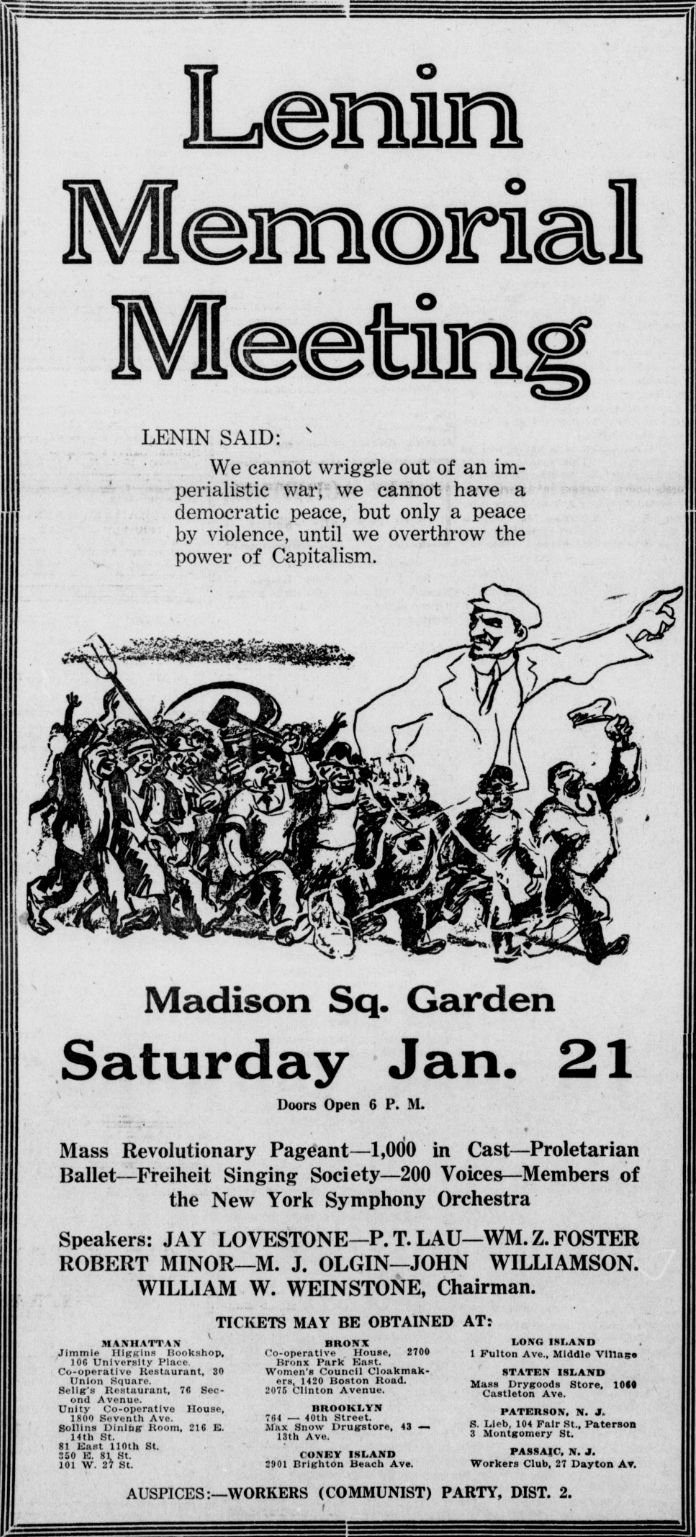
And that scene that embodies the first session of the Second Soviet Congress! Did we care much whether the actors really resembled Lenin and Trotzky? Was it of great importance whether the uniforms or even the gestures were “true to life”? There was something truer and more real than mere appearances in that scene. There was the truth and the reality of our own feelings, our own determination. We all merged in a flood of revolution. We knew it was coming, it was there.
When the comrade bearing the Red Flag appeared on the edge of the platform to appeal for aid to the U.S.S.R., we did not think of anybody acting. A comrade was, in truth, appealing to us. Everybody swore to do his utmost to drive away the black shapes that crawled from everywhere. Were we children once more? No, we were fully aware of reality. We were a collective body with a collective mind. We left our inherent unity with our brothers over there. We experienced class unity, through the power of impersonation. This is, perhaps, the greatest task a proletarian performance can strive for.
“The Internationale.”
When, at the end of the performance, the crowd joined with the platform in singing the “Internationale,” when shouts of joy went up both from the stage and the mass, the climax was reached.
The performance is significant not only as an experience but also as pointing the way for a real proletarian mass-theatre. Where the actors are workers animated by the class struggle and participating in the battles of the working class, where the plays are giving form to the unclear but powerful strivings of the proletarian masses, where spectators and actors are united by a common bond of class emotions, where the things performed on the stage are of vital importance to all concerned, there the technique will not fail to assume an original form.
The Red Pageant marks, in this as in many other ways, a turning point in the history of our Communist movement. It was an expression of vitality. It summed up in a graphic fashion years of work. It revealed to ourselves the presence of something new that is more than sections and sub-sections, committees and units. It gave us all new courage for further work and further effort.
The Daily Worker began in 1924 and was published in New York City by the Communist Party US and its predecessor organizations. Among the most long-lasting and important left publications in US history, it had a circulation of 35,000 at its peak. The Daily Worker came from The Ohio Socialist, published by the Left Wing-dominated Socialist Party of Ohio in Cleveland from 1917 to November 1919, when it became became The Toiler, paper of the Communist Labor Party. In December 1921 the above-ground Workers Party of America merged the Toiler with the paper Workers Council to found The Worker, which became The Daily Worker beginning January 13, 1924.
PDF of full issue: https://www.marxists.org/history/usa/pubs/dailyworker/1928/1928-ny/v05-n021-NY-jan-26-1928-DW-LOC.pdf

