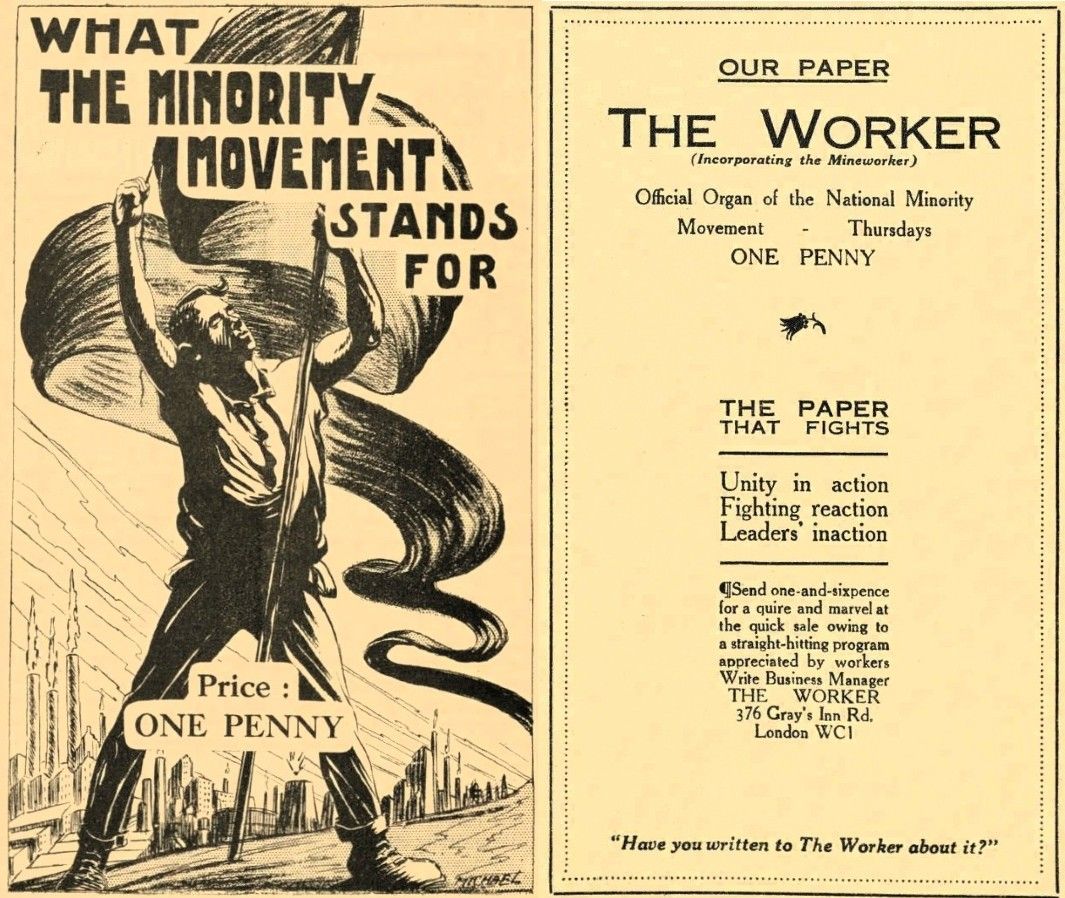
Things are clearly moving, but the enormity of the General Strike to shortly come is not yet on the agenda at this gathering of Britain’s Minority Movement, the British R.I.L.U. groups, kin to the Trade Union Educational League in the U.S. Tom Bell, a visiting T.U.E.L. delegate, reports on the conference this centenary year of the British General Strike.
‘British Minority Movement Moves Up’ by Tom Bell from The Daily Worker Magazine. Vol. 3 No. 76. April 10, 1926.
THE special conference of the National Minority Movement held here (in London) on Sunday, March 21, was a wonderful demonstration of the swing of the masses of the trade union rank and file against the dilatory tactics of the trade union officialdom. Eight hundred and five delegates represented over 900,000 trade unionists organized in local unions, trades and labor councils and local groups of the National Minority Movement.
Tom Mann, veteran of the British labor movement and chairman of the National Minority Movement, acted as chairman of the conference. George Hardy, well known in the U.S. labor movement before his deportation and secretary of the National Minority Movement, was secretary of the conference.
The conference was held in the Battersea Baths, and was greeted in the name of the Battersea Trades and Labor Council by Brother Clancy, the president. S. Saklatvala, member of the house of commons for Battearsea, welcomed the conference in the name of the labor movement of this borough.
The largest number of delegates were from the Amalgamated Engineering Union, the second being the Miners’ Federation of Great Britain. It is significant that delegates were present from more than fifty of the trade union councils. Every important industrial center of the country was represented, including the South Wales and Scottish mine fields.
THE spirit of the left wing of the British trade union movement is demonstrated. The first resolution presented was the “defense and maintenance of trade union rights.” The present menacing situation confronting the trade unionists of Britain in outline in the resolution, the brutal attacks on the coal miners of Ammanford and the arrest of the twelve leaders of the Communist Party, together with the organization of all kinds of fascist organizations, is pointed to as a direct warning to the workers that they must prepare to resist all attacks of the bosses on their organizations.
The most important point in this resolution is Clause B, which reads:
“To form (thru and under the supervision of the trades councils) workers’ defense corps, In order to protect working-class speakers from bourgeois terrorism, to protect trade union headquarters from fascist incendiarism, to defend strike pickets against police Interference, and finally to build up a powerful working class force capable of defending the political and industrial rights and liberties of the workers.”
This resolution was introduced by Alex Gossip, general secretary of the Furnishing Trades’ Unions, who was a regularly elected delegate to the conference. He urged the passage of the resolution and recited the necessity of the formation of a workers defense corps because of the use of violence by the bosses in many strikes in which he had participated. While he is a convinced pacifist and opposed to the use of violence on principle (either by capitalists or workers) he saw the necessity of the defense corps the present situation. The resolution was seconded by Brother J.J. Vaughan, recently Communist mayor of the Bethnal Green and delegate from the London Electric Trades’ Unions. Many delegates participated in the discussion and the resolution was carried unanimously.
THE next resolution was entitled “The Capitalist Offensive,” and calls for the following measures to be taken to meet the offensive of the bosses on the working class:
(a) The complete scientific utilization of the whole trade union movement in the struggle.
(b) Securing the co-operation of the co-operative organizations.
(c) Securing the active participation of the parliamentary and National Labor parties in the organization of the struggle by placing themselves at the disposal of the general council of the Trades Union Congress.
(d) Urging the general council of the Trades Union Congress to take steps to ensure the full support of the International Trade Union Movement for the struggle of the British working class.
In the discussion on the resolution the delegates stressed the necessity of the general council of the Trades Congress to utilise the resolution of the Scarborough congress to become the real leading center of the trade union movement and also to call a special meeting of the congress to take steps to put the movement in readiness for the coming battles. The mining situation, the engineering crisis and the unemployment situation were pointed to as justifying this course.
THE speeches of the delegates showed that the bosses had determined to place the burden of the continuance of the capitalist system on the backs of the workers by reducing their standard of living. It was particularly refreshing to see that many delegates pointed to the low standard of living of the colonial peoples exploited by British capital as one of the main reasons for the desperate plight of the British working class. Delegates from Dundee textile unions showed that the reason for the unemployment and starvation was the low wages of the Bengal textile workers and demanded that this be taken into consideration.
THE resolution on international trade union unity was introduced by Comrade George Hardy, acting secretary of the National Minority Movement. He delivered a splendid speech on the subject and was greeted by great applause by the conference.
The resolution calls on the Trades Union Congress to issue a special bulletin for the information of the trade unions on this subject, to work for closer co-operation with the Russian trade unions, to send workers’ delegations to the trade union conventions on the continent to explain the necessity of world trade union unity and to work untiringly for the convening of an international trade union congress of delegates from organisations, irrespective of whether they belong to Amsterdam or the Red International of Labor Unions.
The discussion from the floor showed what a grasp of the necessity of world trade union unity the left wing of the British trade union movement has. Delegate after delegate took the floor and pointed out that the success of the British workers in defending their already low standard of living depended on the solidarity of the international trade union movement. The resolution was carried unanimously amidst loud applause.
DR. BAHT represented the All-India Trades Union Congress and in his speech showed the close connection of the situation of the Indian workers with those of Britain. Three Indian sailors who accompanied him on the platform were given a rousing welcome.
The Trade Union Educational League of the United States was represented by Tom Bell. In his speech of fraternal greetings he outlined the situation confronting the left wing trade unionists of the United States.
The question of “company unionism” and the “B. and O. plan,” labor banking and the other forms of class collaboration practiced by the trade union officialdom highly amused the conference. He declared that the work of the National Minority Movement and the other left wing trade union movements in other countries were of the greatest importance to the working class and must continue until the workers are organized in international solidarity for the defeat of the international capitalist class.
THE concluding speech of Chairman Tom Mann brought forth great applause when he declared that the wonderful success of the conference made it evident that in the near future the National Minority Movement would be the Majority Movement in the British trade union movement.
Altogether the conference was wonderful and shows that the left wing trade unionists of this country are on the job determined to win the masses of the trade unions for the path of the class struggle and a determined fight against the British ruling class.
The Saturday Supplement, later changed to a Sunday Supplement, of the Daily Worker was a place for longer articles with debate, international focus, literature, and documents presented. The Daily Worker began in 1924 and was published in New York City by the Communist Party US and its predecessor organizations. Among the most long-lasting and important left publications in US history, it had a circulation of 35,000 at its peak. The Daily Worker came from The Ohio Socialist, published by the Left Wing-dominated Socialist Party of Ohio in Cleveland from 1917 to November 1919, when it became became The Toiler, paper of the Communist Labor Party. In December 1921 the above-ground Workers Party of America merged the Toiler with the paper Workers Council to found The Worker, which became The Daily Worker beginning January 13, 1924.
PDF of full issue: https://www.marxists.org/history/usa/pubs/dailyworker/1926/1926-ny/v03-n076-NY-apr-supplement-1926-DW-LOC.pdf

