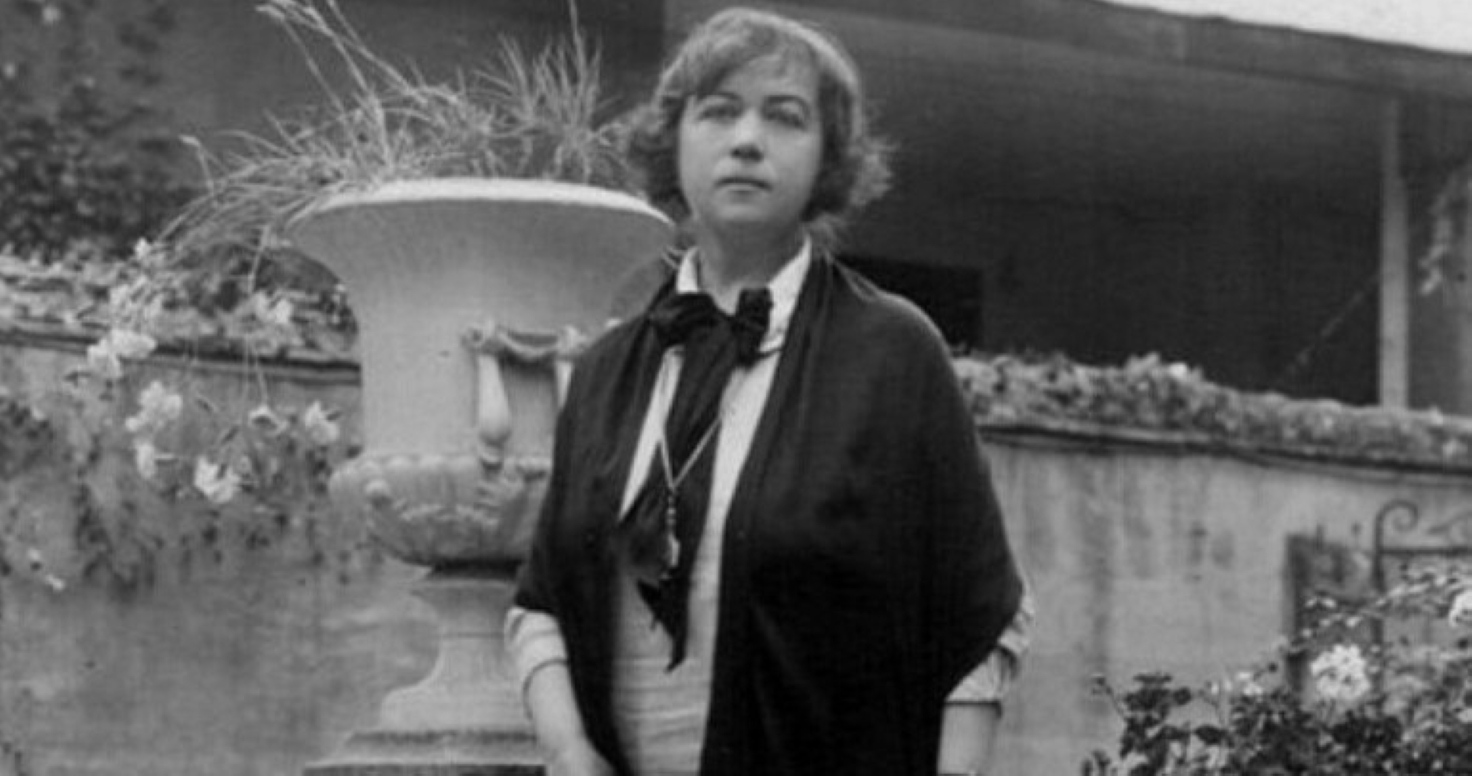
An important document in the history of the Communist women’s movement. Alexandra Kollonatai, as Assistant Secretary of the Comintern’s International Secretariat for Work Among Women, reports to the Second International Conference of Communist Women which took place in Moscow immediately before the Third Comintern Congress in June, 1921.
‘Work Amongst Women: Report of the International Secretariat’ by Alexandra Kollontai from Moscow. Nos. 9-12. June 3-7, 1921.
Construction and Composition.
The establishment of the International Secretariat for the work among women, was confirmed by the Executive Committee of the Comintern on August 8th 1920. Comrade Clara Zetkin was elected general secretary and Comrade Kolontai, assistant secretary.
The question of forming a Secretariat was raised by the First International Conference of Women Communists. The structure of the Secretariat is outlined in the theses, worked out by a special commission, headed by Comrade Zetkin. The Secretariat is composed of eight members, out of which six members including the General Secretary reside outside of Russia. The Secretariat has its own permanent representative in the Executive Committee of the Comintern, with right to a decisive vote on questions in connection with women, and a consultative on all other. In the absence of the General Secretary, Comrade Kolontai, the Assistant Secretary took her place on the Executive Committee. All decisions and measures are subject to the approval of the Executive Committee. The Secretariat is composed of the following comrades: Clara Zetkin, the General Secretary, six representatives from Russia: comrades Krupskaya, Kolontai, Lillina, Samoulova, Ithal, Smedovitch: from the Western countries: comrades, Roland Holst, and Rosa Bloch.
The Aims and Tasks of the International Secretariat.
The task of the Secretariat; 1. through the medium of the apparatus of the Communist Parties (the Departments of the Committees for Women Workers), in the various countries, to extend the influence of the Comintern to the widest masses of proletarian women, 2) to aid the Comintern in its task of educating the proletarian and semi-proletarian women’s masses in the spirit, of Communism, by adopting special methods of work amongst women, 3) to awaken the activity and Independence of Women Workers, and draw them into the struggle for the Dictatorship of the Proletariat, or in the building of Communism, 4) to participate in the work of the Comintern, and put questions before the International, which are bound up with the problem of emancipation of women, and the defence of their interests as mothers.
The Secretariat must show initiative in securing the active defence of the Comintern of the indicated tasks, and to bring them into force.
The Secretariat serves as a centre for uniting the work of the Committees of the parties of the East and West, Bourgeois-Capitalistic and Soviet countries, and for attracting women to the Comintern and to educate them as active fighters and builders of Communism.
The Secretariat makes it its aim, to aid in the strengthening of the International bond of party apparatus, (Women’s Departments, or Women’s Committees), conducting work among women.
The Secretariat arranges regular communications between the Committees, and Department of Women Workers, unites international activities conducted by the Comintern, assist the exchange of Communist literature on the question of work among women, provides information on the position of the work in various countries, on the conditions of woman labour, of the activities of women. etc., collects literature which deals with the tasks of the Secretariat, and material on the question of women’s emancipation, summons the International Conference of Women Communists, and directs the carrying out of the International Working Women’s Day.
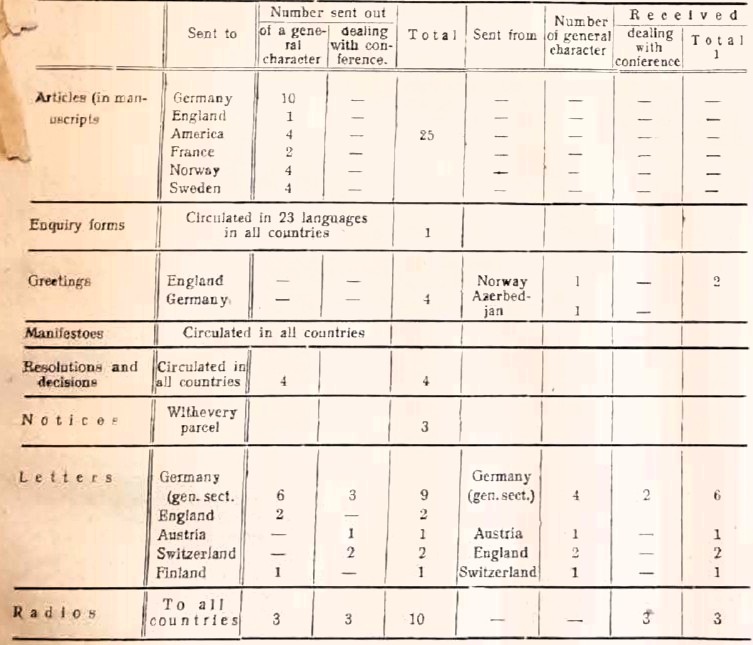
The work of the Secretariat, apart from the inconvenience of communication with the separate countries, was made more difficult by the existing weakness of the Party Committees for work amongst women, owing to the failure of a number of countries to set up such apparatus (Commissions and Department) in spite of the decision of the First International Conference. The Moscow section of the Secretariat maintained a more or less constant communication with Germany, France and England, but not with the Scandinavian countries. With the other countries communication was only casual or conducted through the General Secretary in Germany. Apart from a small number of letters, received by the Moscow section of the Secretariat, from the General Secretary, and the Committee for work amongst women in Germany, the Secretariat in Moscow received two letters from Switzerland, and one from England. The Secretariat regularly sent to all countries utilizing all means of dispatch, appeals, greeting, resolutions circulars, inquiry forms, theses on the international working women’s day, the announcement of International Women’s Conferences, (and all the literature at their disposal), pamphlets periodical publications, leaflets, etc.
In spite of all these difficulties of communicating with comrades from other countries and with the General Secretary, the Moscow section, conjointly with the General Secretary was successful in strengthening the International solidarity of women workers: 1) by organizing the particularly successfully in Russia, Germany and Scandinavia. 2) by preparing for the convocation in connection with the Third Congress of Comintern, the Second International Conference of Women Communists, which must take place in June of the current year.
The Work of the Secretariat.
Altogether from the formation of the Secretariat on November 20th till May (i.e. five months), 12 meetings were held out which the five last, were devoted chiefly to the convocation of the Second International Conference of Women Communists, in connection with the Third International of the Comintern. At the meeting held on March 27th 1921, it was decided to from an organising Bureau for convening the International Conference.
At the beginning of December, the Secretariat, delegated comrade Stahll, for constant work at the Comintern, and to be personally in touch with the women delegates as they arrive.
Attached to the Secretariat there is also a Bureau, which collected material about the woman workers movement and the work among women in all countries, suppled the Russian Press with information which sent literature abroad, etc.
The accomplishment of these tasks however, met with a series of difficulties particularly of a technical character.
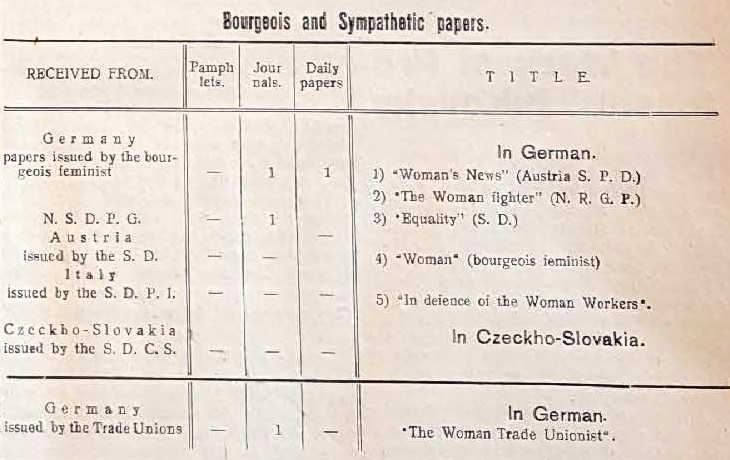
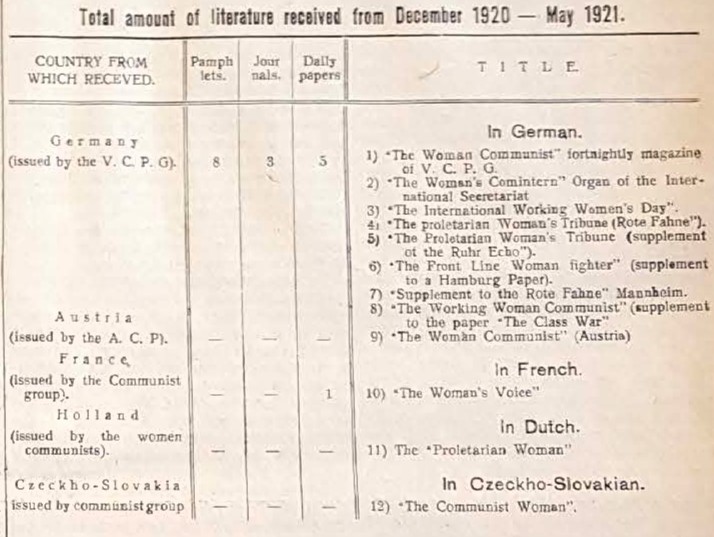
The International Secretariat for the work amongst women, by the force of circumstances finds itself under exceptional conditions, which does not allow it to carry on systematic work. First of all, the Secretariat was isolated from its responsible member, the General Secretary, and secondly, the General Secretary herself was isolated from the Executive Committee. The technique of communication did not permit of constant contact, and as is evident from the report from all the letters, and literature sent by both sides, only a small part found its way to its destination. Those of the letters, and packages which did arrive were months behind time. Hence the absence of proper guidance, the exchange of information and the live co-operation hindered the introduction of the necessary system into the work of directing the movement. Thus, not one package of official reports and even information by radio from the Moscow section of the Secretariat was replied to by the member of the Secretariat in Holland Likewise, the section dealing with information, sent to all countries an inquiry form, translated into 23 different languages, on the position of the Proletarian women and the work amongst women in every country. Nevertheless, only ten replies were received and those only. from the delegates who arrived in Moscow.
II.
Intelligence department.
In order to keep Russia informed with the work being done amongst the women of ether countries the Information Bureau of the Secretariat carried out the following work.
1. Kept a regular summary of the foreign press
2. Obtained the following and transalated them into Russian:
i) Material on the Paris Commune.
ii) An article of Com. Rosmer on Louise Michelle (translated from the French).
iii) The condition of German women (Rothe Fahne).
iv) Articles of Madeline Marx on the bankruptcy of feminism and on women.
v) In Soviet Russia.
vi) Summaries of German articles (Dedrikel).
vii) The German Communist Women’s Congress
viii) The Women’s movement in German Austria and Germany (Steinhardt).
ix) Women Workers Movement in Hungary (Varga).
x) Iternational Women’s day in Bulgaria (Shablin).
xi) Bulgarian Women’s Conference (Shablin).
xii) Mexican Women Workers Movement (Evlyn Roy).
xiii) On the French Socialist Women’s Movement (Rosmer).
xiv) The trial of Women Communists in Paris (Sovern, Dedrikel).
xv) The Female Civil Servants Movements in Germany (Dedrikel).
xvi) Three Magazines (Dedrikel).
8. Extracts on the Women Communists movement were taken from the press.
In order to keep the women of other countries informed as to the work done on behalf of women in Soviet Russia, the Secretariat took the following steps 1). A program of the work to be undertaken amongst women was compiled, translated into 23 languages and sent abroad 2) a series of debates and lectures with the arriving delegates were arranged 3) A number of lectures were organised in the women’s question for both party and trade union women delegates from abroad who were at that time in Moscow 4 lectures have been read–3 by Comrade Sthal and 1 by Comrads Kolontai) and one informatory meeting of women delegates has been held 4) information was given to each of the arriving delegates individually 5) Foreign women delegates were invited to participate in the women workers’ conferences and delegate meetings organised by Women’s Departments; as for example at the All Russian Congress of Goubernia Women’s Departments; the Goubernia women workers meetings and the meeting in Moscow on the 8th March.
Simultaneously a series of meetings was arranged by the Head of the Secretariat’s Information Bureau amongst the women of Turkestan, in the East. The foreign women delegates travelling in the Communist International’s Propaganda Train participated in these meetings.
In order to keep in close touch with abroad, our own delegates were sent abroad, or else we made use of our comrades sent oversea on behalf of the Communist International.
Literature on the work amongst women and forms to be filled in by each delegate on her return home were given to each returning representative.
An album of photographs illustrating the work and life of women and children in Soviet Russia has been compiled from a series of Journals.
A number informatory articles and statistics dealing with the women’s movement in various countries were collected and sent abroad through the columns of the “Kommunistka” (the Woman Communist).
Besides this, the Secretariat has had articles printed in German, French and English in the following numbers of the Russian Press Review:
17 French Nos. 11-13, 15, 17, 18, 20, 21, 22, 23, 25.
2) German Nos. 12, 13, 14, 17, 18, 21, 23, 65.
3) English Nos. 8, 10, 13, 14, 15, 19, 20, 21, 22, 63, 24.
A list of articles will be given to each delegate personally.
The following manuscripts have been sent out;
1) Comrade Semashko On Abortion”. A. Kolontai “Prostitution and the means of combating it”. Comrade Kolontai “The Great Advance” (printed in the Dreadnought”). Comrade Stahl “On the Goubernia women workers congress in Moscow and “International Working Women’s Day in the Viatskai Goubernia”. A speech by comrade Vemmer, and articles by Comrades Quelch and Steinhard dealing with International Day.
2) Theses on “International Working Women’s Day” on the means of combating prostitution and on abortion.
Resolutions and Decisions dispatched:
1) All Russian Goubernia Women’s Departments congress.
2) Decisions of the 8th All Russian Congress of Soviets regarding the position of women in the economic structure
of the Workers’ Republic (printed in No. 18 of the Russian Press Review).
3. The working women of Moscow on the International Women’s Day.
4. The decree abolishing punishment for Abortion.
Appeals issued:
1) From the International Working Women’s Departments Conference to the women workers of the World.
2) For the International Working Women’s Day (sent to all countries).
Greetings sent to:
1) Comrade Clara Zetkin from the Conference.
2) Comrade Clara Zetkin in celebration of the 8th of May.
3) Comrade S. Pankhurst from the Women’s Section of the Executive of the Russian Communist Party.
4) Comrade S. Pankhurst from the working women of Moscow on the anniversary of “Bloody Sunday”.
III.
The secretariat attached to the Comintern in Moscow, expected to celebrate the International Woman Workers’ Day this year on the specified day, March 5th, as has been done since the beginning of the great Russian revolution in 1917. The secretariat, not having received word from Berlin of the postponement of celebration this year until April, commenced the work of preparation, as early as the end of January.
The following work was done by the secretariat in Moscow in this connection: 1) Two radios, numbers 3 and 6 were drawn up, translated and sent out.
2) An appeal of the Executive Committee of the Comintern to all the Communist Parties and sections on this International celebration was written, translated and mailed.
3) Comrade Kollontai wrote an appeal on the International Day in German which was translated into the Russian and sent out.
4) The theses of the International day were translated and sent out by radio.
5) The articles written by Comrade Stahl: The Celebration of the International Woman Workers’ Day in Viatka, Gubernia of Witebsk (for the Russian and Foreign press) and: Prepare for the International the Woman Workers’ Day printed in the bulletins of the Executive Committee of the Communist International and also the article of Comrade Samoilov: “Woman Workers’ Day in the Czar’s Prison” were translated and sent out.
6) Delegates from Germany, England, Switzerland, Norway, South Africa, India, France and Austria were obtained to speak in Moscow and Turkestan on the International Woman Workers’ Day.
The secretariat prepared and sent out: 1) Thesis of the International Woman Workers’ Day. 2) An appeal on the International Day.
7) Greetings were sent to a) Comrade Clara Zetkin and b) To the woman workers of all countries from the Woman Workers of Moscow, c) Greetings were received for the International Day from the women workers of Norway, (published in the Bulletin of the Executive Committee of the Communist International) and greetings from the women of the East (Bulletin of the Executive Committee of the Communist International).
Report.
The Work of the Organization Bureau in connection with the convocation of the Second International Conference of Woman Communists.
The organization Bureau of the Second International Conference of the Woman Communists was organised in accordance with the resolution of the International Secretariat for work among women, the Communist International, on March 27th, 1919.
The members included: 1) Members of the International Secretariat, Comrades Krupsky, Kollontai, Samoilov, Stahl, Smidovich and Lilina, 2) the chairmen of the Women’s Department of the Central Committee of the Russian Communist Party, Comrades Menshinsky, Itkin, Godubov, Kasparova, Vinogradskoya 3) Delegate of the Women Workers of the Moscow Committee Comrade Unksov and 4) Delegate from Petrograd Comrade Nikolaev, the foreign delegates present in Moskow: Comrades Kusinin, (Finland), Quelch (England), Chirki (Hungary), Rossmer (France) and Molt (Germany), Comrade Kasparova was appointed responsible secretary of the Organization Bureau.
The task of the Organization Bureau on the one hand was to work out a program of the Conference, appoint the speakers on the fundamental questions of the agenda, obtain the theses of their reports from them, edit them and work out the agenda of the Conference, on the other hand to get connections with all countries, inform the branches of women workers among the Communist Parties of the world, of the coming Conference and finally, to do the entire technical work in preparation for the Conference.
In order to do this work properly the Organization Bureau formed an Editorial Board and three committees: 1) Literary publishing, 2) Information, which takes charge of the connection with the countries of the world and 3) a technical committee. Besides this a special working apparatus was formed.
1) Establishing connections with the women communists of all countries on the questions of the Conference. 2) the carrying on of the information of the Russian and foreign press concerning the coming Conference and its tasks. 3) The organization of exhibitions, lectures and excursions for the delegates for the purpose of acquainting them with the work of the Russian Communist party among women and with the participation of women workers in the Soviet Reconstruction. 4) To as a series of technical measures which will insure the material conditions, necessary for the successful work of the Conference.
The agenda, the resolution, which was proposed by the Organization Bureau, which with minor changes, was accepted by the General Secretary, and at the present time has been dispatched to all countries. The agenda consists of the following questions:
1) a) Ways and Means of strengthening the universal ties of the departments for work among women of the communist parties. b) The Tasks of the International Secretariat and its activity.
2) Methods and forms of work of the communist parties among women.
3) The participation of women workers in the struggle for the establishment and strengthening the dictatorship of the proletariat.
4) The political rights of women under the Soviet regime and under the old capitalist system.
5) Participation of the women workers in the economic struggle and reconstruction (woman labor and unemployment.)
6) Various questions.
Dependent upon the location of the speaker, the theses of the reports are sent partly to the General Secretary, Comrade Zetkin and partly to the Organization Bureau in Moscow.
Together with the agenda, an appeal was dispatched to the Communist organizations of all countries. Concerning the aims and tasks of the conference, which were prepared by the organization Bureau and sanctioned by e General Secretary, the proportion of representation at the conference, set by the Communist International. The information was dispatched by radio, by means of couriers and by comrades leaving for the different countries. The apparatus of the Comintern was utilized for this purpose. Besides this, the Organization Bureau sent a special person abroad with a mandate. Seventy sets of materials were dispatched and, we hope not a single country which has communist organizations, remained ignorant of the coming conference. Besides news of the conference would have reached all countries through the press.
Space has been assigned in these columns for questions, connected with the International Conference. Besides this the Bulletin, in which the secretariat will be published during the Congress.
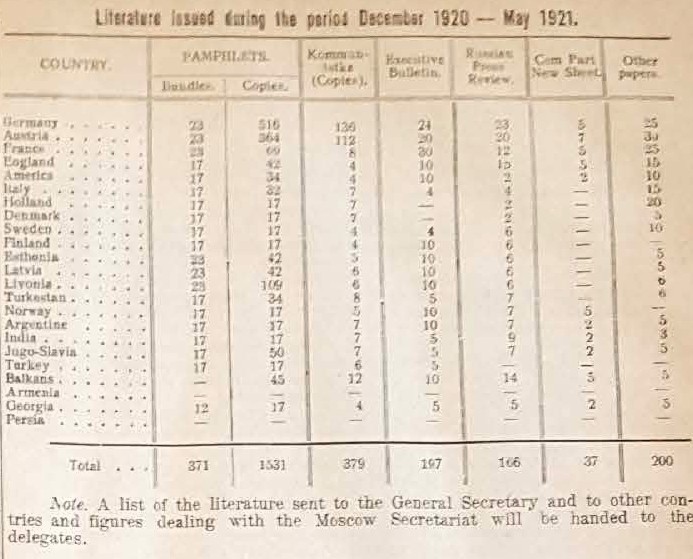
The Organization Bureau is preparing a series of pamphlets for publication; The Woman Worker and Peasant in the R.S.F.S.R.,” by A. Kolontai, “Protection of the Mother and Child” by Comrade Lebedev, “Woman Labor, its Protection. in Soviet Russia” by Comrade Kaplun, “Social Education” by Comrade Lilina, and the “Russian Woman Workers and Peasant in the Civil War by Comrade Vinogradov.
Together with the above mentioned pamphlets the “Report of the Work Among Women” of the Branch connected with the Central Executive Committee of the Russian Communist Party, must be published.
Owing to the shortage of paper, which hinders the publication of the above mentioned pamphlets in foreign languages in Soviet Russia the Organization Bureau prepared the translation of these pamphlets typewritten in three languages (English, German and French) to be given to the delegates.
The organization of exhibitions. Diagrams, schemes, placards and photographs collected by the information department of the secretariat have been prepared. The exhibition has been prepared to show the work of the women workers and peasants in the different departments of the soviet construction and to show what has been done by the soviet power in the interests of the working women. The exhibitions will be followed by discussions, information and explanation in Russian, German and French.
A special guide has been prepared for the delegates. The organization Bureau has prepared a special questionaire to secure full information of the condition of the women workers in the different countries and their participation in the civil war, which will be filled out by the delegates and those interested in the questions of the work among women. When the conference will end the Organization Bureau has arranged the following excursions for the delegates the first day; 1) Delegates meetings of the workers at the factory, 2) Woman’s Page, 3) Investigation of the dwelling of the workers of the Tram Park, 2nd day 1) Investigation of the factory at Gabal: a) meeting of the Factory Committee, b) colonies for the children of the workers and, c) Protection of Labor of the Women. 2) Subotniks. The third day 1) Investigation of the Children’s city.
These excursion will wind up the work of the conference.
Assistant Secretary, International Secretariat for work amongst Women (Comintern).
A. Kolontai
Moscow was the English-language newspapers of the Communist International’s Third Congress held in Moscow during 1921. Edited by T. L. Axelrod, the paper began on May 25, a month before the Congress, to July 12.
 Revolution's Newsstand