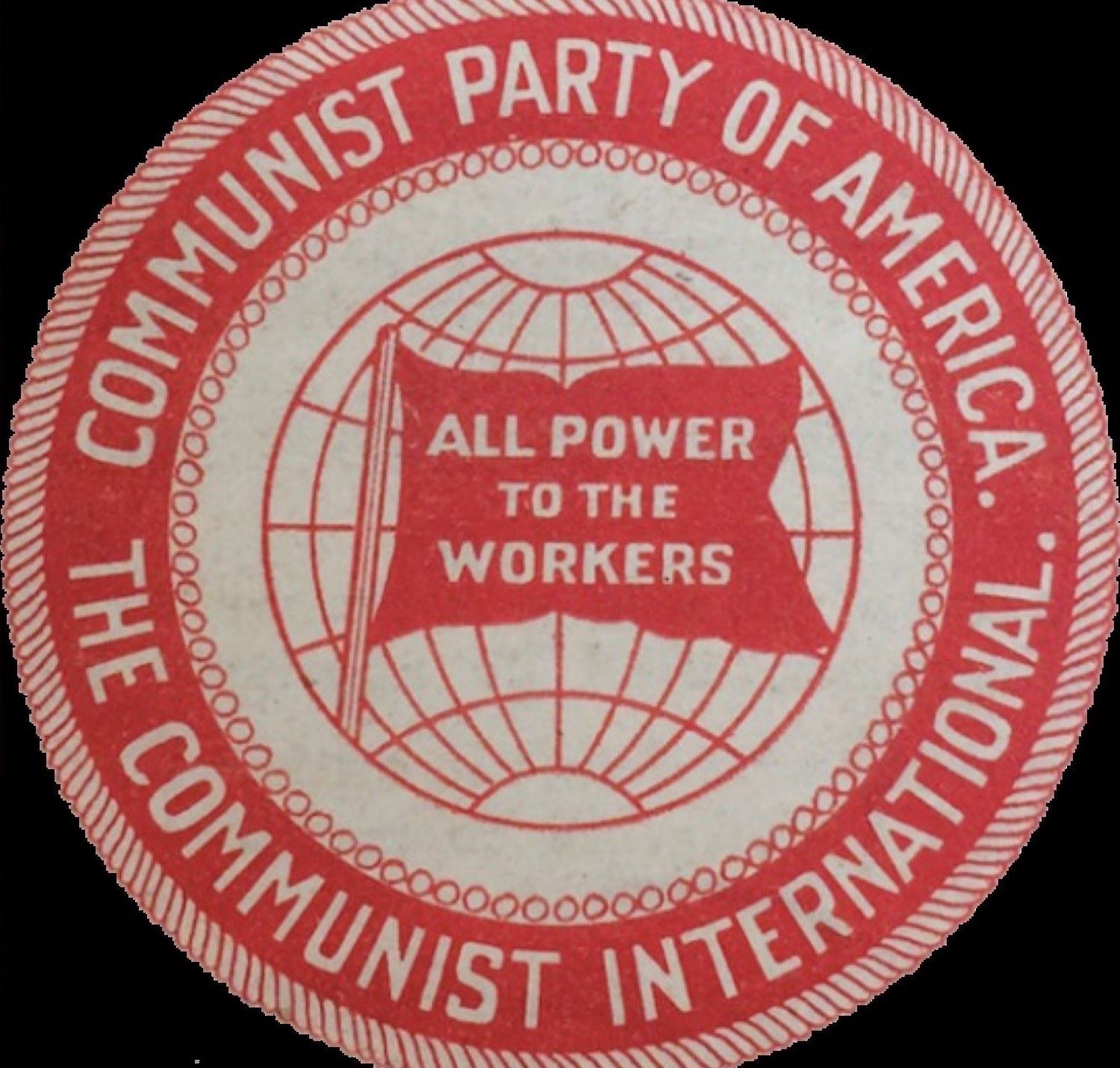
As part of defining itself, the newly formed Communist Party of America states its position on the electoral struggle. While not ideologically anti-parliamentarian in the European ‘Left Communist’ sense, the majority of the old Communist Party-wing of the 1919 splits was certainly ambivalent on the question. Interestingly, while labelled ‘workerist’ and ‘syndicalists’ by their C.P.A. rivals, the Communist Labor Party raised the least objections to the Comintern’s position favoring the combination of electoralism and mass action. However, in context of the severe repression in the U.S. and outlawing of the Communist movement, the 1920 election that saw Debs run for president from prison was boycotted by all wings of the disunited Communist Party.
‘Communist Party and Socialist Party: The Use of the Ballot’ from The Communist (C.P.A.). Vol. 1 No. 4. October 18, 1919.
THE Socialist Party depends entirely for working-class gains upon electing representatives to public offices, these representatives to formulate and support various kinds of occupational, political, and social reform measures.
The Communist Party does not carry on a propaganda of reforms, most of which are of no real benefit to the workers, but simply mean better methods of capitalist domination. The Communist Party carries on the propaganda of the class struggle, pointing out all the time that in this struggle the only real victory for the working-class as a class is the attainment of complete political control. That is, the workers must have such control that they can change the entire character of the laws and political institutions so as to make an end of the profit system and to set up a workers’ administration of industry.
The Communist Party declares that the working-class can never obtain this control through the channels of the capitalist legislatures. The Communist Party brands as a rank fraud the Socialist pretense that this can be done by piling up many reform measures.
The Communist Party looks upon the present government of the United States as a weapon of the capitalist class, against the working-class. The economic power of the capitalist class, with the banking houses of Wall Street at the apex, is the power which controls this government and directs its use against the working-class. But this is more than a temporary circumstance, more than a matter of popular neglect (in which sense Woodrow Wilson speaks of this control of the government in his “New Freedom.”) It is a control which is inherent in the capitalist system, a control which is bound to persist so long as the game is played according to the rules of capitalist “democracy.’
The world war was fought to make the world safe for capitalist democracy. The class war must be fought to make the world safe for proletarian democracy. There can be no democracy which means anything to the working-class until the workers get into a position where they can possess themselves of the railroads, the factories, the mines, the mills and the forests. Economic power is superior to political power. It dictates the It dictates the entire character and operation of the political government.
The fundamental nature of the American government has been from the beginning a reflex of the economic power of American Capitalism. Our democracy is a rule against the working-class.
The Communist Party, unlike the Socialist Party, faces this situation squarely and openly. The Socialist say: “Yes, it is true that the government is the powerful weapon of the ruling class. That has been true of all governments since one group in society has been able to compel slave or wage service from another group. But we will try to change the government first, then we can use the government against the capitalists.”
How change the government? By use of the ballot. In actual practice the Socialist method comes down to this: to change the government according to the rules of capitalist democracy. In other words, to beat the capitalists with their own loaded dice.
The Communists say: “The working-class has not a ghost of a chance to win the class fight through the capitalist government, nor even to win a first-class skirmish in this way. What the workers must do is so to organize themselves and so to direct their mass power that they can overwhelm both the economic and political power of the ruling class. This organized working-class power cannot be developed within the capitalist frame of government but outside of it. The political organization of the workers must correspond to the actual circumstances under which the workers now find themselves. It must be something new, something growing out of the circumstances at hand. It cannot be the sickly aping of regular capitalist politics which has disheartened the workers who have put faith in reform socialism. It must be an organization based on the politics of revolution; that is, the politics which challenges the capitalist system in its entirety.”
Take the Triple Alliance of England, the alliance of the powerful unions of the railroad workers, the miners and the transport workers. These unions develop out of the immediate circumstances of the work in the mines, on the docks and in the railroad shops. The combined power of the workers in three such unions is something capable of being pitted against the power of British Capitalism intrenched in the British Government.
The threat of a strike on the part of the Railway Brotherhoods in this country compelled the capitalist Congress to adopt the Adamson law as a means of granting the workers’ demands.
Such organized power of the workers, which may take on many forms, when directed to the goal of winning for the workers the complete political power which enables the workers to take over industry, finance and the natural resources of the country, is Communism in action. The development of such organizations and the simultaneous development of the understanding on the part of the workers of the class struggle in its fullest sense is the immediate process of Communism. The organizations come as the necessary response to the job needs of the workers. The understanding of the workers must be developed by Communist education.
Do the Communists disavow the use of the ballot? No. They declare that the ballot, under capitalist democracy, is not a weapon which can win for the workers fundamental victories. But the political campaigns and the legislative forums offer excellent opportunities for Communist agitation. These campaigns present the opportunity to analyze the programs of the other parties, whether Democratic, Republican, Socialist, Labor or Non-Partisan, and to show how any and all of these programs fail to meet the real issues which face the working-class. These campaigns, and the legislatures, can be used for the propaganda of the revolutionary class struggle. (The Communist Party makes absolutely definite its use of the elections for propaganda purpose only by limiting nominations to legislative offices, thereby emphasizing the point that it does not seek any part in the administration of the capitalist government).
There can be no possible objection to the use of the ballot, except that it be used in a way to deceive the workers into false expectations. This is the way of the Socialist and Labor Parties, which lead the workers to expect a transformation of the social system by casting votes according to the rules of capitalist democracy. It is only in a workers’ kind of government that the ballot becomes a real exercise of democracy to the worker. In the capitalist government there are hundreds of devices within the scheme of government and by outside economic pressure or bribery, by which the vote is nullified. In the workers’ government, such as now exists in Russia, there is nothing to thwart the workers’ vote. There is no powerful group of financiers and monopolists to pull the strings attached to governmental puppets, as is now the case in the United States.
The supreme delusion of the Socialists has been that the proletariat actually has an overwhelming majority of the votes. The actual fact in the United States today is that not more than 25% of the 30,000,000 wageworkers can cast a ballot, not more than 7,500,000; while the recipients of profits, fees, salaries, etc., have an effective voting strength of about 12,000,000. Non-citizenship, disqualification of negroes, residential disqualification, and age limitations dispose of over 75% of the wage-earners as voters.
The most solid group of voters is the farmer group of 6,000,000 owners and tenants. This group is over 90% native born, nearly 100% citizens and voters. The farmers, except for the few real insurgents, vote with the same regularity and enlightenment with which they go to church; by the same rules of routine and tradition which their ancestors transmitted to them, and with a jealousy of small property notions which makes them a social anachronism. (Even the Non-Partisans, who still go no farther than to make a choice between the Republican and Democratic candidates, are only distinctive in their special concern for farmer advantages as against the other economic groups, labor included.)
Consider the 6,500,000 farm laborers by contrast. Most all of these are floaters, aliens or disfranchised negroes; and, at the very best, it is inconceivable that any method might be found to bring these scattered laborers into effective class-conscious voting groups.
This sort of contrast can be shown all along the line as between the bourgeois and petty bourgeois (capitalist and small property owner) voting strength and that of the proletariat (the wage-workers). It will be found that the only real voting strength on the side of the working class consists of the skilled mechanics, who have fairly permanent homes, many of them owning their homes. This group of workers has already shown that it has such jealousy of its little property, or its “property in skill” as protected by tight little craft unions, that it will vote and act against a fundamental change of the social system. The Labor Party, assisted by Moderate (Reformist) Socialism, may build up this voting strength of about 2,500,000, together with as many more of the small farm-owners and small shopkeepers and clerks, into a powerful phalanx against the revolutionary momentum of the 25,000,000 unskilled or semi-skilled wage-workers. That is exactly the situation in Germany today, where the Social-Democracy is doing such splendid service for German Capitalism and Junkerdom against the working masses.
But the spirit and understanding of Communism is already making rapid headway against reactionary Socialism and Laborism in the United States. American Imperialism has overplayed its hand, and it is no longer so easy for reactionary unionism and reformist working-class politics to fool the workers. Also there is the stirring example of successful social revolution in Russia, and the demonstration in Hungary and Bavaria that there is no power of capitalism which can cope with the organized, conscious mass action of the workers. It is going to be hard any longer to stave off the working masses with the false hopes of capitalist democracy, even when held out by Socialist or Labor parties.
The capitalists understand keenly their own voting game. Note the statements of Mark Sullivan in the current issue of COLLIER’S: “If you have nightmares about revolution in America, there is one thought you can always take to bed with you. Farmers who own their farms don’t engage in revolutions. In any presidential election in America the farmer and his sons contribute over a third, and close to a half, of the entire vote. In politics the farmer gets what he wants and keeps what he has. Every politician knows that the farmers are not only the most numerous class of voters, but the most dependable. The farmer swings the country.
“Now, the farmer who owns his farm is a conservative and a capitalist. There is no more intense devotion to any form of property anywhere than the farmer has toward his acres. Not only is the farmer certain to oppose anything in the nature of communism; further than that, the farmer hates labor as a class. With the farmer dominant in politics, the real difficulty is going to be to put through as many concessions as labor seriously ought to have…The farmer is the dominant element in American politics and American life, and there isn’t going to be any revolution.”
Mr. Sullivan journalistically plays up the farmer to the exclusion of similar city groups, like the shopkeepers and the artisans. But it is undoubtedly true that so far as the use of the ballon is concerned, the case is complete against fundamental change by count of the farmer vote alone.
The “dominant element in American politics” is the farmer, manipulated for the general capitalistic use by the astute political experts employed by the financiers, manufacturers and jobbers, the “dominant element in American life” is the proletariat in the basic industry.
And the game of politics of which the farmer is himself the dupe is only a small aspect of the class conflict. But Mr. Sullivan’s reassurance against the proletarian revolution in America will not end the capitalistic “nightmares”. They will go on with their Loyal American League preparations for working-class massacre. They will go on with their assassinations, deportations, jailings and bomb-planting.
They know that the use of the ballot is only a side-show. They know vaguely that there is reason for “nightmares” in the mass power of the industrial workers. And their civilization and its culture has taught them only one method to use against this power, the method of terrorism.
The Communist Party calls upon the workers to give effective organization and direction to their mass power. Not to be deceived by the emptiness of capitalist democracy or the evasiveness of Socialist or Labor reformism, but to meet squarely the issue of capitalist dictatorship of society versus working-class dictatorship.
Emulating the Bolsheviks who changed the name of their party in 1918 to the Communist Party, there were up to a dozen papers in the US named ‘The Communist’ in the splintered landscape of the US Left as it responded to World War One and the Russian Revolution. This ‘The Communist’ began in September 1919 combining Louis Fraina’s New York-based ‘Revolutionary Age’ with the Detroit-Chicago based ‘The Communist’ edited by future Proletarian Party leader Dennis Batt. The new ‘The Communist’ became the official organ of the first Communist Party of America with Louis Fraina placed as editor. The publication was forced underground in the post-War reaction and its editorial offices moved from Chicago to New York City. In May, 1920 CE Ruthenberg became editor before splitting briefly to edit his own ‘The Communist’. This ‘The Communist’ ended in the spring of 1921 at the time of the formation of a new unified CPA and a new ‘The Communist’, again with Ruthenberg as editor.
PDF of full issue: https://www.marxists.org/history/usa/pubs/thecommunist/thecommunist3/v1n04-oct-18-1919.pdf

