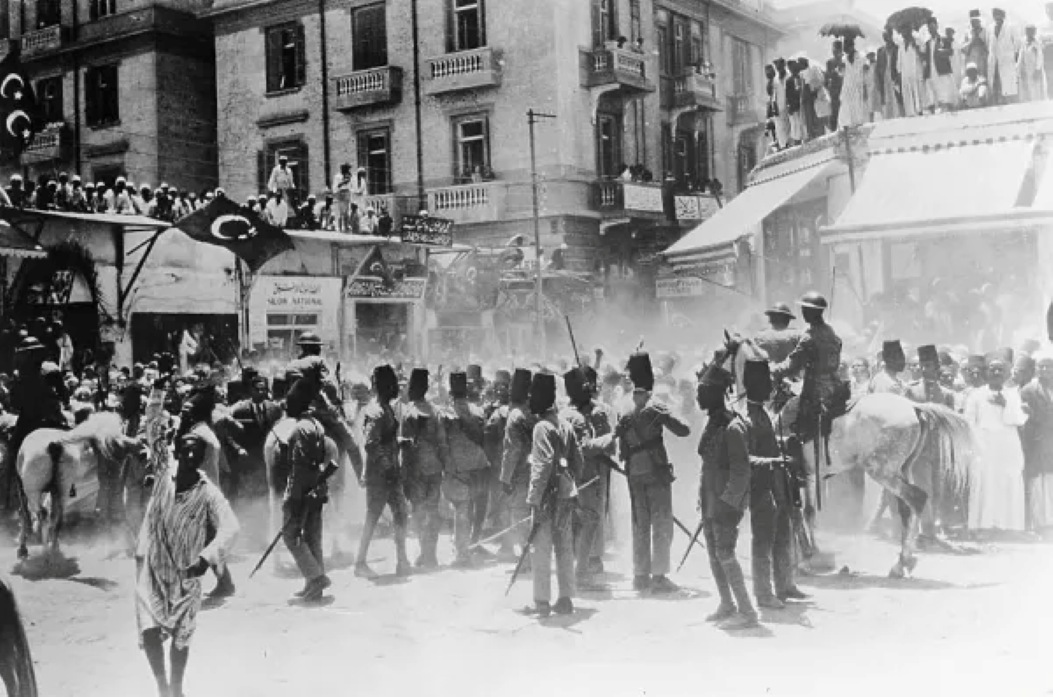
In the summer off 1930 mass confrontations in many Egyptian cities and towns erupted after King Fuad, as was his want, abrogated the ‘constitution’ that of 1923. The main opposition to the Egyptian monarchy, the bourgeois nationalist Wafd Party wished to negotiate a full independence with the British overlords who controlled Egypt, and the Suez, through their navy and the Alawiyya dynasty. The Wafd called people into the street while already capitulating behind the scenes as the regime brutally put down the mobilizations. Also included below is a statement on those events from the League Against Imperialism.
‘The Revolt in Egypt and the Treachery of the Wafd’ by Joseph Berger from International Press Correspondence. Vol. 10 No. 37. August 14, 1930.
Law and order has again “triumphed” in Egypt. A powerful wave of popular revolt has been beaten back by the intervention of military forces. Many hundreds of killed and wounded form the bloody balance of the July fights which took place in Bilbeis, Klausurah, Alexandria, Cairo, Port Said and Suez. The revolt of the Egyptian people has not, for the time being, achieved any of its aims; British imperialism, with its creatures Fuad and Sidky Pasha, has maintained its positions for the present. Nevertheless, the July revolt of Egypt represents an important episode in the fight for emancipation of the Egyptian masses, an important link in the chain of colonial revolutions which characterise the years 1929/30, an unmistakable prelude to new fights for emancipation.
The Egyptian revolt has shown that British rule on the Nile and on the Suez Canal is anything but firm; it has resulted in a further shaking of the British Empire, already undermined by the Indian revolution, the disturbances in the colonies and mandatory territories and the economic crisis at home. The fact that during the fights in Alexandria and Cairo only Egyptian troops were employed against the excited masses, that the British soldiers and the hastily dispatched warships of MacDonald were too late to intervene, does not alter the fact that in reality it was only the British occupation which decided the issue for Sidky and Fuad and against the masses. The first retreat of the Egyptian troops would have led, as Henderson who talked so much about British “neutrality” and non-intervention in the inner affairs of Egypt was obliged to confess, to the immediate intervention of the British army. Its presence and readiness, quite apart from: the fact that the Egyptian army is under British control, decided the fate of the revolt. This was understood before all by the Egyptian masses; for the cry: “Faljahze istiklal mass” (Long live Egyptian independence!), which was the ever recurring central slogan, showed that they instinctively knew and recognised the real enemy behind the figure heads of Fuad and Sidky, and that their anger was directed before all against British imperialism.
What, now, was the role of the Wafd? It made use of the indignation of the masses by placing itself at the head of the movement which broke out spontaneously everywhere. After the resignation of Nahas Pasha and his conflict with the king had become in fact, but against the will of the Wafd leaders, the signal for a rising of the people, it endeavoured to get the latter as quickly as possible into its hands. As long as it could it preached discipline, law and order. When, however, the mass demonstrations assumed a threatening character, when the peasants began to stream into the towns, when the first collisions had taken place and the police stations stormed, when the crowd received the troops sent against them with showers of stones and improvised “bombs” bottles filled with sand, the popular revolt was already in full swing then the Wafd hastened to accept the new situation and to divert the mass movement, which was directed on the much farther aim of complete emancipation, into the channel of constitutional demands. This was done with the clear and definite intention, which was to be plainly seen at every political turn, of putting the brake on the movement as much as possible, of preparing the way for negotiations, and of not losing contact with MacDonald, who on his part was fully aware of the non-revolutionary character of the Wafd leaders, and not letting the revolutionary outbreaks spread to a sphere where, in view of the increased self-confidence of the masses, they would get out of the control of the Wafd leaders, raise social questions and give rise to revolutionary slogans.
The Wafd leadership is no less responsible for the crushing of the popular revolt of July 1930 than the ruthless terrorism of Ismail Sidky and the imperialism of MacDonald. The masses were in the fight; they were determined to carry it on to the last consequences. The slaughter in Mansurah and Alexandria had led to a general strike, and in spite of the fact that the Egyptian masses are badly armed, and in spite of the sending of warships against them, there was to be expected a fresh storm of tens and hundreds of thousands. Trembling, the imperialist Powers (Italy etc.) who claim to have interests in Egypt, and the “European” papers published in Cairo, issued panicky news on the approaching new outbreak, and even the “dictator” himself considered his troops and their equipment insufficient in the event of serious outbreaks.
Then the Wafd came to the rescue: the Wafd leaders fixed the day for the revolution! The Waid determined that on 21st of July Parliament should meet “under any circumstances”; the mass storm should be held back until that day. The restoration of the rights of Parliament was the Waid’s slogan to the masses, and the day of the fight therefor was openly fixed. Instead of sporadic demonstrations concentric attack, instead of spontaneous revolt purposeful revolution. The bourgeois leadership of the Waid understood perfectly how it could deceive the masses at the decisive moment.
In the night of 21st of July Sidky Pasha had already done everything that lay in his power; had concentrated all the military forces at his disposal, fortified all government positions and was ready for the decisive battle the Wafd held a consultation; its result was abominable betrayal. Against the opposition of the radical petty-bourgeois wing it was decided, “in order to avoid bloodshed”, to drop the Parliamentary meeting on 21st of July and instead, to submit a humble petition to his majesty King Fuad, begging him to convene an extraordinary session on the 26th of July. That meant, in the situation then existing in Egypt, complete retreat. It meant that the masses who were to be led into the fight on July 21st, were delivered over without a fight to Sidky’s hirelings. The capitulation of the Wafd was all the more shameful as it was perfectly clear beforehand that the king would reject the petition; the whole manoeuvre obviously served as a pretext for avoiding a collision with the dictatorship.
That the Wafd then, after the rejection of their demand by the king (whose prestige was restored precisely by the treachery of the Wafd) even on the 26th of July did not summon the masses to revolt, but convened its deputies to a meeting held during the night in a private building, in order to make the gesture of protesting against Sidky that Nahas Pasha, in his reply to MacDonald’s “warning”, anxiously assured him that law and order and the “property of foreigners” would be protected at all costs is only the logical continuation of the treachery of 21st of July.
The treachery of the Wafd, however, has in no way succeeded in allaying the revolutionary excitement of the Egyptian masses. On the contrary, the revolutionary pressure of the toilers in the towns and villages still continues. After cases of spontaneous refusal to pay taxes are to be recorded in various villages in lower Egypt, the Wafd is now itself compelled to place on the agenda the question of proclaiming general “civil disobedience”. There arises from this, however, a number of fresh conflicts which are bound to lead to further collisions. The discontent with the Wafd leaders must in the course of the revolutionary struggles lead to the formation of a new leadership of the masses capable of coping with the revolutionary tasks and pursuing a correct path to the victory of the Egyptian workers and peasants.
This way is shown by the appeal of the Communist Party of Egypt, which appeared in the middle of July and was distributed among the Egyptian workers. It is directed against the dictatorship of Sidky Pasha, but at the same time stigmatises the treachery of the nationalist leaders and shows that the real emancipation of the Egyptian masses can only be achieved when the national emancipation of Egypt is linked up with the social emancipation of the workers and toiling peasants. The new activity of the C.P. of Egypt affords good prospects for the approaching period of the revolutionary upsurge in a country whose anti-imperialist fight forms a serious danger to the British Empire, which is based on oppression and exploitation.
***
For the Independence of Egypt!
We publish below an extract from a Manifesto of the League Against Imperialism.
The anti-imperialist front has now been extended to Egypt which has been under the iron heel of British imperialism for 48 years and where the masses have now risen in revolt against the terrible conditions to which they have been reduced by imperialist and native capitalist exploitation and feudal tyranny. From being a rich and self-supporting country producing its own food, Egypt has now been reduced to a cotton-growing area and the entire population, mostly peasant producers, have now become largely dependent upon their foreign and native exploiters for the sale of their cotton production. The poverty-stricken and underfed fellaheen and the young Egyptian proletariat, living in miserable hovels and working from morning to night, produce the wealth that goes into the pockets of the landlords and moneylenders, of the native and foreign bondholders, capitalists and merchants and for the maintenance of the imperialist-feudal state apparatus and the foreign army of occupation. From the surplus value created by their labour is maintained also the Reserve Fund which the puppet governments, appointed by British imperialism, devote for the most part to placing orders with British heavy industry. Under this system of increasingly intensified exploitation the petty bourgeoisie of the towns has also become steadily impoverished. The country is drained of no less than 30 million Pounds a year for interest alone on the investments of British capital.
But British capitalism maintains its stranglehold on Egypt not merely because of the financial profits squeezed out of the toiling masses, but because it has to safeguard the route to its whole gigantic system of exploitation. For these reasons it has established its sole control over the Suez Canal and over the Sudan and resists by force of arms any attempt to diminish or jeopardise that control.
The history of the British occupation of Egypt is one of the most disgraceful even in the annals of British imperialism. After the defeat of Arabi Pasha who had successfully organised a rebellion against the foreign intruder, British troops occupied Cairo on September 15th, 1882, on the pretext of protecting foreign lives and property. One British government after another gave the most solemn assurances that Egypt would not be annexed or permanently occupied and that the troops would be withdrawn as soon as order had been restored. Those hypocritical pledges were made in order to deceive the Egyptian masses, until Egypt was openly declared a British Protectorate in December 1914. The revolt of the Egyptian masses in 1919 was crushed by British troops and British warships. In 1922 the British Government attempted to conciliate the propertied classes by recognising Egypt as an “independent sovereign State”, but with certain important reservations which reduced the so-called independence to a mere farce. And they proposed that these conditions should be embodied in a Treaty accepted by the Egyptian Parliament which was then specially called into being in 1923.
But the Egyptian Parliament, representing mainly the propertied classes, refused to accept the Treaty which seriously curtailed their power to exploit the Egyptian masses. One government after another was set up in order to give the sanction to the Treaty in the name of the people, until in April 1930 Nahas Pasha and his colleagues in the Wafd Cabinet, returned by an overwhelming majority secured under the existing electoral law, went to London to conduct negotiations so as to obtain from the Labour Government the maximum concessions of British imperialism.
The nationalist leaders of the bourgeois Wafd Party, mostly capitalists, landowners and lawyers, have placed themselves at the head of the anti-imperialist struggle of the masses in order to exploit it in their own interests and to prevent it from taking a really revolutionary course. They have attempted to give the movement the form of a constitutional struggle against the absolutism of the feudal monarchy, and for the protection of the rights of the Egyptian Parliament, in order to prevent it from becoming a direct and open struggle between the masses and British imperialism, because this would mean also a fight against the native bourgeoisie and landowners. The Wafd Cabinet of Nahas Pasha, which had nearly signed the Treaty, demanded by Great Britain and legalising the British imperialist exploitation of Egypt, declined to do so at the eleventh hour under the pressure of the rank and file of the Party and in view of the growing revolutionary discontent of the broad masses of the peasants and workers, stimulated and encouraged by the revolt of the Indian masses. The Wafd leaders pretend to have taken up the struggle in the name of the people, while at the same time their agents are negotiating in London and they themselves are diverting the attention of the masses from the real issue, namely, the overthrow of British imperialism, by concentrating on the defence of the Constitution, i.e., on the attainment by the propertied classes of full control over the machinery of the State and of Parliament in order to share more fully with British imperialism the profits of the exploitation of the toiling masses.
In spite of the pacifist manoeuvres of the Wald leaders, the masses have given expression to their militancy in the mass demonstrations, barricade fighting and bloody conflicts, with the armed police and military force of imperialism that have taken place during the last few weeks in the streets of Mansurah and Bilbeis, of Alexandria and Cairo, of Suez and Port Said. During these conflicts, hundreds have been killed or maimed for life, thousands injured, thousands arrested. The country has been placed under a regime of military terror. Every printed expression of anti-imperialist revolt has been suppressed. The freedom of speech, of the press and of assembly have been abolished. The country is under a Fascist dictatorship which receives the praise and the support of the Imperialists and Social Fascists of Great Britain.
In the suppression of the anti-imperialist revolt of the Egyptian people, the Labour Government is playing the same dastardly role as it has been playing in India and in Palestine. It has sent warships to Alexandria while making a hypocritical declaration of neutrality and has given military and moral support to its feudal vassals in Egypt to prevent the further development of the revolutionary movement and to protect the interests of British imperialism. At the same time the Labour Government has been continuing its negotiations with the Wafd Leaders in whom it rightly sees the men that will finally and inevitably make the desired compromise with British imperialism.
The League Against Imperialism, while giving its wholehearted support to the Egyptian masses in their struggle for national independence and social freedom, deems it necessary to warn them against the treacherous tactics of the Wafd leaders, which are similar to those of the Indian National Congress and which must be clearly exposed to the masses of workers and peasants, as well as to the students and urban poor that constitute the rank and file of the Wafd Party and among whom there are sincere anti-imperialist elements. The League wishes to make it clear to them that their condition can only be improved by carrying on an uncompromising struggle for the complete overthrow of imperialism and its feudal and capitalist agents among the Egyptians, and for the establishment of full national independence. This struggle cannot be carried on under the domination of leaders whose interests demand a compromise with imperialism, but only with a clear programme that corresponds to the real economic and political interests of the broad masses.
The League Against Imperialism calls upon all truly anti-imperialist elements in Egypt to unite their forces and bring into being a strong anti-imperialist mass organisation that shall coordinate the struggle for Egyptian independence in Egypt itself with all the anti-imperialist forces of the world and thereby ensure the complete victory of the Egyptian masses.
International Press Correspondence, widely known as”Inprecorr” was published by the Executive Committee of the Communist International (ECCI) regularly in German and English, occasionally in many other languages, beginning in 1921 and lasting in English until 1938. Inprecorr’s role was to supply translated articles to the English-speaking press of the International from the Comintern’s different sections, as well as news and statements from the ECCI. Many ‘Daily Worker’ and ‘Communist’ articles originated in Inprecorr, and it also published articles by American comrades for use in other countries. It was published at least weekly, and often thrice weekly.
PDF of full issue: https://www.marxists.org/history/international/comintern/inprecor/1930/v10n37-aug-14-1930-Inprecor-op.pdf

