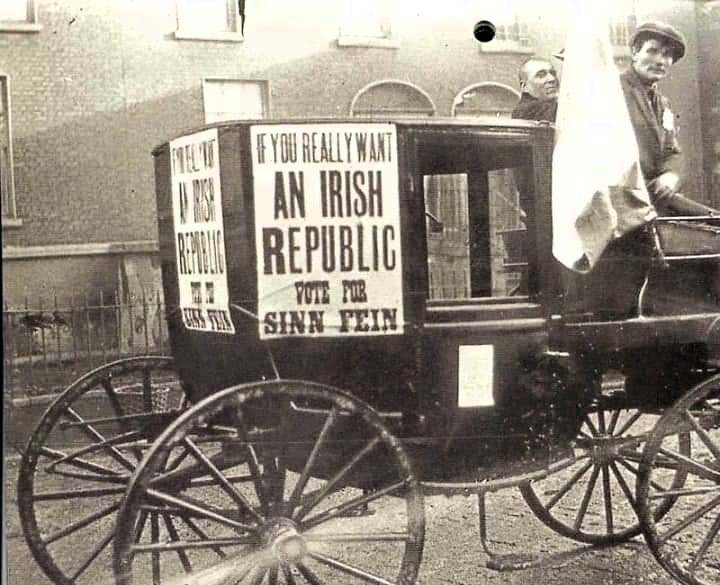
An important figure in James Connolly’s joining and working for the Socialist Party was Chicago-based Bernard McMahon. Like Connolly a former member of the Socialist Labor Party, McMahon was the lead comrade behind that city’s Irish Socialist Federation and an observer of Irish politics for the Party press. Having recently left the S.L.P., Connolly traveled to Chicago in May, 1908 to publicize his ‘Harp’ newspaper with a booth at the National Socialist Party Convention. McMahon and Illinois State Secretary J.O. Bentall became sponsors of Connolly’s, with McMahon writing for the Harp and appealing to the S.P.’s national leadership to hire Connolly as an organizer, which they did. McMahon would remain a supporter of Connolly’s, writing a moving obituary of personal memories after his May 12, 1916 execution. Here, McMahon analyzes the rising national liberation movement epitomized by Sinn Fein, founded in 1905.
‘The Sinn Fein Movement in Ireland’ by Bernard McMahon from The Chicago Daily Socialist. Vol. 1 No. 269. September 6, 1907.
The Sinn Feln movement in Ireland is an aggressive expression of the national sentiments and economic ideas of a large element of the Irish people residing in the old land.
“Sinn Fein” (pronounced Shin Fane) literally means “ourselves” and the words reveal the hopes and aspirations of the overwhelming majority of Erin’s sons for over a century.
There is nothing new, therefore, in this movement, but it has taken hold of a large percentage of the people and the balance remain aloof because they are fearful of its being impractical. It is a many-sided movement and, from a purely Irish point of view, is praise-worthy in many respects.
Briefly stated, this is part of their programme: Abstention of Irishmen from the English parliament. Revival of Irish industries. Stopping of Irish emigration. Restoration of the Irish language and its literature. Fostering of a more intense national spirit in the people and the boycotting of everything English.
These might be might be called the main planks in the Sinn Fein platform and the average outsider could subscribe to this, no matter of what race, by simply applying the national sentiment expressed above and substituting his own country.
But there is another side to this and some of the objections are considered fatal by those in opposition to the Sinn Fein thought.
Let us take them up in their order so that we can better understand the other side of the question. By the Irish desertion of Parliamentary duties it is claimed they could set up a Dublin Parliament and discuss and plan the country. It is true the parliament methods to better the condition of the country have to have legal binding, but it is thought that the awful pressure that could be brought on local bodies like our country boards and city councils would infuse new life into the country. On the other hand it has been held that it would be ridiculous to simply play at legislation in this fashion and particularly as the findings would have no force except a sentimental one. The Sinn Fein followers point out that the Irish members do no good in London anyhow: that every beneficial measure is so maimed and emasculated (even if it does get through the House of Commons) by the House of Lords, that it is wasted energy to bother. In this there is considerable truth, for within this last few days the Government Bill for the Relief of the Evicted Tenants (Ireland) is so completely changed by eliminating its best features that the Irish nationalist members left the house in a body on the government announcing acceptance of the various changes.
It is more than a century ago since Irish industries were completely crushed by the vicious legislation of English manufacturers. It is true, of course, that these unfair laws have now been removed, but to all intents and purposes the injury remains.
During the past sixty years there have been spasmodic efforts to create new industries or increase and stimulate those already there. This, of course, is an uphill struggle, for as England steadily grows richer Ireland grows poorer, and this works like a double-edged sword. Some particular industry will be started with a great flourish of trumpets and the people are almost sworn to purchase their own manufactures, but the poor everywhere have to trade where they can buy the cheapest. This in turn lessens the opportunity for the Irish worker, as the home manufacturers cannot compete with the powerful English producers. So the result is that the people have been emigrating to all parts of the world. Besides, it is the young and vigorous that leave the country, thus virtually draining it of its very life.
Ireland is practically the only country in Europe decreasing in population, having lost almost fifty per cent in sixty years, There is another trouble that the Sinn Fein people do not mention–in fact they would be afraid, and that is the continuous growth of religious orders and institutions notwithstanding the people’s decay. One does not express anti-religious views in calling attention to this, but it is a subject that must be reckoned with in the near future.
The same decay is of course apparent in the language and literature of the country that one would naturally surmise in learning of Ireland’s blood-letting and economic troubles. Ireland is wonderfully rich in Gaelic literature–her past is simply glorious in this regard and it is rather humiliating to the Hibernians that the German scholars are more familiar with it than themselves. It is a revelation to the literary man who first delves into the ancient lore of Ireland and this is attested by President Roosevelt’s article in the “Century” magazine a few months ago on the old Irish Sagas.
Ireland’s rising generation is being enthused by Hyde and Yeats and many others in the richness and beauties of the old songs and stories of the bards and minstrels of long ago. This element is therefore at home with the Sinn Fein idea.
The same is true of the old games and pastimes and they are being restored rapidly even in the most obscure villages of the island.
Many people in Ireland do not see the wisdom of restoring the old language and take the broader view that it would be better for the whole world if there were only one language in universal use, and leave such languages as the Irish to college professors and philologists.
Many really patriotic Irish people who sympathize with the Sinn Feins in their efforts are opposed to the plank advocating the boycotting of everything English. The world has grown more tolerant than when Dean Swift advised his countrymen “to burn everything from England but the coal.” Besides, boycotting is a game that two can play at and Irish goods that find a ready market in Great Britain might find her gates closed if such a policy were adopted by Irishmen. In addition to this, it is estimated that there is over a million people of Irish blood in England, and it is barely possible that their places in the factories and mines and hundreds of less laborious positions might be filled by English or Scotchmen. For these reasons many sincere Irishmen are opposed to the whole movement as tending to widen the unfortunate visions and increasing the differences that separate the Saxon and Celtic races.
In the meantime the Irish Parliamentary Party, with a couple of exceptions, is busily engaged in denouncing the new cult. John Redmond, the chairman refers to them rather contemptuously, as “cranks and faddists.” Now that Parliament has adjourned until the Fall the discussion in Ireland between the Sinn Feins and the Parliamentarians will be an interesting one.
The Chicago Socialist, sometimes daily sometimes weekly, was published from 1902 until 1912 as the paper of the Chicago Socialist Party. The roots of the paper lie with Workers Call, published from 1899 as a Socialist Labor Party publication, becoming a voice of the Springfield Social Democratic Party after splitting with De Leon in July, 1901. It became the Chicago Socialist Party paper with the SDP’s adherence and changed its name to the Chicago Socialist in March, 1902. In 1906 it became a daily and published until 1912 by Local Cook County of the Socialist Party and was edited by A.M. Simons if the International Socialist Review. A cornucopia of historical information on the Chicago workers movements lies within its pages.
PDF of full issue: https://www.marxists.org/history/usa/pubs/chicago-daily-socialist/1907/070906-chicagodailysocialist-v01n269-simonsonstuttgart.pdf
 Revolution's Newsstand