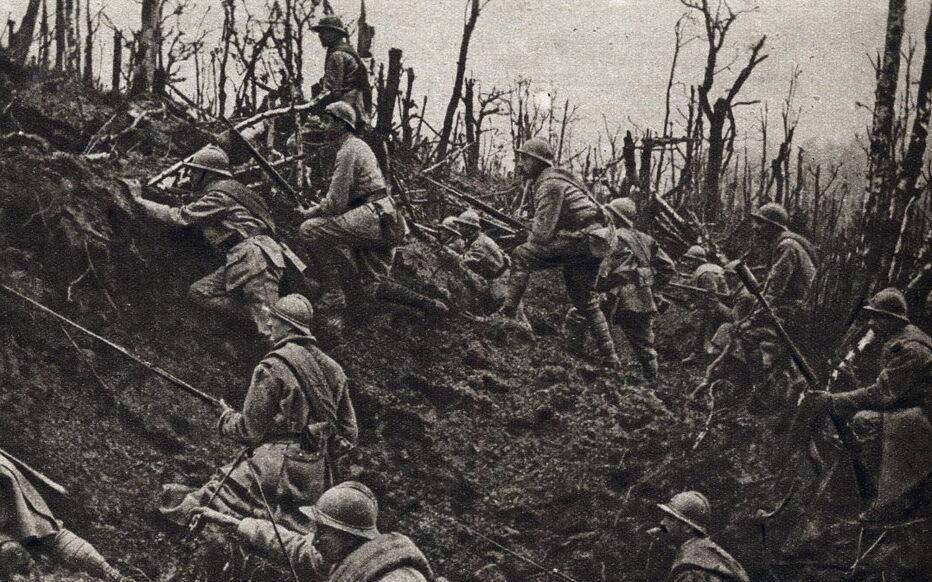
A veteran of the war (and future veteran of the Resistance) on the Spring, 1917 mutiny of French troops in during World War One.
‘The Mutinies of the Soldiers on the French Front (May-June 1917)’ by Marcel Fourrier from International Press Correspondence. Vol. 7 No. 31. May 26, 1927.
At the beginning of 1917, the soldiers in France were thoroughly weary of the war. The war seemed to drag on forever. Bluntness and loathing had followed the enthusiasm of the first days. The senseless offensive of 1915, the slaughter before Verdun in 1916 had decimated the fighting troops without bringing the military issue of the war a day nearer.
The Briand Government, which realised the necessity of making the impression that it wanted to do something, had resolved to call upon those in supreme command of the army to prepare a great plan of offensive for 1917, the plan of a simultaneous attack on all fronts. In December 1916, General Joffre, the “kind-hearted murderer”, had been removed from the supreme command and had been replaced by General Nivelle, who had attracted attention by his unusually successful military operations before Verdun in 1916.
From January onwards, rumours were circulating through all the cantonments at the front of an approaching offensive to break through the enemy’s lines. At the commanders’ quarters, the officers’ messes, in the dug-outs and dressing stations, everybody tried to find out more details about the sudden attack which was to throw the “Boche” back behind the Meuse, about the part the coloured troops were to play, about the aircraft and the mysterious “tanks”, which pulverised railway lines, levelled up trenches and crushed everything in their path. In order to raise the morale of the troops, it was trumpeted abroad that it was a case of the last, the “peace offensive”, which would end the war with a brilliant military victory, as a result of which all the soldiers would return to their own hearths as heroes.
The replacement of the Briand-Liautey Ministry by that of Ribot and Painlevé, made no change in the plans for the offensive. It was finally fixed for April 17th.
On April 16th, the offensive began to develop on the front of the 5th and 6th armies.
“At 6 a.m., with snow falling”, wrote a trustworthy witness, “the French infantry made a storm attack in the section of the front between Rheims and Soupir; the German machine-guns, which were posted in advance, mowed down the first ranks; powerful counter-attacks developed at suitable points. The enemy fire devastated and decimated our ranks and with certain aim hit the enormous masses of reserves of infantry, artillery and cavalry which had been thrown into the front line in view of the great assault. Long lines of artillery, army service corps and ambulance divisions blocked the roads; an indescribable confusion reigned.”
On the night of April 18th, more than 20,000 French soldiers bled to death between the lines without the cause having advanced a single step.
The Supreme Command, however, obstinately persisted in its plan. On April 17th the offense was continued with equal futility and loss of lives on the front of the fourth army. General Nivelle persisted until April 21st in his murderous insanity. In ten days the French front counted 34,000 dead and more than 50,000 wounded.
***
After the formal promises which had been made to the fighting armies that this was “the last offensive”, a massacre of this kind raised a storm of indignation and rage at the front.
From April 26th onwards, breaches of discipline took place at the front of the 6th army. In certain regiments, which were exhausted by ten days in the trenches, whole companies refused to go out to fresh attacks. On May 3rd, a general mutiny broke out on the front of the 21st infantry division of the colonial troops. It was cruelly suppressed. The dull fermentation and agitation however was only strengthened in this way, both among the units which had already been put to the test and which were called back to the front after too brief a rest, and among the fresh divisions which, on approaching the lines, heard the indignant reports of their comrades about the massacres they had just witnessed.
The Government soon found itself compelled to turn into account the wave of indignation which rapidly spread from the front to the rear. Painlevé, the War Minister had not much trouble in getting the incapable Commander in Chief removed from his office. In order to “save General Nivelle’s honour”, as Painlevé wrote, word for word, many years later (“Revue de Paris”, Jan. 15th, 1922), it was resolved not to replace Nivelle until he had gained a “success to retrieve his honour”. Thus, in order to save the military reputation of an incapable general Painlevé had a new offensive made which, between May 5th and 10th, became the battle near Craonne and which again cost 20,000 human lives for less than nothing.
This filled the measure to overflowing.
The revolt, of which dull rumblings had already been heard, broke out almost simultaneously in fifty bodies of troops, 22 divisions being affected. It originated at the front. But it very soon found a strong echo at the rear.
The way things happened in the 128th Regiment of Infantry was as follows:
On May 20th the regiment received the order to re-occupy the front line. The 120th Regiment of Infantry, which had already received the same order, had refused to carry it out.
In the cantonments, groups form round a few soldiers. Cries are heard of: “We will not go forward again!” Meetings are improvised. The most moderate of the speakers castigate the incapacity of the generals and the ministers. The boldest cry: “Down with the war!” and they loudly declare that the thing to do is to follow the example of the Russian soldiers and form Soviets.
The mutineers take refuge in caves, carrying their rifles with them. Thence they negotiate for three days with the stronger party before they surrender.
Even in Soissons, two regiments leave their cantonments and storm the railway station where they take possession of a locomotive; they declare that they will march on Paris and turn the gas-bags, who are responsible for their being slaughtered, out of the Palais Bourbon. At the station itself, a struggle takes place, and only after some lively fighting, do the “loyal” troops succeed in disarming the mutineers.
In the course of the month of May, such events recurred frequently.
“On June 7th”, wrote Painlevé—in the ‘Revue de Paris’ the condition at the front was so threatening that General Petain, General Nivelle’s successor, demanded that courts martial be set up again.”
In the period between May 10th and June 10th, more than 150 death sentences were pronounced for collective refusal to obey orders.
M. Painlevé boasted later that he had had “only” 23 soldiers shot. In reality however unless the secret archives of the War Ministry are made public–we shall never know the exact number of executions which took place at the front, nor even the number of those who were condemned to penal servitude which certainly involved many thousands.
In any case, the example of the Russian soldiers bore fruit and the Supreme Command telegraphed that the Soviets of Russian soldiers should be isolated from the French troops.
With regard to this, M. Painlevé wrote:
“It was impossible to conceal from the Russian brigades the new military régime which had been established in their country (according to which the officers were elected and were deprived of the right to punish); when the Provisional Government appointed representatives to negotiate with the troops in France, it was impossible to avoid taking facts into account for better or worse The example given by these soldiers through their Soviets, their resolutions and their attitude towards their officers demoralised the neighbouring French troops, and the reaction was felt along the whole front. The only remedy was to transfer them to the interior of the country.”
In connection with the events at the front, strikes broke out in various factories, especially in Paris and its neighbourhood and in St. Etienne in the Loire Basin. “Safe” troops, cavalry and Senegalese rifles were put at the disposal of the prefects. Above all, however, use was made of treacherous Socialist and trade union leaders in order to suppress the revolutionary movement which was spreading in the factories. The renegade leaders worked so well that before long “order” reigned everywhere, all the more because the Government allowed its lackeys to grant higher wages and further announced an increase of billet-money. On June 15th the mutiny at the front was ended; by June 30th the last resistance in the factories within the country was broken. The French bourgeoisie could breathe freely again and resume the war.
International Press Correspondence, widely known as”Inprecorr” was published by the Executive Committee of the Communist International (ECCI) regularly in German and English, occasionally in many other languages, beginning in 1921 and lasting in English until 1938. Inprecorr’s role was to supply translated articles to the English-speaking press of the International from the Comintern’s different sections, as well as news and statements from the ECCI. Many ‘Daily Worker’ and ‘Communist’ articles originated in Inprecorr, and it also published articles by American comrades for use in other countries. It was published at least weekly, and often thrice weekly.
PDF of full issue: https://www.marxists.org/history/international/comintern/inprecor/1927/v07n31-may-26-1927-Inprecor-op.pdf

