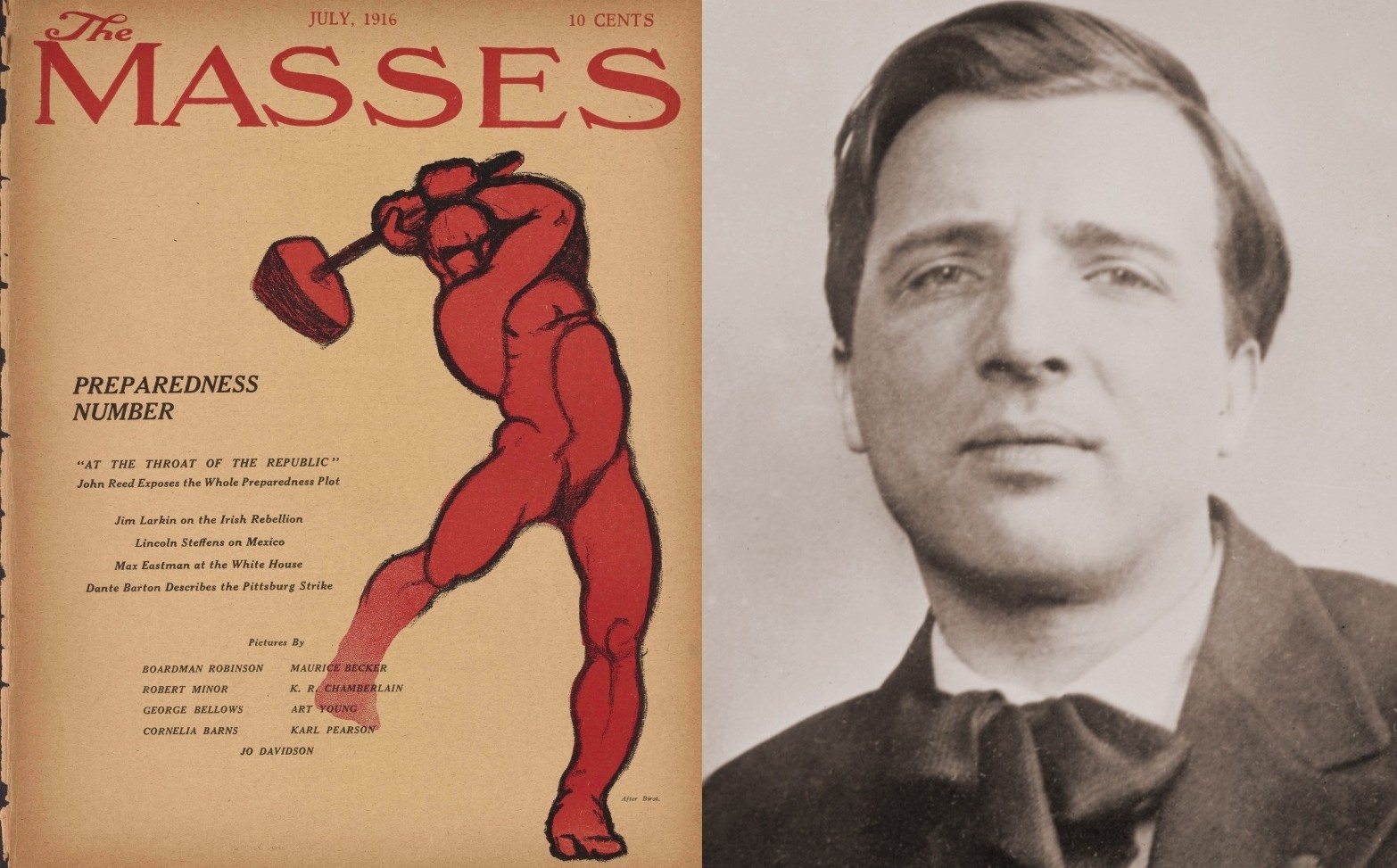
Stirring words from Giovannitti on the foremost cultural magazine of the Left that helped to define the World War One-era Socialist movement and was the vehicle for writers like John Reed to introduce U.S. readers to the European revolutions.
‘What I Think of The Masses’ by Arturo Giovannitti from The Masses. Vol. 8 No. 9. July, 1916.
I BELIEVE that THE MASSES, next to the masses of Organized Labor; the Preamble of the I.W.W., the Panama Canal, Jess Willard and the Woolworth Tower is the biggest thing America has produced so far. It belongs to the realm of miracles as well as to the empire of portents.
The reasons for holding this somewhat exaggerated view are many, but the chief of all is that THE MASSES grew out of nothing and lived for fully five young years, coming out regularly every month, growing considerably in size, becoming more and more important, and all this without ever demanding a single cent of contribution from its readers, as all journals which are not published for business purposes are bound to do sooner or later.
More still, it proved that the best magazine in America could be run without any of the generally accepted qualifications of success: without money, patronage, publicity and acquiescence in the status quo, which is Latin for this rotten system of affairs. Its success, for it has been bewilderingly successful, was chiefly due to its stern policy of steering rigorously clear of all things that are successful: successful politics, successful business methods, and successful journalistic humbug. It tried to be as unpopular as possible; to speak as little good and see as much evil as its loud mouth and unchaste eyes allowed; to tell the truth when it did not pay, and to tell a lie when it would prove that truth absurd. It tried to publish real literature in an age of drivel, and talk common sense in a period of universal insanity, while it brought the warmth of humor into the cold storages of serious-minded stupidity and the freshness of laughter and song into the sweat-shops of ready-to-wear intellectual bunk. It stood for all the shocking realities, not because they were shocking but because they were realities; it entered the union halls with a silk hat on and attended the fashionable “radical” dinners in flannels and overalls. It stood for all things that stand for destruction and for one great vision of rebuilding; it was with the I.W.W. when this organization was doing its best, and for the A.F. of L. when it was preventing the bosses from doing theirs; it stuck to no one particular creed, but tried to beat all isms into one: indeed it was Socialistic, Anarchistic, Syndicalistic, Feministic, optimistic and pessimistic and all sorts and varieties of istics whenever these awful things implied walking ahead–impetus, the leaping forth across the wastes of patience and resignation.
It considered motion as the sole reason of life, and therefore it was never static. It believed that to stand meant to take root and to rot. Accordingly it moved along with its namesake, advancing and retreating, sallying forth and falling back, rioting and pleading, shouting and praying, plotting, planning, scheming, dreaming, singing, weeping, laughing, cursing and living its life in all its tumults and its passions, in all its contradictions and inconsistencies, its loud revolts, its silent broodings, its unseen renunciations. Born without any ringing of bells and chanting of priests out of the meretricious relations of Prosperity and Cowardice–unpedigreed, unchristened, unregistered in the records of any official movement nor in the family Bible of any established party–this bastard child of the sinful concubinage of the Ideal and Reality followed in the tracks of the parental impulses and stuck faith–fully to the downward path, wherever it led. It had no eternal truths to reveal, no unappealable decalogues to proclaim–it took itself too seriously to attempt to be always serious. But it held as its destined end the transformation of the world, and it knew that the world could be transformed solely by those who made it, or allowed it to be as it is. And so whenever a crowd assembled, whether to sing or to mourn or to riot, THE MASSES was there. Wherever ominous clouds gathered, it ran into the thick of them. Wherever a tumult roared, a battle raged, an old terror groaned, a reshaped truth resurged, an artery of the world bled, a wing of life was broken, and above the din and the thunder rose the battle shout of the oppressed embattled against their tyrants, there this unconscripted and ununiformed free-lance of Revolt rushed in yelling, calling, inciting, prompting, picking up the wounded, blessing the dead, hurling magnificent insults and holding aloft the red rag of the Rabble, the rent and gambled peplum of the murdered Christ.
If it did not go to jail, it wasn’t because it did not honestly and faithfully try to; if it did not starve to death it was not because its enemies did not wish it, but because its editors were used to the fast cure; if it was not lynched by a mob of Christian gentlemen, the fault lay not with it but with Christianity and gentlemanliness; if it was not electrocuted or shot at sunrise it was not because it did not deserve it, but rather it was due to its persistent hard luck. However, if you look over the back files of this paper and read the names of those who have appeared in it either in person or by proxy, you will see filing before your eyes several centuries in the penitentiary and the biggest challengers of the times. The MacNamara boys, Haywood, Schmidt and Caplan, Tanenbaum, Pat Quinlan, Ben Legere, the alleged dynamiters of Saint Patrick’s Cathedral, Joe Ettor, John Brown, Emerson (not the Boston one), Joe Hill and, in the last issue and this one, Emma Goldman and Ben Reitman, all came here a-visiting and were received with honors. Modesty compels me not to mention my name, but I also am here, however much I would like to disguise it.
It cannot be charged, therefore, that THE MASSES ever tried to be respectable; the worst that can be said against it is that it tried very hard to be unrespectable and failed. But here are some of the things that really happened to it within one year or a little more: The Associated Press sued it for libel and had two of its editors arrested. It was thrown out of the New York Subway stands on a charge of blaspheming the Divinity and was forthwith fined a large amount of its circulation every month for life, without trial and without the complaining divinity appearing either in person or by power of attorney. And finally, two months ago, in the very midst of a great crisis, it was refused admittance to Canada, thereby losing another large number of subscribers. If these are not good and honorable counts in the cause of Social Revolution, then I don’t know what gallant behavior before the enemy means. Had all these things happened to any other radical magazine, its editors would have raised a cry to the seventh heaven, appealing for funds, mobilizing all land and sea forces, invoking the wrath of God and, incidentally, increasing their circulation one hundred per cent., which would have been a perfectly good and legitimate thing. But did THE MASSES Editors do that? They did not. They made some funny cartoons about their troubles, wrote a few lines of humorous nonsense, and proceeded to do the same great stunts with a reduced income. Awfully clever, these MASSES chaps, don’t you think?
Well, this must stop. THE MASSES must be helped by the masses. The circulation must be increased; the subscribers it has been robbed of must come back more numerous than ever.
There is no reason why this magazine should not have a circulation of 100,000 copies a month within one year. If that reason exists, I want to know it. In the meantime, I want every red-blooded man and woman who has been a reader of this magazine to become a booster of it and a missionary for it. I want the readers to consider it as their organ, their property, their mouthpiece, and to show it to their friends and make them subscribe at once. We must have by all means from five hundred to one thousand new subscriptions every week in order to go ahead as we have so far, and no excuse will hold or be accepted. Who will help? Who will come forward?
It’s an easy job and an easier glory. It does not require any great effort to get another subscriber or to send in a dollar and the name of your best friend. That’s all I ask of you just now. I don’t ask you to go to jail for your principles, nor to risk your life, not even to lose your job. I only want you to understand this journal in its true essence and then proceed to do for it what is strictly your duty.
This paper belongs to the proletariat. It is the recording secretary of the Revolution in the making. It is the notebook of working class history. As a recorder of great deeds and great faiths, it is the lineal descendant of the Book of Exodus and the Acts of the Apostles. Its nearest ancestors sleep in the stately vaults of the Worlds’ Pantheon. Its grandfather is Marat’s “L’Ami du Peuple”; its father is Garrison’s “Liberator.” It is NOT meant as a foray of unruly truant children trying to sneak into the rich orchards of literature and art. It is an earnest and living thing, a battle call, a shout of defiance, a blazing torch running madly through the night to set afire the powder magazines of the world.
Friend Reader, we want you to come and work with us. Whoever you are, no matter in what field you militate, if you are moving along, if you are not dead nor yet wishing to die, if you have a soul to save and a song to sing; if you have seen beauty and want to share it with other eyes; if you have a dream to retreat into in your hour of distress and a dungeon you want to break out from; and, above all, if you have an ideal of social justice and human brotherhood which you want the world to revere and honor as you do; then, my friend, this is YOUR voice your power–the oriflamme of your blood floating in the winds of the gathering storm of the Revolution.
The Masses was among the most important, and best, radical journals of 20th century America. It was started in 1911 as an illustrated socialist monthly by Dutch immigrant Piet Vlag, who shortly left the magazine. It was then edited by Max Eastman who wrote in his first editorial: “A Free Magazine — This magazine is owned and published cooperatively by its editors. It has no dividends to pay, and nobody is trying to make money out of it. A revolutionary and not a reform magazine; a magazine with a sense of humour and no respect for the respectable; frank; arrogant; impertinent; searching for true causes; a magazine directed against rigidity and dogma wherever it is found; printing what is too naked or true for a money-making press; a magazine whose final policy is to do as it pleases and conciliate nobody, not even its readers — There is a field for this publication in America. Help us to find it.” The Masses successfully combined arts and politics and was the voice of urban, cosmopolitan, liberatory socialism. It became the leading anti-war voice in the run-up to World War One and helped to popularize industrial unions and support of workers strikes. It was sexually and culturally emancipatory, which placed it both politically and socially and odds the leadership of the Socialist Party, which also found support in its pages. The art, art criticism, and literature it featured was all imbued with its, increasing, radicalism. Floyd Dell was it literature editor and saw to the publication of important works and writers. Its radicalism and anti-war stance brought Federal charges against its editors for attempting to disrupt conscription during World War One which closed the paper in 1917. The editors returned in early 1918 with the adopted the name of William Lloyd Garrison’s The Liberator, which continued the interest in culture and the arts as well as the aesthetic of The Masses/ Contributors to this essential publication of the US left included: Sherwood Anderson, Cornelia Barns, George Bellows, Louise Bryant, Arthur B. Davies, Dorothy Day, Floyd Dell, Max Eastman, Wanda Gag, Jack London, Amy Lowell, Mabel Dodge Luhan, Inez Milholland, Robert Minor, John Reed, Boardman Robinson, Carl Sandburg, John French Sloan, Upton Sinclair, Louis Untermeyer, Mary Heaton Vorse, and Art Young.
PDF of full issue: https://www.marxists.org/history/usa/pubs/masses/issues/tamiment/t63-v08n09-m61-jul-1916.pdf

