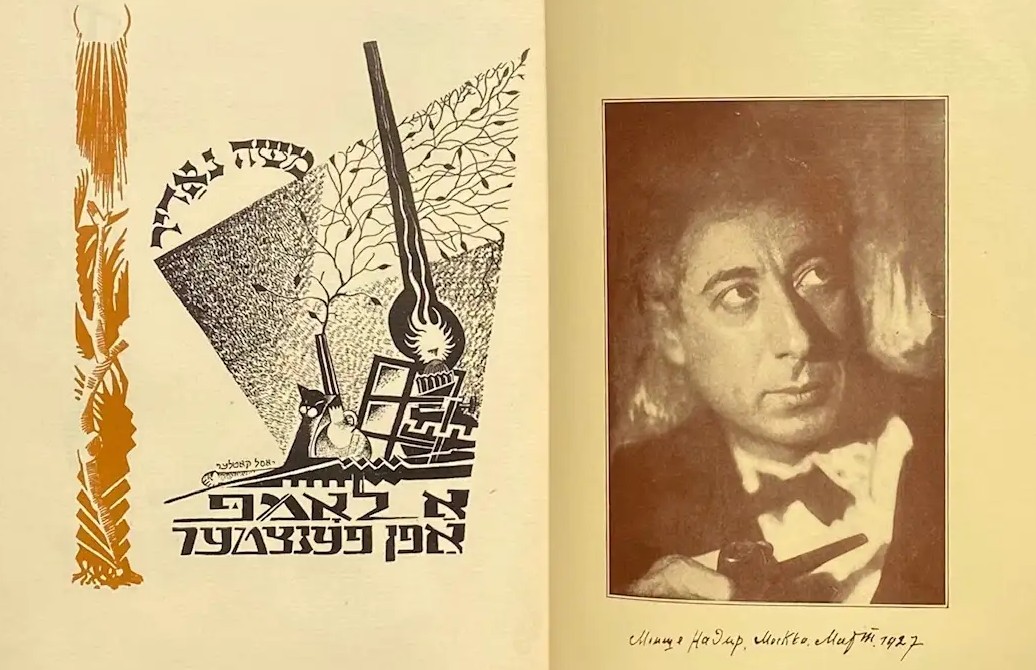
Moishe Nadir’s contribution to the American Writers Congress on his role as a Yiddish writer and internationalist in the United States. Nadir, satirist and playwright, from ‘playboy’ to revolutionary, was one of the most popular and influential voices of the already rich Yiddish-language Communist press of the 1930s. Nadir would, like many, leave the Party after 1939’s Nazi-Soviet Pact. The American Writers Congress was held in 1935, and began as a ‘popular front’ era replacement for the John Reed Clubs as a vehicle for Communist Party arts work.
‘The Writer in a Minority Language’ by Moishe Nadir from The American Writers Congress. International Publishers, New York, 1935.
THE MINORITY group language–Yiddish–which I have the honor to represent at this Congress, has the unique distinction of having been from its inception the language of the toiling Jewish masses, as contrasted with the ancient Hebrew of the upper-class chauvinists, or the “pure” German of the vulgar middle-class assimilationists.
Though every conceivable kind of bunk from soup to Dada had exercised its vogue for a time, it left not the slightest impression on the proletarian Jewish reader, who, with his healthy instincts unmarred, has at all times shown a remarkable capacity for differentiating between life in its stark reality and what passes as such on the Boulevard Montparnasse and Broadway, where in an effort to conceal its hunchback, it is enshrouded in the mystifying black operatic cloak of ultra-modernism.
Much ink has been spilled in recent years about the question, “What is proletarian art?” One Marxist-Leninist shortcut to a definition is: “Art that serves the proletariat as a weapon in its struggle against capitalism, art that tends to make the worker conscious of his class, of his important historic role in the Hegelian ‘altogetherness of everything.’”
The proletarian writer of to-day must above all unceasingly call attention to the fact that the old war-mongers of the Stinnes, Morgan, Deterding, DuPont and Krupp stamp, as well as their hirelings, Wotan, Hitler, Father Coughlin, Brother Roosevelt, are once more plotting to rid themselves of the “over-production” of laboring men, by dumping them into the hell fires of the coming imperialist war, a most “convenient” way, no doubt, of liquidating the contradictions inherent in capitalist economy.
Reading the “air-conditioned” bourgeois word-manufacturers, one gets the impression that their attitude is: that while a fellow-man (in this case, humanity itself!) is drowning, the “free” artist, not being able to swim himself, must cautiously refrain from jumping into the icy waters to save him. Nor must he shout for help. Good breeding proscribes such bad manners. Instead the bourgeois æsthete proposes to the drowning man (in this case humanity itself!) that he would be charmed at this very moment to paint a picture of him. Will he please turn his face this way?
There is a story told about a Yiddish writer from the interior of Lithuania who, arriving at the port where a ship was to take him to our glorious American shores, on seeing the ocean for the first time in his life, piously clasped his hands and exclaimed: “So this is the ocean I have been singing about in my poems! What a remarkable resemblance!”
On the other hand, there are those among the younger set of proletarian writers who are as literal minded as the Scotch gardener told to water the front lawn every Friday. He repaired to the garden with a hose in one hand, and an umbrella in the other–for on that particular Friday there was a terrific downpour of rain.
A Yiddish idiom runs: “One cannot suck wisdom out of one’s finger,” which when translated into Bolshevik ideology simply means that in order to be an influential figure in world proletarian letters one must identify himself with all active phases of the struggle for liberation from the capitalist inferno; one must be in the thick of things, ready to serve the cause of the revolutionary proletariat with every possible kind of weapon.
We, on the proletarian pen front, must neither write to live, nor live to write, but live and write, alternatively using our pen and our fists, or both, as the revolutionary occasion may demand. There are those among the bourgeois economists who have concocted a thesis all their own that in order to gain our revolutionary end, Communists are hopefully looking forward to a world war, which, of course, is sheer nonsense! From the Brest-Litovsk conference at the end of the World War, to the time of Eden’s visit to Moscow and Litvinov’s open attacks on the imperialistic war machinations in Geneva, the Soviet Union, as well as the Communists the world over have done and are doing all that is in their power to stave off the hecatomb of war. Although we are convinced that the red Phoenix will rise from the ashes of the next world war, so terrible and vast in its destructive possibilities as to horrify the very imagination, we are equally well convinced that it will take a long time to nurse that disaster-born “bird of fire” back to normal health and civilized social effort….It is indeed against the crumbling walls of capitalist economy that the Communists hope to see the swastika heads shattered–in times of peace.
Nor must we let the enemies of the workers intimidate us with that “love of fatherland” buncombe either! Like cannibals the capitalist patrioteers love their country–love it broiled, love it charred, turning it with watering mouths over the spits of a hell of their own making. We, the proletarian writers, on the other hand, love the land of our fathers, and brothers, and sisters, and sister-in-laws to such an extent that our love easily embraces all lands on this small earth. We love America as we love our own face, though it would be temporarily swelled up with toothache. It’s our face after all. We love it for its inexhaustible potentialities for the social good, its highly industrialized mode of production which we are determined to turn from a curse into a blessing for mankind. Above all: We love America as one of the most beautiful flowers in the bouquet of the world Soviets of tomorrow.
Reduced to a humble formula there are really only two distinct literary methods (1) to complicate that which is simple; (2) to simplify that which is complex. The first is the method and technique of the bourgeois writer, who after complicating the most simple things, sometimes, by sisyphean labors and with the aid of metaphysics succeeds in making matters half as plain as they were before he began complicating them.
To simplify, to educate, to teach, to see–not our own revolutionary eyeglasses, but the object itself. The revolutionization of the mass mind is the only thing that matters at this juncture when instead of bread a howling political circus full of hyenas, jackasses, zebras, and kangaroos of Father Coughlins and Huey Longs, of Hearsts and Abraham Cahans is being offered to the starving masses as a distraction from the bitter realities.
As this is a writers’ congress it would not be amiss to say a word about the creative process which in our estimation will achieve the best revolutionary results. It would be most fruitful, we think, for the proletarian writer, while melting his materials in the red-hot fire of his rebel passion, in order to achieve a finished proletarian product, to temper them in the cool waters of Marxian logic. One must write fast and breathlessly learning at the same time to rewrite coolly and painstakingly with that artistic pride inherent in all effective proletarian creations. Literature being one of the weapons of the ruling class, we must go it one better by producing a weapon of a superior quality. In a period of social upheaval and revolution there is really no time to be concerned with revolutionizing art-forms. Far more important is it to employ all current art forms, as a means to a revolutionary end, which forms themselves are subject to undergo a complete revolution, as soon as our final aim is achieved.
We must always remember that proletarian writers are not made in heaven, but in the hell fires of capitalist economy, which has recourse to war as a way out from the threat of collapse. Fearing that the lid may go off the powder keg before they have time to run for shelter, the stage managers of the next world war keep on kicking the powder barrel from one smoldering boundary line to the other, but there is imminent danger that the mere kicking about of the powder keg will cause a sudden explosion…So let us be on our guard, colleagues! Let us at no time be lulled into temporary inactivity and into a false feeling of security every time a scrap of paper is signed at some weekend party of diplomatic intrigants.
With patience unmarred by temporary failure let us keep on agitating among our fellow-workers who for one reason or another are not yet with us or are even against us. Let us try to convince not only by our revolutionary arguments, but by our revolutionary deeds. Let us have done with all literary snobbism, with all artistic groupism and formalism that tend to isolate us from the undulating stream of life. Let us unceasingly and untiringly fight against the cultural Neanderthalism of the fascist barbarians.
International Publishers was formed in 1923 for the purpose of translating and disseminating international Marxist texts and headed by Alexander Trachtenberg. It quickly outgrew that mission to be the main book publisher, while Workers Library continued to be the pamphlet publisher of the Communist Party.

