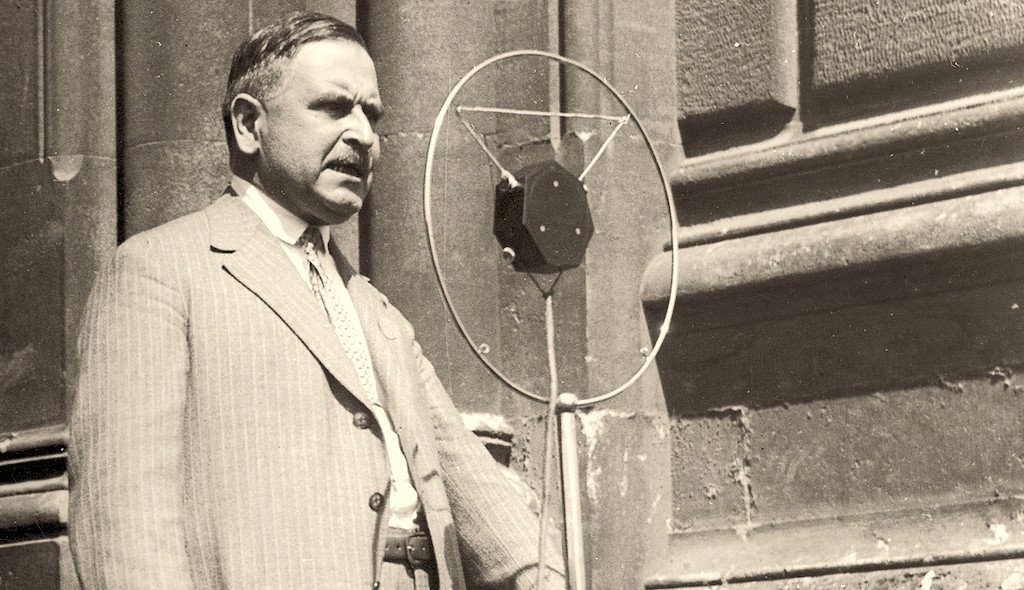
Ludwig Lore on the founding of the International Working Union of Socialist Parties, sometimes called the 2 1/2 or Vienna International, involving parties such as the German Independent Social Democrats and Britain’s Independent Labour Party with leading figures most closely associated with Austro-Marxism like Friedrich Adler and Otto Bauer. The grouping lasted only two years before merging with the rump Second (the Berne) International to form Labour and Socialist International in 1923.
‘The Resurrected Second International’ by Ludwig Lore from Workers Council. Vol. 1 No. 2. April 15, 1921.
The conference of the 2 1/2 International that was held in Vienna from the 25th to the 28th of February was met with open hostility by the supporters of the Third International everywhere. Their opposition was more than the prejudiced criticism of a political opponent. It was rooted in the conviction that this new International is only an endeavor to resuscitate the old Socialist International, under a new firm name. Certainly there is nothing that divides the leading spirits of the 21⁄2 from the old Second International, but their attitude on war policies. Beyond that they are heart and soul in accord. Friedrich Adler, the press agent of the Vienna Conference, expresses this quite openly in a letter written to Ramsay Macdonald, now secretary of the Second International.
“Circumstances have forced us in the last two years, in order to clarify our position upon political questions of immediate importance, to discuss frequently and at some length our differences with the Third International. Those points that separate us from the Second International have, meanwhile, been left practically without discussion, because they are concerned, in the main, with socialist policies during the war. A discussion of principles with the Second International will be, above all, a discussion of socialist action in times of war, of that position which we have become accustomed to call social patriotism.”
Friedrich Adler finds it unnecessary to discuss the policies of the Second after the war. He knows nothing of Noske’s massacres, he has forgotten Scheidemann’s coalition manoeuvres, he no longer remembers Thomas’ ministerialism, he recalls neither Branting’s short-lived ministerial honors nor Henderson’s or Clynes’ “strictly socialistic labor policies” that left the cart of the British Labor movement hopelessly stuck in the mud.
“If the Second International,” the letter goes on, “whose secretary you have become, to our great surprise, consisted only of persons of your calibre, all further discussion would be superfluous.” Somehow this assurance sounds strongly like the Anti-semite who had a habit of assuring every Jew with whom he came in contact, “Ah, dear Sir, if all Jews were like you, there would be no Anti-Semites.” But Adler finds it necessary to prove beyond all doubt, that only mere formalities divide himself and his colleagues of the 2 1/2 from Ramsay Macdonald and the Second. For this reason he defines his position toward the Russian revolution so as to leave no doubt as to where he stands.
“It was this anarchy in the International that gave Lenin the opportunity to throw the working-class, not only of Russia, but of the whole world, into one of the most dangerous experiments, without consulting the representatives of the class-conscious proletariat in other countries.” Thus the leading personality of the “new” International takes his stand definitely and aggressively against the Russian revolution. The presence and active participation of Martow and Abramowitz in the Conference and in the committees served only to underscore what was already obvious.
Nevertheless the creation of the 2 1/2 International, whatever may become of it, was inevitable. It gives expression to the natural after-war development of those proletarian parties which do not approve, on the one hand, of open coalition with the bourgeois government, and which, on the other, cannot be content with a negative position of the working-class parties in every country. The world war which ended not with a proletarian revolution but with a military victory of one of the two imperialistic groups, did not realize the cherished hopes of the “loyal” workers. They had believed what their labor union and party leaders had told them, had counted upon the gratitude of the bourgeoisie in return for their sacrifices and their sufferings, had hoped that now, when once the war was over an era of peace, brotherliness and democracy would set in, In the victorious nations not the proletarian revolution, but Wilson’s Fourteen Points became the supreme hope of the working-class, as the enthusiastic reception that Woodrow Wilson met at the hands of the masses in France, Great Britain and Italy plainly demonstrated. The awakening was as swift as it was brutal. The bourgeoisie recovered from the fright that followed the October revolutions. It had honestly feared that these demobilized hundreds of thousands of workers would call them to account. But the bourgeoisie makes concessions to the proletariat only when it feels its hands at its throats. And the workers never dreamed of doing any harm to their “allies and associates” in the great war for imperialism.
In Germany it soon felt so secure, that it deprived the Workmens’ and Soldiers’ Councils of all governmental functions. In England the bourgeoisie forgot that it had, at one time, almost guaranteed the nationalization of the mines. In France every thing that is reactionary united to take up the fight against Bolshevism. The Versailles Treaty showed, furthermore, how truthfully the Communists in all countries had spoken, when they maintained that there could be no peace–and certainly no just peace–so long as the bourgeoisie remained at the helm. Eastern Europe was driven into intervention after intervention in Soviet Russia, until its very foundations are tottering under the strain. The Central Powers were deprived of the possibility of industrial recuperation. The brief period of prosperity that followed the armistice, came to an abrupt close. It is becoming daily more obvious that the world cannot recover while one half of the world is condemned to industrial ruin. And in the ears of the working-class there rings unceasingly the grim and sinister question: “Who is to pay?”
These are the influences that are steadily at work radicalizing the masses. The proletariat is recognizing the impotence of the capitalist world, the hopelessness of reestablishing even capitalistic conditions as they were before the war. In Great Britain a strong revolutionary tendency is making itself distinctly felt in the labor movement, demanding, insisting upon the nationalization of the railways and the mines. In France organized labor is turning more and more openly against the bourgeois democracy. Even in the United States, we have lived to see large portions of the A. F. of L. organization in rebellion against the dictatorship of Gompers.
This state of affairs offers a rich field of activity for a movement that stands midway between the radical and the openly opportunistic wing, that stands, in theory, upon the principles of Marxism without carrying out these principles to their practical ultimate application. Germany had given an example of this triple division even before the war, for the German movement was even then sharply divided, in spirit if not in fact, the Center about Kautsky holding out against the Bernstein opportunists on the Right and against the radical wing, under the leadership of Luxemburg, Zetkin, Mehring and Liebknecht on the question of mass-action and imperialism on the Left. During the war, this center had stood, either openly with reformism, or had contented itself with passively protesting against the social patriotic policies of the Right, the same straddling policy that they are continuing to the present day, unable to become the bearers of a radical labor movement on the one hand, and unwilling to oppose it openly on the other. They met this difficult situation by winning the support of the masses with a pretense of revolutionary thought on the one hand and by holding back the masses from revolutionary action on the other.
Along these lines of thought the Vienna conference did its work. It adopted sounding revolutionary phrases, its attacks however were directed not against the Second, but against the Third International. Friedrich Adler opened the Conference by calling upon all delegates to forgive each other their war-sins and to think only of the present, that the Second International is dead, but that it is unseemly to speak of it as the Third International has done. Of “Moscow” he spoke in a different tone. Moscow seeks to divide the proletariat, Vienna will unite it. In closing he sang the praises of the Amsterdam Labor Union International, “which alone holds the power to unite the workers of the whole world.”
The conviction that there could be no understanding between Vienna and the Third International was the Leitmotiv of every speech that was delivered. Surely there was little need of these protestations. Much more to the point would have been some differentiation between the Second and Vienna. Nothing of the sort was so much as attempted, probably because there is no difference that would go beneath the surface. Indeed a resolution was unanimously adopted that says: “The International Socialist Conference in Vienna calls upon all workers to unify the socialist movement in the various countries. It is determined to work for this unification to the utmost upon the basis of the motions here adopted, and calls upon the Socialists of all nations to support its endeavors.” In other words, a unification from Noske to Bauer, of course on the above-named basis. But since this “basis” provides for intimate cooperation between Bauer and the raging social-patriots Renaudel, Scheidemann, Vandervelde,Branting, and all the other fossils of a long forgotten period in the international movement with “radicals” like Ledebour, Longuet and Nobs will find in this new international a harmonious meeting place.
True, the report of the Committee on Ways and Methods of Organization of the Class Struggle stressed the necessity of a proletarian dictatorship after the political supremacy of the proletariat has been established. According to its report of the democratic power of the state, it recognized the existence of a wide-spread desire for a united instrument of the entire class-conscious proletariat.
The value that such platonic declarations have may be judged from the fact that even Renaudel, the most determined opponent of proletarian dictatorship as well as the representatives of the Polish Socialist Party which fully supported its government in the war with Soviet Russia, found it possible to vote without a visible qualm for this ambiguous flourish.
Equally amusing was the position taken by the conference to that central problem in West-European proletarian politics, the Peace Conference, and the reparation crisis. Nothing could have shown more plainly, that the unity of their capitalist classes is the first premise of the unity of the parties that comprise this new International. Its great aim is to be not the revolutionary education of the masses in times of national capitalist conflicts, but the reconciliation–upon a purely pacifistic program–of the capitalist enemies with each other.
The Leitmotiv of the resolutions that were adopted on the question of reparations might well be expressed by the words “Capitalists of all countries, unite.” After acknowledging the declarations adopted by the various menshevist parties, and concurring in the proposal of the French Party that a conference of the menshevist parties of Germany, France and England–an exact replica of the notorious London Conference of the great powers be called, the resolution goes on as follows: “The conference regards the internationalization of all war debts and the rendering of unlimited assistance by those countries which suffered least under the devastations of the world war to those which bore the brunt of destruction, in the building up of their productive and consumptive forces as the supreme necessity in the regulation of the problem of reparations. The conference maintains that the capitalist governments are incapable of solving the problems opened up by the war. It warns the working-class in all countries to guard against the methods employed by their governments and their chauvinistic press to carry on their dangerous and insidious propaganda among the masses.”
That these gentlemen also declared for disarmament goes without saying. They all but indorsed the League of Nations, and even that distinction has been achieved by some of its individual participants in the past. Indeed, the whole conference fairly oozed pacifistic sentimentality. Under these circumstances, to be sure, the fight against the Treaty of Versailles became little more than a lame gesture. The Powers behind this treaty have only one foe whom they need fear: Moscow and the Third International. By the same token the Vienna Conference directs its venom against the Third as its own most dangerous opponent. It refuses the unification of all revolutionary elements and proclaims, instead, the unification of capitalism by pacifistic phrases.
Unquestionably the time is not far distant when this conglomeration of pacifistic phrasemongers will unite with its half brother, the Second International, the latter supplying the masses, the former the bait in the shape of revolutionary slogans. For it is a fact that in Germany, Holland, the Scandinavian countries, in Great Britain and in practically every other nation in Europe the big majority of the socialistically inclined workers stand behind their reformistic social patriots.
And in the struggle that will follow, the working-class will be forced by the ruthless logic of events, to recognize that their leaders are, intentionally or unintentionally, the tools of the capitalist class against the revolutionary forces represented by the Communist International.
PDF of full issue: https://www.marxists.org/history/usa/pubs/workers-council/02-workers-council-1921.pdf

