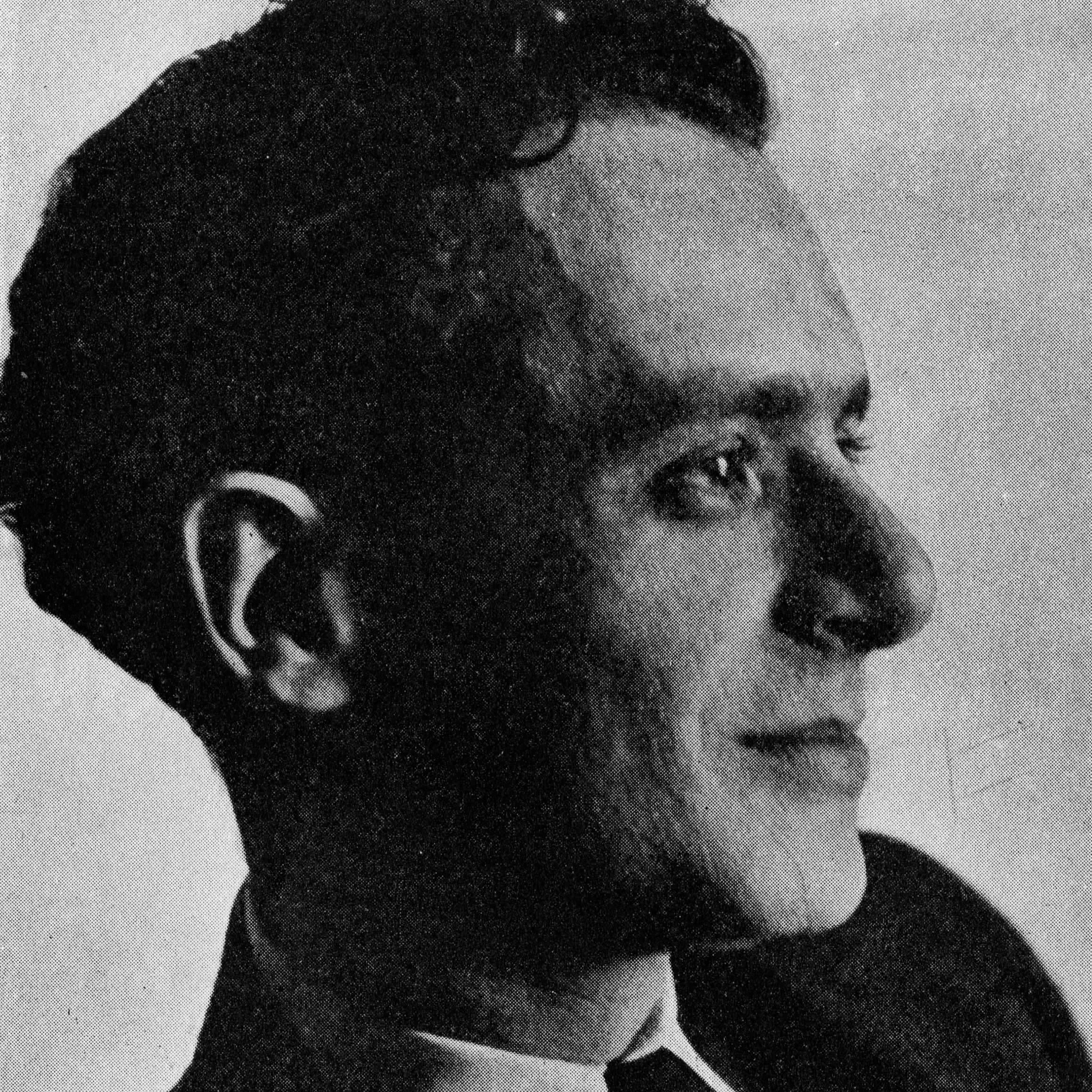
Harry Alan Potamkin, the Philadelphia-born pioneering Marxist film critic, founder of the John Reed Club and the Film and Photo League, died far too young at 33 on July 19, 1933. Joseph Freeman looks at his work.
‘The Poetry and Critical Work of Harry Alan Potamkin’ by Joseph Freeman from The Daily Worker. Vol. 10 No. 175. July 22, 1933.
To those who knew Harry Alan Potamkin, his death comes as a profound shock. There was in him a rare gift for friendship which inspired affection as his talents inspired respect. No one who talked with him or worked with him could fail to be captured by his gaiety, his wit, his deep conviction and his energy, all of which he devoted without reserve to the cause of the proletarian revolution.
These personal qualities graced a capacity for creative work that was equally rare. It is impossible in a brief memoir, hastily written for the daily press, to survey work which was as prolific as it was versatile. Such a survey ought to be made, and soon; for Harry Alan Potamkin’s work, particularly in cinema criticism, was an important contribution to revolutionary literature. Here one can only state a few facts, in the hope that those who are in a position to do so may be stimulated to collect and publish the best of Comrade Potamkin’s essays.
***
AMONG Comrade Potamkin’s talents was a marked gift for verse. His poetry grew steadily in precision of form and in revolutionary content. A poem in the New Masses of May, 1932, on the Haymarket martyrs ends:
“Masters of provocation, Pinkertons of prey,
O Boards of Trade men, merchant princes.
Railroad kings and factory lords,
Balance your budgets and take your rewards,
These are the days of liquidation!”
The sense of the continuity of the revolutionary tradition also fills his poem on the Paris Commune which appeared in the New Masses of April, 1932, ending:
“This is our heritage, our consanguinity,
The one blood of the one class
The world has long awaited
To catapult its law against disaster,
To load the guns against the master rogues,
To load the guns against the loaded dice,
The stratagems of delusion,
The virtuosities of greed.
Ours is the blood of the one assurance;
ALL POWER TO THE SOVIETS!”
The last line of this poem is an example of Comrade Potamkin’s belief in the poetic effectiveness of slogans incorporated in verse. He wrote a number of moving poems based on letters sent by workers to the Daily Worker, in which he combined their phrases with his own.
***
THE revolutionary feeling which animated his poetry, gave edge to his criticism of the movies. These were not mere intellectual exercises; they revealed a hatred for the capitalist system, a devotion to the struggle of the working class for its emancipation. The movie was to Comrade Potamkin not merely a form of entertainment, but a social instrument which was used by the capitalist class in the interests of reaction, and could be used by the working class (it was so being used in the Soviet Union) as an instrument of social advance. From this revolutionary viewpoint, Comrade Potamkin wrote about the film with deep insight and with biting irony.
Reviewing John Drinkwater’s life of Carl Laemmle in the New Masses of July, 1931, Comrade Potamkin observed: “Racketeering and movie are inseparable in the present pattern; and the first whisper in the movie business was racket. Its accents are thunderous now.”
His review of current films in the New Masses of May, 1931, was studded with pointed epigrams: “Redemption is the keynote of every American film…The thesis of the levelling and collaboration of the classes is recurrent in the movie…The movie is a ritual that purges everything it touches–purges everything of veracity and sense…it is, after all, the response and agent of the class that produces it.
***
THE use of the film by the capitalist for fascist propaganda is exposed in the last review which Comrade Potamkin wrote for the New Masses. Discussing “Gabriel Over the White House” in the May issue of this year, he pointed out that the film sanctifies the fascist dictator while providing the loophole of fiction.
“The American audience,” the review continues, “already duped by the glibbest of campaigns, now has an active image of the ‘benevolent dictator’ and the ‘new deal’ which takes on daily the physiognomy of F.D. Roosevelt. Meanwhile the movie campaign is enlarged with pictures glorifying Mussolini. At the showing of one of these, the supporting RKO newsreel started with a display of aviation in support of F.D.’s aero program, followed by a Japanese nationalist demonstration against the League, concluding with a Hitler parade, approved by the announcer as stemming the ‘Red Menace.’ RKO is the component of RCA, whose head is Major General Harboard, America’s leading Nazi. In French venal slang “nazi” is syphilis: a correct picture of the virulent stage of capitalism.”
In contrast to the capitalist film, Comrade Potamkin pointed to the Soviet film. He took the revolutionary movement and the Soviet film too seriously to be an uncritical enthusiast.
“I do not think,” he wrote in 1929, “the Russian film has as yet found a method that suits its profound material.” Eisenstein and Pudovkin agreed. Comrade Potamkin, following the development of the Soviet film carefully, was able to report its progress by 1932. He saw it approaching a point where it was coordinating the experiences of the individual worker with mass events.
***
HE understood, too, the reasons for the progress of the Soviet film. “Creation and criticism,” he pointed out, “are in constant touch with one another in Soviet Russia, not solely the specialized criticism of the professional, but also the criticism of the alert worker. This fluidity of relationship is the chief guarantee of the artistic as well as political life of the U.S.S.R.”
Comrade Potamkin carried his ideas on the film into the daily struggle and advocated in the Film and Photo League, in which he was a leading spirit, “methods of direct action, boycott, picketing against anti-working class, anti-Soviet films;” and urged “the education of the workers and others in the part the movie plays as a weapon of reaction in the U.S.A., and as an instrument for social purposes in the U.S.S.R.”
His great services to the revolutionary film are described in the following resolution adopted by the Film, and Photo League:
“The Workers Film and Photo League records the death of Comrade Harry Alan Potamkin, revolutionary film critic and a member of the National Committee of our organization, as a severe blow to the struggle against the reactionary, openly anti-working class film in America. Comrade Potamkin was beyond any question the best equipped among us in this important struggle, having been a close student of the cinema for over a decade.
“Comrade Potamkin, even long before he joined the ranks of the revolutionary workers, instinctively recognized the complete bankruptcy of the bourgeois film as an art, which he later understood to be an integral part of the decay of bourgeois culture as a whole. No other single writer has done as much as he to force the recognition of the high artistic merits of the Soviet cinema and its personalities by the bourgeois intelligentsia. Comrade Potamkin was recognized even by “respectable” bourgeois film circles as an individual whose knowledge of the cinema ranked infinitely higher than that of their own best critics.
“Comrade Potamkin’s death must be the signal for the redoubling of our efforts to build a powerful Workers Film and Photo League in America. His unreserved devotion to our cause, which undoubtedly proved to be a contributory factor in his premature death, must serve as an example to thousands of others who must fill the place he occupied in our ranks.”
To this must be added the following statement by the National Board of Review:
“To the National Board of Review of Motion Pictures, Harry Potamkin was one of its best loved and most admired co-workers. For years he had given immeasurable help in the slow task of developing public appreciation of what is worth while and important in motion pictures. No American critic–no critic known to American readers–was his equal in technical knowledge of films, in sensitiveness to the fine qualities of cinematic art or in a profound feeling for the social significance of the motion picture, and he had the literary power to express what he knew and felt with an analytical vigor and eloquence that put him far in the lead in film criticism. Moreover, since with all his artistic gifts and appreciation, he cared more for human beings than he did for art, he stood almost alone among writers in his passionate insistence that the great force of the motion picture should be used in the broadening and strengthening of human understanding, and in helping build a civilization in which the lives of men and women and children would be worth living. As a man and as a writer we can look far and near and see no one to take his place.”
The Daily Worker began in 1924 and was published in New York City by the Communist Party US and its predecessor organizations. Among the most long-lasting and important left publications in US history, it had a circulation of 35,000 at its peak. The Daily Worker came from The Ohio Socialist, published by the Left Wing-dominated Socialist Party of Ohio in Cleveland from 1917 to November 1919, when it became became The Toiler, paper of the Communist Labor Party. In December 1921 the above-ground Workers Party of America merged the Toiler with the paper Workers Council to found The Worker, which became The Daily Worker beginning January 13, 1924.
Access to PDF of full issue: https://www.marxists.org/history/usa/pubs/dailyworker/1933/v10-n175-NY-jul-22-1933-DW-LOC.pdf

