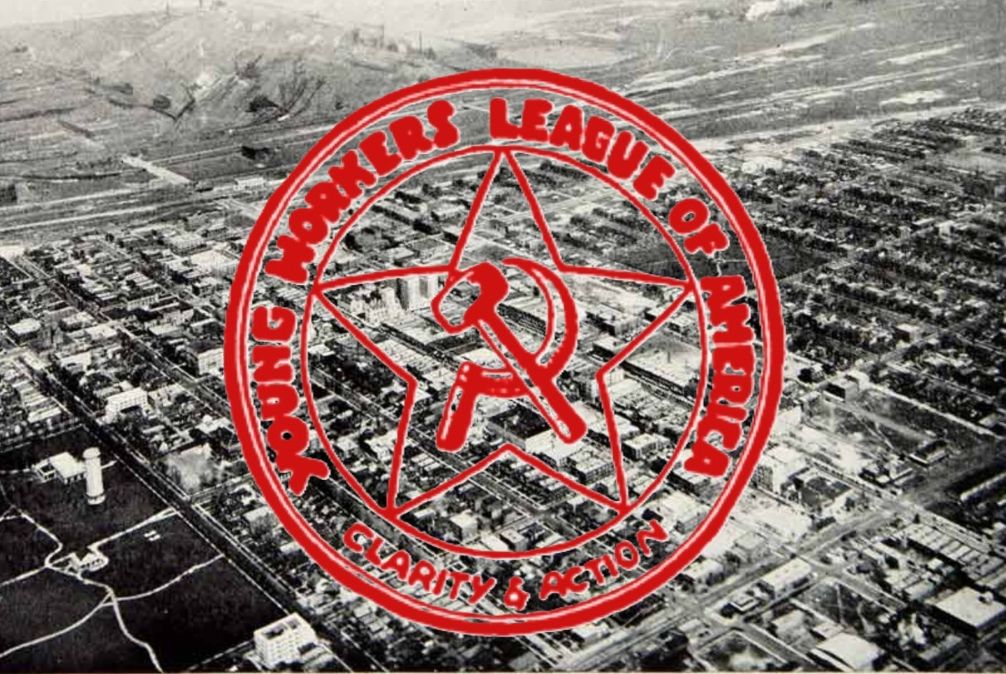
An early Young Workers League branch in Gary, Indiana describes the specific challenges they face in organizing.
‘Our Problems–and Success’ from Young Worker. Vol. 2 No. 2. February, 1923.
IF there is any town in America that exemplifies the oppression and degradation of the capitalist system, that town is Gary, Ind. If any town has ever demonstrated the necessity of organizing and educating the working class youth of America, that town is Gary, Ind. And if anybody doubts the importance of the Young Workers League, he need but visit Gary, Ind., and he’ll no longer doubt.
The United States Steel Corporation own the town of Gary. It owns the mills, it owns the street cars, it owns the land,–and it owns the people. It tells the people when to sleep, when to eat, how much to eat what to wear, where to move,—in short, it tells the people just how to live. And all this it does without even consulting the will of the people, and by the simple expedient of regulating the hours and controlling the wages. For instance, it has seen fit to divide up the working day into two shifts of ten hours and fourteen hours. The men put in 10 hours of daywork one week and then 14 hours of night-work the next. And occasionally, for variety’s sake, they put in a straight stretch of 24 hours. It can readily be imagined how this irregularity of hours plays havoc with the health of the workers. Also, when the corporation announces a cut of two or three cents an hour in pay it means less to eat; it means shabbier clothes and poorer lodgings. With the average rate of pay from 20 to 40 cents an hour, it requires the efforts of the entire family to earn a living. The wages of the father alone, are woefully insufficient. And so the boys and girls are forced at the earliest possible time to leave school and go to work.
With what consequences! The excessive heat, the hard work, the irregular hours stunts their growth, both mental and physical. They age prematurely: lose all healthy interests in life and fall a prey to immorality and vice.
The girls and women especially, are terribly exploited. The Gary Screw and Bolt Works, which employs a large force of female help pays 21 cents an hour! The work, in addition, is dirty, tiresome and unhealthy. A certain minimum amount of work is required from every girl. The place is a regular slave shop, and the pace is so terrific, that new help is constantly being advertised for.
It is evident from the above that the Gary Branch has a fertile field for its activities. It would seem to be a comparatively simple task to enroll a large membership from amongst these discontented young workers and to build up a powerful branch. But there are certain serious obstacles to the realization of such prospects. First and foremost, there are the effects of their environment to combat. They are discontented, that is true; but their discontent takes expression either in a craving for fun and relaxation, or else in a dull apathy which is almost as bad. Secondly, because of their squalid existence they are averse to studying.
These were the problems that confronted us six months ago. We numbered at that time about ten members, but we were anxious to work and get things done. We realized that good results could be achieved providing the right tactics were pursued. First, steps would have to be taken to interest the young workers in our organization. And second, an educational program would have to be worked out, which, while embodying all of our ideas, still did not go over the heads of our new members.
These conditions we have gradually attained. During the last few months, parties and dances have been run, and have been notably successful both in the way of obtaining new members and bolstering our treasury. All over town amongst the young workers there is circulating the news of a club whose members have a fine time. Of course the elements thus attracted are not what could be desired. They are loathe to study, and even though they are dissatisfied with life, they are not radical or class-conscious.
This is by far the most difficult problem to be solved: how to present our ideas in such a way that they will not seem scholastic or theoretical, but will appeal to them as relating to their every-day life. And we have good reason to believe that we are doing this and that our educational work is taking effect. Every Sunday for an hour or more we have discussions and lectures. Common sense, practical aspects of the class struggle (which all are more or less familiar with) are dealt with, and their historical significance pointed out. Every one present is urged, and called upon to participate actively in the discussions. Questions are put to the reticent members, who gradually begin to take pride in being able to answer. There is nothing bookish or elevated about the proceedings. The young people begin to realize that it is nothing but a combination of common sense and facts!
We have purchased pamphlets and books and established a library for the members’ use. Simple individual assignments are weekly made and reported upon. Fiction of a propaganda nature is being utilized.
All the members have come to look forward to our meetings as something to be enjoyed. Our average attendance is 95 per cent perfect. They come (as yet) not out of idealistic motives, but because they would rather be there than anywhere else. And therein lies our achievement and success! We have made the Young Workers League an attraction, without deviating in the least from our principles.
We believe that the Young Workers League cannot obtain members by propaganda alone. The young workers are after recreation, and the League in order to interest them, must provide it. If a branch is possessed of a good nucleus of devoted members capable of maintaining control, then there should be no hesitancy about attracting new members by socials, parties, hikes, or any other means. If the Christian Associations, the Church Leagues, and the Scouts can attract the young by offering recreation, then we should be able to do the same. And if these capitalist organizations can miseducate the young, we with truth, and economic interests on our side, should be able to bring them to a realization of their true position in society.
We are convinced, from our own experiences, that by pursuing such tactics, the Y.W.L. can extend its influence and spread its ideals. It is up to the live wires to get things going, and then to maintain control and do the “steering.” They’ll find it tough sledding at first but it’s productive of results, and that’s the main thing.
Now as to our plans for the future. We have made a pretty good start, that’s true, but it’s only a “start.” We have enrolled quite a few new members, but there are a lot more where they came from. We have made a success of our educational work, but we still have a lot to learn. And finally, we have done something to combat the slavery and oppression of Garyism but we still have a great deal to do.
The Young Worker was produced by the Young Workers League of America beginning in 1922. The name of the Workers Party youth league followed the name of the adult party, changing to the Young Workers (Communist) League when the Workers Party became the Workers (Communist) Party in 1926. The journal was published monthly in Chicago and continued until 1927. Editors included Oliver Carlson, Martin Abern, Max Schachtman, Nat Kaplan, and Harry Gannes.
PDF of full issue: https://www.marxists.org/history/usa/pubs/youngworker/v2n2-feb-1923-yw.pdf

