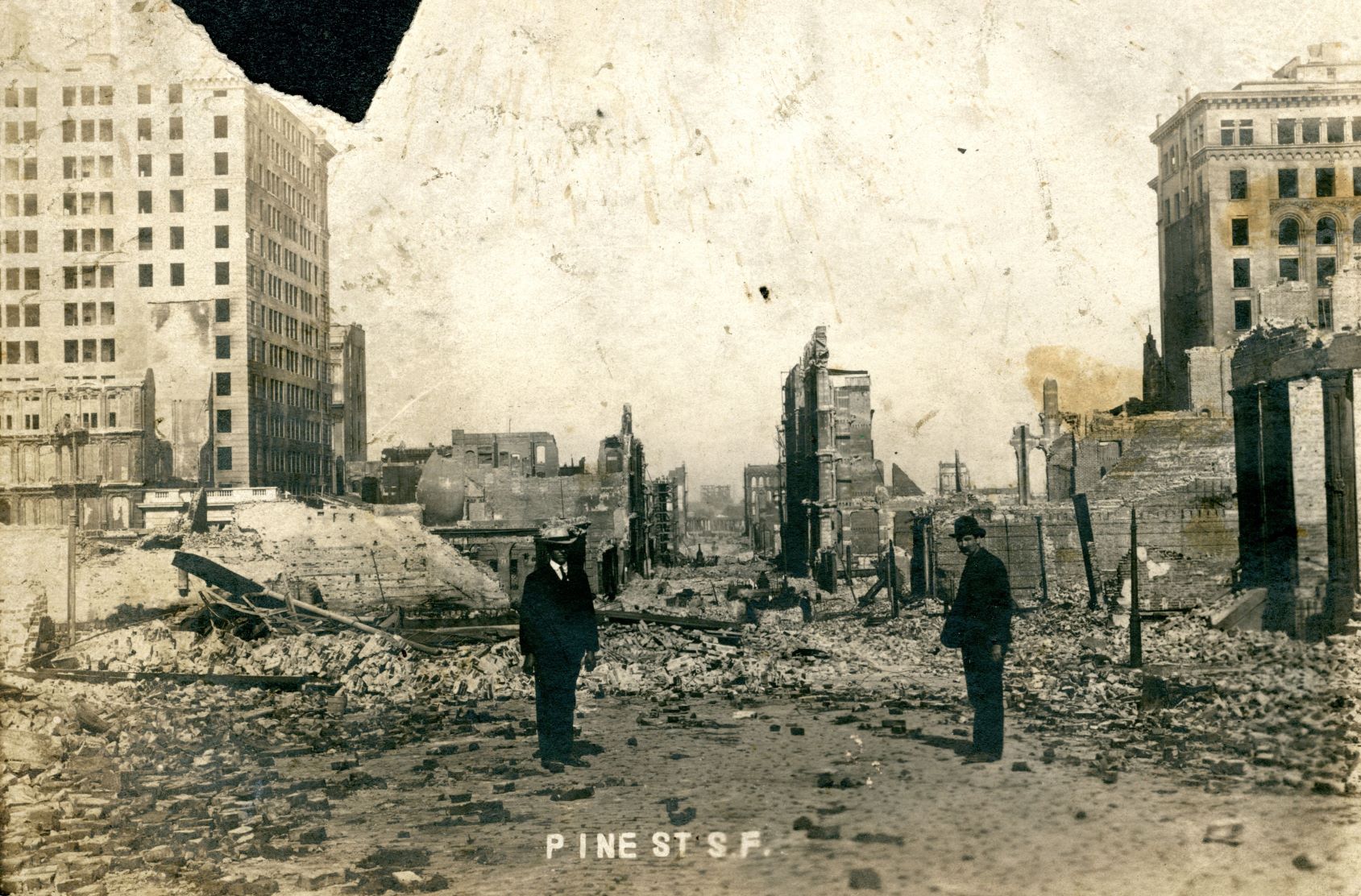
A fine survey from Sandgren of the conditions of labor in the immediate aftermath of San Francisco’s devastating 1906 earthquake.
‘The Labor Situation in San Francisco’ from The Weekly People. Vol. 16 No. 8. May 19, 1906.
The number of actual wage workers in San Francisco at the present time, not counting their families, may be estimated at about 75,000. The number of rations distributed on the last day for which a report is at hand is stated to be “sufficient to feed 260,000 people.”
Of these 75,000 only about one-third can find employment. P.H. McCarthy, president of the Building Trades Council, estimates that out of 21,000 building trades employes registered about 10,000 are working. This may not have been intended as a correct estimate, but under all circumstances it is manifestly exaggerated. There can hardly be more than 5,000 of them at work at the very best. The Union Iron Works and Risdon Iron Works employ between two and three thousand men, and the other few remaining works perhaps a thousand altogether.
The Railway Companies are no doubt working with a full force, but the street car lines can use only a small part of their men. Two cable road companies are practically wiped out, and the United railroads are not yet operating 10 per cent of their cars. With the exception of the linemen and electricians the workers in most of their departments are idle.
The Water, Gas, and Telephone companies talk a great deal about being busy, but do not employ all their regular men.
Stevedores are apparently not overcrowded with chances for work. The writer waited patiently in one of their lines for an hour one day. There were about fifty men in line. One was picked out. Some stevedores and riggers are engaged in tearing down walls with the help of donkey engines.
Safe experts have some work on hand for a while, opening safes among the ruins. But there seems to be one of them for every two safes.
A few hundred men are engaged in tearing down walls with picks and cleaning out burned buildings. Others are cleaning and piling brick. The pay is $1.75 to $2. The work is extremely dangerous and several men have already been severely injured. There are minor earthquakes almost daily sometimes heavy enough to make the brick walls crumble. Many who have tried the work have abandoned it for this reason. In addition to the work being dangerous and the pay small, the pay is uncertain. This is the way it works. Able bodied men are either shamed out of the breadline by newspaper abuse or are refused rations. They are told “Loafers must go to work or leave.” This is vicious sophistry. It is impossible to go to work and remain in the breadline, first because you have to stand in line for hours in order to receive your pittance, secondly because as soon as you go to work you are told “Go buy your own food.” When you have worked for a few days and want your money you are told that you have to wait, because “there is no money yet for a while.” So there you are in the vicious chain. The Board of Public Works has on their lists 3,000 applications for work, but instead of employing more men, the men are quitting them by the hundreds. The Board owes now $35,000 for common labor, and the men refuse to work because their wages are not forthcoming. It is simply impossible for them to work without pay. Men working along the wharf, and even on the U.S. transport dock, are referred to the Quartermaster’s department for their wages, and there they are put off curtly. with the explanation that they will have to wait. How is a man going to wait when he has not got a cent and is driven out of the relief line because he has the misfortune to be able bodied? The Labor Commissioner and the Red Cross Chief have established a free employment agency, and they announce that in the couple of days they have been at work they have 1,200 names of men looking for work. In the meantime the papers, in column after column, are showering abuse upon the luckless workers who have lost everything, stating: “Idlers must not take criminal advantage of charity,” “there is no room for idlers,” “there is work for every man in San Francisco who wants to work.” “There are jobs all about us in full view! Ask for them. Keep out of the relief lines. Don’t hang about the offices of contractors. Let your own individual manhood assert itself. All work is honorable. Do that which you can find to do.” In other words: “If you cannot find an employer don’t let that worry you. Keep out of the breadline and start in pitching bricks on your own hook, for your health, in order to assert your manhood. Never mind the pay. Work is honorable.”
If you object and say that the capitalist owns every inch of land in San Francisco, directly or indirectly, and also the tools with which to work, and that you are apt to be shot as a looter if you begin to assert your manhood by stirring in the ruins without permission, they answer you that such vicious reasoning is due to “this cowardly socialistic propaganda which teaches that individual effort is useless.” Thus, after refusing to feed us unless we work, they refuse to feed us because we work; while calling us loafers and idlers they fail to tell us where the work is to be had; when they do “give us work,” they promise to pay us in the sweet by and by. In the meantime we are held up to the community and the country as hoboes, scamps, rascals, worthless and vicious. Verily, verily, our lot is a hard one.
It is contemplated to discharge or give “leave of absence” without pay to one half of the city employes. It goes without saying that nobody will be laid off who can assist in the re-election of Schmitz and his gang. It will be the clerical force and others who do some useful works, thus adding to the army of unemployed.
The school teachers have been informed that their salaries can not be paid now. They will have to wait until July 1st.
Sacrifices are imposed upon those who live from hand to mouth, to whom the disaster was a “damnum emergens,” a direct and complete loss. But it is not known that sacrifices have been demanded from the millionaires to whom the disaster was only a “lucrum cessans,” slight interruption in the flow of profits. On the contrary, every social agency private and public, is put in motion to restore that flow of profits.
The constructive activity in the city is at present limited to the erection of temporary one-story wooden structures, which may be put up by anybody without permit. The building of permanent structures may not begin to any great extent for a year. The President of the Building Trades Council declares that after the completion of the temporary shacks and repairing damaged dwellings there will be a lull in the building line for lack of materials. This is probably correct. As most buildings in the business section will hereafter be built of stone and steel, there will be an unprecedented demand for structural steel. The papers declare that the steel trust is unable to give its attention to San Francisco orders during this year, and that the steel will have to be imported from Europe and brought round the Horn. When building commences in earnest, in a year or two, there will, no doubt be considerable work for structural iron-workers and all other building trades At present and for a long time there is work only for a few carpenters, plumbers, [word missing].
A great many buildings will have to torn down, and practically all the rest will have to be repaired.
The railroads have laid tracks on some of the principal streets, and soon locomotives will be seen on Market street polling away the debris to the dumping grounds
Expressmen have put some rickety chairs in their wagons and are carrying passengers between the Park and the Ferry for 25 cents.
Bakers are busy making bread, because housewives can do very little baking not being allowed to have any fires.
The above comprises practically all the work in San Francisco at present. I have only forgotten the signpainters. They have been busy painting signs, and every one of these reads “Temporary Office of–“
It would be next to impossible to enumerate what kinds of work can not be had. Suffice it to say that all kinds of manufacturing is practically wiped out. Thousands of women and children who worked for $1.50 to $5 a week will find nothing to do for a long time. The male factory slaves will have to join the long line which waits for a chance to grab a pick or shovel handle. There is very little use for clerks, bookkeepers, stenographers, hardly any for commission man, watchmen, elevator men, porters and packers, none for engineers and firemen.
Barbers have little to do, because people are growing whiskers. Brewers and others are on the waterwagon and in the breadline, because the saloons are closed tight. Laundry workers are idle because people cannot afford to change as often as they used to. Tailors will have to leave town while we are wearing out the rags we saved and those distributed by the relief committee. Cigarmakers will have to wait until we can afford to smoke cigars. Waiters and cooks will starve where everybody cooks his own meals and waits on himself.
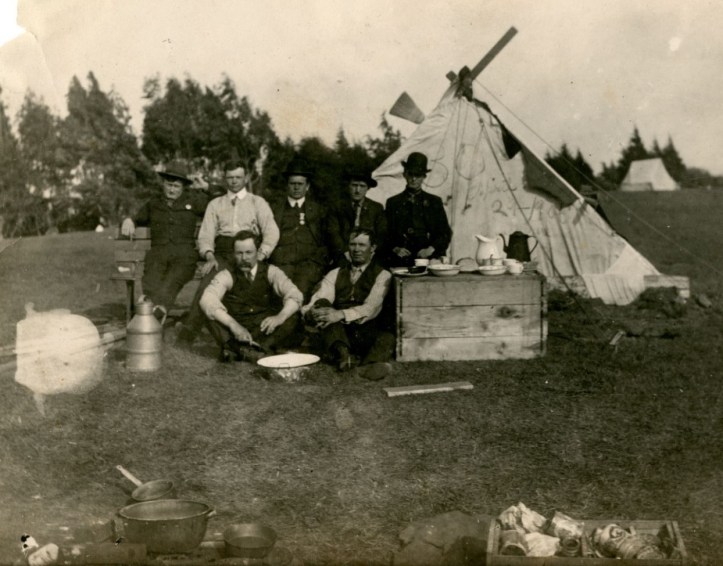
All those engaged in the production of luxuries will have to find the addresses of their patrons. They are all leaving town for some softer place, where a “clawhammer,” a hundred dollar hat, and an opera cloak would not come near creating a riot. And so on ad infinitum,
A workingman with a particle of sense stays away from San Francisco for the next three years, and if he has any friends here for whom he can find work in some other place, he will please send for them immediately, fare prepaid.
The only workers strained to the limit of endurance are the cobblers who burn the midnight oil repairing the sandals you wear going back and forth to the breadline, or while you are stumbling among the bricks, vainly looking for a master, or while trying to collect your wages for work already done.
In the midst of these conditions McCarthy and Tveitmore, president and secretary, respectively, of the Building Trades Council, have issued a proclamation suspending all union rules as to pay, hours, overtime and other conditions (later limited to relief work) and an order restraining the unions from raising the wage scale–IN THE NAME OF HUMANITY!
This is enough to make the gods smile. This proclamation and this order is intended to convey the impression that these men have the situation well in hand and can determine wages at will, when they, in fact, could plainly see that it would be impossible for them to enforce union rules and to prevent wages from falling. With ten men looking for one job, all penniless at that, and under these extraordinary conditions, the job monopoly is temporarily broken. Few will be found willing to pay from fifty to one dollar a month in dues and from twenty to one hundred dollars initiation fee for the privilege of carrying a card in a union whose rules are suspended and which hides its inability to maintain wages under a bluff injunction against demanding a raise of wages. The good union men are now about to get a dese of their own medicine. Having stupidly and selfishly sacrificed the welfare of the working class as a whole for the sake of a job monopoly for a few, they are now on a level with the rest, helplessly struggling for a chance to sell their labor power for what it will fetch according to supply and demand.
However, such proclamations will serve to impress the rank and file with the importance of their leaders, until the bubble bursts. But it will not bluff the master class. With ill-concealed glee the “Oakland Herald” exclaims, apropos the first of May disturbances in Paris, France: “What Paris now needs is an earthquake to settle their labor troubles.” The masters know that just now McCarthy and Tveitmore are shepherds without a flock.
And it is IN THE NAME OF HUMANITY that wages shall be kept down, and hours and overtime shall be unrestricted! I hope the good union men will appreciate that.
To an unsophisticated mind like the writer’s, it would seem that, now, if ever, it would be decidedly proper to appeal, instead, in the name of humanity, to the capitalist class, to grant increased wages and lenient conditions to the sorely afflicted toilers who lost everything, whose wives and children are in the reconcentrado camps and have to stand for hours in the breadline, to receive the pittance wherewith to keep them alive, who have only some paltry rags wherewith to shield their nakedness. Now, if ever, humanity would dictate, that higher wages be paid, in order to enable the poverty-stricken workers to recuperate and re-establish, if possible, their shattered semblance of a home. But, no. Charity is not asked of the rich for the people. It is asked OF the poor FOR the few multimillionaires who will own “The New and Greater San Francisco.”
Part of the capitalist vampire brood was on the 18th and 19th of April rudely torn from the workers’ back and, so to speak, the tubes through which they absorbed the workers’ life-blood were snapped for a moment. Some of them lost their hold forever, there and then. They were the remnants of a dying middle class or those that were sparring for elbow room with the bulkier parasites on the worker’s back. Others are still wriggling and making desperate attempts to regain their position. But the larger parasites whose tubes for absorption of life-blood extend over the whole land were not much worried. They could crawl back into the worker’s back without aid into the saddle, and to better advantage than before. But here come the McCarthys and the Tveitmores and order their blind flock in the name of humanity” to lay supinely down on the ground, so that the fat parasites may, without trouble, roll into their positions, apply their fangs, and make up for what was lost, and add still more to their ill-gotten gain Will not even an earthquake and holocaust awaken snoring Labor? He who lives will see.
The San Francisco locals of the Industrial Workers of the World are alive, very much so, and in good working order. No earthquake can demolish an organization built upon the rock foundation of the class struggle. In the name of our class, and “in the much-abused name of humanity,” we shall carry on a ceaseless war upon all parasites and their tools, Heeding no obstacles, counting no reverses, we shall hold high aloft the banner of the revolutionary working class, so that when the “New and Greater San Francisco” becomes something else than capitalist hot air, the workers of this city and this nation shall own the homes on its beautiful hills, built earthquake-proof and fire-proof by our own hands, shall own the mills and factories, its vessels and railways. Then, and not before, will we forget.
April 18, 1906.
New York Labor News Company was the publishing house of the Socialist Labor Party and their paper The People. The People was the official paper of the Socialist Labor Party of America (SLP), established in New York City in 1891 as a weekly. The New York SLP, and The People, were dominated Daniel De Leon and his supporters, the dominant ideological leader of the SLP from the 1890s until the time of his death. The People became a daily in 1900. It’s first editor was the French socialist Lucien Sanial who was quickly replaced by De Leon who held the position until his death in 1914. Morris Hillquit and Henry Slobodin, future leaders of the Socialist Party of America were writers before their split from the SLP in 1899. For a while there were two SLPs and two Peoples, requiring a legal case to determine ownership. Eventual the anti-De Leonist produced what would become the New York Call and became the Social Democratic, later Socialist, Party. The De Leonist The People continued publishing until 2008.
PDF of full issue: https://www.marxists.org/history/usa/pubs/the-people-slp/060519-weeklypeople-v16n08.pdf

