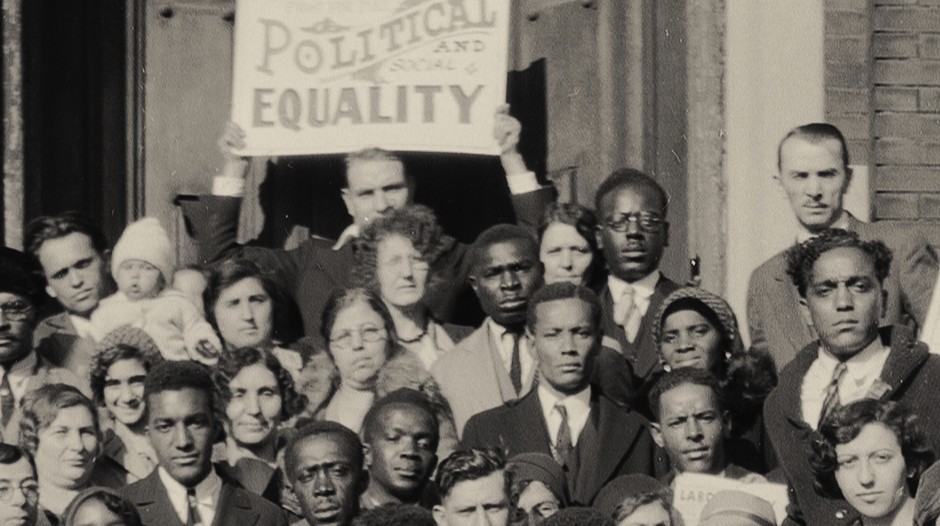
With millions of Black workers unable to vote due to a slew of legal and extralegal practices, Elizabeth Lawson says it is not contrary to the struggle for Black self-determination nor is it an illusion of legalism to fight for voting and all elementary democratic rights, indeed it “is one of the most important struggles that the Communist Party must lead.”
‘Guns and Rope for Negroes Who Fight for Their Right to Vote’ by Elizabeth Lawson from The Daily Worker. Vol. 9 Nos. 222 & 230. September 16 & 26, 1932.
4,000,000 Negroes Now Barred from the Polls
FIVE hundred Negro citizens of Shreveport, La., approached the doors of the Lakeside Auditorium not very many weeks ago, prepared to hold a meeting in which they would plan to cast their ballots. They were, In the overwhelmingly majority, followers of the Democratic Party.
These Negro citizens found the auditorium guarded like a fortress. Police, armed with rifles and machine guns, stood sentinel at every door. The meeting was broken up. Albert White, editor of the Shreveport Afro-American, who was to be a speaker at the meeting, was driven out of town and forced to remain in hiding for many weeks. Said the police:
“Before Negroes are allowed to vote, the streets of this city will run red with blood.”
“WE DON’T WANT YOU TO VOTE!”
At about the same time in Houston, Tex., C.N. Love, editor of the Houston Informer, who had also been active in the fight for the suffrage, awoke at midnight with the smell of fire in his nostrils. He found that slabs of wood saturated in oil had been pulled around and under the house, and lighted.
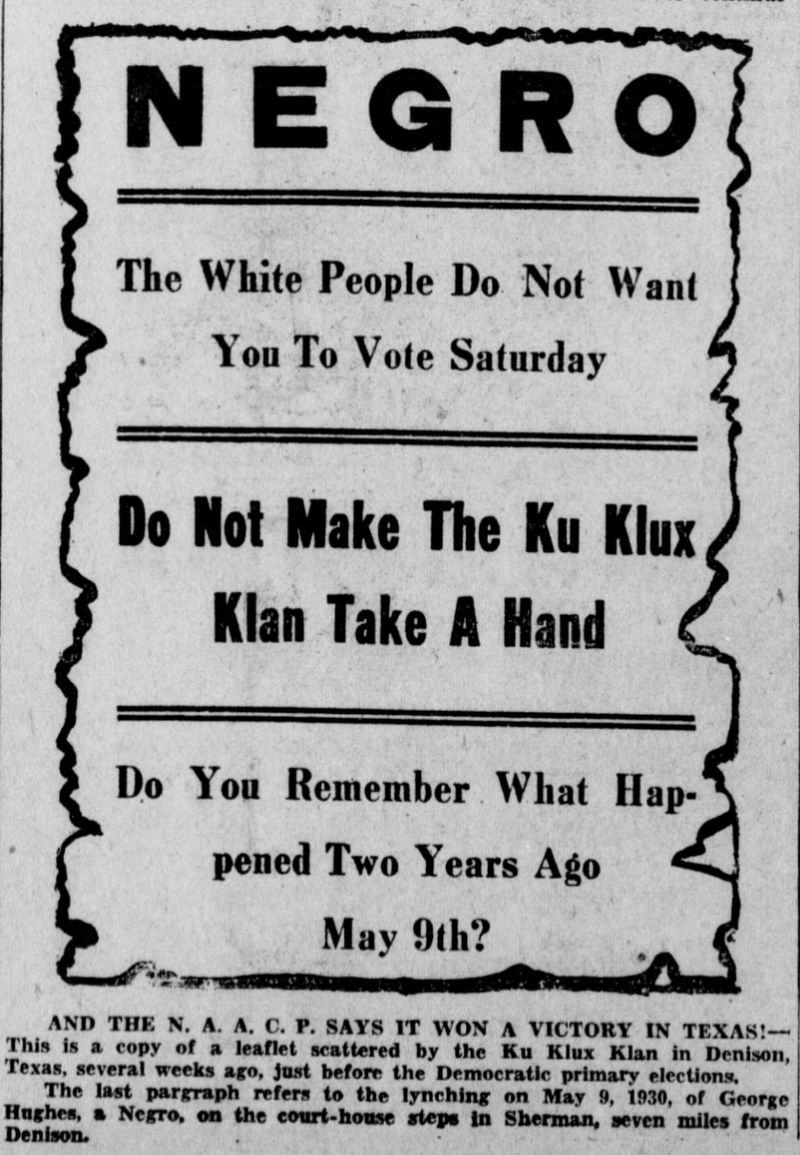
A short time later, at Denison, Texas, leaflets were distributed in the name of the Klan. They read:
“Negro: the white people do not want you to vote Saturday.
“Do not make the Ku Klux Klan take a hand.
“Do you remember what happened two years ago. May 9?” (This refers to the date when George Hughes, a Negro, was burned alive at Sherman.)
***
FOUR million Negro citizens of the United States are today deprived of that most elementary democratic right, the ballot. Almost two-thirds of the American-born Negroes 21 years of age and over, are disfranchised.
In ten states of the Union and the District of Columbia, the nation’s capital Negro citizens are today barred from the polls. The area of disfranchisement covers an immense territory of the South–including the states of North and South Carolina, Georgia, Florida, Alabama, Mississippi, Virginia, Arkansas, Louisiana and Texas. It is through these states that the Black Belt runs—that great territory in which the majority of the population is Negro.
SHARE CROPPERS, TENANTS RESISTING
This year, the struggle has sharpened. The increasing unity of Negro and white workers, the struggles in the South, the resistance of Negro croppers and tenants against robbery and peonage—these have struck terror into the hearts of the white robber landlords, bankers, bosses and state officials.
Their furious efforts to continue and extend the disfranchisement of Negroes is one of their ways of trying to fight back the wave of resistance.
***
BY what methods are the Negro citizens disfranchised?
First, high poll taxes, and the requirement that all personal taxes be paid before registration. In Georgia, all taxes legally required since 1877 must be paid six months before election. Picture the poverty-stricken Negro worker or tenant-farmer, deliberately kept on the verge of starvation, being able to meet these requirements.
Second, a high property qualification.
Third, a fake “educational test,” whose only purpose is the disfranchisement of Negroes. No Negro will ever be able to read to the “satisfaction” of the lily-white committeemen or poll-watchers of the South.
Fourth, an “understanding and character” test. But obviously, a Negro who wants to exercise his right of suffrage thereby becomes an “undesirable citizen” in the eyes of the poll-watchers.
Fifth, the famous “grandfather” clauses, which operate to permit persons to vote even when they are not able to meet other tests, or their ancestors, provided they voted in 1867. The lily-white purpose of this clause is obvious.
Sixth, sheer terror—the use of armed force, by police, sheriffs and militia; the threat of lynching; the stirring up by the white press and other boss agencies of crowds of white hoodlums against would-be Negro voters.
SOME RECENT EXAMPLES
Here are the some recent examples from the field of struggle for the suffrage;
North Carolina: Negroes of Raleigh who were unable to pronounce words in the state constitution or explain them to the “satisfaction” of the poll-watchers, were stricken from the lists. Two hundred and ten colored Democrats were deprived of their ballot in this way.
In other North Carolina localities, a last-minute challenge to Negro voters—so late that there was no time to answer it—resulted in the disqualification of over 1,400 Negroes. No whites were challenged.
Tennessee: The state convention of the Democratic Party did not pass a proffered resolution against the franchise for the Negroes,—because it “would be inefficious”—that is, it wouldn’t work.
But terror and intimidation were used to try to keep the Negroes from the polls. Former Governor Paterson, now once more a candidate for the governorship, said: “It is a travesty upon law and decency to allow the votes of these Negroes to determine the result of a Democratic primary.” Paterson is being urged in the campaign as “the white man’s choice.”
Texas: In Houston, election judges refusing to admit Negroes to the polls were backed up by the police. At Sherman, a flaming cross warned Negroes in the name of the Klan to keep away from the voting booths.
South Carolina: Democratic committeemen invoked the grandfather clause to strike from the lists the names of Negro citizens.
***
THUS by one method and another, millions of Negro citizens are deprived of one of their elementary democratic rights, as part and parcel of the struggle of the white bosses to keep them apart from the white workers, to maintain them as a specially exploited group.
White workers are also disfranchised—to a greater extent this year than ever before. The foreign-born, the soldiers and sailors, the youth, are disfranchised by law. An enormous percentage of the unemployed are disfranchised in fact, by residence qualifications, by poll taxes, by property-requirements, etc., etc.
It is necessary to fight against the disfranchisement of the workers, black and white. But we must never forget—while a certain percentage of white workers are deprived of the right to vote, the Negroes in the South are deprived of the ballot—almost to a man. This national aspect of the problem should never be lost from sight.
In another article to be published soon. I shall show how the Republican, Democratic and Socialist parties have combined to deprive the Negroes of the South of the right of the ballot, and I shall take up the question: What is the duty of the Communist Party and of the revolutionary mass organizations in the fight for Negro enfranchisement?
II. Who Leads the Fights of the Negro Masses?
Four Million Negroes of South Are Now Prevented from Voting–Shows Need of Struggle for Equal Rights
NOTE:—In a previous article the writer showed how four million Negroes in the South are deprived of the vote, by every method from “grandfather” clauses and fake literacy tests to sheer terror. In the present article, the question is raised: To whom can the Negroes look for leadership in their struggle to gain the franchise? What is the duty of the Communist Party in this fight?
***
FOUR MILLION Negroes of the South are today disfranchised. The struggle for the elementary democratic right of the franchise becomes today one of the most important fronts in the struggle for Negro rights. To whom can the Negroes look for leadership in this struggle?
Obviously, the Democratic Party of the south is in the forefront of the fight against the Negroes’ right to vote. But those followers of the Democratic Party lie, they tell the Negroes that there is any difference in this respect between the democrats of the South and the Democratic Party as a whole. The recent national convention of the Democratic Party rejected a preferred plank against lily-white democratic primaries. The same convention refused to abolish the two-thirds rule, thus continuing and approving the leadership of the South within the Party’s ranks.
***
THE REPUBLICAN PARTY in the South has made no effort to gain the ballot for the Negroes. On the contrary, the Southern Republicans have been at considerable pains to prove themselves more lily-white than the democrats. To this end, the Republican Party in Southern states “cleaned out” Negro committeemen. At its national convention, it unseated many Southern Negro delegates.
The collusion between the republicans and democrats in the disfranchisement of the Negroes, is shown with striking force by an incident only a few days old. In Houston, Texas, democratic committeemen and the democrats as a whole barred hundreds of thousands of Negro voters from the primaries. And when these Negroes appealed to the republican U.S. District Attorney, Henry Holden, for redress, he formally declined to prosecute the democratic election judges for violation of the federal code regulating suffrage rights in congressional elections.
WHERE DOES THE S.P. STAND?
Nor is there any help or leadership in this struggle from the Socialist Party. Have not their own candidates declared against the suffrage for Southern Negroes? Let me cite two quotations:
Said Heywood Broun, leading socialist: “If I were a candidate for high executive office, or judiciary office, I would say, even without being concerned, that I would not now sanction the efforts to enforce the 14th and 15th amendments to the constitution.”
Said A.F. von Blon, socialist candidate for Lieutenant-Governor of Texas in 1930: “The South will not for at least 50 years tolerate voting for a colored man.”
And the courts? The N.A.A.C.P. and other organizations of this type have made much of recent decision of the U.S. Supreme Court voiding the Texas white-primary law. But what the court actually did was to point out to the bosses of Texas a better method of disfranchisement. Said the Supreme Court: “Whatever inherent power a state political party has to determine the content of its membership, resides in the state convention.” And the democratic state convention in Texas, quick to take the hint, passed a resolution barring all but “white citizens” from its primaries.
***
THUS the line-up is complete. The Democratic Party disfranchises the Negroes in its primaries (which, in the South, are virtually the elections.) The Republican federal officials whitewash this disfranchisement, and the socialists condone it on the ground that the time is not “ripe” to make a fight on this question. And the courts take a hand only to point out to the democrats how to disfranchise in such away that their actions will stand the tests of legality.
The conclusion is clear. Only the Communist Party and the revolutionary mass organizations will fight for the elementary democratic rights of the Negroes. And more clearly than ever is shown the correctness of the Communist slogan: “The right of self-determination for the Black Belt.” How futile is all talk of equality in this section, without the right of self-determination, is shown by the fact that the white rulers of this territory have tom from the Negroes even that elementary right granted to white workers —the right of the ballot.
SOME OBJECTIONS CONSIDERED.
Thus the struggle for the right of the Negroes to vote is one of the most important struggles that the Communist Party must lead. But here there will be objections from those who underestimate the struggle for elementary democratic rights as part of the struggle of the workers against the capitalist offensive.
These say: “We cannot fight for the Negro’s right to vote in general. Most of them, if enfranchised, would vote for the republicans or the democrats. We can fight only for the right of the Negro workers to vote for the Communist ticket. We must be very careful not to raise legalistic illusions.”
This tendency to underestimate the importance of the fight for elementary rights is, unfortunately, all too common in our Party. Some months ago, a comrade in the South objected to the slogan: “For the right of the Negroes to serve on juries.” on very similar grounds: “We cannot fight for the right of Negroes to serve on juries. We can fight only for their right to serve on juries in particular cases, as Scottsboro, etc. We cannot interest ourselves in this as a general democratic right, for in doing so we would be raising legalistic illusions.”
***
SUCH an attitude is highly incorrect. The struggle for the franchise for the Negroes and for his other democratic rights is part of the struggle “for equal right for Negroes”; it is likewise part and parcel of the struggle “against capitalist terror and against all forms of suppression of the political rights of the workers,” The determination of the white bosses and landlords of the south to keep the Negroes disfranchised, is part of the efforts of these bosses and landlords to keep the white workers separated from the Negroes, to beat the Negroes down, and with them the whole working class. To the objection that to raise such demands would be to create legalistic illusions, we must answer:
TWO METHODS.
Any immediate demand, such as the right of the franchise, may be raised and fought for in a revolutionary manner, or it may be raised (and therefore betrayed) in a reformist manner. An example of the reformist method of raising immediate demands is the action of the National Association for the Advancement of Colored People on this very question of the franchise. The N. A. A. C. P. raises the question in the courtroom only; there it raises it in such away as to absolve the courts and the government from their responsibility in this theft of the Negroes’ right to vote It wants to whitewash the courts. It warns the Negroes against mass action and mass protest on this question. It promotes the belief that by means of the ballot, once gained, all rights and freedom may be achieved. Thus it betrays the struggle, and, by taking up the question, actually sets the Negro masses back in their fight for the franchise.
Similarly with the question of another democratic right, the right of the Negroes to sit on juries. Here again, the N.A.A.C.P. betrays the struggle. Unfortunately, some of our own comrades fall into opportunist, legalistic ways of looking at this question. Thus a leading comrade in Baltimore allowed a statement to be made in his name, to the effect that Lee’s (Orphan Jones) case, that “he can get a fair trial.”
***
WE must be very clear on this question. The Communist Party will fight for all democratic rights of the Negro masses—and for the workers as a whole. It will fight for the Negroes’ right to vote, for their right to sit on juries, for their right to assemble. It will fight not only for the right of the Negroes to vote the Communist ticket, but for the right of the Negroes to vote.
But in the very process of struggle, the Communist Party and the revolutionary mass organizations will, if they work in the proper revolutionary manner, destroy legalistic and parliamentary illusions. We will expose the role of the courts and of the state and federal governments in the disfranchisement of the Negroes. We will expose the treachery of the reformists on this question. We will show clearly the limitations of the ballot in the struggle for food and freedom. We will utilize this struggle to further our demand for self-determination in the black belt. United mass action of Negroes and white workers—action in which the white workers must be in the forefront,—mass pressure, mass protest, defense corps of white workers to protect Negroes in their right to vote—these are the only methods by which the Negroes can win the right of the franchise.”
The Daily Worker began in 1924 and was published in New York City by the Communist Party US and its predecessor organizations. Among the most long-lasting and important left publications in US history, it had a circulation of 35,000 at its peak. The Daily Worker came from The Ohio Socialist, published by the Left Wing-dominated Socialist Party of Ohio in Cleveland from 1917 to November 1919, when it became became The Toiler, paper of the Communist Labor Party. In December 1921 the above-ground Workers Party of America merged the Toiler with the paper Workers Council to found The Worker, which became The Daily Worker beginning January 13, 1924.
Access to PDF of full issue: https://www.marxists.org/history/usa/pubs/dailyworker/1932/v09-n222-NY-sep-16-1932-DW-LOC.pdf
PDF of issue 2: https://www.marxists.org/history/usa/pubs/dailyworker/1932/v09-n230-NY-sep-26-1932-DW-LOC.pdf

