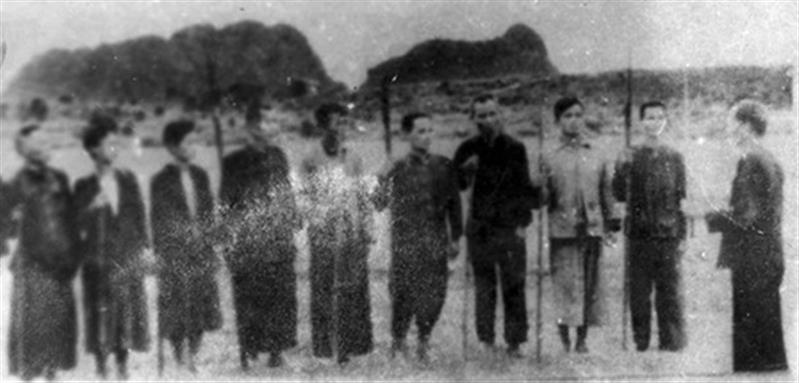
The aftermath of the Yên Bái mutiny by Vietnamese soldiers in France’s colonial army that began on February 10, 1930 saw something far more serious develop. The ‘Nghệ-Tĩnh Soviets’ were mass risings of workers and peasants throughout the country that would roil over the following year. While the deeply divided Communist movement was unable to control and develop the mobilizations, that radicalizing period saw VIetnamese Communism become a real force in the colony, and not just among exiles and helped to force unity on the different factions.
‘The Revolt in Indo-China Spreading’ by J. Berlioz from International Press Correspondence. Vol. 10 No. 28 June 12, 1930.
The French bourgeoisie has been made extremely anxious by the revolutionary events which have followed each other in Indo-China since the beginning of the year. All the newspapers are full of reports concerning bloody revolts which are spreading in Tonking, Annam and Cochin-China, statements by highly-placed imperialist officials and other personages who are afraid of losing the colony, appeals for brutal and systematic suppression and threats against “bolshevism” in Moscow and in Paris, which is made responsible for the powerful wave of revolt rapidly rising in Indo-China.
The ferment in Indo-China dates back to years 1924/25. But then it was of quite a different nature. The anti-imperialist movement then was chiefly a matter of small circles of intellectuals and was led by small conspirative groups which often carried out individual acts of terror, although here and there, there were also isolated revolts of the coolies and the peasants. As there was no Communist Party in Indo-China at that time, the greatest political confusion prevailed.
In the meantime however, the geographical situation of Indo-China caused it to feel the tremors of the tremendous revolutionary movements of the masses in China and in India. Further, the world economic crisis also had its effect on the colony. The fall in the prices of raw materials for industry and for agricultural produce in general and the fall of silver (the silver piastre was the currency in Indo-China) resulted in a considerable fall in the purchasing power of the population. Serious bankruptcies occurred. The already miserable wages of the coolies were cut still further (the coolies on the plantations earn 4 Francs for a 12 hour day). The rice grown in Indo-China is either exported or used for the production of alcohol without regard to the feeding of the native population. There is therefore literally a famine in numerous districts. The taxes imposed by the French imperialist authorities are being steadily increased, and as a result the mass misery is growing.
The rising in Yen-Bay on the 10th February was not a local affair, but affected a great part of the area of Tonking extending over 200 kilometres. Numerous strikes broke out in various places. 1,200 coolies went on strike on the rubber plantations of the world famous rubber company Michelin, the coolies struck work in the textile factories of Nam-Dinh, 2,000 railwaymen in Di-An joined in the strike. The coolies on many other plantations stopped work. On the 1st May mass demonstrations of workers took place in Indo-China for the first time in history. The French authorities went mad with fear and suppressed and dispersed them with brute violence. 5 workers were killed and many wounded in Ben-Thuy, 16 were killed and 25 wounded in Cat-Ngan and other places. A few days later several thousand poor peasants rose suddenly and unexpectedly in Cochin-China, the richest and up till then quietest part of the colony. Refusing to pay taxes and attacking the contributions extracted by the rich landowners, the peasants armed themselves with bamboo sticks and other primitive weapons, formed themselves into small armies and fought manfully against the armed police. Collisions occurred daily and the peasants were slaughtered mercilessly by the armed police and military.
What is now happening in Indo-China is a mass movement against French imperialism, a mass movement which is not yet united but which extends over the whole colony. The working class and peasant masses have come into movement and the political level of their struggle is fundamentally higher than in former years. The red flag of the revolutionary proletariat is carried at the head of their processions and the bourgeois press howls with fury at the discovery that communist leaflets have been found on the corpses of the revolutionaries murdered by the military. The imperialists are particularly nervous about the native troops as they have good reason to believe that these troops are no longer reliable. On the 1st May a band of a native regiment played the “Internationale” in Yen-Bay. A high officer declared openly to a correspondent of a Paris newspaper that the native troops were no longer reliable as they were “infected with Russian propaganda” and that where a revolutionary movement on a large scale was concerned they might refuse in obey their officers.
The influence of the Communist Party of Indo-China is growing despite the sectarian tendencies of certain of its officials. This growth is obviously taking place at the expense of the constitutional party in whose ranks a remarkable process of differentiation is going on. The leaders of the constitutional party, members of the native bourgeoisie, condemn the “communist agitation” which also threatens their own class, and one of them Duoc, has even offered to co-operate with the French authorities against the communists. The masses behind the constitutional party, however, are rapidly abandoning the hard and fast nationalist attitude of this Party and are going over to the communists.
The French bourgeoisie has invested 4 milliard Francs in Indo-China and tremendous profits have accrued to it in consequence. The total trade of Indo-China is over 7 milliard Francs in value. In Tonking 2 million tons of coal are produced annually, and 20 million Francs worth of tin and 30 million Francs worth of zinc etc. The rubber plantations are still developing and are intended to provide the mother country with all its necessaries in this respect. The frightened capitalists threw their Indo-China papers overboard in a hurry and as a result they suffered immense losses on the exchanges. French imperialism is determined to carry on a bitter struggle to crush the movement of its 20 million colonial slaves in Asia for independence.
The repression is therefore still raging. Thousands of arrests have already been made. The penal commissions are working at high pressure and 58 death sentences have already been passed as well as hundreds of life-long sentences of imprisonment and banishment, etc. already taken place and others are to follow. The police are Many executions have also engaged in persecuting the Indo-Chinese workers and students in France. On the 22nd May hundreds of Indo-Chinese demonstrated in Paris before the palace of the French President, and on the 25th May hundreds of them marched together with the Paris workers to the Wall of the Commune in Père Lachaise. 20 of them were arrested by the police. The courts had to release them for want of any basis for raising a charge, but the police re-arrested them without charge and sent them under cover to Marseilles for deportation to Indo-China where prison or death is certain for them.
At the last session of the French Cabinet the Colonial Minister announced that a series of energetic measures would be taken against the revolutionary movement in Into-China: widespread legal prosecutions, a thorough cleaning in the native militia to eject all doubtful elements, the despatch of mercenary troops from the Foreign Legion etc. As far as the native troops are concerned, they are deprived of their arms immediately after all exercises and the rifles and ammunition are kept under lock and key. The social fascists are contributing their part to securing increased repression.
The French government now announces that it intends to crush the head of the movement once and for all. In this connection a wild campaign of incitement is being conducted against the Communist Party of France and against the Soviet Union which are made responsible for the unrest in Indo-China. The Resident Governor of Annam, Jabouille, and the Minister himself have openly declared that soviet propaganda is responsible for the revolt. The French Colonial Institute in a solemn session demanded the breaking off of relations the Soviet Union. An atmosphere for the formation of Anglo-French block against the Soviet Union is being created with the argument that Great Britain in India has the same fight on its hands as France in Indo-China.
The world proletariat must raise its voice in protest against the bloody terror of French imperialism in Indo-China. The communist slogan, “Free the Indo-Chinese National-revolutionaries!” must be taken up everywhere, must be developed into a powerful campaign of solidarity and protest action on behalf of the heroic fighters in Indo-China, who represent the most important connecting bridge between the revolutions in India and China. The united front of the imperialists against the colonial peoples who are fighting for their emancipation and against the Soviet Union, must be faced with a united front of the oppressed peoples in the colonial countries and semi-colonial and the working masses in the capitalist countries.
International Press Correspondence, widely known as”Inprecorr” was published by the Executive Committee of the Communist International (ECCI) regularly in German and English, occasionally in many other languages, beginning in 1921 and lasting in English until 1938. Inprecorr’s role was to supply translated articles to the English-speaking press of the International from the Comintern’s different sections, as well as news and statements from the ECCI. Many ‘Daily Worker’ and ‘Communist’ articles originated in Inprecorr, and it also published articles by American comrades for use in other countries. It was published at least weekly, and often thrice weekly.
PDF of full issue: https://www.marxists.org/history/international/comintern/inprecor/1930/v10n28-jun-12-1930-inprecor-Virginia.pdf

