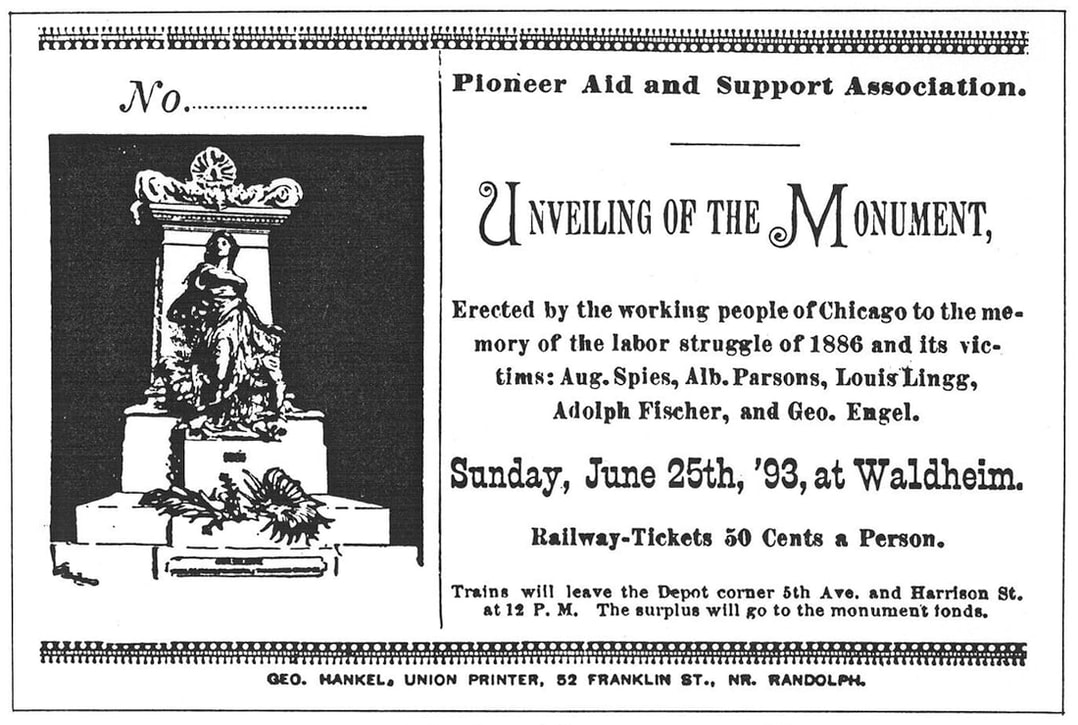
A deep, but essential, cut of Haymarket history where a central figure in the story mourns at the Waldheim resting place six months after burial, and before the 1893 dedication of the now-famous monument. In this moving piece Lizzie Holmes (Swank) is among the many visitors that Memorial Day—May 30, 1888—garlanding the graves of the comrades executed on November 11, 1887. It would be the following year that the date of the eight-hour strikes–May 1, 1886–that led to the Haymarket affair and the martyrdom of Parsons, Spies, Lingg, Engel, and Fischer was declared as International Workers’ Day by the founding congress of the Second International in 1889. Holmes was a remarkable figure in the early revolutionary U.S. labor movement and a close collaborator with Lucy Parsons and the dead. I have a feeling that the somber mood she describes six months after was one shared by many activists at the time.
‘Our Memorial Day’ by Lizzie M. Swank from The Alarm. Vol. 1 (new) No. 14. June 16, 1888.
THE GRAVES OF OUR MURDERED COMRADES REFULGENT WITH FLOWERS OF HOPE.
THE MEMORY OF THE FATAL NOV. 11 NOT TO BE SMOTHERED WITH ROSES AND GARLANDS
On the 30th of May we visited the graves of our beloved and martyred comrades; not formally, not because it was the conventional time for flowers and regretful memories, but principally for the reason that it was a holiday, and we “who return to society more than an equivalent for what we consume,” had a few hours leisure.
The day was bright and cool, and the new green of spring looked especially refreshing; nature had revived since that dark November day, when the very clouds drew near and shut us in with our heavy sorrow–the sad day when we laid our heroes to rest, where dead leaves rustled and snow flakes filled the air. But ah, how deep the regret, the rain longing, and the ceaseless sorrow, even there amid flowers and sunshine on this brighter day, dwelt in our hearts, none can tell.
The graves are well cared for; one broad bed is divided into five compartments, with the initial letters of each growing in evergreen in the order in which they are laid: Spies, Fischer Parsons, Engel, Lingg. The plot belonging to the graves is tastefully laid out in plants and flowers. A neat and appropriate headstone, containing the five names, the fatal date, “Nov. 11,” and a corruption of SPIES last words, marks their resting place; this will, in due time, be replaced by a monument which shall better represent their noble lives and sublime deaths. Wreaths and clusters of cut flowers from different societies and friends covered the green of the growing flowers beneath; Parsons’ picture, in a frame of green, tied with red ribbon; hung near the foot of his grave; Spies’, in a semi-circle of crimson flowers, rested over his own.
All day throngs of sympathizing friends gathered around, gazed, pondered, and departed, and truly those silent graves spoke more powerfully than murderous enemies designed they should in their hour of stupid vengeance. I stood long at the headstone, recalling the thrilling events of the past two years. I remembered them in their brightest days, when they, with those shut in their sadder, living graves, were busy, and bright, and strong in their work. Of the grand meetings we used to hold, of the trips into the very centers of wrong, poverty, and suffering they would make, of their sympathy with the poor, their equal ability in meeting the rich and cultured. I recalled them personally, so genial, full of life, courage, hope, animation, enthusiasm and devotion that any little gathering of people straightway became infused with the same spirit the moment they entered it. Then I thought of the present, and must own that hopelessness for a time prevailed. It is not, I feared, as they had hoped or expected. The spirit of justice and retribution dwells deep if it lives at all, for it stirs no ruffle on society’s surface today. The old days and ways of agitation are gone. The working people have no meetings and the authority which forbids open assemblages is scarcely felt, for there is no one to speak and few to hear. Disorganization seems to be the order of the day. The men of intellect, strong enough, brave enough, great enough, to weld and wield the many conflicting thinkers and their theories, do not exist. Able men we have devoted souls, too, but they do not dwell in the self-same bodies. The few reformers who are in the front are careful to state they are not anarchists. The people are apathetic and intimidated. And yet–and yet–the cause never dies. The form of development itself changes, but progress never ceases. In an explanatory letter of Bellamy’s is this: “What is the teachings of history, but that great national transformations, while ages in unnoticed preparation, when once inaugurated, are accomplished with a rapidity and resistless momentum proportioned to their magnitude, but not limited by it? In 1759, when Quebec fell, the might of England in America seemed irresistible and the vassalage of the colonies assured. Nevertheless twenty-nine years afterward the first president of the American republic was inaugurated. In 1849, after Novara, Italian prospects appeared as hopeless as at any time since the middle ages: yet only, thirteen years later Victor Emanuel was crowned king of united Italy. In 1833 the original anti-slavery society was formed in Boston by a few so-called visionaries. Thirty-seven years later, in 1870, the society disbanded, its programme fully carried out.”
And in 1888, with some of the fore most leaders of industrial emancipation in prison, with its martyrs in their graves, with press and speech under surveillance, political mobs howling themselves wild over an old ram and his silly wife, and the people blinded by false issues to be easier led into traps, even in such an hour they are nearer the dawn of freedom than the wily and boastful leaders of power and privilege would dream.
“Tis darkest before dawn.” Extravagance; corruption, injustice were never so extreme as just before the fall of the court of Louis XVI. The extravagance, corruption, injustice, iniquitous splendor of American class-rule are almost at the highest point. There is hope for the sorrowing masses, in the very darkness that surrounds us.
LIZZIE M. SWANK.
The Alarm was an extremely important paper at a momentous moment in the history of the US and international workers’ movement. The Alarm was the paper of the International Working People’s Association produced weekly in Chicago and edited by Albert Parsons. The IWPA was formed by anarchists and social revolutionists who left the Socialist Labor Party in 1883 led by Johann Most who had recently arrived in the States. The SLP was then dominated by German-speaking Lassalleans focused on electoral work, and a smaller group of Marxists largely focused on craft unions. In the immigrant slums of proletarian Chicago, neither were as appealing as the city’s Lehr-und-Wehr Vereine (Education and Defense Societies) which armed and trained themselves for the class war. With 5000 members by the mid-1880s, the IWPA quickly far outgrew the SLP, and signified the larger dominance of anarchism on radical thought in that decade. The Alarm first appeared on October 4, 1884, one of eight IWPA papers that formed, but the only one in English. Parsons was formerly the assistant-editor of the SLP’s ‘People’ newspaper and a pioneer member of the American Typographical Union. By early 1886 Alarm claimed a run of 3000, while the other Chicago IWPA papers, the daily German Arbeiter-Zeitung (Workers’ Newspaper) edited by August Spies and weeklies Der Vorbote (The Harbinger) had between 7-8000 each, while the weekly Der Fackel (The Torch) ran 12000 copies an issue. A Czech-language weekly Budoucnost (The Future) was also produced. Parsons, assisted by Lizzie Holmes and his wife Lucy Parsons, issued a militant working-class paper. The Alarm was incendiary in its language, literally. Along with openly advocating the use of force, The Alarm published bomb-making instructions. Suppressed immediately after May 4, 1886, the last issue edited by Parson was April 24. On November 5, 1887, one week before Parson’s execution, The Alarm was relaunched by Dyer Lum but only lasted half a year. Restarted again in 1888, The Alarm finally ended in February 1889. The Alarm is a crucial resource to understanding the rise of anarchism in the US and the world of Haymarket and one of the most radical eras in US working class history.
PDF of full issue:https://digitalcollections.crl.edu/record/1117363?ln=en

