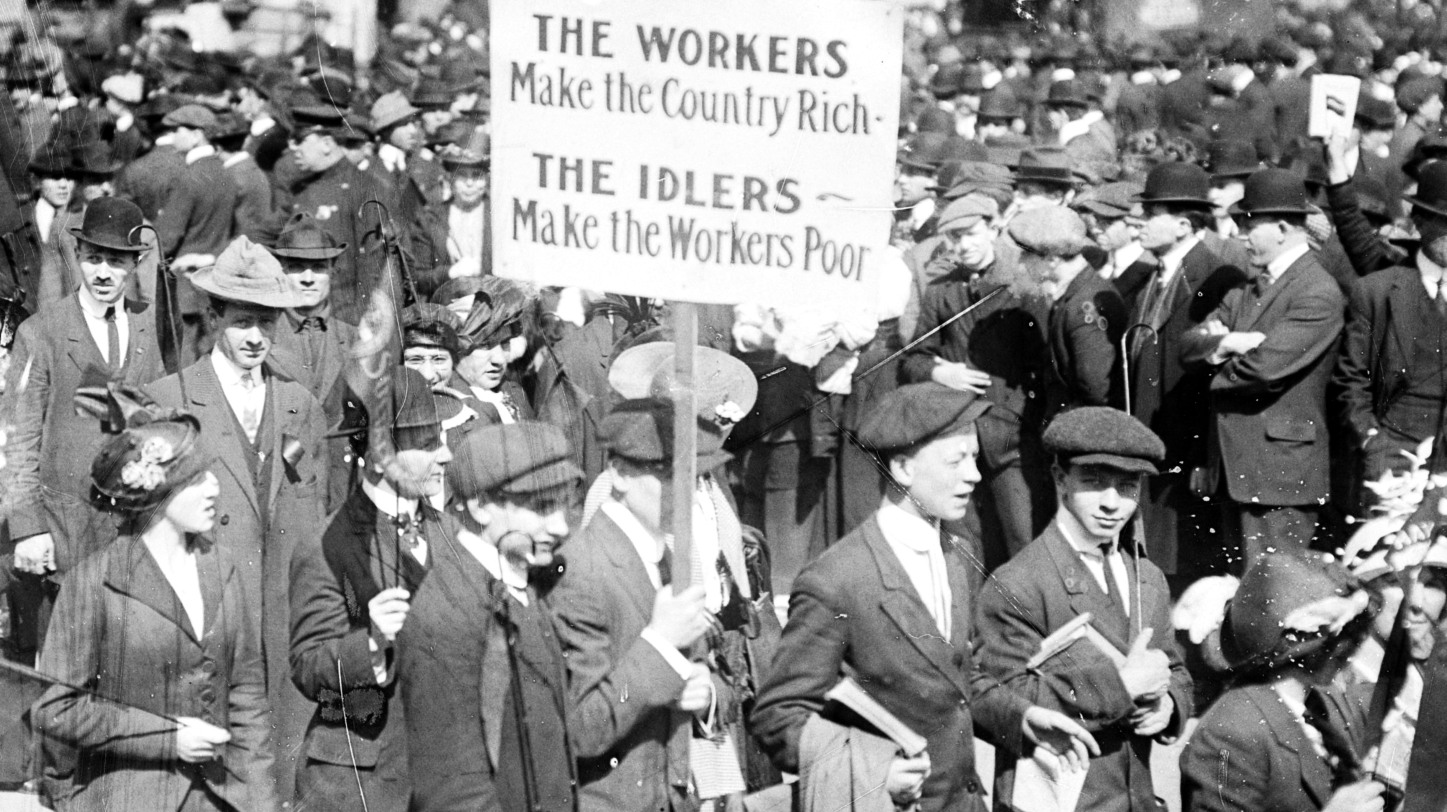
A proletarian holiday of renewal from ancient times to today. Always with the long view, Caroline Nelson brings her perspective developed from activity in the North American and European labor movements.
‘The Past and Present of International Labor Day’ by Caroline Nelson from Revolt (San Francisco). Vol. 3 No. 52. April 27, 1912.
May day has been celebrated by the workers from the most ancient time. It was a day when the children of toil betook themselves to the forest and field to forget their toil and to rejoice with nature in all her glory at the beginning of a new period. Our modern revolutionists in Europe took advantage of this day to promulgate their doctrine. Most of ancient festival days that the workers used to celebrate the capitalists took away from them in the name of virtuous thrift. They were so eager for profit. And they had their preachers and moral teachers tell the workers that the extra holidays led to vice and immorality. But May Day was too deeply rooted in the social psychology to be done away with. So that the workers at the present time celebrate in Europe their ancient festival day as Labor Day. What could be more fitting than that the new life of nature and that the beginning of a new age should be celebrated together?
In olden times in many countries May Day was celebrated for three days in succession. In fact, many festivals of the workers were celebrated for that length of time. It was indeed a poor couple who could not afford a three days feast when they had their wedding. In some out of the way places in the old world remnants of the olden times still linger in the customs of the people. And people born in those, out of the way places know that instead of cheap theaters, nickelodeons, dance halls, saloons and other horrible places instituted to rob and degrade the worker, there was a time, not so long ago, when the workers came together in wholesome enjoyment in their own homes. True, in those feasts and festivals there was a great deal of drinking. But every drop of liquor was brewed by the women. It was pure. No ill effects followed. It was not like the poisonous stuff of today manufactured and sold for profit, incidentally ruining the mind and body of the worker, and filling the pocketbook of rich vampires who talk about charity and how to uplift the human race. It is a crime against ourselves to drink that stuff and it ought to be a penitentiary offense to brew it…
Those ancient festival days were the source of good cheer and social strength among the common people. Nowadays we hear, so much gush about no class. distinction. The fact of the matter is that we never had an age where the workers have been so divided up into little cliques. Every trade and profession has its snobs and social superiors. In ancient times on feast days all the workers, the peasants and trades people came together on equal footing. Only the official and the nobility held aloof. We have lost a good deal more than our homes, with them we have lost the spirit of hope and cheer and innocent association.
Mr. Bliss, a parlor Socialist, in his encyclopedia of Social Reform, tells us that European authorities found that May Day celebrations led to riots and that therefore they had to do away with them in large cities. He did not tell us that thugs hired by the upper class were the cause of those riots. It was necessary to get an excuse to prevent the workers from coming together to learn about their own philosophy. But in spite of it the workers manage to hold their labor celebrations on May Day throughout Europe, to spread the philosophy by speeches and literature and increase the class-conscious host. Thus they undermine the present order of things and build the foundation of the new.
Here in America, by the pressure of the workers’ demand the masters set aside a labor day in the fall. It has chiefly been a day of the trade unionists, who celebrated it as a day to picnic and parade in upper class style. Their orators have been selected from the masters. They have been preachers or university professors, who had not a smattering of working-class philosophy. All this, however, is beginning to change. The rank and file of the trade unionists begin to get class-conscious and demand something more than upper class respectable sermons in their orators: The class-conscious workers in America have always insisted on celebrating May Day as the true Labor Day. And in the large cities parades in the evening through the principle streets have taken place. The Red Flag has not always been very conspicuous in these parades for various reasons, but last year in San Francisco a big Red Flag was carried in our May Day parade without the stars and stripes, and the police didn’t even seem to object. We had a parade ten blocks long. But we need a whole day as labor day. In the evening thousands of workers are too tired to tramp the streets in a parade. Besides, it gives us no opportunity to mingle with the agricultural workers and the workers in the little towns. It is the beauty and significance of May Day celebrations in Europe, it brings the rural workers and the city workers together to discuss. We must do the same thing here in America. We must have the whole of May Day to ourselves. The evening is not enough. In our present labor day the agricultural worker is entirely left out. Thousands of them don’t even know that there is such a thing as a Labor Day. In Europe on the other hand Labor Day is essentially a holiday of the rural population. He comes to town and is caught in the flow of revolutionary oratory and carries the “dynamite” home with him. But here in America, he has no part in the trade parades and their picnics. It is up to us to get a Labor Day for all the workers, where we can come together from the country and city. We have important matters to discuss. The workers in trade unions are not the most potent nor are they most susceptible to class consciousness. They are rather the least, and there is no reason why we should not go to work to compel the powers that be to recognize that May Day is the universal Labor Day the world over, and to use it for our propaganda.
The human being is a child of nature. At the season of the year when new life buds forth, he is most susceptible to new hope and new ideas and new convictions. That is one of the reasons why May Day is our Labor Day.
Revolt ‘The Voice Of The Militant Worker’ was a short-lived revolutionary weekly newspaper published by Left Wingers in the Socialist Party in 1911 and 1912 and closely associated with Tom Mooney. The legendary activists and political prisoner Thomas J. Mooney had recently left the I.W.W. and settled in the Bay. He would join with the SP Left in the Bay Area, like Austin Lewis, William McDevitt, Nathan Greist, and Cloudseley Johns to produce The Revolt. The paper ran around 1500 copies weekly, but financial problems ended its run after one year. Mooney was also embroiled in constant legal battles for his role in the Pacific Gas and Electric Strike of the time. The paper epitomizes the revolutionary Left of the SP before World War One with its mix of Marxist orthodoxy, industrial unionism, and counter-cultural attitude. To that it adds some of the best writers in the movement; it deserved a much longer run.
PDF of full issue: https://www.marxists.org/history/usa/pubs/revolt/v3-w52-apr-27-1912-Revolt.pdf

