Full of facts and figure on the effort to bring women into political activity and administration through participation in the Party, the soviets, cooperatives, and trade unions in the first fives years of the Revolution.
‘Propaganda among Working and Peasant Women in the Russian Soviet Republics’ from International Press Correspondence. Vol. 3 No. 61. September 20, 1923.
Since the beginning of 1922 the activity of the C.P. of Russia has been making great progress among the masses of working women. The sections of the Party committees for work among the women have gained a much firmer footing, and their activity has become an inseparable part of the total Party work. In the apparatus of the Party committees for work among women there are 360 provincial women functionaries occupied, 1505 district functionaries, and 300 for the localities. Besides this there are organizers of work among women in a considerable number of nuclei in the factories and workshops, not paid by the Party.
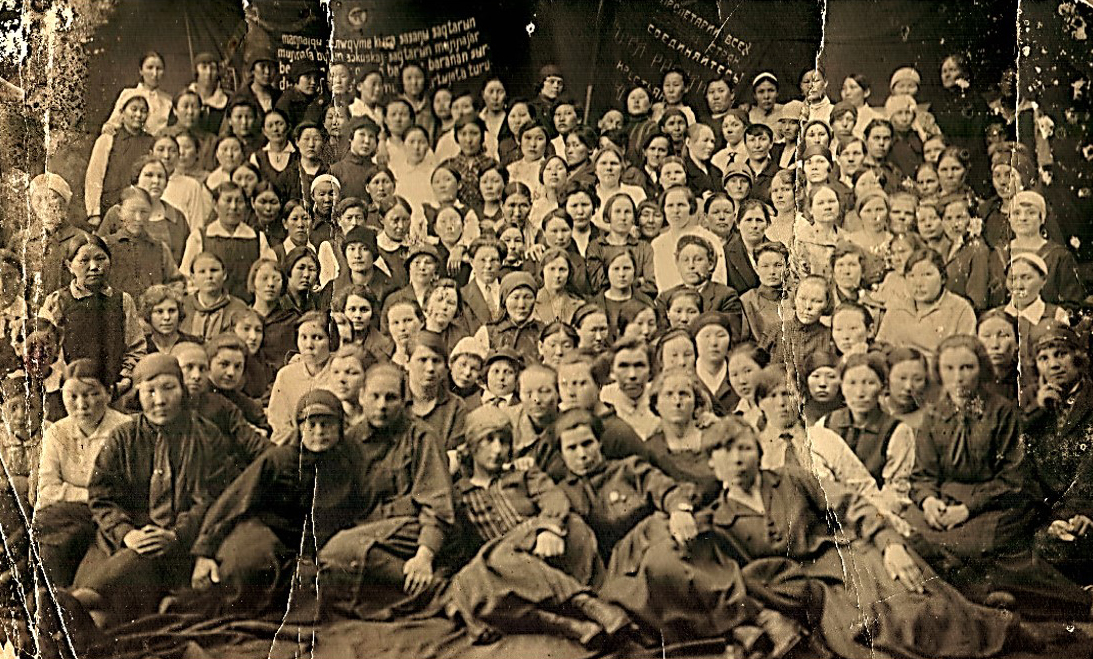
A special form of activity is still the delegate meetings of working and peasant women. The activity of these delegate meetings has become more systematic and thorough-going. In the autumn of 1922 city delegates were re-elected over the whole territory of the Soviet republics. The general number of delegates, now as before, amounts to 60,000.
In order that the delegates may take part in practical work within the various spheres of Soviet construction, the Council of People’s Commissaries has decreed the participation of the delegates in the section work of the city Soviets, with equal rights to those of the Soviet members. In these sections the female delegates gain a thorough knowledge of the corresponding branch of the Soviet structure, and take part in the practical activity of the various institutions. Reports from 25 provinces show 972 delegates to be working in the sections of the Soviets. Where there are no sections in the city Soviets, the delegate meeting itself is divided into such. There are such sections in 16 provinces. In the majority of the provinces the following sections have been organized: protection of mothers and children, public enlightenment, labor protection, and trade union and cooperative sections. The sections are under the supervision of women comrades working in the corresponding organizations. As a result of inducing working women to take part in Soviet work, many of them have risen to high positions in various branches of the apparatus. In the year 1921 there were 15% working women among the leaders of the provincial sub-departments for the protection of mothers and children, and 32% in the districts, in 35 provinces. In 1923, 15% working women were to be counted among the leaders of provincial sub-departments in 60 provinces. These have judiciously utilized the knowledge of the medical specialists, and have gradually developed into organizers and administrators.
An increase in the number of female members may be noted in the Soviets. In the year 1921-22 there were 7.2% women among the total number of Soviet members in the city Soviets of the provincial towns. In the year 1922-23 this percentage rose to 11.3%. In the municipal Soviets of the district towns 7% of the members were women in the year 1921-22. According to reports from 27 provinces, the general average at the present time is 8.3%; but in certain towns the number of women members in the Soviets is particularly great. In Saratov the percentage of women in the city Soviet is 40, in Petrograd 20. According to reports from 49 provinces, there are 14,469 working and peasant women in the city and local Soviets.
Since 1922 the trade union organs have been carrying on a systematic campaign among the women members of the trade union associations. A member of the All-Russian Central Council of the trade union associations has been given the task of stimulating activity among the women members of the trade unions. This comrade acts as instructor for work among women in the instruction department of the All-Russian Central Council of Trade Union Associations, and belongs to the leading collegium of the Central Women’s Section. In the trade union councils of the provinces this activity has been placed in the hands of a responsible organizing functionary, connected with the local women’s section. In the trade union nuclei of the factory committees and of the local committees, this work is generally undertaken by organizers who are in most cases simultaneously nucleus organizers of the Russian C.P. The result of this activity has been an increase in the number of women belonging to the administration of the unions, although the number of women engaged in production has decreased. The number of women in the administrations of the textile workers’ unions rose in the year 1922 to 7.2%, in those of the tailoring industry to 6.4%. In the same manner the participation of women in the All-Russian Trade Union Congress rose in the year 1922: among the textile workers to 12.1%, among the mining workers to 3%. At the IV. All-Russian Trade Union Congress 8.3% of the representatives were women, at the V. Congress this number had already increased to 9.9%.
Efforts are being made in the sphere of cooperation to induce the participation of working and peasant women in the cooperatives. The women’s section of the Central Committee of the Russian C.P. has appointed an instructor commissioned to maintain contact with the cooperative organs, and to induce the masses of working women to take part in cooperative work. Propaganda work has been carried on upon a large scale. In 37 provinces 436 working and peasant women have taken up work in the administrative and managing organs of the consumers’ cooperatives. In 14 provinces 128 women were sent to take part in courses of cooperative instruction. According to reports from 39 provinces, the number of women probationers employed by cooperative organs is 287.
Besides performing the above work, the women’s section devotes special attention to questions of improving industrial qualification for women’s work, of the liquidation of illiteracy among the masses of women, and of the improvement of the living conditions among working women.
One measure for the improvement of women’s industrial qualifications is the securing to women of a definite percentage of places in the technical and other trade union schools. This measure is also intended to alleviate female unemployment, and to improve the status of female work in production.
Work towards the abolition of literacy is carried on for the most part among the organized women–delegates and trade union members–the women’s sections participating. The whole of the 60,000 delegates whose term of delegation expires in the year 1923 will have a knowledge of reading and writing.
The improvement of the living conditions of working women is the object of the organized endeavors of the Soviet, trade union, and cooperative organizations. The work of organizing crèches, kindergarten schools, and refectories, much hindered during the time of transition to the New Economic Policy, now begins to expand again, Communal institutions are put to a great extent at the disposal of the women employed in large undertakings.
The special lines of activity to be pursued among the women of the Soviet East, where feudal and patriarchal views still predominate, have to be accorded particular consideration among the women of the Tusem people. In March, 1923, the central section convened a special conference of the functionaries for the women of the Eastern republics, at which the balance of the work already accomplished was drawn, and lines for further work laid down. During the course of the past year considerable successes have been gained amongst these most backward masses of women. Thus, in the year 1922, 112 congresses and conferences were held, which were attended by working women from the South Eastern territory, about 1500 from the Mountain Republic, 1300 Turkish women from Azerbaidjan, etc. 282 people’s schools were opened, 28 women’s clubs organized, etc.
The publication of periodicals and literature for working and peasant women has recently been established on a much broader basis than before, both in the central section and in the provinces. The Kommunistka (The Woman Communist) has been appearing since 1920 as the leading organ of the central section.
In the course of the year 1922 seven numbers were printed, each of 91,000 copies. Besides this, the publication of a popular journal, The Peasant Woman was begun, to meet the needs of the villages (up to now 12 numbers have appeared of this, the total edition amounting to 170 000 copies). In January 1923, the central Women’s Section proceeded to the publication of a popular newspaper: The Woman Worker, for the masses of working women in the towns (up to now 4 numbers have been published, the edition of each being 15,000 copies). The demand for popular literature has been so great among the working and peasant women that a large number of periodicals have appeared in various provinces. The Siberian women’s section publishes a paper: The Red Siberian. The Mountain Republic issues a periodical, The Woman Mine Worker; Azerbaijan The Caucasian Women Worker; Moscow The Delegate; and the Ukraine, as hitherto, the paper: The Woman Communist.
As a result of this activity carried on by the Party among the non-partizan masses, there is an increase in the female membership of the Russian Communist Party. According to the figures of the All-Russian registration for the year 1922, there is a percentage of 7.8 women in the Party. The proportional numbers of the male and female candidates for membership in the C.P. of Russia leads one to conclude that the percentage of women party members will increase in the immediate future. There are 100 men to 8 women in the Party, but among the candidates there are 9 women to 100 men. In the city organizations there are 100 male members to 10 female, but 14 women to 100 men among the candidates. With regard to their social position, these candidates are working and peasant women. We are therefore justified in drawing the conclusion that they have been won for the Party by the activity of the sections for work amongst women.
International Press Correspondence, widely known as”Inprecorr” was published by the Executive Committee of the Communist International (ECCI) regularly in German and English, occasionally in many other languages, beginning in 1921 and lasting in English until 1938. Inprecorr’s role was to supply translated articles to the English-speaking press of the International from the Comintern’s different sections, as well as news and statements from the ECCI. Many ‘Daily Worker’ and ‘Communist’ articles originated in Inprecorr, and it also published articles by American comrades for use in other countries. It was published at least weekly, and often thrice weekly.
PDF of full issue: https://www.marxists.org/history/international/comintern/inprecor/1923/v03n61[39]-sep-20-1923-Inprecor-loc.pdf

