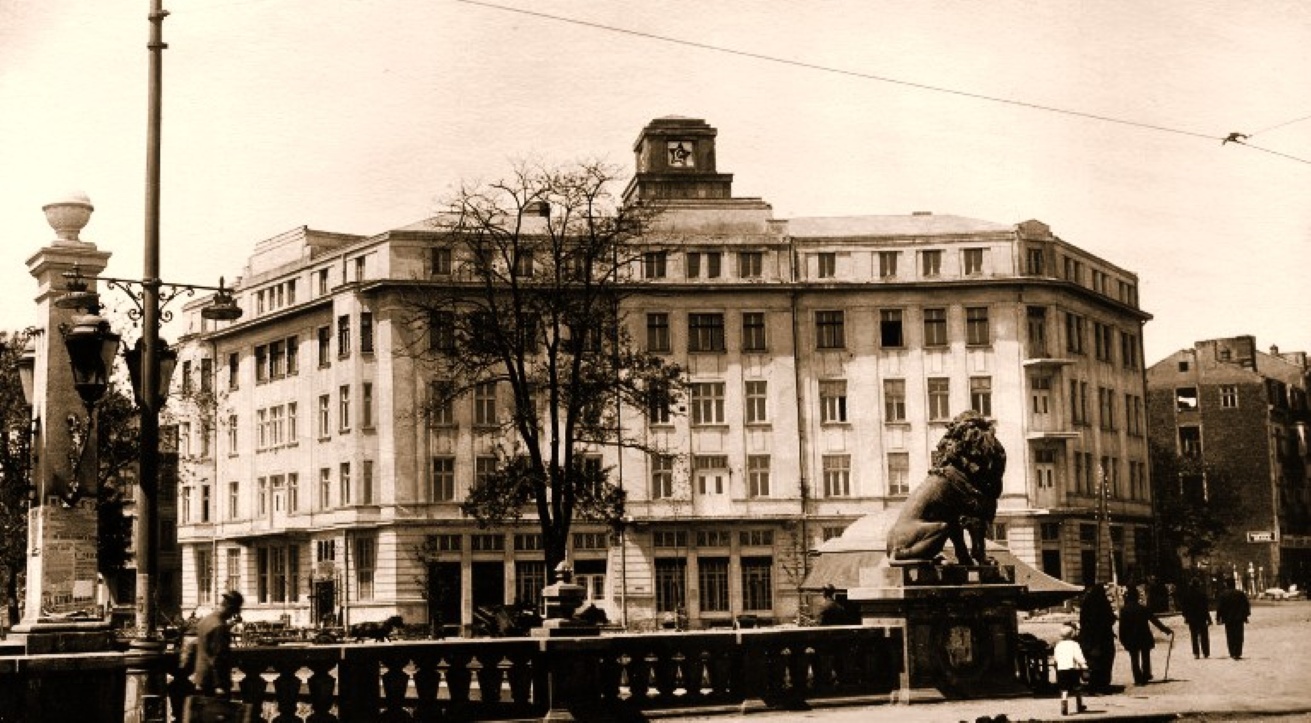
One year before Bulgaria’s fascist coup and the Communist Party, the largest single party in the country with 38,000 members, reports on the organizations, representatives, and publications in under its authority and its massive rebuilt Sofia headquarters, the People’s House.
‘The Situation in the Communist Party of Bulgaria’ by T. Lechanoff from International Press Correspondence. Vol. 2 No. 71. August 22, 1922.
We take the following from a report of the Secretary of the Bulgarian Party, Comrade T. Lechanoff, delivered before the 4th Congress of the Bulgarian, Communist Party.
On May 20th, 1922, the Communist Party of Bulgaria included 1534 local organizations with a membership of 38,036, as against 1512 organizations with 34,898 members at the end of 1921. This represents an increase of 104 local organizations with 2849 members, between the 1st of January and the 20th of May 1922.
The Party controls the following organizations:
1. The General Trade Union Federation, comprising 19 trade unions with 497 local groups and 29,139 members. These are divided as follows; 3900 transport workers; 3197 tabaco workers; 2390 miners; 2583 metal workers; 1912 leather workers; 2038 helpers; 1846 textile workers; 1505 tailors; 1407 lumber workers; 1456 office employees; 620 engravers; 829 construction workers; 1027 restaurant workers; 836 agricultural workers; 128 theatrical workers; 429 hospital workers; 248 barbers; 1862 state and communal employees; and 2206 teachers.
2. The Central Women’s Committee with 72 local groups and 4200 members, including 1552 working women, 2226 house-keepers and 293 women without exact occupation. Their organ Ravenstvo (Equality) has 8155 subscribers.
3. The Central Foreigners’ Committee, with 18 sections and 1310 members.
4. The League of the Bulgarian Communist Youth, which comprised at the end of 1921, 362 groups with 13,216 members. They are divided into 78 city groups, with 6831 members and 224 rural groups with 6355 members. Their organ, Mladec (The Young People) appears in an edition of 14,000 numbers.
5. The Communist League of War Invalids and the League of former War Prisoners, which united at the beginning of the year into the Union of War Victims. At the end of 1921 this union had a membership of 4261 members, divided into 105 local organizations. Their organ The War Victim has a circulation of 4,300 numbers.
6. The Group of Communist Engineers with 52 members.
7. The Cooperative Society “Osvobojdenie” (Liberation) which, on the 31st of March 1922, had a membership of 57,000. At the end of 1921 their consumers’ division controlled 37 branches and 85 agencies. The publishing division prints all the newspapers, magazines and other publications of the Party. They have over 300 organs, possess headquarters, with a modern printing press equipped with the largest rotary machines in the country. Their construction department disposes of a modern sawing mill and a well equipped carpenter’s shop. They are now working on the construction of a new, five-story People’s House. The cooperative has close connections with the Russian and American labor movement.
The Party has a representation of 43 members in Parliament. The election of 9 more Communist deputies was declared void by the government so that its majority would not be endangered.
In the local elections of October 2nd, 1921, and of February 19th, 1922, the C.P.B., received 126,464 votes. The party now controls 113 communes and 9 city executives. In a great many other communities it has won a greater or lesser number of offices. Altogether, it has elected 3,623 communal, and 115 provincial councillors.
The C.P.B. had to fight in all cases against a coalition of the other parties. All its campaigns have been successful. We need only mention the protest campaign against the burning of the People’s House, May 24th, 1921, its campaign for the relief of Russian famine, and not least, and its campaign against the Wrangelists in Bulgaria. The propaganda is conducted by the Central Committee which has named a special committee for that purpose.
The Party publishes the following newspapers: Rabotnitchetski Vestnik (Labor Herald), the central organ of the C.P.B. and the General Trade Union Federation with a daily circulation of 25,000; the Selski Vestnik (Rural Herald), a weekly with, a circulation of 25,000; the magazine Novo Vremia (New Times) the scientific bi-weekly of the Party, circulation 5800; the Tcherven Smech (Red Laugh) a humoristic weekly, circulation 4,000; the Ravenstvo (Equality), weekly organ of the Communist women, circulation 10,000; the Mladec (Young People), a weekly published by the Communist Youth and having a circulation of 14,000; the Osvobojdenie (Liberation) organ of the foreign Communists, which will be published in the near future in 3200 numbers; the War Victim, organ of the former soldiers, a bi-weekly with a circulation of 4000; the Zia (Light) published in Turkish for the Bulgarian Turks, 1800 numbers; the Novo Svet (New World), organ of the American Communists in Bulgaria, edited in 1000 numbers; the Bratstvo (Brotherhood) a magazine for propaganda among Bulgarian Jews; and, finally, the Narodna Armia (People’s Army) a weekly for propaganda in the Army.
Outside of this, the C.P.B. published the Bulgarian number of the Communist International; during the year 1921 it also printed 61 books and many pamphlets.
International Press Correspondence, widely known as”Inprecorr” was published by the Executive Committee of the Communist International (ECCI) regularly in German and English, occasionally in many other languages, beginning in 1921 and lasting in English until 1938. Inprecorr’s role was to supply translated articles to the English-speaking press of the International from the Comintern’s different sections, as well as news and statements from the ECCI. Many ‘Daily Worker’ and ‘Communist’ articles originated in Inprecorr, and it also published articles by American comrades for use in other countries. It was published at least weekly, and often thrice weekly.
PDF of full issue: https://www.marxists.org/history/international/comintern/inprecor/1922/v02n071-aug-22-1922-Inprecor.pdf

