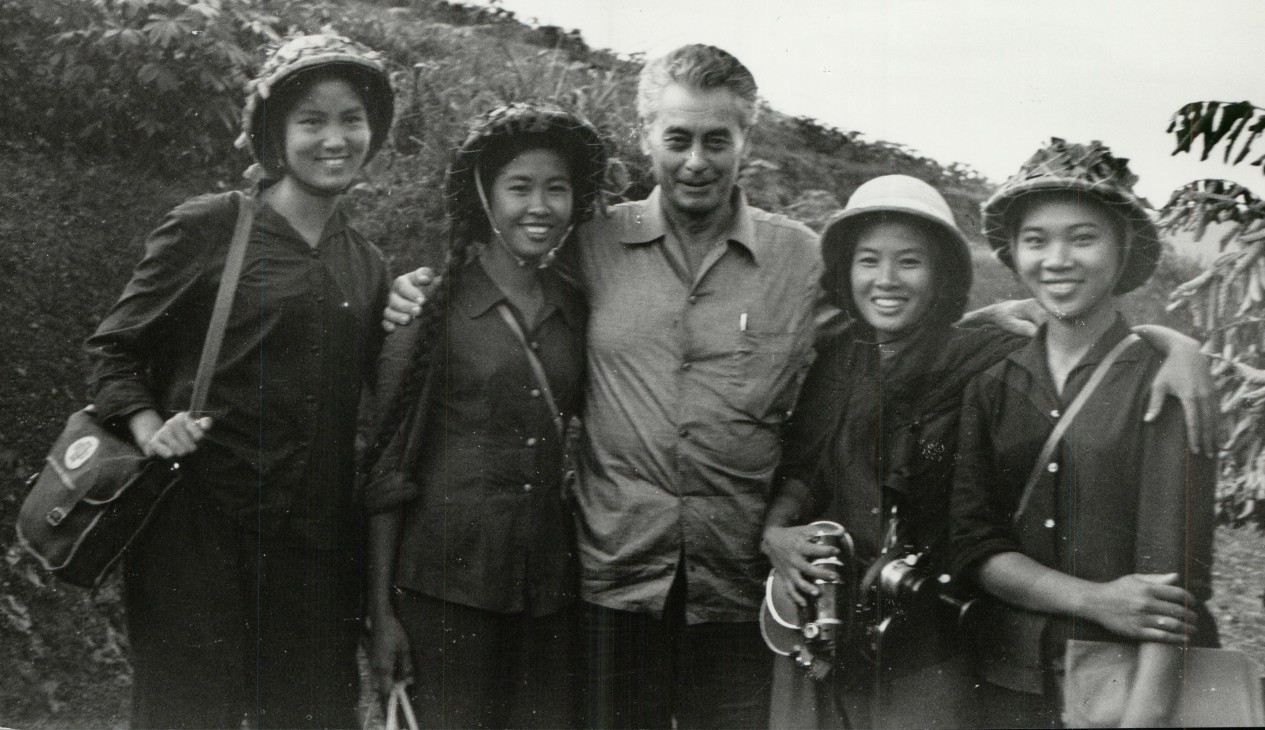
The prolific radical Dutch documentary filmmaker with some real insights on the world of Hollywood and the reality of the United States. Having spent several years studying and working in the Soviet Union, Ivens moved to the U.S. from 1936 until the end of the war. Here, his most famous production was probably The Spanish Earth on the Civil War and antifascist propaganda work during the War. Ivens worked for sixty years making movies around the, with a focus on the anti-colonial revolutions and Vietnam’s war of liberation, including a13-hour documentary on China’s Cultural Revolution.
‘Notes on Hollywood’ by Joris Ivens from New Theatre and Film. Vol. 3 No. 10. October, 1936.
To us in Holland, and in the engineering and aviation in order to be whole of Europe, Hollywood appears a strange empire, with embassy palaces and consulates in every country, city and hamlet. Whoever enters one of these palaces (and he must pay for it) is on neutral ground: on the outside are sorrows, insecurity, protests-demonstrations, struggles, war. Inside is darkness. An endless series of false illusions flicker across the screen, and the cunning producer, with the help of a Clark Gable, Jeanette MacDonald and Shirley Temple, tries to prove to the whole world—the American coal miner as well as the Dutch peasant that human nature never changes.
It is clear in whose interest such a perversion of fact and reality is perpetuated. Who owns the screen? The talkie? The loudspeaker? Think of the thundering yell of culture over the world each evening–and think also of the following story.
In British India there lived a strong isolated tribe of mountaineers who didn’t like continually paying taxes to the London bankers. They took their rifles and marched against the authorities. A bright English officer proposed to his general that he send an aeroplane with the world’s most powerful loudspeaker over the camp of the mountaineers who were so audacious as to defend their liberty. A well-paid Hindu priest assuming the voice of the God of the Mountains announced through the silvery amplifying tubes that he wished the tribesmen to bring all their rifles, weapons and powder to the river bank. The people complied, and were conquered. Today, some of their young warriors are studying radio able to deliver their own message.
I
Hollywood seemed to us in Holland very far away, much farther than the much farther than the film centers of London, Moscow, Paris, Berlin. With these centers our own independent film groups and audience organizations like the film leagues maintained regular contact. Celebrated continental directors spoke at our public meetings on their conception of film art and their methods of work: René Clair, Pudovkin, Renoir, Eisenstein, Pabst, and others. But Hollywood remained far removed. Our only contact with it through the years was its many mediocre and bad pictures. You can imagine what a distorted idea of American life the Dutch, the French, the English, received. A country full of gangsters and G-men; country full of gangsters and G-men; every office girl with the chance to marry her boss; the old fairy tale that every boy has the opportunity to become a millionaire; Negroes who were merely clowns with nothing to do but dance and sing the whole day long. All this time and time again.
Things took a turn for the better much too slowly. Every year four or five good works (of course far too few) came out of this dream factory where films–500 per annum, 65% of the world’s production–were made on the conveyor belt. Names like King Vidor, Milestone, Mamoulian, Von Sternberg–later John Ford, Capra, Cukor, Hawks, La Cava and Le Roy–and those of a few good actors and actresses, appeared. Pictures began to be made which could no longer be derisively labelled “box office,” “religion and sex, “war and sex.” One had to differentiate. We now saw some good pictures. Hence there were some good people in the field, creative forces, artists who wanted to create something beyond cheap entertainment.
II
During my first few weeks in Hollywood, as a craftsman I naturally concentrated on the marvelous working places. Hollywood is indeed a magnificent place in which to produce pictures a mild even climate, for many a bit too monotonous–a lot of sun, little wind, scenic variety and in addition, the best technical equipment in existence. People from all over the world come to watch the studios in operation and to study their perfected methods of production. (Shumiatsky, for instance, the head of the Soviet cinema industry, came to Hollywood preparatory to the building of a gigantic film center in the South of the Soviet Union.) Visit these studios for a few hours and compare them with London or Paris, the sureness, the speed and calm of the directors, cameramen, stage and electrical workers and carpenters. Here one finds a working method of the utmost efficiency, systematic mass production, a concentration of the whole population of a city for one end–to produce films.
Technically, everything is possible. The lenses move over the scene faster than the eye of the interested visitor. The microphone hears more acutely than the ear of the snooping publicity agent. In twenty minutes one passes through twenty different streets, through a few thousand years of human history. Indeed, a marvelous place in which to produce pictures.
Then, after a week, one suddenly remembers that this apparatus, technically so marvelous, only produces four or five good pictures a year. It is not as efficient as we thought! One realizes the discrepancy between the technical possibilities and the result. Why?
In the scenario department the inbreeding of ideas proceeds on an unprecedented scale. Every year an endless row of variations on boy meets girl or the Cinderella story. Experiments in direction and shooting by director or cameramen are impossible, or emerge mutilated from the cutting-room. An actor has to fight for his life to escape standardization; once a dancing girl, gangster, butler, always a dancing girl, gangster, butler. In Hollywood one is not permitted to change. One is not permitted to make use of the rich life outside American life. And it lies right next door–all around. Do not forget: Hollywood borders on Los Angeles, a city of two million, with the greatest aviation industry in the United States, the greatest fruit orchards of America, the second greatest center for rubber and oil.
But between Hollywood and Los Angeles lies a boulevard, which separates the motion pictures from reality.
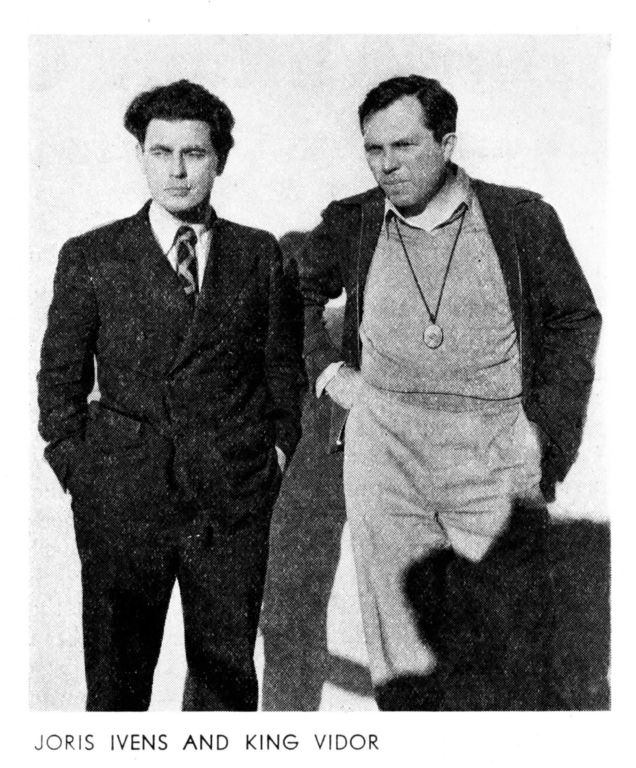
In the scenario department the last word in contact with life is a short story from the Saturday Evening Post, or a book. Sometimes even a good book. But the pages are juggled, and often wiped clean of their words, leaving a blank white sheet to be used as a movie screen!
III
There are certain things in Hollywood, however, which are not hampered by restrictions. One is the censors. You get the feeling that these all-powerful and ignorant midwives got in on each film from the very birth of the idea, that they hover over each meeting of boy and girl armed with the vetoes of religious and moral decency.
The curiosity of the public is similarly unlimited and unhampered, stimulated by the fan magazines, whose myrmidons scurry, like rats, in and around private life. Diaries, bedrooms, gardens, are all open to them. They dutifully help to make the atmosphere of Hollywood deadly for true talent. Many writers succumb in the struggle and become business men, more so than in any other film center I have observed and worked in. Most of them come to Hollywood with a modest package of ideas but the package is soon emptied. Life in Hollywood makes the writer soft. “Of course, I only came for three months, to make a pile. Soon I’ll quit and do what I want–write a book—a play–or study or make my own film.” But if you ask these writers (or actors) how long they have been in Hollywood, they answer, “Three years four years.”
Among them there are those who really had something to say. But after three or four years they dried up–like the sea in Holland slowly, painlessly, in a marvelous climate, in a house with a view and a good car. Only a few of them can indulge in the luxury of permitting themselves individuality. With these, the producers have their troubles! The better type of production requires strong, original talent. The producers engage writers who are known to possess it and then have to nullify the very qualities they need so badly, because in most instances the writer turns up with a scenario far too powerful, too original, too honest. (“Controversial topics are barred.”)
The producer has other troubles. He has to get writers into some sort of collective relationship, because it usually takes more than one to turn out a script on a picture. I experienced one typical case. The collective didn’t form itself around the theme or the idea of the picture, but around the prospective title: four words. (The producer assured me, “Every letter is worth gold.”) I shall not divulge it, it was something like Love On the Moon. Four writers, the producer and the title a brilliant gathering! A very strange process: four writers brooding like roosters over an empty egg-shell, making a full egg of it, and the public having to swallow it!
The writers are divided into various categories. After the Love On the Moon collective has done its work, the gag men and the heavy dialogue men are called in. (“And I have three idea men–fine fellows. No, they always do the same kind of work.”) Once I was almost run over by the first aid doctor. “Help! One of the idea men has suddenly developed into a laugh man!”
Such a “collective” is a vulgarization, a profanation of collective work as I have experienced it in Moscow.
IV
Instead of resorting to such travesties of the creative process, Hollywood should turn to the rich, full life at its door, life in which a Balzac or a Zola would revel! I saw a fruit-pickers’ strike–three thousand Mexican workers–which offered material for at least two Viva Villa’s. In la Habra I was present at the birth of a fighting song, the circumstances of which, if incorporated in a film, would have had ten times the strength, and directness and optimism and probably have been more of a popular hit than the usual Hollywood epic. Yet how many Hollywood film workers were aware of this heroic primitive struggle in the fruit orchards, where trees seem to be better they are playing, before work on the film cared for than men?
In San Francisco it shouldn’t be necessary to fake an earthquake to create a theme of interest. San Francisco provides other themes for pictures besides earthquakes. On any ordinary day there is more tension in this harbor than in the Hollywood superfilm. One is conscious of five continents meeting in the harbor; international complications offer great cinematic material.
The writers must add depth to their work, they must tell more than they do at present. The screen writers were right to organize. It was and is necessary. They must defend not only their salaries but their professional honor and integrity.
Fuller and richer scenarios would not have to wait for good directors and actors; they are there, they want to make better films. There are great artists and experts available; I realized it again when I saw Capra shooting Lost Horizon. It is the love of an artist, of a craftsman for his profession that guides him. With equal intensity he directs a mass of one thousand people or the wrinkled brow of one of his actors. He notices with equal acuteness the mistakes of five extras is a mass of a thousand, or an incorrect fold in Ronald Colman’s Chinese gown. And he corrects everything himself. He doesn’t trust his eye, and controls the screen picture in the finder of the camera. One would almost think he had the screen with the completed film on it right beside him while he is shooting. I asked him whether he cut the film himself. “Of course. I consider that part of the director’s job.” Capra is one of the few directors in Hollywood who are free from front office interference. In his studio there reigns the quiet, the intense atmosphere of devotion essential to the making of good pictures, which I also found with René Clair in Paris and Pudovkin in Moscow. The same is true of others here whom I watched at work: Vidor, Milestone, Mamoulian. The calm sureness of men who are the complete masters of their art, their craft. One becomes furious at the thought that such talent has not the freedom necessary for the further development of the filmic art.
One might think that Hollywood would be a marvelous green-house for actors. On the contrary. I have already commented on how each actor is typed. Only with the help of courageous directors or perhaps an intelligent producer can they escape this fate. All too rarely do they work earnestly at their profession. They always have time and energy for a physical workout, tennis, polo, etc., but only rarely to study their roles, the character is begun. I had expected a great deal; I had thought that at least something of the methods of the Russian film actors had reached Hollywood, or that the modern American theatre had exerted some influence. Such was not the case. At times I saw an astounding lack of discipline among most of the leading actors and stars. The players lack the power or the desire to submerge themselves in their work. Concentration is impossible.
At home their calendar is full of engagements. I tried to remain calm when a star with a yearly income of at least two hundred thousand dollars complained earnestly to me: “Thursday night and Saturday night, no date, no invitation!” (Invitations are the barometer of popularity.) One mustn’t wait! Call up your friends! Organize a party yourself! That’s the first straw one clutches (Modern court atmosphere.) Publicity manager. These are her troubles. Her final goal is a footprint in the concrete at the entrance to Grauman’s Chinese theatre. Madam has worries indeed!
The young cameraman working for years without advancement has greater worries. No promotion possible. In certain companies a small group of older cameramen is in control and effectively block the way. No younger man however talented is allowed to get a chance. Tired musicians tell me of overlong working hours and bad pay. Matters are even worse among the army of extras. The Central Casting Bureau reports that of the 15,275 people given work during the first six months of 1936, 13,463 earned less than $200. This is the Hollywood about which the fan magazines never write.
V
When I said that Hollywood was shut-in and isolated, I did not mean that it was not completely dominated and controlled from the outside, and that it was not being used as a powerful medium to reconcile the masses to the insecurity of their daily work and life by giving them cheap entertainment as an escape from reality. To my mind Hollywood is the world’s greatest center of agitation and propaganda. One has only to remember how in 1917 the war spirit was worked up with miles of celluloid and a few telegrams and meetings. Would not such a thing be possible again today?
The mental attitude of those who work in this center of propaganda is not simple. Meeting different people in Hollywood taught me to understand better what Donald Ogden Stewart said at a public reading of Bury the Dead about the profession of screen writing. There are many fine, charming people in Hollywood. At home they play with their children, read a great deal, take an interest in art. But at the office they write and produce bad films which their own children and the rest of the world as well, will see. They distort, consciously or unconsciously, the fundamentally healthy illusions of human beings, and project them on the screen as a new kind of reality. Their work constitutes a moral disarming of the masses.
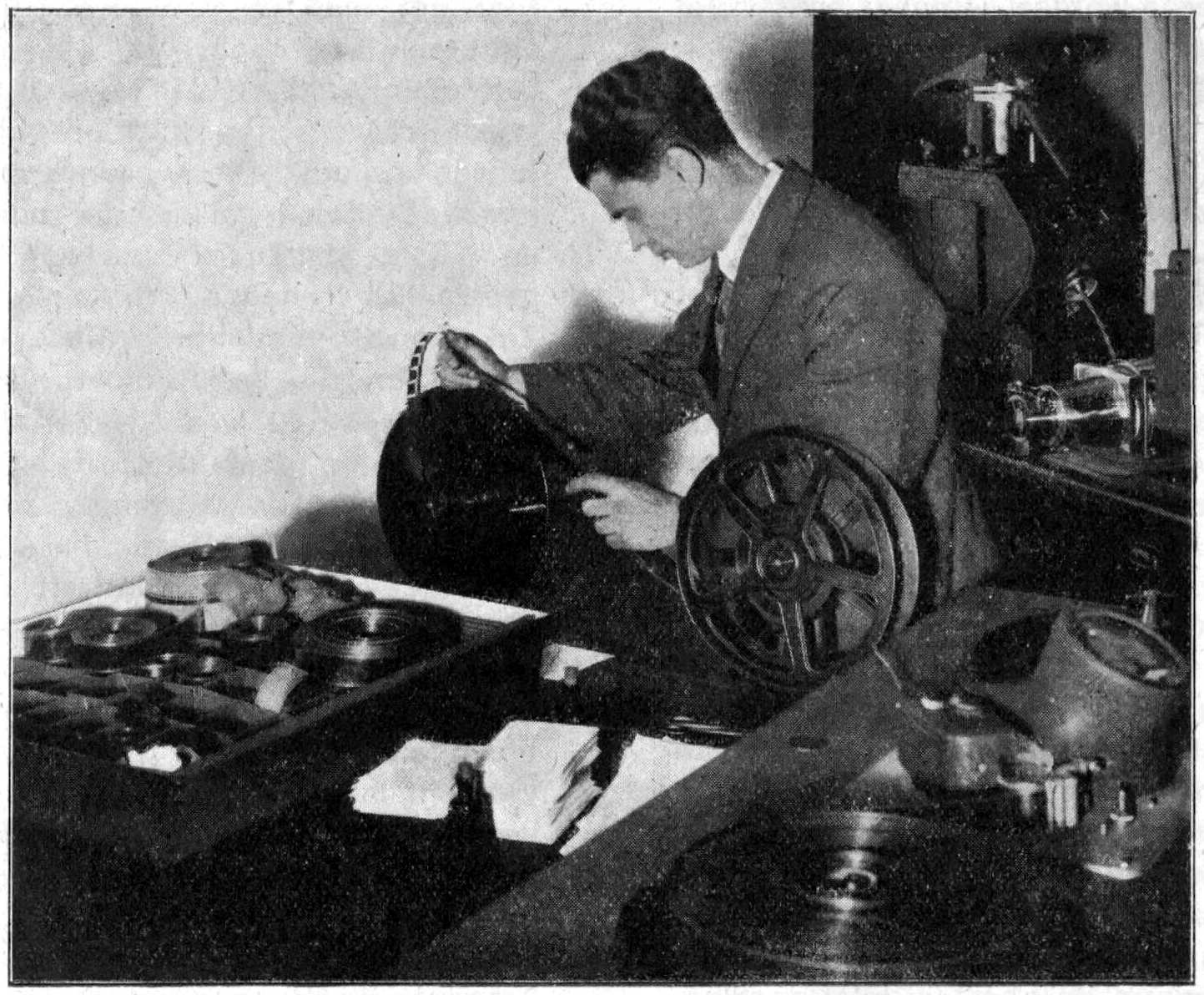
If one asks the producers or film magnates: Why entertainment on such a low level, why so few good pictures?–they always hide behind the box-office, which they insist represents the wishes of the masses. The masses become a sort of big brother. “My big brother likes it that way.” But “big brother” is becoming wiser, more conscious of his own life. He spends his earnings to see these pictures. And he finds them too empty. The industry’s answer is, not better pictures, but the double feature. Still my “big brother” is not satisfied. The pictures give him nothing for tomorrow, for the hard working day. And the industry’s answer? Screeno, and Bank Nights! Still not enough? Then give away a car! What next year, producers, directors?
It is a pity that a few of the leaders of the film industry couldn’t accompany me on my tour on which I showed the films of independent film groups in Holland and Belgium. They would have marvelled at how widespread and lively is the desire for better pictures in all circles, among students, intellectuals and workers. The honest film critic could render great service by voicing this too little expressed desire.
All those who wish to raise the American screen to a higher level should heed the example of the young new theatre movement in America. No other country except the USSR can show such a steady growth of the modern theatre as America. (In Germany, by contrast, the theatre has withered away under the Nazi dictatorship.) Playwrights, directors and actors in New York sense a great task. The American screen must follow their example; the days of merely cursing or deploring Hollywood are over.
Hollywood can produce such pictures as The Informer, Modern Times, Mr. Deeds Goes to Town, Fury, Pasteur. Good artists in Hollywood need the help of the public in order that the box-office risk of such pictures can be reduced. The producer must sense a new terrain with new possibilities. Educational, youth, peace and labor organizations could support such productions, could stimulate the demand for progressive films and form a bulwark against anti-labor, fascist and war tendencies in pictures.
It must be made possible for Hollywood writers, directors and actors and with them the public, to face the real problems of life. The film must take part in the cultural development of the people as must the theatre, literature, music, painting and the radio.
Why shouldn’t directors, screen writers and actors found an experimental studio for a systematic examination of the fundamental laws of the art of the film? This is essential. This studio would shoulder the cost of the experiments which the producers of feature films do not want to assume. Special studio films intimately associated with the reality of the world would enrich their aesthetic sensitivities and give new vitality to their work.
Independent film groups are engaging in courageous pioneer work with already excellent professional quality: Nykino’s Labor March of Time, American Labor Films’ Millions of Us. It must go on. For the public good pictures are indispensable in its struggle for life.
Pictures with the power, the artistic level and the social function of books like Don Quixote, Uncle Tom’s Cabin are now due in America. A young film movement must open the way.
The New Theatre continued Workers Theater. Workers Theater began in New York City in 1931 as the publication of The Workers Laboratory Theater collective, an agitprop group associated with Workers International Relief, becoming the League of Workers Theaters, section of the International Union of Revolutionary Theater of the Comintern. The rough production values of the first years were replaced by a color magazine as it became primarily associated with the New Theater. It contains a wealth of left cultural history and ideas. Published roughly monthly were Workers Theater from April 1931-July/Aug 1933, New Theater from Sept/Oct 1933-November 1937, New Theater and Film from April and March of 1937, (only two issues).
PDF of full issue: https://www.marxists.org/history/usa/pubs/workers-theatre/v3n10-oct-1936-New-Theatre.pdf

