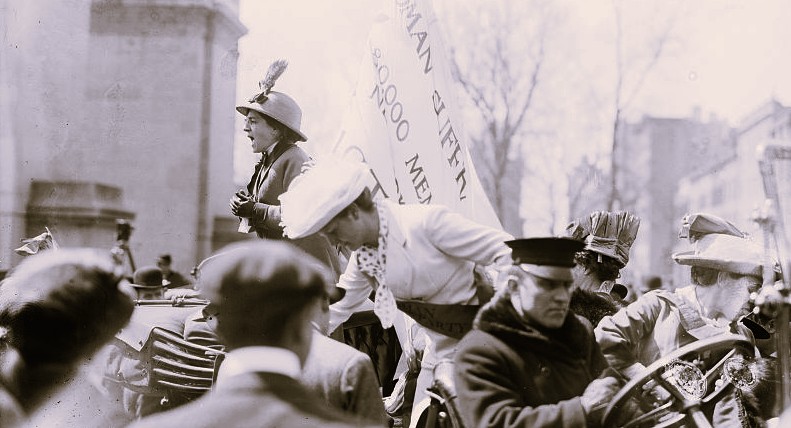
Before the inauguration of International Women’s Day, Socialists had set aside a day in late February as ‘Woman’s Day.’ Here pioneering radical librarian Maud Malone (and future librarian of the Daily Worker) leads a manifestation of Socialist suffragettes in New York City at the beginning of the election year of 1908.
‘Women Protest’ from The Weekly People. Vol. 17 No. 48. February 22, 1908.
NO PARADE, BUT HOLD ROUSING MEETING.
Stirring Speeches–City Administration Criticized–Blame Male Voters for Panic and Unemployed–Ballot and Pay Envelope Should Go Together.
Union Square was the gathering place of about 2,000 woman suffragettes last Sunday afternoon. Most all wore the yellow buttons, “Votes for Women,” and carried leaflets written in behalf of the right of woman to the ballot. It was intended to have a parade, but a squad of police was on hand to prevent any marching. Miss Malone therefore addressed the throng of women and told all to follow her and the committee, It was thought to move up to Madison Square and hold a meeting there. But the police were again on hand to stop any speech-making. A hall was in readiness at 211 E. Twenty-third street, and thither everyone flocked.
Miss Malone in opening the indoor meeting scored the police administration severely. Remarking that since it was found by the police that to parade on Sunday was against the Sunday laws, she would like to know if all Sunday laws were being as strictly enforced in the city. “Are the laws of looking to relieve the miseries of the people being as carefully enforced as the Sunday laws?” The shot went home.
Mr. Leonard Tuthill followed. He believed in “equal rights to all, special privileges to none.” Men have the special privilege of the suffrage, women are denied the ballot because of their sex. All just government rests on consent of the governed. Women are governed but have no say.
An extensive speech was made by Mrs. Lydia K. Commander, who urged the necessity of enlisting workingwomen to the cause.
“All through life, from cradle to the grave, the sexes stand shoulder to shoulder, woman bearing the additional burden of bearing children and rearing future citizens.
“There are one million female farm laborers, as many more in the mines and in the mills and shops. Three-fourths of the ready made clothes are produced by women. In fact, in everything does woman share the burdens equally with man, but at the polls she is denied her say. Not the ballot and the musket should go together, but the ballot and the pay envelope,”
Mrs. Borrman Wells, the prominent woman suffragist from England, asked:
“How many women in New York have a holiday today? They work week days and Sunday, and starve as many days. Since the law allows them to starve all these days why cannot they protest?”
She said that two million children in the country are being ground down by the industrial machinery, and that in New York city alone 170,000 unemployed line the streets. “What are legislators doing about this?”
Another speaker said that women voting could do no worse than men, and not put the country into any worse panic than exists now.
Miss Malone here called upon one of the women in the audience to address the meeting. Mrs. Arnold, who was thereupon introduced, told of her struggle to make a living for herself, her sick husband and three sons. Said she: “After going through all this trouble, bringing up these boys, they get each a vote, but I do not. Why is this, I would like to know!”
The political corruption and the election methods of the political parties were neatly handled by Miss Coleman, who practices law. She said she had stumped in the last campaign in the interest of her father, and she knew that it was money which counts–“democracy” counted for nothing. She demanded the ballot as a social necessity. “If woman was as corrupt as the politicians she would have no need to ask for the ballot; she could buy it.”
Miss Anna Maley said to the men that the women had come to criticize your administration.
“There were now thousands of people unemployed through the men’s use of the ballot.
“We would like to have a try at it. We are competent to vote as intelligently.”
Referring to the claim that only those should have the ballot who bore arms Miss Maley said: “Let those who agitate for war, the captains of industry, the ministers in the pulpit, and the public press, then go to war. But in such case there would be very little shouldering of muskets. These people only cared to have working men do that fighting. They trained the youth of the country up to a kind of patriotism which meant the shooting of Uneeda biscuits and surplus clothing into the foreign markets and the Philippines.
The speaker said that while she was a woman suffragist he was first of all a Socialist.
The women are determined to fight on until their demands are won.
New York Labor News Company was the publishing house of the Socialist Labor Party and their paper The People. The People was the official paper of the Socialist Labor Party of America (SLP), established in New York City in 1891 as a weekly. The New York SLP, and The People, were dominated Daniel De Leon and his supporters, the dominant ideological leader of the SLP from the 1890s until the time of his death. The People became a daily in 1900. It’s first editor was the French socialist Lucien Sanial who was quickly replaced by De Leon who held the position until his death in 1914. Morris Hillquit and Henry Slobodin, future leaders of the Socialist Party of America were writers before their split from the SLP in 1899. For a while there were two SLPs and two Peoples, requiring a legal case to determine ownership. Eventual the anti-De Leonist produced what would become the New York Call and became the Social Democratic, later Socialist, Party. The De Leonist The People continued publishing until 2008.
PDF of full issue: https://www.marxists.org/history/usa/pubs/the-people-slp/080222-weeklypeople-v17n48.pdf

