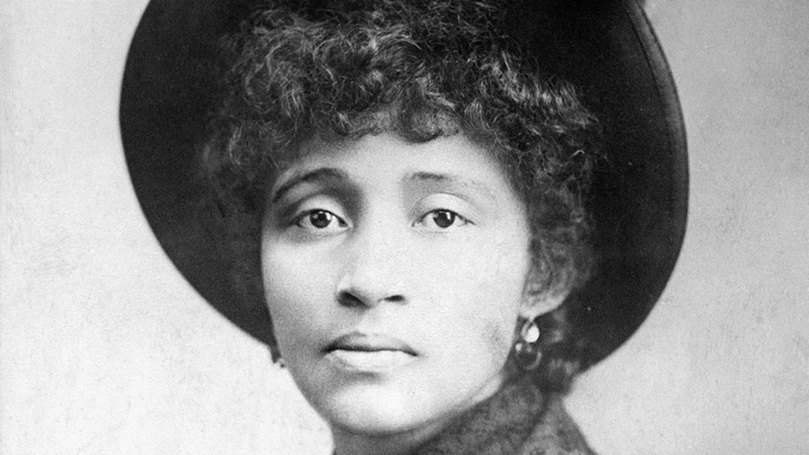
In a sharp intervention, Lucy Parsons, who knew something of the consequences of violence, writes to the reborn Alarm newspaper to castigate violence-baiters then in heated debate with the editor Dyer Lum, and places the bomb thrown at Haymarket in the context of the class war she was a life-long combatant in.
‘That Dynamite Bomb!’ by Lucy Parsons from The Alarm (Chicago). Vol. 1 (new) No. 25. September 1, 1888.
ANOTHER CONTESTANT ENTERS THE ARENA TO DISCUSS THE QUESTION OF FORCE–AN INDIGNANT PROTEST FROM MRS. PARSONS RELATIVE TO SOME RECENT CRITICISMS.
I am rusticating away out here among the beautiful hills in the state of Wisconsin, at the home of the whole-souled “Dan” Hoan, of Waukesha, who says (and one has but to see him to believe him) he wouldn’t exchange places with Jay Gould, I can, therefore, view with equanimity the deluge of criticism being poured upon the devoted head of the editor of The ALARM. And were I not personally acquainted with the mild-mannered, genial editor I should feel sorry for him. But being thus acquainted I shall save my stock of pity for more deserving subjects.
Nor do I wish to be understood as “gallantly” rushing to the editor’s assistance. Neither do I care to be entered as one regularly in the lists in the discussion of force. The question may then be asked:–Well, what are you coming into it for? The only explanation I can give is that of the boy who, seeing his companion slugged by a bigger boy, just rushed into the fray to see if he couldn’t hit about as hard. Well, to the subject, namely, the bomb in particular.
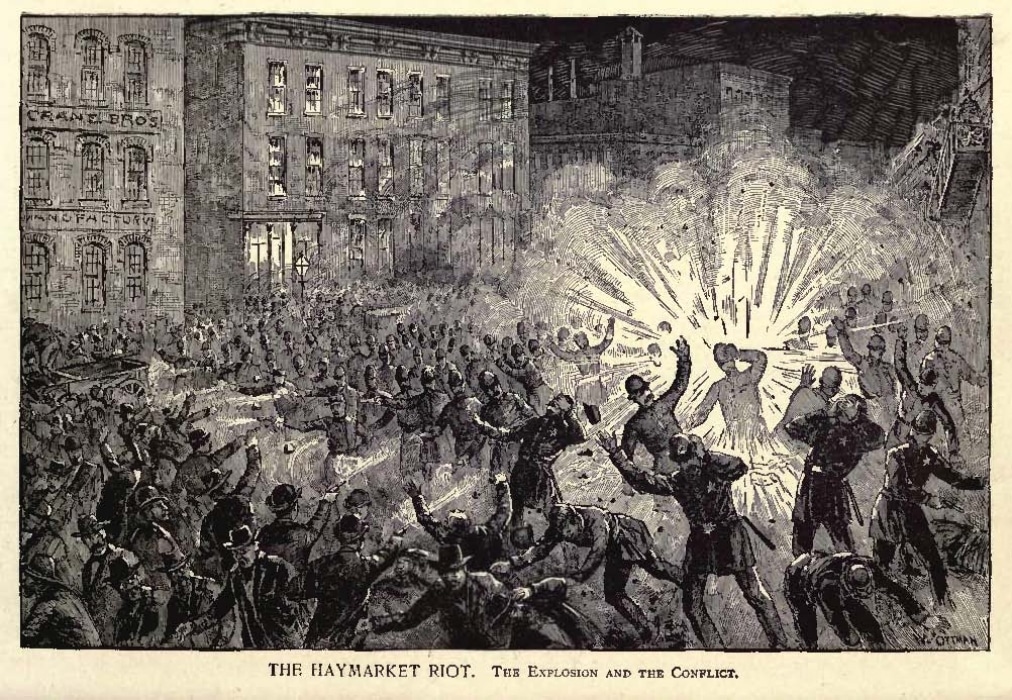
If we wish to appreciate the grandeur of a mountain, we must view it from a certain distance, if we would understand the effect of such and such an effect upon historical development we must read not contemporary history only, but that of succeeding centuries. If these premises are correct, then it seems to me that a good deal that is being said about what that one little bomb did or did not do for the cause is just a little previous. Still there is one view which might be taken of that dreadful bomb. Was it not a new factor in modern warfare? Did it, or did not, give a practical test of what science has done for man, including the poorest? I am not discussing whether that bomb should, or should not, have been thrown at the Haymarket meeting. But did it or not demonstrate that a powerful weapon of warfare had been forged? And that, if used, would make present methods of war practically useless? Did it, or did it not, demonstrate that the “horrible bomb” is a defender of peace? Let us take as an illustration the Haymarket meeting. There were the tactics of the old and the new methods brought into direct contest. The police inarched upon a peaceable meeting at the Haymarket in the order of the latest “street riot drill.” Result: Some unknown person hurls a bomb at the invaders. One man was killed on the spot. Six policemen subsequently died, and over fifty were reported as wounded. A large number of innocent citizens were killed and wounded by police revolvers, but their number is not known owing to the fact that the “authorities” saw fit to keep it hid in order that they might work up public feeling regarding “the awful massacre of the police!”
And it was indeed awful, horrible. No one with a spark of humanity will deny it. Still the question arises did that bomb demonstrate that a powerful weapon could be placed in the hands of the people at small expense? And it also raises the further question: Did the tragedy at the Haymarket, awful as it was, save many fold more persons than were actually killed? Were the 180 police who marched upon that peaceable meeting of unarmed citizens coming for fun or for murder?
And the further inquiry arises: Would the police, militia, Pinkertons, etc., be as willing tools of “the powers that be” in future if they knew, or even thought, probable that there was a likelihood of their running against loaded twenty-cent bombs instead of empty dinner pails, hungry bellies and rags? And if this should be the case would not the murders of La Motte, in this state, Chicago, East St. Louis, Jersey City, and innumerable other points become more rare? and human lives saved?
There is no attempt on my part of painting a “beautiful picture of purely Edenic simplicity;” no “casting of guns and providing all sorts of munitions of war.” On the contrary, it is only claiming the right of the citizen to keep and bear arms.”
Mr. Kelly, getting fairly warned up to his subject, says: “But suppose the men had been fairly proven guilty of organizing to massacre the police and the board of trade how much indignation would there deaths have produced?” Does Mr. Kelly bring in the board of trade to give a lurid background to this picture? Or is it a patent process of making the cold shivers come up and down one’s spinal column these hot days? The wildest imagination of Gary, Grinnell & Co., never hooked on to the board of trade massacre as part of the alleged programme. And the ratification meeting afterwards held by the supreme court never stated they (the defendants) were “organizing a social revolution.”
I feel considerable timidity in having to mention Mr. Kelly’s name, because I am sure that I will be regarded as a midget who should enter the arena where John L. Sullivan was having a contest. Why, the great man would want to know why I “should try to take part in this controversy?” Precisely what Mr. Kelly has already asked Mr. Holmes.
Mr. Perrine says: “When that bomb exploded I heard a cry of horror!” From whom did the cry come? From those who have had occasion to feel the presence of “the guardians of law and order” by a cracked skull or blackened bruises? Or from the “law and order” crowd who value human lives at so much per hundred heads? But, exclaims Mr. P.: “Were it an act of war I should consider myself a fool to ask for a remission of the penalty.” More egoism it is impossible to conceive of in the same number of words. What do you mean by “an act of war,” Mr. P.? Do you place on the same plane the man who commits an “act of war” in self-defense with one who commits an “act of war” for the sake of depriving his fellows of their lives, liberties and happiness? Yet you who are so pronounced for peace in one sentence, prove yourself as blood-thirsty in the next as an inquisitor of the fifteenth century. Are you aware that the penalty, which you would have considered yourself a fool to have asked the remission of, was death upon that blot upon nineteenth century civilization–the gallows? Do you admit, then, that the state has the right to commit murder? And your position, sir, becomes all the more damnable when it is remembered that it has never been denied that the Haymarket meeting was perfectly peaceable until the police rushed in upon it, some flourishing their revolvers as was proven in evidence. You seem to say that all you would have wanted to know whether Mr. Spies and his comrades committed an “act of war” to hand them over to the state murderer with all the complacency of a middle-age monk.
Consistency, thou art a jewel! and all the more so because so few find you.
MRS. A.R. PARSONS.
The Alarm was an extremely important paper at a momentous moment in the history of the US and international workers’ movement. The Alarm was the paper of the International Working People’s Association produced weekly in Chicago and edited by Albert Parsons. The IWPA was formed by anarchists and social revolutionists who left the Socialist Labor Party in 1883 led by Johann Most who had recently arrived in the States. The SLP was then dominated by German-speaking Lassalleans focused on electoral work, and a smaller group of Marxists largely focused on craft unions. In the immigrant slums of proletarian Chicago, neither were as appealing as the city’s Lehr-und-Wehr Vereine (Education and Defense Societies) which armed and trained themselves for the class war. With 5000 members by the mid-1880s, the IWPA quickly far outgrew the SLP, and signified the larger dominance of anarchism on radical thought in that decade. The Alarm first appeared on October 4, 1884, one of eight IWPA papers that formed, but the only one in English. Parsons was formerly the assistant-editor of the SLP’s ‘People’ newspaper and a pioneer member of the American Typographical Union. By early 1886 Alarm claimed a run of 3000, while the other Chicago IWPA papers, the daily German Arbeiter-Zeitung (Workers’ Newspaper) edited by August Spies and weeklies Der Vorbote (The Harbinger) had between 7-8000 each, while the weekly Der Fackel (The Torch) ran 12000 copies an issue. A Czech-language weekly Budoucnost (The Future) was also produced. Parsons, assisted by Lizzie Holmes and his wife Lucy Parsons, issued a militant working-class paper. The Alarm was incendiary in its language, literally. Along with openly advocating the use of force, The Alarm published bomb-making instructions. Suppressed immediately after May 4, 1886, the last issue edited by Parson was April 24. On November 5, 1887, one week before Parson’s execution, The Alarm was relaunched by Dyer Lum but only lasted half a year. Restarted again in 1888, The Alarm finally ended in February 1889. The Alarm is a crucial resource to understanding the rise of anarchism in the US and the world of Haymarket and one of the most radical eras in US working class history.
PDF of full issue: https://digitalcollections.crl.edu/record/1117363?ln=en

