A report and analysis from then Australian Communist and P.P.T.U.S. delegate on the gathering in Bihar, where Ryan attempted and failed to get the Congress to adhere to the Profintern. Also, he meets U.S. comrade Jack Johnstone there who is arrested and held incommunicado by British colonial authorities. By the end of World War Two the Congress would be under Communist authority.
‘The Ninth All-India Trade Union Congress’ by Jack Ryan from Pan-Pacific Monthly. No. 26. May 1929.
Director, Labor Research Bureau, Sydney
THE Ninth Convention of the All-India Trade Union Congress was held at Jharia, the center of the most important coal fields of India, on the 18th, 19th and 20th of December, 1928. Jharia is a town in the province of Bihar, about eighty miles north of Calcutta.
More than ordinary importance must be attached to the Congress because it met at a time when the organized resistance of the working masses against their miserable wages and working conditions had caused the British exploiters and their allies among the Indian capitalist class to adopt extreme methods of oppression, including shooting down in cold blood of strikers and the imprisonment of trade union leaders.
Anti-Labor Bills
Repressive legislation was also on the eve of being enacted; such Bills as the Public Safety Bill and the Trade Disputes Bill had already been introduced into the legislature and it appeared to be inevitable that they would become law in the immediate future. The Public Safety Bill is designed to give the government power to deport “agitators,” even though they be British subjects. When the Trade Disputes Bill becomes law, strikes will become illegal unless the employers are given sufficient time to recruit scabs (one month), and sympathetic strikes will be for bidden under heavy penalties.
Additional interest was given to the Congress by the fact that a number of worker delegates, leaders direct from the rank and file, were in attendance. These worker-leaders are a product of the intensification of the class struggle in India and the general wave of militancy, which is sweeping over the working class and rapidly unmasking the futile lawyer-politician leaders who have held the movement in check to a great extent. Unfortunately, there was still a preponderance of lawyer-politicians at the Congress, but it was obvious that their days as leaders of the trade union movement are numbered. I arrived at Jharia on the evening preceding the opening session, and was introduced to many of the prominent delegates from the various provinces. Most of them spoke fluent English, therefore conversation was not at all difficult. Much whispering and intriguing was going on, and it soon became apparent to me that the older leaders were alarmed at the strength of the left wing or worker elements.
On the opening day the Executive Committee met to discuss the business of the Congress. English was the language used. The Executive Committee numbered about sixty delegates. It was much too large and unwieldy for efficient work; also because of the fact that many non-delegates are permitted to take part and vote, such as past presidents and influential personalities, it was movement. The unfortunate feature of the not truly representative of the trade union whole thing is that the Executive decides all of the questions on the agenda, and the Congress itself adopts the decisions practically without discussion.
Suspected “Blue Sky” Locals
N.M. Joshi, the General Secretary, could not attend, owing to illness. Therefore the assistant secretary, R.R. Bakhale, handled the secretarial work. He reported that the credentials were in a deplorable state and that it was with difficulty that one could ascertain who were and who were not, delegates. As Bakhale is extremely conservative, the confusion over credentials was not favorable to the left wing delegates, who expressed grave doubts regarding the credentials of many of those who claimed to be representing unions in out-of-the-way places.
It appeared that there were approximately 120 delegates, representing 120,000 unionists, at the Congress. This is less than half of the organized workers in India, but is a fairly good representation compared with previous congresses. Owing to the rules making it necessary for a union to have been established twelve months before it can be represented at a congress, the largest union in India–the Bombay Girni Kamgar Union, which is controlled by the left wing-was denied representation.
P.P.T.U.S. Represented
Only credentials and standing orders were dealt with at the first meeting of the Executive. At 4 P.M. the Congress itself was opened by the president, M. Daud. The whole session was devoted to the presidential address, which lasted two hours, and speeches of welcome from delegates of various organizations. Two overseas organizations were represented; the League Against Imperialism, by Jack Johnstone, and the Pan-Pacific Trade Union Secretariat, by myself.
I had met Jack Johnstone at Calcutta a few days previously. He is a well-known working class leader in the U.S.A., having been active in the packing-house strikes and building trades unions for many years. On the Friday before the Congress commenced, he was served with an order signed by the Chief Secretary to the Government of Bengal, ordering him to remove himself forthwith from British India, by sea from the port of Calcutta. The order was made under an Act of 1864, which gives the government power to deport non-British subjects without explanation.
However, Johnstone managed to turn up smiling at Jharia in time for the opening session of the Congress. He delivered a brilliant speech to the delegates, exposing ruthlessly the oppressive character of British imperialism. I followed him, and spoke on the Pan-Pacific Trade Union Secretariat, its aims and objects, the danger of an imperialist war in the Pacific, the necessity of liquidating racial prejudices and the desirability of achieving World Trade Union Unity.
We were both enthusiastically applauded and garlanded with flowers. After speeches had been delivered by Bradley (whom I mentioned in a previous article), Spratt, an Englishman engaged in research work in India, and Jawahalal Nehru, General Secretary of the Indian National Congress, the Congress was adjourned until the following day.
It was 11 P.M. when I left the Congress “pandal” with Johnstone. We were walking along the road towards the center of town. I was telling him and others of my impressions of the Congress, when someone tapped me on the shoulder and said: “Johnstone has been arrested!”
It seemed that Johnstone had been suddenly seized about a hundred yards back along the road. I rushed back, but could only see a motor car speeding away in the distance. Some onlookers told me that Johnstone was bundled into the car which was immediately driven off at top speed. I immediately got into communication with the Indian trade union leaders, who made inquiries at the police station and other likely places. We could get no information whatever as to where Johnstone had been taken. Even after the Congress, diligent inquiries did not reveal the whereabouts of Johnstone.
(Editor’s Note: In the April issue of Pan-Pacific Monthly, Johnstone wrote of his the experiences in India, telling how he was held incommunicado in four different jails, from December 18 till January 3, when he was taken, as a prisoner, on board the Italian ship “Aquila,” and deported under guard through Italy into Austria.)
When the Executive of the Congress met on the day following Johnstone’s arrest, the delegates expressed indignation at the outrage. A strongly worded protest was sent to the government, and it was decided to affiliate with the League Against Imperialism for a period of one year, in order to show the government that its action had the reverse effect to what it had anticipated.
Some Crooked Work
An extremely clever piece of crookery was then indulged in by Diwan Chamanlal and Bakhale, who had both visited Geneva during the year, under guidance of a representative of the International Labor Office of the League of Nations. By shameless misrepresentation, they persuaded the delegates to agree to them using the name of the All-India Trade Union Congress for the purpose of convening an “Asiatic trade union congress.”
Upon request, I was given permission to speak on the subject. I pointed out that Bunji Suzuki, who is an agent of the Japanese government, masquerading as a labor man, was the originator of this scheme, which was designed to further the interests of Japanese imperialism. Also, that the proposition had been adopted by the I.L.O. for the purpose of binding the Indian trade union movement to the boss-controlled League of Nations and the reactionary Amsterdam International. I likewise stressed the fact that this was a blow aimed at the Pan-Pacific Trade Union Secretariat, which had been organized for a considerable period and was functioning effectively. “In any case,” I said, “we should organize on class lines, not as Asiatics against Europeans or vice versa.” Consistent lying by Chamanlal and Bakhale, coupled with lack of knowledge of international matters on the part of the bulk of delegates, carried the day, and it was decided by 43 to 26 to endorse the Asiatic conference. The left wing made a spirited fight on the question; the vote they recorded was an indication of their strength in the Executive.
Attack On I.L.O.
An attack was then launched against the I.L.O. by the left wing. It was pointed out that the I.L.O. was an adjunct of the imperialist League of Nations and that no good purpose had been, or could be, served by sending delegates to Geneva. The lawyer-politicians realized only too well that if a break was made with the I.L.O., their chances of a free trip abroad would vanish. They fiercely opposed the proposal of the left wing not to send any more delegates, but in doing so they did not defend the I.L.O., nor speak one word in favor of it. In fact they agreed with practically everything the left wing delegates had said. However, they pleaded that it was a pity to lose the opportunity of sending representatives abroad, who would be able, so they claimed, to broadcast the sufferings of the workers of India in England and other European countries. By almost exactly the same number of votes as on the previous question, the left wing proposal was defeated.
Delegates were then elected for the next Geneva conference. It was pitiful to notice the excitement and enthusiasm of some of the briefless barristers who by some method or another fasten themselves on the Indian trade union movement in order to obtain a nomination for Geneva. They speedily disrupted the meeting in their eagerness. I am strongly of the opinion that the connection between the I.L.O. and the Indian Trade Union Congress is the most important retarding influence on the Indian trade union movement. Worker delegates are elbowed out of leading positions of the movement by “educated” opportunists whose whole ambition is to gain a trip to Geneva. A break with the I.L.O. would automatically mean that these parasitical elements would find other methods of personal advancement, thereby allowing the workers a greater control of their own movement.
In order to be able to send more tourists to Geneva, it was decided to “demand” of the government that two advisers for each item on the agenda of the next conference be sent with the delegates, otherwise no delegates will be sent. It is unlikely that this plea, camouflaged as a threat, will be given effect.
Amsterdam Hotly Condemned
On the agenda there was a proposal to affiliate to the International Federation of Trade Unions (Amsterdam). In discussing this item, the delegates took the opportunity of denouncing the Amsterdam International as a tool of the imperialists. Condemnation came from delegates of all schools of thought. Only one delegate–Kirk, an Englishman from Madras, who is suspected of being in the pay of the British authorities, spoke in support of affiliation. There were others, such as Bakhale, who favor Amsterdam, but they were so overawed by the torrent of condemnation for that organization that they remained silent.
Eventually, it was decided to affiliate with neither International until world trade union unity is achieved. This resolution automatically disposed of another item on the agenda, which proposed affiliation to the Red International of Labor Unions.
An outburst of criticism of the British Trade Union Congress occurred when it was decided to sever connections with that body and not to allow it to be the agent in England of the Indian Trade Union Congress in the future. The majority of the delegates were of the opinion that the British T.U.C. is a lackey of British imperialism, and that it is assisting the exploiters of India to perpetuate their rule. A motion to appoint the Workers’ Welfare League of India as the London agent of the Indian Trade Union Congress was defeated, owing to the opposition of Diwan Chamanlal and Bakhale.
When the question of affiliation to the Pan-Pacific Trade Union Secretariat came up for decision, I was permitted to address the delegates once more. There was very little actual opposition to the Secretariat, except from Bakhale, but it could easily be seen that the fears of the right wing delegates had been played upon and that they felt diffident about joining up with an international trade union organization. A motion was made to affiliate with the P.P.T.U.S.; then an amendment was moved suggesting the postponement of the matter for one year. The amendment was carried by 36 votes to 28.
Much time had been taken up disposing of the foregoing matters, therefore adequate discussion could not be given to many resolutions dealing with various questions that were brought forward. Dozens of resolutions were adopted at an incredible speed. Some of the resolutions were excellent, particularly the resolution calling for a general strike if the Trade Disputes Bill is enacted. Other resolutions were not so good, but there were few really bad decisions. Most of them deal with problems in India itself and need not be outlined in this article. One resolution called upon the workers of Battersea (England) to vote for Saklatvala at the next elections in Britain.
Fight for Worker Leadership
An interesting position arose over the election of president for the ensuing year. Jawahalal Nehru, General Secretary of the Indian National Congress, was nominated. He is well-known personally in India, but has not been active in the trade union movement, nor is he a worker. Gulkirni, a practically unknown worker from Bombay, was also nominated. In the past it has been the custom to elect the president by a unanimous vote, but on this occasion it was significant that the nominee of the officials, Nehru, was elected by a small majority of seven votes. This is important, as it displays, rather forcibly, the desire of a greater number of delegates than usual, to have workers in the leading positions. Joshi was reelected, unopposed, to the position of General Secretary.
All of the questions mentioned were decided upon by the Executive Committee, also many others of minor importance. They were then submitted to the full Congress and adopted practically without discussion.
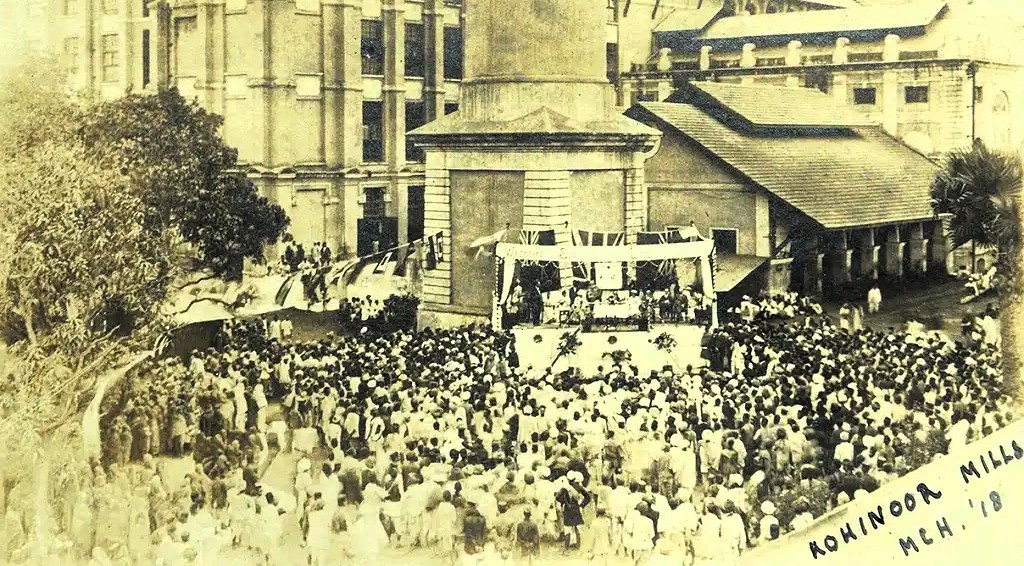
The Congress itself was held in a huge canvas structure called a “pandal.” As mentioned previously, there were approximately 120 delegates. Several thousand workers attended the open sessions. They had to pay for admission. I was informed that if a charge for admission was not made, the “pandal” would be overrun by enthusiastic workers. This, to my mind, proves that the workers of India are enthusiastic about their unions.
Briefly summing up the Congress, while there were no remarkable changes in policy, the IX Congress was more important than previous congresses because a definite, energetic and organized left wing made its appearance for the first time. In addition, there was a decided opinion among a large number of delegates, that there were far too many lawyer-politicians in the movement and that the workers themselves should have a greater measure of control.
Future Outlook Good
For the future, the prospects are decidedly encouraging. The left wing is rapidly gaining strength and importance, mostly by its intensive organizing of previously unorganized workers and its successful handling of strikes. By the time the next congress is convened, there is every reason to believe that the left wing will be no longer a minority, and that the old conservative leaders will be defeated. Even at this Ninth Congress, the left wing would have been considerably larger had it not been necessary for several of the Bombay militants to remain in that city owing to the strike movements there. The victory of the left wing will immensely strengthen the movement for trade union unity and effective action in the Pacific area.
The growing strength of the militants and the awakening of the Indian workers have not been unnoticed by the British authorities, Shootings of strikers have become a regular who are becoming ever more oppressive feature and, as already mentioned, repressive legislation is being introduced into the legislatures.
The potential strength of the aroused Indian workers is so enormous, however, that the efforts of the British imperialists to hold them in check must surely prove futile.
The Pan-Pacific Monthly was the official organ of the Pan-Pacific Trade Union Secretariat (PPTUS), a subdivision of the Red International of Labor Unions, or Profitern. Established first in China in May 1927, the PPTUS had to move its offices, and the production of the Monthly to San Francisco after the fall of the Shanghai Commune in 1927. Earl Browder was an early Secretary of tge PPTUS, having been in China during its establishment. Harrison George was the editor of the Monthly. Constituents of the PPTUC included the Australian Council of Trade Unions, the All-China Federation of Trade Unions, the Indonesian Labor Federation, the Japanese Trade Union Council, the National Minority Movement (UK Colonies), the Confédération Générale du Travail Unitaire (French Colonies), the Korean Workers and Peasants Federation, the Philippine Labor Congress, the National Confederation of Farm Laborers and Tenants of the Philippines, the All-Union Central Council of Trade Unions of the Soviet Union, and the Trade Union Educational League of the U.S. With only two international conferences, the second in 1929, the PPTUS never took off as a force capable of coordinating trade union activity in the Pacific Basis, as was its charge. However, despite its short run, the Monthly is an invaluable English-language resource on a crucial period in the Communist movement in the Pacific, the beginnings of the ‘Third Period.’
PDF of full issue: https://www.marxists.org/history/international/profintern/pan-pacific-monthly/n26-may-1929-PPM.pdf

