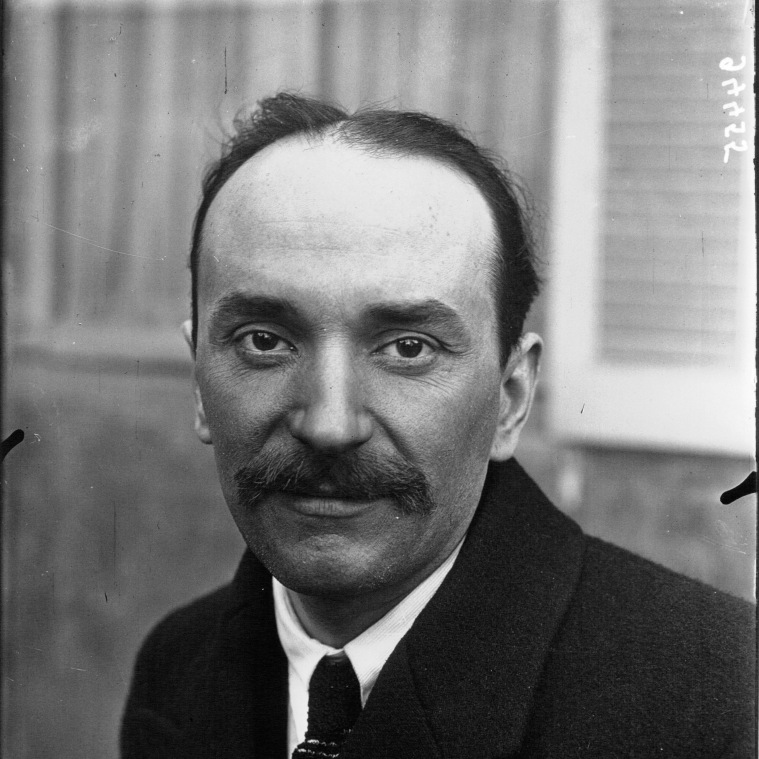
Ker says that opposition to the Versailles Treaty was the essential framework of post-war Communist organizing in France. Antoine Ker (Keim), a professor of economy, was a central figure of the early French Communist Party and its international representative who died on July 21, 1923 at 37.
‘Against the Treaty of Versailles’ by Antoine Ker from International Press Correspondence. Vol. 3 No. 2. January 18, 1923.
The program of action of the French Communist Party places the fight against the Versailles treaty in the foreground of our tasks. It lays upon us the duty of strengthening by word of mouth and by aid of the press the feeling of solidarity binding the workers of France to the workers of Germany. At the same time it imposes, upon us the duty of fighting with equal energy against French imperialism where it is endeavouring to oppress the peoples of Central Europe and the Balkans, the victims of the treaties of St. Germain, Neuilly, Trianon, and Sevre.
Besides this, the program demands a systematic intensification of our propaganda in the army, and an increase of communist work among the exploited colonial peoples. In this manner various duties are expressed as being special tasks of the French revolutionists, though at the same time coming under the general heading of the universal struggle of the proletariat against treaties of robbery and enslavement: the chief of these special tasks is the exposure of the parasitical character of the French bourgeoisie, and the lending of effectual support to the proletariat of the vanquished and vassal states, and to the colonial slaves.
Action in the colonies.
The colonial peoples were appealed to by France and England to fight for right and liberty. France has exhausted to a great extent the reserves of human material in Northern Africa, Senegal, the Soudan, Madagascar, and Indo-China. France made the most alluring promises to its colonial slaves. The Arabs of Algeria even hoped for civil rights. All these illusions have become cruelly destroyed. The yoke of the motherland has become even heavier and more oppressive than before the war. North Africa in particular is experiencing a reign of terror. There the communists are practically outlawed. Their letters are opened, their press suppressed and they themselves maltreated.
But at the same time the general movement among the colonial peoples has become a great revolutionary force. It has become a source of indescribable embarrassment for England, and is beginning to occupy public opinion in France. When thrown into the uncertain balance created by the Versailles peace treaty, the demand of the oppressed colonial peoples for emancipation may be of decisive weight. Therefore the party must support the native proletarians in their national, political and trade union struggles.
Help for the proletarians of Central Europe.
By the peace treaties our bourgeoisie has created for itself a number of powerful levers for the extension of its political and economic dominance on the continent of Europe. These treaties are besides, supplemented by a number of more or less secret or at least obscure agreements, ensuring the participation of French capital in the great industrial, commercial, and building undertakings of the vassal states of Poland, Czecho-Slovakia, Hungary, Austria, Yugoslavia, Roumania, and Bulgaria. In this manner powerful groups of capitalists, represented by our greatest firms (Creusot, de Wender, Acieries de la marine, Credit Lyonnais, Banque de Paris et des Pays-Bas, Union Parisienne), with the aid of the French government, have been enabled to take an important share in the metal industry, the mines, the textile industry, the railways, the ports, and the banks of the states created or enlarged by the dissolution of the Austro-Hungarian monarchy.
This financial, industrial, and military protectorate is nothing more nor less than a veiled form of territorial extension. In any case the role being played by our bourgeoisie in the countries of Central Europe and the Balkans creates clearly defined tasks for the French communists. The action of our capitalism in these countries shows itself in two forms: in economic penetration, and in the White Terror. It is the French bourgeoisie which instigates and leads the reaction in Poland, Hungary, Yugoslavia, Bulgaria, and Austria. And therefore the communists must come to the aid of the proletariat of the countries thus dominated by France, must aid them in their press, their agitation in the country, and their efforts in Parliament.
The enormous profits yielded by the exploitation of Central Europe, and the projects for a complete seizure of German economy, clearly show the parasitical character of French capitalism. Our bourgeoisie is surprised that Germany’s solvency does not increase in proportion to the requirements of the French budget. It wants to submit Germany’s finances to the strictest control, it wants to stabilize the mark, collect the German taxes, balance the German budget–and all this in order to save itself from the inevitable financial ruin. The balance of our state finances, and the hope of restoration of our ruin, are based on the expectation that a foreign power will pay tribute. In France we have not had the courage to tax the bourgeoisie to the degree in which it has been done in England. The French minister of finance las no other plan for clearing off deficits than the hope of German payments, in which but few people still believe. It is a perfect impossibility for Germany to pursue any sensible financial policy if we continue to increase our demands without reference to the improvement or deterioration of Germany’s position. Our government wants to force Germany, by economic and military compulsion to raise money by further developing her foreign trade. But in this way production is ruined more and more, and the result is more harm than good. But what does this matter to our bourgeoisie, so long as it does not have to pay!
During the war we exposed the lie of national defense; today we have to expose the parasitical role played by French capitalism, its annexations and extortions. Too often have limited ourselves to criticizing the world bourgeoisie in general terms. Let us now take up the conflict with our own bourgeoisie in particular, for in view of the leading part which it is playing in world reaction, it is the most dangerous enemy of the world proletariat.
International Press Correspondence, widely known as”Inprecorr” was published by the Executive Committee of the Communist International (ECCI) regularly in German and English, occasionally in many other languages, beginning in 1921 and lasting in English until 1938. Inprecorr’s role was to supply translated articles to the English-speaking press of the International from the Comintern’s different sections, as well as news and statements from the ECCI. Many ‘Daily Worker’ and ‘Communist’ articles originated in Inprecorr, and it also published articles by American comrades for use in other countries. It was published at least weekly, and often thrice weekly.
PDF of full issue: https://www.marxists.org/history/international/comintern/inprecor/1923/weekly/v03n02-jan-18-1923-Weekly-Inprecor-stan.pdf

