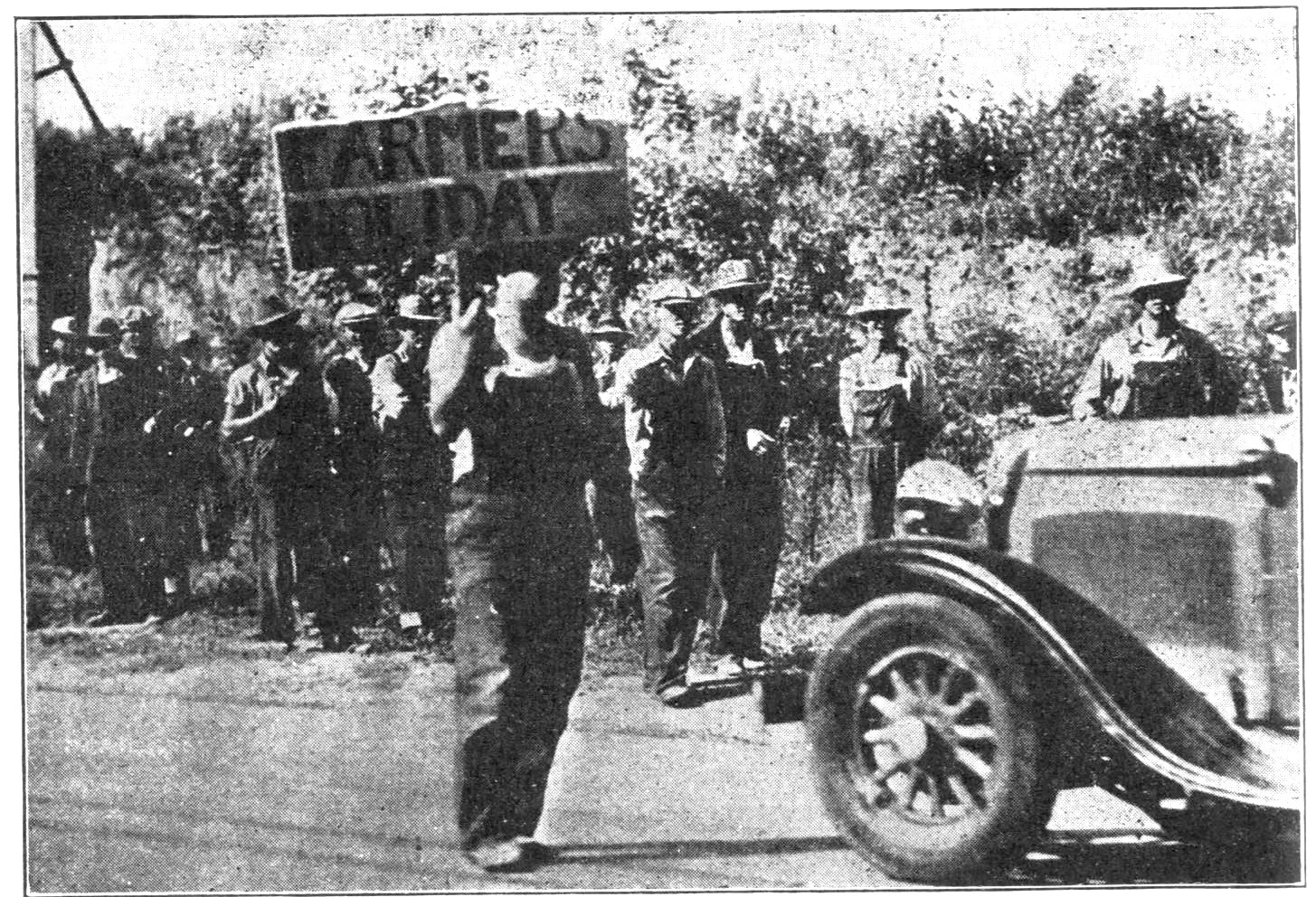
Actual farm strikes are rarer than hen’s teeth in this country. A look at the ‘Farmer’s Holiday’ movement in the as it gathered momentum in the Upper Midwest.
‘The Farm Strike’ by Arnold Sather from Labor Age. Vol. 21 No. 9. September, 1932.
READING a leading article in one of the papers of the Middle West one comes across this statement, “Meanwhile deputy sheriffs were forced to lay down tear gas barrages on highway 34 leading into Council Bluffs Tuesday night as picketers changed their methods from ‘peaceful persuasion’ to ‘forceful blockading’.” Does this statement refer to a strike carried on by the miners of Illinois or by textile workers in Massachusetts? No. It refers to striking farmers in Iowa. For the first time in history farmers have adopted the direct action methods of their city brothers in an attempt to secure justice. They have gone out on strike. They have not struck against their employers, for farmers are supposed to employ themselves. But as producers they have struck against buyers and middlemen in an attempt to secure cost of production for their commodities.
The writer first heard intimations of a possible farmers’ strike in the fall of 1930 while he was attending the annual convention of the Farmers Educational and Cooperative Union of America in Omaha, Neb., J.J. O’Shea, Roberts, Montana, secretary-treasurer of that organization, on the floor of the convention, uttered words to this effect: “If we as farmers cannot secure cost of production for what we have to sell through legislative appeal we will resort to direct action. We will buy nothing, sell nothing, do nothing and thus compel society to render justice to us.”
This summer the strike idea, as expressed by O’Shea, took root in the rolling farm land of Boone County, Towa. On the various roads leading into the town of Boon, farmer pickets appeared to stop truck loads of hogs, grain, poultry, cream and other farm commodities, and gently but firmly insisted that the drivers turn back and return the products to the farms from which they came. “There is a farm strike on,” said the picketers “and no farm products go to market until prices go up.” Some of the drivers turned back readily enough. Others insisted on going to market. Then the picketers resorted to other methods of persuasion. They leaped on the running boards, snatched the ignition keys from their locks and threw them among the roadside weeds; or they threw heavy planks thickly studded with spikes in front of the trucks; or perhaps a heavy piece of timber came crashing through the windshield. In case of a cream truck where the driver insisted on going on the cream cans were upset and thick streams of precious cream flowed from shiny cans into the ditch along the road. This particular act aroused the ire and enmity of the residents of Boone and of other Iowa towns. Many of them have not been able to afford such a luxury as cream in their coffee in months and even years. Many of them could not afford to buy milk to feed to their children. To them wasting cream in this manner was a sacrilegious act. It increased their dislike for the farmer. It served as another wedge to drive farther apart the people of the town and of the country.
Most newspaper readers did not think the strike would amount to very much. But it has spread rapidly in the past few weeks into Nebraska, South Dakota, Wisconsin, Minnesota, Michigan, and may at any time spread into other states. All summer farmers have held mass meetings in all parts of Iowa for organization purposes. Committees of farm leaders meet frequently to plan how best to conduct the strike, and how to interest farmers in other states in the movement. The national leader is Milo Reno, past President of the Farmers’ Union of Iowa.
The strike came into national prominence a short time ago when dairymen in the vicinity of Sioux City, Iowa, demanded a higher price for their milk from the distributors than they had been receiving. They had been getting only $1.00 per hundred pounds. They demanded $2.17 per 100 pounds. Later they compromised on $1.80. Farm picketers concentrated their efforts on Sioux City attempting to stop completely the entrance of all farm products to that city. They succeeded so well that nothing came into that city save what arrived on trains. Farmers even began to attempt interfering with train movements. Yet for all the activities of the strikers no noticeable results were to be seen on the markets. Farm products continued to fall in price.
No sooner did the farmers begin their picketing activities than the officers of the law rushed into action. The sheriffs in the various affected counties swore in deputy sheriffs by the hundreds. Many of the latter were chosen from the unemployed, who were most happy to secure not only something to do but a great deal of excitement as well.
It was the duty of officers of the law to see that the farmers did not resort to violence in the process of enforcing their demands, and that the highways were kept open for traffic. They insisted they would not interfere with ‘peaceful’ picketing. But if any truck driver failed to be influenced by “peaceful” persuasion and insisted on going through the picket line he had but to appeal to the officers of the law and they would escort him through safely.
To date there have been almost no fatalities in this strike, though a few of the farmers have been wounded in their skirmishes with the officers of the law and hundreds of them have been arrested. Every day sees fresh recruits on the picket lines, more meetings held with a growing attendance and interest, enthusiasm rising to fever heat. As far as the general public is concerned the “farm holiday” as the strike is generally called is crowding prohibition off the map and off the front pages of the press. So far the concentration spots of strike activity have been Sioux City, Council Buffs and Omaha. As the movement grows other cities will draw the attention of the strikers.
Milo Reno says that the aim of the strike is to secure economic justice for the farmer. He says further, “For 12 long, weary years we had petitioned Congress to correct a deflated situation in agriculture only to be refused. Promises were made only to be broken, until finally the farmer, discouraged, broken-hearted and bankrupt, has come to realize that he is at the parting of the ways and that if his rights as an American citizen and an independent owner and operator of a farm are restored it will be by and through his own efforts.”
As far back as 1927 the Corn Belt Committee, a group of men selected by the major farm organizations of America met in Des Moines and passed the following resolution: “If we cannot obtain justice by legislation, the time will have arrived when no other course remains than organized refusal to deliver the products of the farm at less than production costs.”
Evidently the farmers of the Middle West have concluded that the arrival of the summer of 1932 marks the end of depending upon the unreliable promises of politicians, and marks the beginning our their determination to take matters into their own hands.
Labor Age was a left-labor monthly magazine with origins in Socialist Review, journal of the Intercollegiate Socialist Society. Published by the Labor Publication Society from 1921-1933 aligned with the League for Industrial Democracy of left-wing trade unionists across industries. During 1929-33 the magazine was affiliated with the Conference for Progressive Labor Action (CPLA) led by A. J. Muste. James Maurer, Harry W. Laidler, and Louis Budenz were also writers. The orientation of the magazine was industrial unionism, planning, nationalization, and was illustrated with photos and cartoons. With its stress on worker education, social unionism and rank and file activism, it is one of the essential journals of the radical US labor socialist movement of its time.
PDF of full issue: https://www.marxists.org/history/usa/pubs/laborage/v21n09-sep-1932-labor-age.pdf

