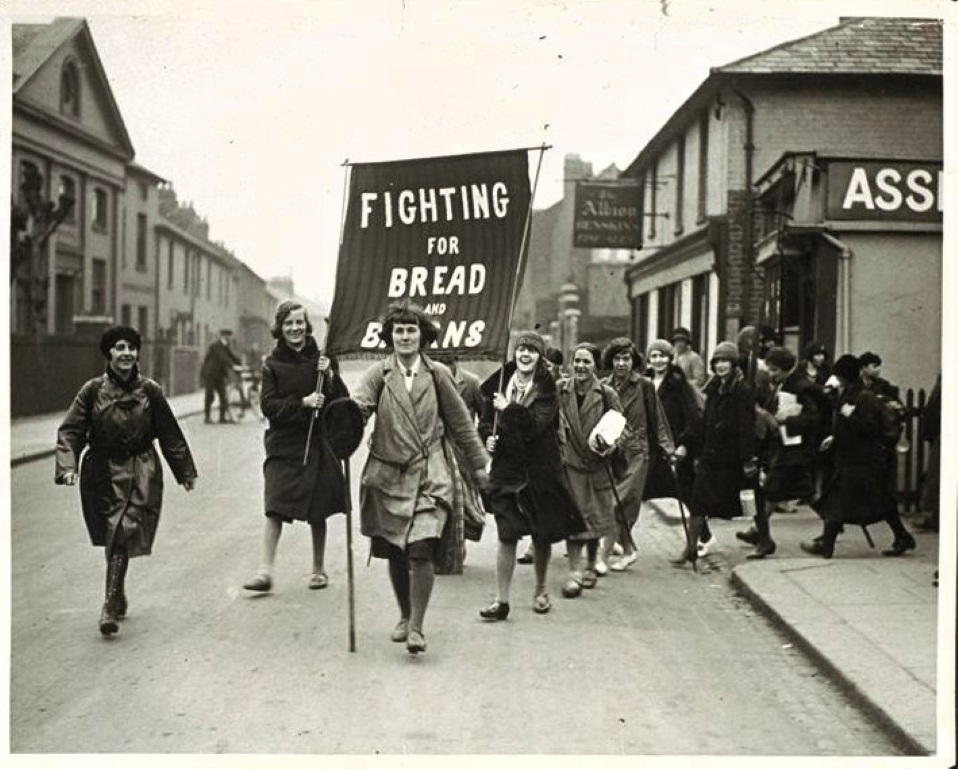
Women’s participation and specific demands on the first national Hunger March of the Great Depression in Britain, then governed by the Labour Party of Ramsay MacDonald.
‘British Unemployed Women and the Hunger March’ by Lily Webb from International Press Correspondence Vol. 10 No. 24. May 22, 1930.
The great hunger march of British unemployed workers who arrived in London on May 1st is historic not only because it is an organised mass demonstration against the Labour Government but also because for the first time women workers and workers’ wives took part as marchers. Special women’s contingents were marched from the textile areas of Lancashire and Yorkshire and were joined by women from the coal fields, and from engineering centres like Sheffield where 6,000 women are unemployed. The march organised by the National Unemployed Workers’ Movement and the Communist Party helped to expose the general anti-working class policy of the Labour Government and particularly its betrayal of the unemployed workers whose numbers have increased by 500,000 under the Labour Government. Unemployment amongst women has risen to 500,000. The registered unemployed women have increased by 107,500 under Labour’s rule. In the textile industry alone there are 120,000 women unemployed. Unemployed women are treated with brutality at the labour exchanges being forced to stand in long queues outside the labour exchanges, many times in a fainting condition due to lack of food. The government and employers representatives exert every effort to trick them out of their unemployment benefits and to force them into sweated Occupations and into domestic service at home or in the dominions. Since the advent of the Labour Government 200,000 women have been deprived of their unemployment benefits and thousands have been forced into unsuitable occupations.
This brutal treatment is increasing the militancy of the unemployed women as shown by their participation in demonstrations organised by the National Unemployed Workers’ Movement (N.U.W.M.) by the increasing numbers who are joining the N.U.W.M. and by the support they have accorded to the great hunger march. In the textile areas committees of women were elected to organise aid for the marchers and to strengthen the women’s contingents. The employed women textile workers whose low wages have been reduced by the Labour Government gave support to the march by collecting subscriptions at the factory gates. Big meetings were held outside the labour exchanges in spite of the police who frequently broke up the meetings and molested or arrested the speakers. Women took an active part in these meetings in spite of the ferocity of the police. The spirit of the women is typified in one woman who said “nothing could be worse than what I am suffering now”.
In addition to the special women’s contingents, women accompanied various sections of the marchers for long distances with special banners. Women were the most active in every district on the marchers aid committees organised by the Workers’ International Relief along the whole route. Besides the general economic and political demands of the marchers put forward the following special charter of demands: 1. a) Increases of unemployment insurance benefits of women to; women over 18 years of age 30/- per week. Girls 16 to 118 years 15/- per week. Girls 14 to 16 years 10/- per week. Adult dependents 10/- per week. b) Abolition of the practice of driving skilled women workers and factory worker, etc. into domestic service and into uninsured occupations. c) Abolition of compulsory domestic training or other kinds of training. Full rate of benefits to be paid to all women who volunteer for such training. d) Proper treatment at the labour exchanges. e) No disallowances of benefits of married. women on the grounds of children being a barrier to them securing work. f) Each dependent child 5/- per week. g) Special allowance for sick children 5/- per week. h) Special maternity grant for all women at least one month before and one month after child birth of 10/- per week. i) Unmarried and married women living apart from their husbands 30/- per week. k) Dependent child of unmarried mother or mother living apart from her husband 5/- a week. 2) The provision of a state pension of 30/- a week to all working class widows. The scales of unemployment pay for unemployed women at the present time are as follows: 16 years of age 5/-, 17 years of age 7/6 per week, 18 to 20 years of age 12 per week, 21 to 65 years of age 15/- per week.
Along the whole route and at the great rally in London on May 1st employed and unemployed women workers put forward these demands of the women workers and exposed the anti-proletarian policy of the Labour Government.
Naturally everything possible was done by the Social- Fascists to sabotage the march, to starve the marchers and to prevent them reaching London. To what length they were prepared to go was shown in the action of Mary Sutherland, a woman agent of the Scottish Labour Party, who systematically traversed the whole of the route a day or two ahead of the Scottish contingent and tried to persuade the workers to refuse support to the marchers. In spite of the efforts of the capitalists and social-fascists, the workers supported the march. In the mining village of Auchinleck which the marchers reached foot sore and hungry in face of extreme cold and a heavy gale and where the local reactionaries refused to give shelter to the marchers the miners wives of the U.M.S. Women’s Guilds stepped into the breach and provided accommodation. For assisting the marchers three miners’ wives have been expelled from the Scottish Labour Party. The organised opposition of the women social-fascists can be well understood. At the general election millions of working women voted Labour Party candidates on the strength of extravagant promises that a Labour Government would better the conditions of the working class. The hunger march exposed the real role of the Labour Government to the masses of working women and this explains why they so actively opposed it.
In spite of the efforts of capitalism and social-facism the women marchers battled through to London assisted by the rank and file workers who are themselves the victims of capitalist and social fascist rule The hunger marchers from Scotland, South Wales, Lancashire, Yorkshire, and the N.E. coast took part in the May-Day demonstrations in London, to the number of 10,000. It was pointed out in the press that the group of Women hunger marchers was greeted with exceptional enthusiasm. In such mass movements as this the working women will learn the necessity to fight against capitalism and social-fascism for the social revolution under the leadership of the Communist Party.
International Press Correspondence, widely known as”Inprecorr” was published by the Executive Committee of the Communist International (ECCI) regularly in German and English, occasionally in many other languages, beginning in 1921 and lasting in English until 1938. Inprecorr’s role was to supply translated articles to the English-speaking press of the International from the Comintern’s different sections, as well as news and statements from the ECCI. Many ‘Daily Worker’ and ‘Communist’ articles originated in Inprecorr, and it also published articles by American comrades for use in other countries. It was published at least weekly, and often thrice weekly. A major contributor to the Communist press in the U.S., Inprecorr is an invaluable English-language source on the history of the Communist International and its sections.
PDF of full issue: https://www.marxists.org/history/international/comintern/inprecor/1930/v10n24-may-22-1930-inprecor-Virginia.pdf

