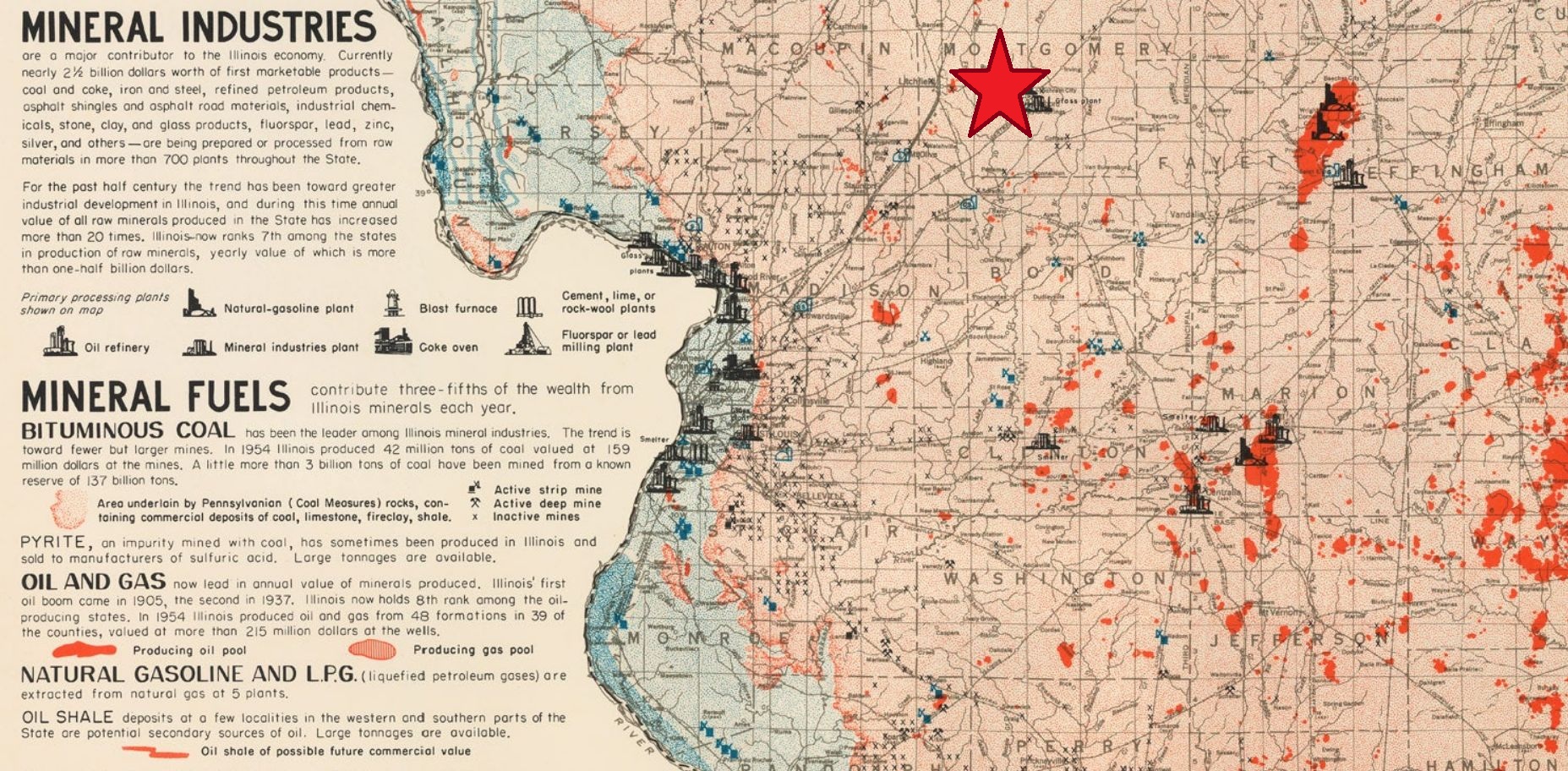
Zinc miners try for a union in the strongly U.M.W.A. coal region of Southern Illinois.
‘Zinc Miners Battle Thugs in Illinois’ by Carl Haessler from The Worker. Vol. 4 No. 289. August 25, 1923.
TAYLOR SPRINGS, ILL. “Another of them damn reporters.”
That was the word went round among miners and smeltermen on the sidewalk in front of Miners’ Hall in Taylor Springs, Ill., as I dropped off the Hillsboro jitney and prepared to break the ice they had carefully presented to the St. Louis Star reporter when he tried to get news out of them for the capitalist press Taylor Springs is a fair bit northeast of St. Louis.
A smelterman had been shot by a gunman on the third day of the 100 per cent strike against low wages, 12 to 16 hours a day and scab shop. The gunman was also temporary deputy sheriff. The American Zinc Co., the smelter trust, had seen to that.
But the gunman and the rest of his armed crew, none of them Taylor Springs boys, all imported, had got a bit tough with the strikers’ wives who were acting as pickets in front of the plant and in the street cars that ordinarily carried the working force of 300 to the plant.
The women, formidable Amazons some of them, spoke none too sweetly to the gunmen. The gunmen hurled sour curses at the women. The women’s men folk rushed the car to avenge their insulted wives.
A guard drew a gun. The gun went off. The bullet sped thru the thigh of William Garcia, a striker, member both of the United Mine Workers and of the International Union of Mine, Mill and Smelter workers. The strikers, all unarmed, drove home rough lessons in courtesy with their fists. The battered bodies of the gunmen were the unwilling pupils. They finished their course in the Hillsboro jail and graduated in a hurry into distant parts with a promise never to go to school in Taylor Springs any more, “Never too old to learn,” said the elder of the pair of thugs that got the roughest of the lessons. He’d been a union miner in his younger days and only half realized what work the smelter manager, Kenneth Rossman, had in store for him.
“All this and a lot more was peeled off to the “damn reporter” as soon as I had identified myself. “Where’s your credential?” demanded Adolph Corazza, of the organization committee, when I said I had come for The Federated Press. Soon as he saw the magic press card his dark handsome young face lit up and he grabbed my hand. In a second the Secretary John Mann of the Kortkamp miners spread the news that a Federated Press man, labor’s news service, had come to get the truth of the shooting story and spike the Associated Press lies.
Organizer Ed Carbine of the smelter workers told me the tale briefly and clearly. For three years the zinc works have been an open shop sore in a union community. Several attempts to organize failed. Now with wages going up everywhere and labor getting scarce Carbine saw his chance to civilize the smelter. In a couple of weeks 25 per cent of the men were organized. A house to house canvass made it 50 per cent. The company hired dicks and stool pigeons. It fired every known union man. When the union had over 150 of the 300 men, it demanded recognition. The company booted the union members out of the gates. Over 200 took out union cards. The company arranged for gunmen. The strike was called Tuesday. Aug. 7. Union membership jumped to 85 per cent that same morning and to 97 per cent by night. Wednesday was peaceful. No work and no strife. Thursday morning the unarmed striker was shot. An hour later all was quiet again. Col. Culbertson, of the Illinois national guard, a tall open faced not bad-sort-of-a-guy, lumbered into the village. State Mediator Dan Dineen hotfooted down from Springfield. The colonel had nothing to do but twiddle his thumbs on the porch of the Hillsboro hotel. The mediator found the company wouldn’t mediate. “Union shop? Nothing doing!” said the manager in conference.
But the strikers see that the company’s threats to close down entirely are bunk. Like the man of God who had received a call to a more remunerative pulpit and was seeking divine guidance but meanwhile packed his trunks, the company is keeping its fires going in the furnaces. The market for zinc is pretty good.
Sentiment in the towns is strong for the strikers. Everyone was proud that no local boys had been mixed up in the melee as company gunmen. One of the nine non-unionists in the works had collapsed from the heat, a white collar doing unaccustomed work before the furnaces. He’s in the hospital now on the floor above the ward where Bill Garcia, the wounded striker, is lying. Comments on the scab were not gentle. Caustic jests fly ’round. It seems that the local undertaker had helped to fan the fink on the way to the hospital. The man continues to live and townsmen see it as an undeserved joke on the undertaker.
The affray was the natural and usual fruit of the policy of hard-boiled employers who deliberately send gunmen on the loose when the workers peacefully band together to correct unbearable conditions.
Common labor gets as low as $3 a day in the American Zinc Co. smelter here. Skilled labor gets no more than $4.50. Hours are eight a day with extra hours up to 12 and 16 at the whim of the company and without punitive overtime. Deodato Campagna, a boy of 16, was fired when he demurred at doing a second continuous eight hour shift Sunday morning right on top of an eight hour shift Saturday night. He’d have got $6 for the 16 hours.
The company operated a smelter in Kansas in the glorious days of the lamented Allen industrial court law that put Alexander Howat in jail. The Illinois boys set the company to rights. “This ain’t Kansas,” they told the manager. He wanted to have coal from the mine. He could have it if union men comprised the unloading crew. “I’ll pick my own crew,” says he. “Then pick your own coal,” says the miner’s committee. Gunmen on the loose are now less plentiful in Montgomery county. Hand hammered courtesy is the style in Taylor Springs.
The Daily Worker began in 1924 and was published in New York City by the Communist Party US and its predecessor organizations. Among the most long-lasting and important left publications in US history, it had a circulation of 35,000 at its peak. The Daily Worker came from The Ohio Socialist, published by the Left Wing-dominated Socialist Party of Ohio in Cleveland from 1917 to November 1919, when it became became The Toiler, paper of the Communist Labor Party. In December 1921 the above-ground Workers Party of America merged the Toiler with the paper Workers Council to found The Worker, which became The Daily Worker beginning January 13, 1924. National and City (New York and environs) editions exist.
PDF of full issue: https://www.marxists.org/history/usa/pubs/theworker/v4n289-aug-25-1923-Worker.pdf
 Revolution's Newsstand