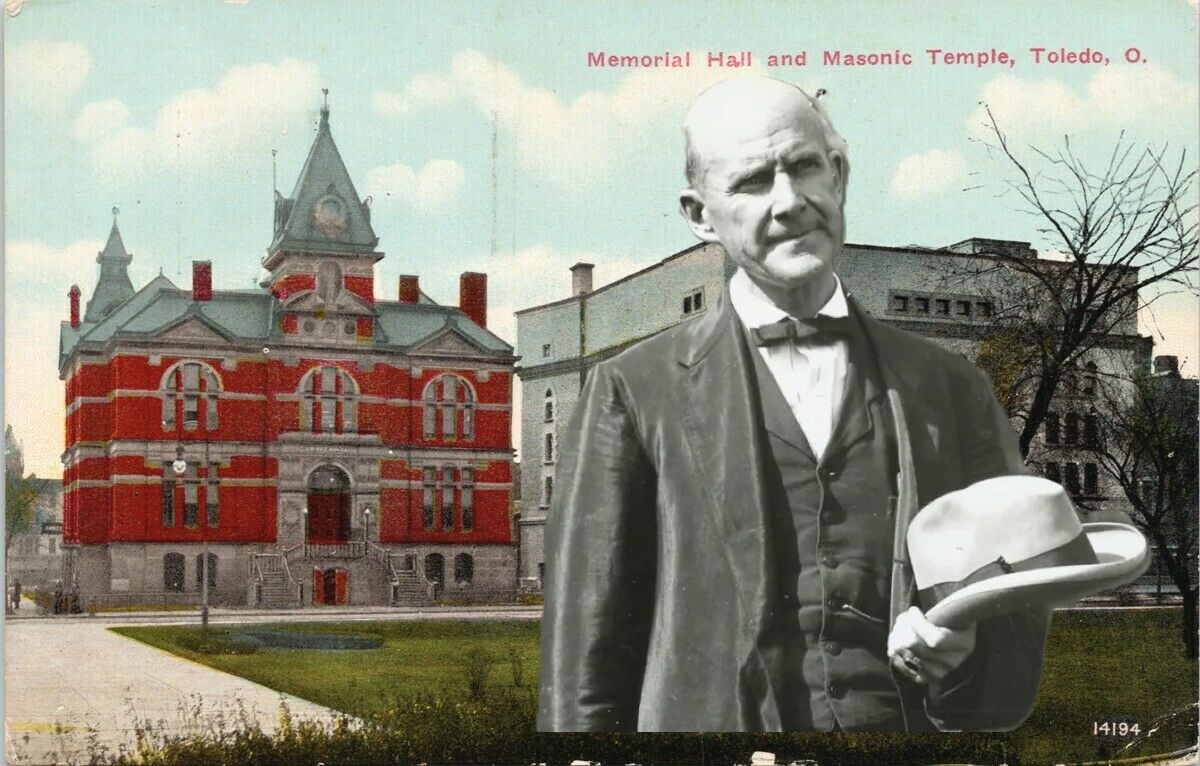
Due to restrictions placed on him after his arrest for a ‘seditious’ speech given in Canton, Ohio on June 16, 1918, Debs was unable to leave Ohio and Indiana until being sent to prison the following year. So for that crucial period in politics where the Left Wing is being organized, with Ohio being a center for that movement, Debs did all of his speaking in that state. We are fortunate to have a rich record in the pages of the Ohio Socialist, a direct descendant of the Daily Worker five years later, of those speeches given when the ‘World Revolution’ could actually be seen.
‘Debs in Toledo’ by Thomas C. Devine from The Ohio Socialist. No. 53. January 29, 1919.
An intense and dramatic movement was experienced by the audience that filled Memorial hall, Toledo, to the door, Jan. 2, to hear Eugene V. Debs, the Socialist leader. Hours before the meeting opened the hall was filled and a second hall in the same building was secured and filled in a few moments with an eager and expectant crowd. Hundreds were turned away unable to get inside the building. Many police were present but no disturbance occurred, the audience. waiting patiently for Debs to make his appearance. Many returned soldiers in uniform were scattered throughout the hall and helped girl ushers in taking a collection.
As Comrade Debs stepped upon the platform a beautiful girl, carrying red carnations, accompanied by her sweetheart in uniform walked to the platform. The soldier stood at attention while the flowers were presented to the beloved Debs.
A dramatic moment ensued. An intense silence seized the great audience as it gazed with tear-dimmed eyes upon the picture of the champion of the working class receiving this tender homage. One thought seemed to hold all minds–that the things which the capitalist class and its hireling press has told of Debs’ utterances and purposes were blackest lies. Tears dimmed the eyes of the audience while Debs’ own eyes were notice to weep with affection, and love.
Taking the girl by the hand and with the other upon the shoulder of the soldier, Debs said: “I have stood upon this same platform many times. Here I met your Golden Rule Mayor and at other times many others–but nothing has ever touched me so deeply as this. I know what you boys have suffered. Something of how your mothers have waited patiently. and longed for a word from over there. This is a beautiful thing, to meet you here tonight, and of all the pleasant memories of my life this moment I believe will live the longest- and remain as fresh as these beautiful flowers, and not only while I live, but at my death and after–yes, after–their fragrance will remain.”
The applause was spontaneous and prolonged. The audience seemed to take relief in giving vent to its heartiest approval in cheer after cheer.
One of the Toledo daily papers reported the meeting as follows: Lauds Lenine.
After acknowledging that he was a Bolshevik “from the crown of his head to the soles of his feet,” Debs protested against Postmaster General Burleson’s action in barring from the mails literature written by Nicholai Lenine, Bolshevik leader in Russia, whom Debs termed “the greatest of European statesmen.”
“In the name of the Socialist Party as I stand here on parole I protest against the suppression of free speech, free assembly and free press,” Debs shouted.
Scorns His Sentence.
Debs spoke with scorn of the ten- year sentence hanging over his head. “I hate and abhor the capitalistic system, but I don’t hate its victims,” Debs said. “I went to Cleveland the other day and took by the hand the man who sent me to jail, and I felt sorry for him. He didn’t know; it was his misfortune.
“I got my ten years for telling them they would rather have the kaiser than see the working class rule.
“I am liable to be accused of stirring up class hatred, and get ten years more for my words tonight. My little liberty–what does that matter? A sentence to the pen for ten years doesn’t thwart me. I can go there and be perfectly serene, but I couldn’t go if I couldn’t look myself in the face for being too cowardly for inviting the sentence.”
Love for Lincoln.
He likened himself to Lincoln, pointing out that both the martyred president and himself loved the common people.
“They murdered Lincoln,” said Debs. “I got only ten years. I don’t look up to king, politician, priest or preacher; I look up to the working class that beautiful class in which I was born. A class with dirty faces but clean hearts, rough hands but tender souls–the class that has fed and sheltered the race through all the ages.
“You working people haven’t lived; you know not love, sunshine, song, laughter. Your life is work, the shop bell, black faces, a boss.
Easy for Master.
“Your wages go up, then they go down, then you are out of a job. Your master is away; he owns the tools. that you work with, but he is not at work.
“You build a mansion for him, but you cannot enter; you fashion a limousine for him, but you cannot ride in it. He has nothing but contempt for you.
“Still he rides you to the polls on election day, and you vote his ticket.
Rich Are Poorest.
“The poorest man I know is Rockefeller, and the second poorest is Andrew Carnegie, who has lost his mind jingling the coins you made for him, and fearing that they would be taken away from him and he would die a pauper.
“Can you imagine how poor Rockefeller feels without one comrade–not one? That is poverty.”
“We know so little about existence. So little about life. We are so used to struggle, treachery, dishonesty. It is bred by the system under which we now live. You, I, all of us, are pitted against each other in a remorseless struggle for existence. We are strangers to our neighbors.
“Have you ever paused in a crowded thoroughfare, where humanity was sweeping toward you? Have you peered into the faces of the young–old before they were born? Have you seen the tragedy of ages written upon the human countenance? Have you ever felt yourself impeached for being decently dressed? Have you ever felt ashamed for having had your breakfast when so many children are starving?
A Contrast.
“Capitalism is the thing you vote for every time you vote the Republican or Democratic ticket; every time you vote against the Socialist ticket.
“I recently picked up a paper and read two items.
“The first told of an impoverished mother, who had borne seven children, who choked her last-born to death so that it would not starve.
“The second told of a capitalist who had just bought a $75,000 sable coat for his wife, a former actress.
“I am not telling you this to appeal to your emotions; rather would I reach your intelligence.”
Meeting Record Breaker.
More than 3,000 people attended the Toledo. Debs’ meeting. Between 600 and 1,000 were turned away, unable to find standing room. Police were kept busy clearing the aisles in conformity with fire regulations. An unusually large collection was taken and much literature sold.
M.A. Toohey, Hoskins and Devine assisted in addressing the overflow meeting. Toledo Socialists feel greatly encouraged over this, their second and most successful Debs’ meeting within a month.
The Ohio Socialist, published by the Left Wing-dominated Socialist Party of Ohio in Cleveland from January, 1917 to November, 1919. It was edited by Alfred Wagenknecht, who spent most of 1918 in jail for “violation of the Conscription Act.” The paper grew from a monthly to a semi-monthly and then to a weekly in July, 1918 and eventually a press run of over 20,000. The Ohio Socialist Party’s endorsement of the Left Wing Manifesto led to it suspension at the undemocratic, packed Socialist Party Convention in 1919. As a recognized voice of the Left Wing, the paper carried the odd geographical subheading, “Official Organ of the Socialist Parties of Ohio and Kentucky, Virginia, West Virginia and New Mexico” by 1919’s start. In November of that year the paper changed to the “labor organ” of the Communist Labor Party and its offices moved to New York City and its name changed to The Toiler, a precursor to the Daily Worker. There the paper was edited by James P. Cannon for a time.
PDF of full issue: https://www.marxists.org/history/usa/pubs/ohio-socialist/053-jan-29-1919-ohio-soc.pdf

