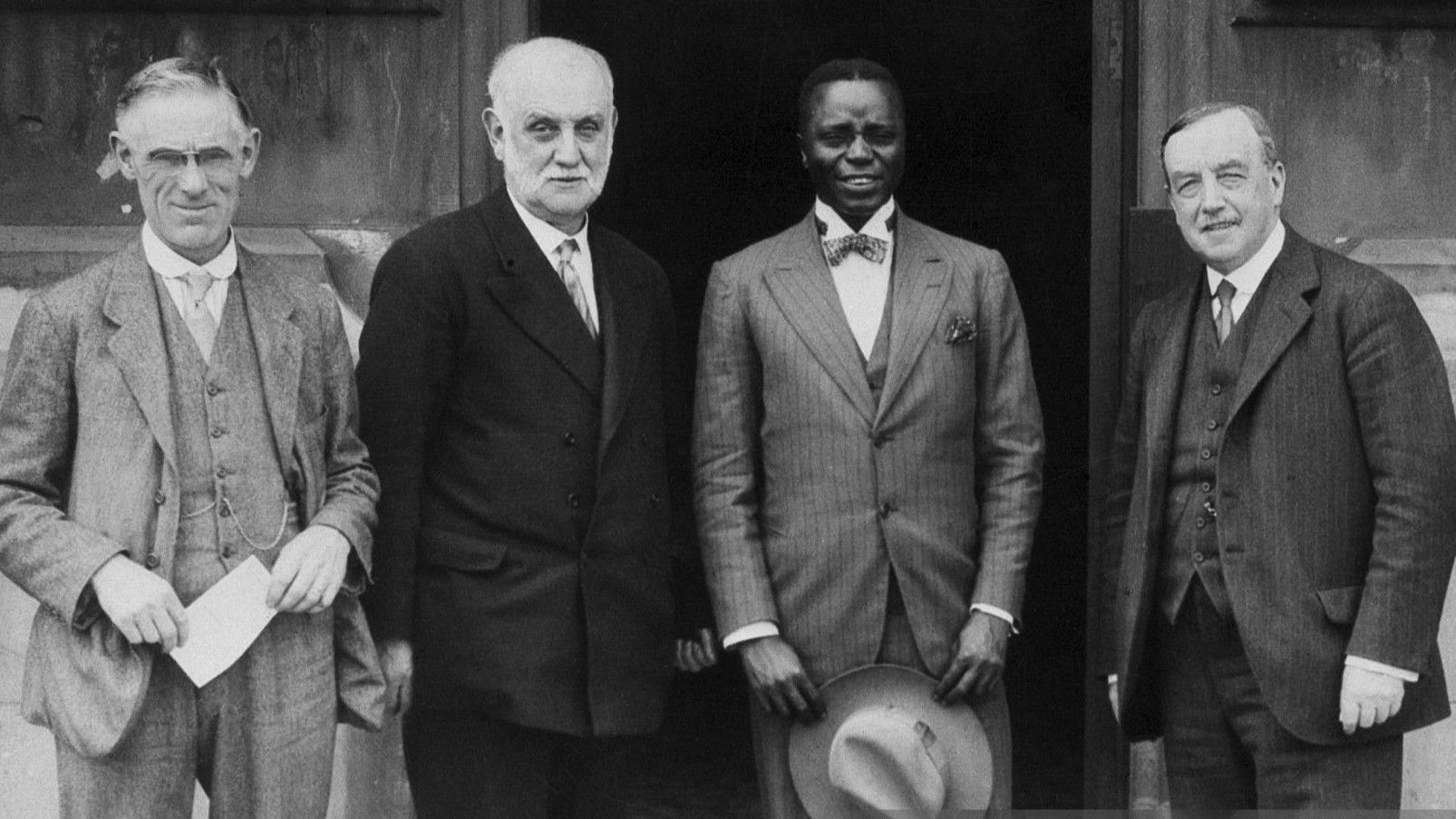
The crisis in the South African workers’ movement created by Clements Kadalie’s Industrial and Commercial Workers’ Union (ICU) expulsions of Communists and increasing relations with British Labour officials.
‘The Anti-Imperialist Struggle in South Africa and the I.C.U.’ by H. Rathbone from International Press Correspondence. Vol. 8 No. 9. February 23, 1928.
In spite of the reactionary policy of Kadalie, the leader of the South African native workers union the I.C.U. (Industrial and Commercial Union), in expelling all members from the I.C.U. who are Communists and in spite of his policy of identifying himself completely with the reformist leaders both in England and in Europe generally while on his recent visit from South Africa, events in South Africa are forcing the I.C.U. into a position in which, if its leadership does not come out clearly on the side of the anti-imperialist struggle with all the implications that that step would involve, its influence amongst the native workers will rapidly decline.
A temporary compromise on the struggle between the British and the Dutch capitalists as to which should be the predominant exploiters of the South African native peoples, expressed as it was in the Flag controversy, has now been reached. This leaves the way clear for an agreement to be come to between the two white capitalist groups to intensify this exploitation of the native peoples. This will be done by the four Anti-Native Bills which will shortly come up before the South African Parliament again for decision. These bills will, on the one hand, intensify the exploitation of the native peasant and, on the other hand, are designed to force him from off his land in order to make him seek employment from the capitalist industries and mines in the towns.
Therefore the I.C.U. in the first place, owing to its recent efforts to get membership in the agricultural areas will be forced into taking a very militant attitude against these bills if it is to retain any of the membership it may have gained in these areas.
Secondly the leaders of the white labour movement have still more clearly shown their essential antagonism towards the native movement in full agreement with the imperialists. The South African Labour Party at its last Annual Congress in the first days of January had before it a proposal to alter its constitution in order to shove off the day still further when it expected to be able to introduce Socialism. An immediate advance to Socialism, so the report to the conference ran, is “in no country more incongruous than in South Africa…garrisoned by a handful of white people, living a civilised life superimposed upon a proletariat of black men gradually evolving from barbarism”. (Cape Argus, 3. 1. 28.) Accordingly due regard must be taken, so continued the report, “of the differences in the fundamental conditions imposed by the presence of an overwhelming native population still for the most part in the most primitive stage of development, side by side with a small European population whose standards of life must be maintained and improved”. (Our emphasis, H.R.)
So only the white workers standards must be “maintained and improved”. The natives well they are still hardly beyond the stage of “barbarism”. Further, the advocacy of Socialism raises inconvenient questions as to how Socialism for the white workers only would benefit the native population; for naturally Socialism is impossible for the latter because they are still “in the most primitive stage of development”.
So the Labour Party cynically abandons the last pretence of serving the workers’ cause and thus openly agrees to share with the exploiters in the most fearful and dastardly exploitation of the native peoples.
Though these proposed alterations from which we have quoted were not apparently discussed at the Conference, yet it is clear from other facts that these alterations really express the policy of the Labour Party. For not only is the Labour Party in favour of the Anti-Native bills now being put forward by the Hertzog Government of which they are a part, but they have even proclaimed their intention of moving an amendment to a Women’s Enfranchisement Bill now before the South African Parliament, in order to restrict the franchise to European women. As a certain number of the natives in the Cape Province still have the right to vote, the extension of the franchise to women under this bill would have meant the enfranchisement of many of the native women in this province. (Times, 4. 2. 28.)
The so-called “Left Wing” of this Labour Party is no better. For one of their E.C. members, Kentridge, prominent in this so-called “Left Wing”, in an interview with the Cape Argus, 30. 12. 27., said that the Pact Government should concern itself “with an agreed programme for raising the standard of life in this country and creating conditions which will assist the white people and make this a white man’s country in fact and not merely in name”. Not a word about “assisting” the native peoples or about assisting them to raise their standard of life, but merely a purely imperialist ideology of keeping the native exploited by the capitalists.
Now the British Labour Party through one of its so-called Left Wingers, Beckett after his visit to South Africa, has approved of the attitude of the South African Labour Party. Can then the I.C.U. expect anything from the British Labour Party?
Thirdly the South African white Trades Union Congress have rejected the application of the I.C.U. for affiliation. In rejecting this application they clearly revealed the same standpoint as the Labour Party. For to the original application of the I.C.U. for affiliation the reply was made by the T.U.C. that the 100,000 native members of the I.C.U. would swamp the 50,000 white membership at present affiliated to the T.U.C. The I.C.U. in spite of this smack in the face turned the other cheek by stating that they were quite willing to agree to any arrangement to preclude such an eventuality”. (For the sake of unity this was of course the only tactic to adopt.) Yet in spite of this they got their second smack by the final rejection of their application. It was pointed out that this rejection was not based really on the white T.U.C.’s fear that they would be outnumbered, but “on reasons mainly economic”. Exactly. They were afraid for their own wages and no thought of assisting the native workers to raise theirs.
The I.C.U. in view of this situation issued a manifesto. In this manifesto it first rejects the counter-proposal of the T.U.C. for “periodical meetings” as “patronising”. Though such a rejection is but natural, it is of course incorrect. For by such meetings the native workers would have had an excellent opportunity of still further exposing the anti-native policy of the white trade union leaders not only to the native workers but also to the white workers. The manifesto then, however, goes on correctly to point out that “We are the real working class in South Africa, the most oppressed section of the working population, and as trade unionists we have the right to dominate all trade union councils in which we happen to be in the majority”. (It should be stated that the adjective “real” in the above quotation is only correct if by “real” is meant the most oppressed and exploited.)
But this process of forcing the I.C.U. onto the revolutionary path in spite of the reformist turn that its leadership has taken has just received new impetus. For the newly formed “self-governing” state of Southern Rhodesia has recently issued a ban against the I.C.U. from organising branches in its state and has summarily deported the I.C.U. organiser from Southern Rhodesia. This has forced Kadalie to come out with some very militant statements. He says: “In spite of your ban we shall find means as we have done in the past to get our message to our fellow workers, and we shall find men and women in your colony to raise and uphold the banner of freedom from all forces of oppression”. With regard to the deportation he says “it is consistent with the best traditions of capitalist ‘democratic’ governments the world over…free speech is as non-existent in Southern Rhodesia as it is in other parts of the British Empire”. (Times, 2. 1. 28.)
While we join in protest against this deportation and call upon all workers to do the same, we would like to point out to Kadalie that such fine sentiments about the non-existence of free speech etc. would come better from one who had not suppressed free speech in his own organisation, the I.C.U., by expelling Communist Party members.
Further, we could ask Kadalie whether all these events do not show that the Communist Party of South Africa, which has consistently fought for the rights of the natives and is proved by the events we have described to be the only body containing European elements to have undertaken this struggle, is correct when it stated that the I.C.U. and the native workers I could find no hope in the British Labour Party or in the Amsterdam International. We have heard no protest from either of these two bodies on these events. The Daily Herald has not thought it even worthwhile to mention, let alone to protest against the deportation. We have had to learn the news from the capitalist Times.
Finally we would warn Kadalie that if he does not break completely with the policy of the Second International expressed by him when he said, after expelling the members of the Communist Party at the end of 1926, that “the strike weapon was obsolete”, if he does not realise that only a revolutionary struggle is possible against the forces of imperialism, if he refuses to co-operate with those who are prepared to assist in such a struggle, if he persists in denying free speech within his organisation while protesting against its denial by the imperialists, he will find himself swept away in the revolutionary struggle which undoubtedly is coming every day nearer in South Africa, and which he himself is assisting by being forced to protest against these acts of imperialist suppression which we have described. The I.C.U. can only exist as an organ to help the native workers if it is prepared to carry on a revolutionary struggle against imperialism. The events we have described clearly prove this.
Let Kadalie and the present leadership of the I.C.U., if they wish to show that their protestations against imperialism are not mere hypocrisy in order to retain their present positions in the I.C.U. let them come out and withdraw the ban against members of the Communist Party being members of the I.C.U. Secondly let them link up with the only other body in South Africa whose leaders are prepared to carry on this struggle against imperialism the African National Congress. For only by consolidating the forces of those who are prepared to struggle against the world forces of imperialism can the native masses of Africa hope to achieve freedom from imperialist exploitation.
International Press Correspondence, widely known as”Inprecorr” was published by the Executive Committee of the Communist International (ECCI) regularly in German and English, occasionally in many other languages, beginning in 1921 and lasting in English until 1938. Inprecorr’s role was to supply translated articles to the English-speaking press of the International from the Comintern’s different sections, as well as news and statements from the ECCI. Many ‘Daily Worker’ and ‘Communist’ articles originated in Inprecorr, and it also published articles by American comrades for use in other countries. It was published at least weekly, and often thrice weekly.
PDF of full issue: https://www.marxists.org/history/international/comintern/inprecor/1928/v08n09-feb-23-1928-Inprecor-op.pdf

