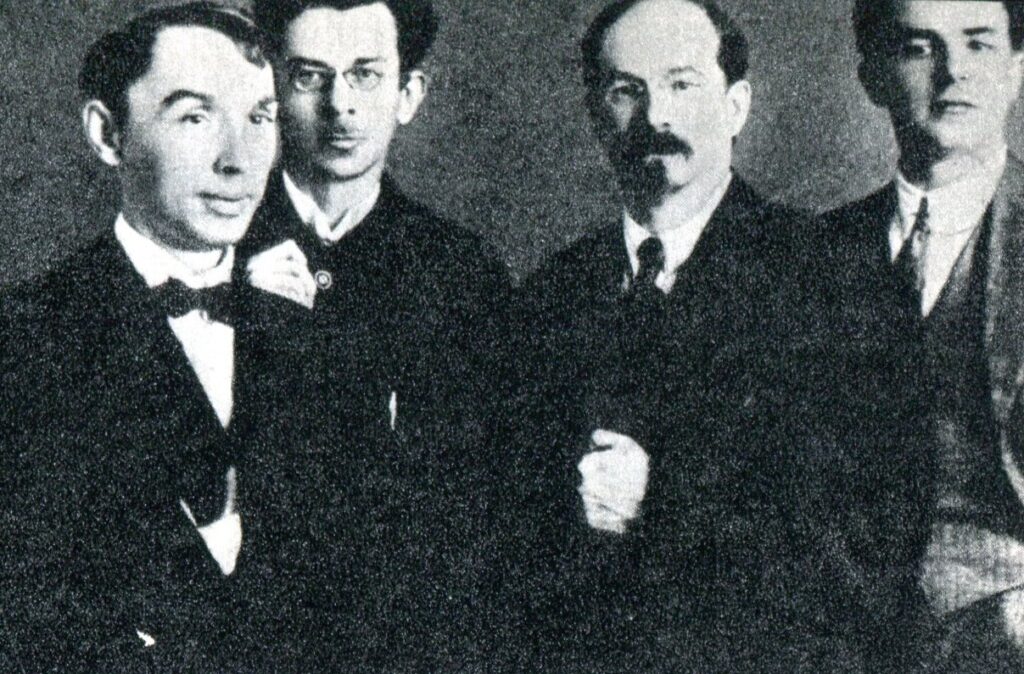
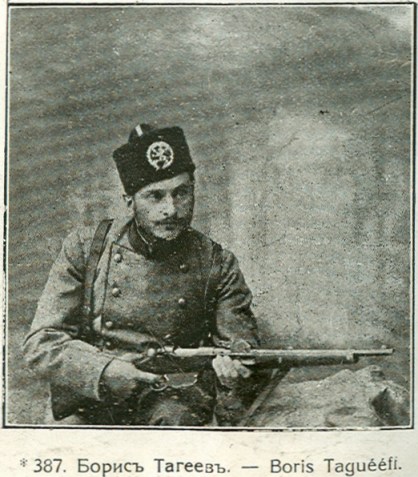
After two decades away, Bek returns to Petrograd and goes to the theater and interviews the leading Soviet theater artist, Ivan Ekkuzovich. Bek (Boris Tageyev) was a former, and exiled, Tsarist officer of Persian descent who had fought in the Russo-Japanese War and became became a military journalist and Social Revolutionary. Arrested and escaping, he wrote for European papers on defense matters, traveling widely before landing in the U.S. Here he became a supporter of the Bolsheviks, and made the Red Army’s representative in the Soviet’s U.S. mission. After the closing of the mission he return to Soviet Russia and continued to write well-regarded military histories until the Purges, Arrested in 1937 and charged as a ‘Japanese, English, American, French and Italian spy,’ he was shot on January 4, 1938.
‘The Theatres in Petrograd’ by B. Roustam Bek (Boris Tageyev) from Soviet Russia (New York). Vol. 5 No. 2. August, 1921.
Petrograd, May 23, 1921. The American press has said little about the stage in Soviet Russia. The capitalist papers, although compelled to admit that the Bolsheviki have not destroyed the theatres, occasionally complain bitterly that they have created nothing new. Such critics, of course, deliberately ignore the truth that an art cannot be recreated in a moment but must pass through a process of gradual development The Social Revolution may direct art into new paths, but it will never destroy the art of the past While the Russian Revolution gave a new creative impulse to the artists, pre-existing art in Russia in all branches not only remained unmolested, but was actively protected by the Proletarian Government from possible injuries during the period of general contusion which was a natural consequence of the destruction of the old regime. The survival of theatrical art in Russia through the most dangerous period of the Revolution and its flourishing condition today are due to the devoted efforts of Comrade Lunacharsky, the People’s Commissar of Education.
It must be remembered that the organization of the State Theatres in Russia was always a complicated and delicate apparatus, requiring an enormous administration of specially trained technicians and artists. The Russian stage has always been more than a mere place of public amusement The Russian theatre was and is a temple of education and an academy of art Before the Revolution, however, the temple was open only to the aristocracy and to the well-to-do bourgeoisie. Millions of Russians heard of the splendor of the Russian ballet and of the magnificence of the Russian opera, but never lived to see or hear either. Today there remain in Soviet Russia neither aristocracy, nor bourgeoisie—or at least those who survive need not be taken into account, since they have lost all their former privileged significance. The theatres in Russia are open only to workers.
The auditorium of any Petrograd theatre in these days is a most impressive sight. The brilliant uniforms and the fashionable dresses have vanished entirely; instead of pearls and diamonds the house shines with thousands of bright eyes turned towards the stage, where the spectacle is performed for these poorly clothed and hungry people who watch intently every movement, listening to each word and every note with keen interest and admiration.
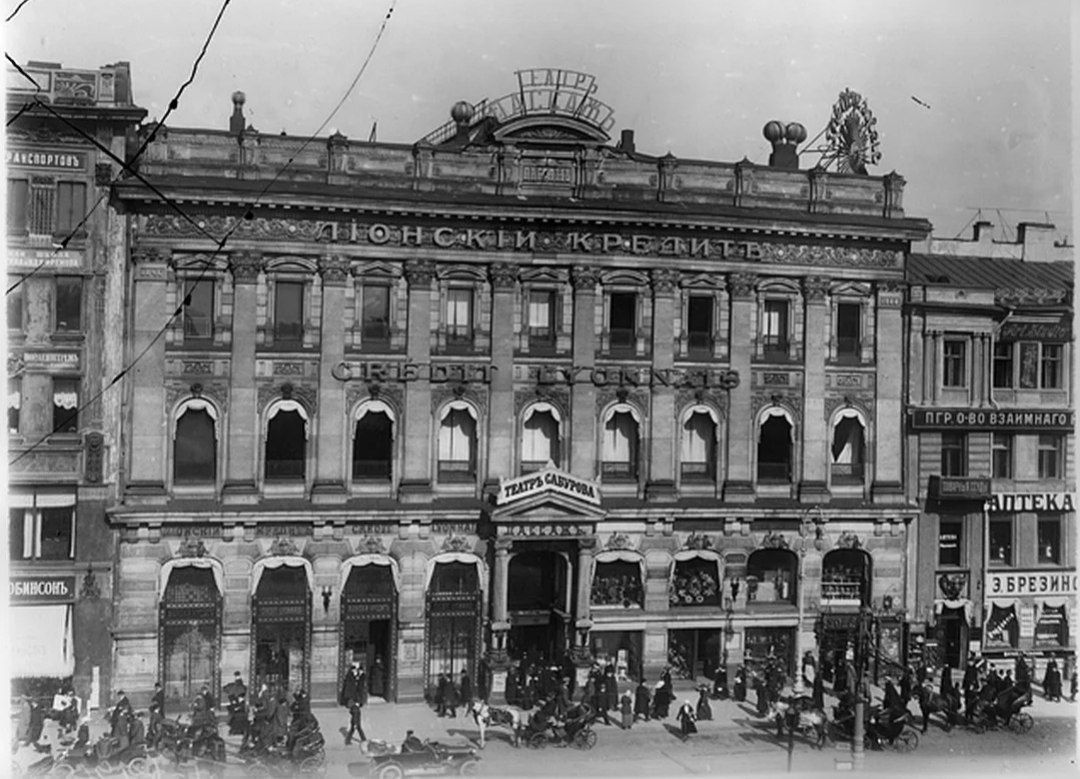
The Petrograd theatres are divided into two classes: The State theatres and the private theatres, or “Collectives”. There are three principal State theatres: The former Mariynsky Theatre, where, during the winter season, opera and ballet are given every day except Monda3r8; the former Mikhailovsky Theatre, where light opera, both of Russian and foreign composers, is produced; and the Alexandrinsky Dramatic Theatre, in which are performed the classics of Shakespeare and Schiller, as well as modem Russian playwrights like Ostrovsky, Gogol, Andreyev, Lunacharsky and many others. In addition to these three, there are four other State theatres, forming a group of “People’s Houses.” One of these is devoted to French and Italian opera, and another to melodrama and classical comedy, such as that of Shakespeare and Moliere. This latter theatre is under the management of a young and promising artist, S.E. Radlov, who has introduced entirely new methods in theatrical art Radlov’s attention has been centered especially upon stage movements and gestures. He is a severe critic of those modem actors who, in his judgment, are unable even to stand properly on the stage, much less to move with artistic effect in order to correct these shortcomings Radlov has not hesitated to adopt everything which might improve the technique of stage movement not excepting acrobatics. There was much criticism against certain innovations introduced by Radlov, especially when he invited acrobats and comedians from the circus to take part in his productions of comedy. The dramatic artists protested vigorously, but Radlov remained firm and finally carried through his ideas. He was enabled in this manner to introduce entirely new elements into comedy and to enrich it immensely with a technique unobtainable without these elements. The result injected a most effective liveliness into comedy.
The Great Dramatic Theatre
The Great Dramatic Theatre, which occupies the building of the former Little Theatre, is under the management of the well-known Russian artists, Monakhov and Maximov. Here have been performed Shakespeare and Schiller and other classic authors, and recently “The Servant of Two Masters,” an Italian comedy by Goldoni, which had great and well merited success. Between the acts artistic dances are given before the curtain, designed to create an atmosphere for the succeeding act The scenery, costuming, and lighting are excellent and the acting very fine, though the actors in this theatre for the most part have been trained from experienced amateurs and young professionals.
The academic State theatres in Petrograd are under the general direction of I.V. Ekskuzovich, to whom the present high standard of these theatres is largely due. Ivan Vasilievich Ekskuzovich is an architect by education and at the same time a professional actor, a combination of professions which make him an excellent director of theatres. When the Revolution came he was working as an architect on a new railway line in the Pskov region and lecturing in an Engineering School in Petrograd. He is a young man of great energy and tact, thanks to which he has become very popular both among the artists and the other members of the numerous staff of theatrical workers.
The Shops of the State Theatres
The disordered events of the first period of the Revolution were reflected in theatrical spheres and unavoidable anarchy prevailed everywhere, even in the State theatres. To meet these circumstances, Ekskuzovich was chosen head of the Theatrical Association and became manager of the State theatres in Petrograd. Later he was confirmed in this position by the Soviet Government. “First of all,” Ekskuzovich told me, “I was anxious to preserve the traditions of our stage. I believed that without those traditions no discipline could be maintained and without such traditional discipline no stage would exist. It was possible to succeed in this because the artists remained out of politics and because they offered to submit themselves entirely to an impartial director chosen by themselves and appointed by the Government”. Those early days of general confusion imperiled the theatrical property, worth many millions of dollars. There were several criminal attempts to steal the costumes and other accessories from the wardrobes of the State theatres, which are the richest in the world. Nevertheless the five hundred thousand costumes and other properties belonging to these theatres remained untouched during the most turbulent days of the Revolution. And today they are in such perfect order that any part of any costume from any play of any epoch can be delivered to the Director in a few minutes. I went through the shops in which the costumes and other stage accessories are made and stored and found them in excellent condition. In the women’s department I was much impressed by the zeal of the workers. At the time of my visit the ballet, “The Fire Bird,” was in preparation and all the costumes for it had to be ready within ten days. Several of the new creations were shown to me. The workers for the most part were aged persons, who had seen more than a quarter of a century of service in these same shops. They told me frankly that nothing in the world would detach them from their beloved theatres. “We passed, comrade,” said one of them to me, “through all the horrors of the Revolution and we still continue at our jobs. To be sure, we are short of materials, but nevertheless we are doing our best” This worker indeed described the case. Because of the shortage of the simplest materials, the leather for boots and for different accessories for the costumes, such as metallic parts, were being imitated with extraordinary simplicity and most artistic effect The canvasses are magnificent, from the designs of the famous artist Alexander Yakovlevich Golovin, who is considered even greater than Bakst. I saw scene sketches also of Alexander Benois, and other distinguished masters who are still working enthusiastically for the Russian stage. The costume stuffs coming from the theatrical dyers are given the most careful inspection by experts. I saw pearls made by hand out of silk and wool and laces printed so artistically that even at a short distance I could not distinguish them from the real. The stores of material are immense and richly provided through the forethought of the Director, who, being an engineer and constructor, realized that large reserves of materials were necessary to keep the theatres going, and accordingly, even at an early period before the nationalization of industry, did not miss his opportunity to buy supplies wholesale for the theatres. Indeed, when I inspected the stocks I could have imagined that I was in a large department store in New York. Materials of all sorts were carefully sorted wad distributed. I do not know of anything similar either in English or American theatrical institutions. In all, there are under the direction of Ekskuzovich about twenty different establishments in Petrograd which serve the State theatres.
The Theatrical Museum
Thanks to the organizing ability of Ekskuzovich, the ten Moscow Academic theatres are united with those of Petrograd and all work together in full harmony—a rare circumstance in theatrical life.
The Theatrical Museum is a new creation of the Revolution, due to the initiative and energy of Ekskuzovich The museum is located in the large building of the main office of the State theatres in a fine suite of rooms which formerly served as the apartment of the Director. Here I found pictures of Russian dramatic and operatic artists, and prominent ballet dancers. There were portraits also of composers, conductors and musicians and scenic artists. Some of these were the work of celebrated portrait painters. There is a section devoted to playwrights, with numerous documents and manuscripts relating to their work from the earliest days of the Russian theatre. All the furniture and the art objects in the museum had belonged to deceased artists and were either bought from private persons or donated by relatives and friends. This collection was actually gathered together during the period of the Revelation. There were some interesting models of stage settings and an extensive and rare collection of photographs of many periods of the Russian stage.
Can Americans appreciate the circumstances under which all this work has been accomplished? In addition to the shortage of food and of clothes there was also a critical lack of fuel, especially during last winter. This reached such a point that Ekskuzovich was at one time actually obliged to remove some beams from several buildings belonging to the State theatres in order to provide fuel to keep the artists warm during the severe Russian winter. Being an architect, he dared to undertake such extreme measures, knowing that when summer came he could replace the beams.
The theatrical schools and the Ballet Academy in Petrograd might serve as models for the entire world, their organization is so perfect and unique that I wish to reserve a description of them for a separate article.
Hie orchestras in the Academic theatres are composed only of musicians who have accomplished their education in the State Conservatory, and all of the teachers in the Conservatory take important parts in the orchestras, which contributes greatly to their artistic excellence. Russian opera singers are most particular in regard to their orchestras. An artist like Shaliapin, for instance, would refuse to appear on the stage with mediocre music. The choruses also are composed only of accomplished pupils of the Conservatory and are very fine. Of the ballet, which is renowned throughout the world, there is no need to speak.
The impression created in the Russian Academic theatres is that of great harmony of color, movement, music and lighting. The technique of lighting has been greatly improved during the Revolution. Moreover, after familiarity with the English and American stage, one is struck by the fact that all the performers are acting all the time. One does not see the puppet-like faces of the chorus, nor the awkward movements of the supernumeraries, which are such a common defect in Western opera. Each scene performed in the Academic theatres, in addition to its high dramatic quality, is a complete picture, academically correct, as well as artistic. The costumes and scenery, the makeup of the actors, are the result of careful study of the historical originals. Here art and science work together. The members of the chorus are physically attractive, full of life and enthusiastic. They mostly come from working class and peasant families.
In all the Academic theatres, as well as in the State theatres in general, before the beginning of any play, opera, or ballet, there is always a lecture upon the forthcoming performance. These are most instructive and popular.
The Comic Opera is under the management of K.A. Mardjanov, and the Theatre of Free Comedy also belongs to the State. They are both very popular. When the Free Comedy Theatre was created it was supposed to stage productions of the type of the French Grand Guignol. They have often performed so-called Miniatures and political satires. The actors are mostly amateurs who, under the talented producer N.V. Petrov, formerly an artist of the State Theatre, are perfecting their acting with extraordinary rapidity. It is expected that Petrov may develop this theatre along most original lines. The Theatre of Free Comedy allows absolutely free treatment and pays no attention to the authority of the playwright, whose play is altered according to the ideas of the producers. I understand that the producer during a considerable period made many experiments without definite results. Then the comedy “Samoye Glavnoye” (The Most Important Thing) by Nikolai Nikolaievich Yevreynov, the proponent of the “monodrama”, put an end to experimentation by becoming the hit of the season. This production produced much discussion. It establishes an intimate connection between the auditorium and the stage. To a certain extent the audience actually took part in the play. The author, who has great knowledge of the theatrical art, assisted in the production, to which he contributed extremely original ideas. Up to 1914 Yevreynov had become an ardent advocate of the so-called “Theatre for One’s Self”, on which he published a most interesting book. Believing that imagination is the greatest factor in theatrical art, he held that by means of simple illusion anyone could enjoy any play at home without alteration and without professional actors. Later he carried this idea still further and suggested that all life was nothing else than a theatre and every person more or less of an actor. Carrying this conception to its mystical development, he transformed the theatrical art into a religion of which he himself became an apostle. His play “Samoye Glavnoye” is an exposition of his theory that life is a stage. The most part of life, he asserts, is an illusion; the actor in his impersonation actually transforms himself into another personality. Thus he believes that the theatre can actually be of social service through this power of the actors, who, like Red Cross nurses, will place their abilities at the service of humanity. In this play a party of actors enter into the private life of a family and by their skillful acting restore the last hopes of its unhappy members. I had several opportunities to study this play in performance and I was greatly impressed by it.
In addition to the State theatres there have grown up in Petrograd during the Revolution several so-called “Collectives”, which exist upon their own resources and represent an independent trend in the art.
Soviet Russia began in the summer of 1919, published by the Bureau of Information of Soviet Russia and replaced The Weekly Bulletin of the Bureau of Information of Soviet Russia. In lieu of an Embassy the Russian Soviet Government Bureau was the official voice of the Soviets in the US. Soviet Russia was published as the official organ of the RSGB until February 1922 when Soviet Russia became to the official organ of The Friends of Soviet Russia, becoming Soviet Russia Pictorial in 1923. There is no better US-published source for information on the Soviet state at this time, and includes official statements, articles by prominent Bolsheviks, data on the Soviet economy, weekly reports on the wars for survival the Soviets were engaged in, as well as efforts to in the US to lift the blockade and begin trade with the emerging Soviet Union.
PDF of full issue: https://www.marxists.org/history/usa/pubs/srp/v4-5-soviet-russia%20Jan-Dec%201921.pdf

