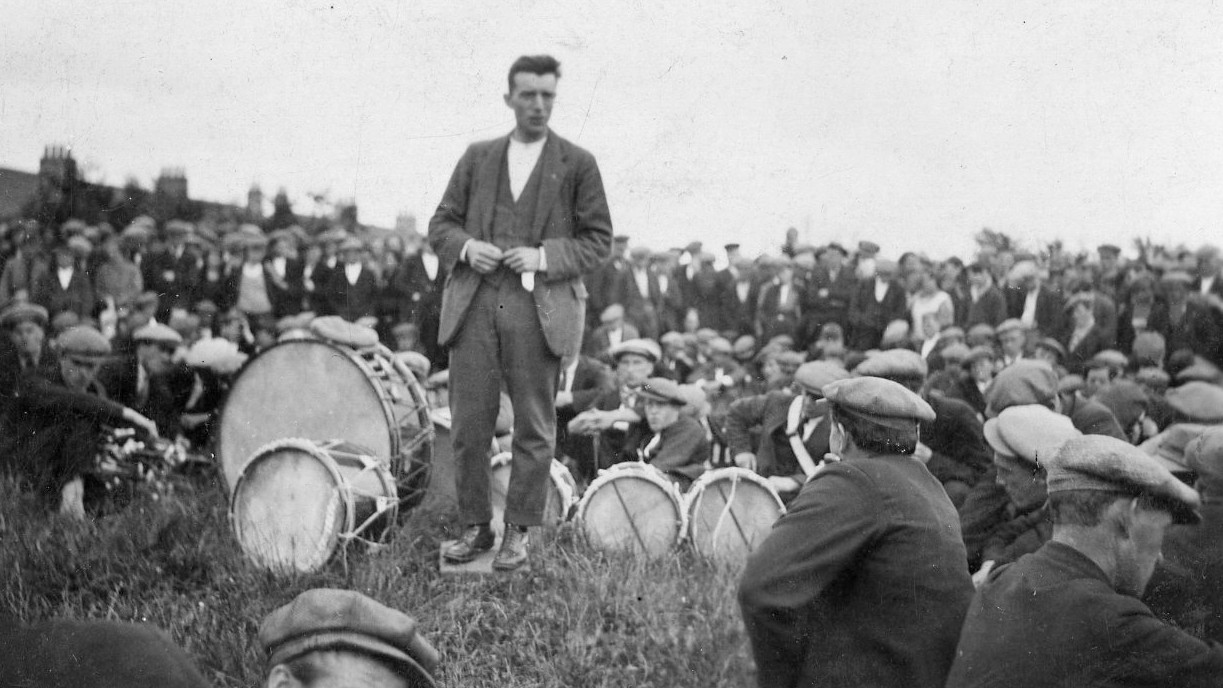
A local at the various actions and campaigns of Soviet workers in solidarity with Britain’s miners.
‘The Workers of the Soviet Union and the General Strike in England’ by K.I.P. from International Press Correspondence. Vol. 6 No. 52. July 15, 1926.
Even before the miners were locked out and before the proclamation of the general strike in England the workers of the Soviet Union were intensely interested in the events which were developing.
In April the local organisations of the Miners’ Union of the Soviet Union brought up the question of assistance for the English miners. The central committee of the Ukrainian miners informed the central committee of the Soviet Union that they “considered it their fraternal duty to render assistance to the English miners in view of the approaching conflict”. The Congress of Miners of the Far East telegraphed to the Central that the miners of the Far East were watching with keen interest from distant Siberia the heroic struggle of the English miners and send them their warmest fraternal wishes for success in the fight. The Central Committee of the Miners of the Soviet Union sent the Executive of the Miners Federation of Great Britain a telegram to the effect that the Miners Union of the Soviet Union were following with the greatest interest and sympathy the struggle of the English miners against a cut in wages and an increase in the length of the working day, and that the miners of the Soviet Union were prepared to help their English brothers in their severe struggle with all the means which lay, in their power.
The Central Council of the Trade Unions of the Soviet Union telegraphed to the General Council of the British Trades Union Congress that all the affiliated organisations declared their proletarian solidarity with the fight of the English miners and were ready, if circumstances demanded, to fulfil to the very last their duty of rendering all-round brotherly help to the English miners.
And then came the memorable days of May. The news is received by wire concerning the unprecedented action of the English proletariat. The miners have rejected the coal owners’ terms and are locked out. The General Council has declared a general strike in support of the miners. In addition to a million miners there are about four million workers of other trades on strike. All the resources of the English bourgeoisie with its powerful machinery of State are being mobilised against the workers.
The general strike in England grips the attention of the whole of Soviet Russia. The working masses eagerly await each fresh report which arrives from the fighting line in distant England. The affairs of the English workers are of the utmost importance to them, they are their affairs, too. The enemy of the English workers the English bourgeoisie is the common enemy. Did not the English bourgeoisie seriously molest Soviet Russia during the years of the civil war? Did they not support Koltchak, Denikin, Wrangel, Judenitch and all the White armies? Did they not ravage Archangel in the far North and Baku in the South and mow down the flower of the Russian proletariat? And are they not even to this day the very soul of all the machinations which the international bourgeoisie devise against the Soviet Union?
Throughout the Soviet Union there is a wave of impressive meetings at which the events in England are discussed with great eagerness. This wave extends to the smallest villages and the remotest corners of the Soviet Union.
Financial Aid.
On May 7th the Central Council of the trade unions of Soviet Russia appealed to all the workers in the Soviet Union to rally to the aid of the English proletariat and contribute a single quarter of a day’s pay. The answer to this appeal developed into a magnificent demonstration of fraternal solidarity on the part of the workers of all nationalities in the mighty Soviet Country with the struggling English proletariat. The workers and employees without exception willingly made the sacrifice. One and all surrendered a quarter of a day’s pay. In many works the workers and employees even went to the extent of resolving unanimously to contribute a half or the whole of a day’s pay.
The conference of the representatives of 14,000 metal-workers at the “Profintern” Works in Bjeshitze, convened in connection with the general strike in England, resolved to contribute half a day’s pay. Of the 36 textile enterprises in Moscow province ten concerns handed over half a day’s pay, two factories a whole day’s pay, two factories worked ten hours overtime and the remainder gave a quarter of a day’s pay. The railwaymen at Tomsk surrendered a whole day’s pay. Quite a number of mining-industry concerns in the Ukraine contributed a day’s pay, while others gave a half days pay. The Sergiyev-Works handed over a day’s wages, as also did the miners of Stalingrad, the Spartak-Works in Jekaterinoslav, the saw-mills of Shoshino, the Glass-Works at Bolshe-Wishera in the Novgorod district etc. Numerous other works gave up a half day’s pay.
In addition to these contributions from the trade unions there was a large accumulation of individual gifts sent to the newspapers and in connection with collecting sheets. Some contributions took the form of cigarette-cases, watches, rings etc. On June 27th the sums collected by the “Prawda” amounted to 74,958 roubles 86 copecks.
The Co-operative Societies.
Out of their funds the cooperative societies of the Soviet Union gave handsomely towards the collections. They furthermore endeavoured through their representative to get the International Cooperative Alliance to do something towards helping the miners during their struggle. But the Cooperative International, led as it is by petty bourgeois elements, refused even to bring the question up for discussion and advanced as an excuse the explanation that the Alliance is non-political and must, therefore, observe the strictest neutrality in compliance with its rules.
The Peasantry.
In the beginning the movement was confined to the towns and to the industrial districts, but later on the villages, too, began to play a part. The peasantry did not remain aloof. For instance, the peasants of the village of Gamuna, an isolated spot away in the Ust-Kulomsk District of the autonomous province of Komi, organised a big meeting and collected money and produce from the individual farms. The agricultural labourers and the gardeners in the Astrachan Gouvernment arranged “Communist Saturdays” and handed over the proceeds to the English miners. The following letter was received by the “Pravda” from the peasants of the village of Polivanovska:
“When we heard over the wireless Comrade Lozovsky’s broad cast account of the events in England, we discussed the situation and resolved to send a brotherly greeting to the English coal-miners and to collect for them what monetary help we could gather.” (“Pravda”, May 30.)
In Jasnaya-Polyana, after a report of the English events, the peasants collected 9 Pud (1 Pud equals 40 pounds) of wheat and one hundred eggs for the miners. The Local Committee of Komarinski sent the following gifts from the peasants to the Red Trade Union International: 6,43 roubles in cash and 8 pud 11 lbs. of grain which was sold for 9,93 roubles. making a total of 16,36 roubles.
The whole country was swept by a movement to help the English workers in their hard fight.
Solidarity Measures of the Workers of the Soviet Union.
Immediately upon receipt of the call from the Central Council of the Trade Unions of the Soviet Union for help for the English workers, the Central Council of the water-transport workers and of the transport workers issued common instructions to the sailors and transport workers in the Soviet Union to refrain from loading with freight and fuel all ships bound directly for England or touching that country in the course of their voyages. Freight could leave for England only with the approval of and upon instructions from the General Council of the British Trades Union Congress a fact which was communicated to the latter body by the Central Council of the Trade Unions of the Soviet Union.
In compliance with these instructions the water-transport workers and the transport workers ceased the loading and dispatching of all ships bound for England. The 5000-ton English steamer “Penrose” was held up in the harbour of Cherson and could not put to sea. The “Valetta” and “Luminous” were kept in Batum and two English steamers were held up in Vladivostok. In addition, a number of steamers of other nationalities were prevented from continuing their voyages to England.
The General Council’s Refusal of Help from the Workers of the Soviet Union.
It was made known on May 9, that the General Council under the leadership of Right Wing leaders had refused to accept the 2 Million Roubles sent by the Central Council of the Trade Unions of the Soviet Union.
The refusal of brotherly proletarian help was a threatening symptom of the shortly following treason of the General Council against the interests of the English proletariat. This refusal was meant to demonstrate a conciliatory attitude by which the General Council wished to render homage to the English bourgeoisie. This refusal which although very polite in form was in fact an unheard of insolence, did not influence the movement among the millions of workers in Soviet Russia. They contributed their last copecks, not for the sake of the General Council, but for the sake of the great cause of the English and the international proletariat.
The Central Council of the Trades Unions of the Soviet Union, besides fulfilling the primary duty of proletarian solidarity, incurred special obligations through its agreement regarding the united front between the Trades Unions of Great Britain and the Soviet Union, and the establishment of an Anglo-Russian Unity Committee. The refusal on the part of the General Council to accept the offered assistance, could of course not release the Soviet Union Trades Unions from their proletarian duty towards English miners. Therefore the Central Council of Trades Unions in the Soviet Union decided to continue collecting for the English miners and to establish a special emergency fund for miners which, at the first appeal, should be placed at the disposal of the General Council or of the Miners’ Federation.
This resolution was adopted on May 10, and a few days later the treason of the General Council became an accomplished fact. The General Council called off the general strike and thereby left the coal miners to their fate. The new situation thus created only, strengthened the feeling of solidarity with the English miners among the working masses in the Soviet Union, and the collections for the miners are still increasing.
After the shameful treachery of the General Council, the miners continued their struggle alone. All the funds collected in the Soviet Union are sent to the British Miners’ Federation which gratefully accepts this brotherly help.
Up to June 9, the English miners had received about £384,000, that is about 3,820,000 roubles from the workers of the Soviet Union.
An Avalanche of Resolutions: “The Workers of the Soviet Union stand solid with you!”
In the resolutions which were pouring in like avalanches from all parts of the Soviet Union, there was a continual reference to the debt which our workers have to pay to the English proletariat, which, through its fight, saved the young Soviet Republic in the years of intervention and especially in 1920, when Lloyd George tried to intervene in our war with Poland and to side with the Poles.
“We are in debt to you, but we will repay our debt a hundredfold” declared Comrade Ugarow at the Enlarged Plenum of the Leningrad Government Trades Union Council, amidst the loud applause of the entire audience. “We will not remain in debt to the British workers, who defended our interests during the time when the bourgeoisie endeavoured to suppress the October Revolution”, stands in the resolution of the workers of the “Maslozentr” factory. The resolution of the workers and employees of the printing office “The Thought of the Printer” states: “We remember the days of civil war, when you, fellow workers, helped us by prohibiting the transport of weapons to the White Guards and the Entente troups.”
The news of the betrayal called forth deep indignation among the workers of the Soviet Union. At numerous meetings resolutions were passed which brand the treacherous leaders with shame. The workers and employees of the “Samolet” Works addressed themselves to the English workers and expressed the hope that “this lesson of treachery will serve you, as just such an example as Gapon and Subatow (provocateurs in the Russian Labour Movement) did us, and that later you will declare: “We have no leaders, they are leaders of the capitalists, but not ours.” The workers and employees of the State Electric Light Works sent the following appeal to the English workers: “Clear out the Privy Councillors, MacDonald, Thomas and Co. who disgracefully suppress the strike and help to enslave still more the British proletariat.” “With a lancet of English steel remove that malignant ulcer, the MacDonalds and Company” says an appeal of the workers of the Boring-Tools Factory “Wodo-Kanal”.
The workers of the Soviet Union who have overthrown the capitalists and are building up a new life with their own hands, passionately wish to see the English workers efforts succeed, and they advise them to follow the example of the Russian October. They endeavour through their compactly worded resolutions to convey to the English workers their rich experience in the illegal fight against the Czarism and in the October Revolution. The working women of Krassnaja Pressnaja (part of the City of Moscow) are sending to the women mine workers and the miners’ wives a flag which bears the following inscription: “We, the women workers of Krassnaja Pressnaja have proceeded to victory over the barricades of 1905. May your heroic struggle be a presage of the speedy victory of the working class over the capitalists.” The workers and employees of Losowaya (Ukraine) declare: “The struggle of the English proletariat will unavoidably sooner or later turn into a struggle for power, because there is no other possible solution.”
The workers of the glass factory of Bolsche-Wischera declare in their resolution: “We, the pupils of Lenin, know that only the General Strike, accompanied by an armed upheaval ensures the victory of the proletariat.”
The Congress of the Miners of the Soviet Union describes in a short paragraph of its resolution the abyss which separates the capitalist world from the Soviet world:
“We, the miners of the Soviet Union, who, together with the entire working class of the Soviet Union, have overcome the capitalist order, have settled once for all with our mine owners by taking over the mines without compensation. The mines of the entire Soviet Union are the property of the workers of our country. The miners of the Soviet Union have practically shown that the mine owners are superfluous factors in mining work, that they are not only unnecessary, but hamper the national economy. We hope that through an energetic and determined struggle and the assistance of the workers of Great Britain and of the whole world, you will repulse the assault of capital and rid yourselves of your mine owners just as the miners of the Soviet Union have freed themselves from theirs.” The general slogan of all the resolutions is: “The workers of the Soviet Union stand solid with you. Your struggle is our struggle. Your victory is our victory, but your defeat is also ours.”
On the occasion of the capitulation of the General Council, the Central Council of the Trade Unions of the Soviet Union as is known issued an appeal to the international proletariat, in which it gave an estimate of “Black Wednesday”.
The British Government and “Russian gold”.
The powerful and effective action of the proletariat of the Soviet Union has roused the fury of the English bourgeoisie. Its Press undertakes a furious agitation against the Soviet Union and raises a howl over the “Red Funds” sent from Moscow. Supported by “public opinion” which is artificially made by the magnates of the English Press, the Lords Rothermere, Weaverbrook and Berry, the English Conservative Government openly proceeds against the Soviet Union.
The first assault takes place in connection with a partial strike proclaimed in the ports of the Soviet Union. The British Mission in Moscow, in a verbal note to the Public Commissary for Foreign Affairs on May 26, asks for the reasons for the stoppage of loading up of English ships in the ports of the Soviet Union, as well as “what persons or organisations are responsible for this holding up, and what steps have been or will be taken to put an end to it”. In its note in reply the Public Commissary for Foreign Affairs draws the attention of the British Mission to the fact, that “the law guarantees full freedom of strike to the workers of the Soviet Union, and that therefore the Government of the Soviet Union, which represents the power of the workers and peasants owing to the very character of the Soviet power and the legislation of the Soviet Union of course does not interfere with a strike of workers, organised by the Trade Unions, and especially not with sympathetic partial strikes, undertaken by seamen and transport workers in the ports of the Soviet Union.
The partial strike has not so much aroused the indignation of the English Lords as the substantial Red Aid for the miners, pouring in like a stream from the Soviet land. The “Daily Mail” and the other organs of the English bourgeoisie have raised a cry that these funds are not sent by the workers of the Soviet Union but by the Soviet Government itself from secret funds. The “Daily Mail” asks for a break off of diplomatic relations and the immediate expulsion of the representatives of the Soviet Union. This paper has threatened the publication of documents which, it claims to have in its possession and which would prove that the money is sent to England by the Soviet Government. Comrade Dogadov, General Secretary of the Central Council of the Trade Unions of the Soviet Union, has, in answer to this, shown the ridiculousness of this assertion by producing an extract from the books of the Trade Unions and the Central Council of the Soviet Trade Unions.
In touching harmony with the yellow Press, the Ministers foolish accusations of the “Daily Mail” and menacingly shake Birkenhead and the notorious “Jix” (Joynson Hicks) repeat these members of the English Government wish to break with the their fists at the Soviet Government. The extreme conservative Soviet Union, but their less stiff-necked colleagues understand that a rupture with the Soviet Union would rouse the entire English working class, and have therefore called Birkenhead and Jix to order. The result was that the mountain gave birth to a mouse and that the short memorandum of June 12 of the English Government is, as the “Daily Mail” stated “curiously gentle”.
Hands off from the Trade Unions of the Soviet Union.
The memorandum of the English Government called forth an outburst of indignation among the broad working masses of the Soviet Union. This attempt at interference with the inner affairs of the Soviet Union in order to restrict the freedom of action of our Trade Unions encountered the resistance it deserved. The Central Council of the Trade Unions of the Soviet Union in its manifesto of June 16 to the workers of all countries, protests against the interference of the English Government and declares that “the Trade Unions of the Soviet Union have helped, are helping and will continue to help, the striking English Workers: for the cause of the English workers is our cause”. Huge meetings are taking place in the whole country, and powerful demonstrations of protest are being organised, the slogan of which is: “Hands off the Trade Unions of the Soviet Union”.
The Leningrad Trade Unions and the Provincial Trade Unions Council state in their resolution: “May the King, the Ministers and the Lords of bourgeois England know that the Soviet Union is not an English colony, and that the workers of Leningrad and of the Soviet Union are not colonial slaves of English capital, without protection or rights.”
The workers of the Soviet Union have shown by their generous help to the English coal miners that the international proletarian revolution is not a mere empty phrase, but a real, vital struggle.
International Press Correspondence, widely known as”Inprecorr” was published by the Executive Committee of the Communist International (ECCI) regularly in German and English, occasionally in many other languages, beginning in 1921 and lasting in English until 1938. Inprecorr’s role was to supply translated articles to the English-speaking press of the International from the Comintern’s different sections, as well as news and statements from the ECCI. Many ‘Daily Worker’ and ‘Communist’ articles originated in Inprecorr, and it also published articles by American comrades for use in other countries. It was published at least weekly, and often thrice weekly. A major contributor to the Communist press in the U.S., Inprecorr is an invaluable English-language source on the history of the Communist International and its sections.
PDF of full issue: https://www.marxists.org/history/international/comintern/inprecor/1926/v06n52-jul-15-1926-Inprecor.pdf

