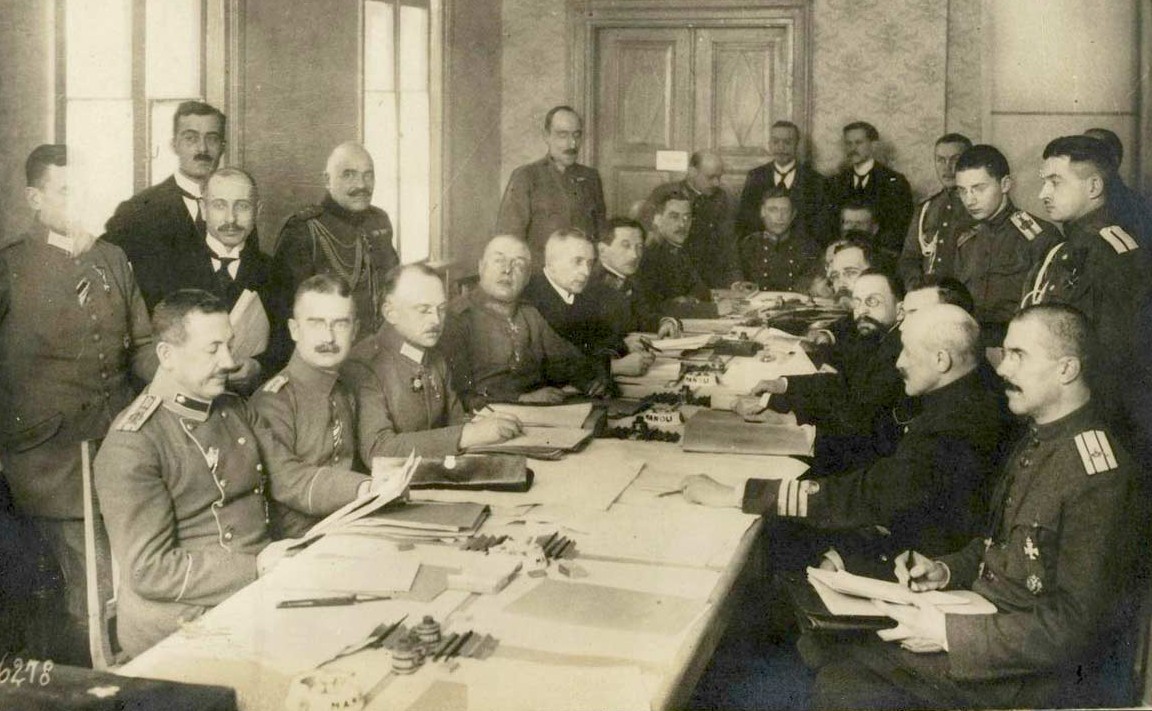
Below, a major article of historical analysis and insight from Paul Frölich on the reaction in Germany to 1918’s Brest-Litovsk Treaty that ostensibly ended that war between the German Empire and Russia’s new revolutionary government. Among the last published in the Comintern press from the prolific veteran before his December, 1928 expulsion for ‘Rightism.’
‘The Brest Peace and Germany’s War Policy’ by Paul Frölich from International Press Correspondence. Vol. 8 Nos. 8, 9 & 11. February 16, 23 & March 1, 1928.
1. Peace without Annexations and Indemnities.
The German Government, true to Bismarck’s traditions, had greeted the outbreak of the revolution in the country of an enemy with applause and had done everything in its power to promote that revolution in Russia. It cherished the hope that one of their opponents would thus be given the check-mate and, in its self-conceitedness, it did not think that the revolutionary movement might spread to its own country and sweep it away. This is the reason why it had permitted the Bolsheviki, the most dangerous enemies of imperialist war, to proceed to Russia and had in this way provided the revolution with leaders. This is also the reason why its sympathies with the Russian revolution awoke at the very moment when it became evident that the revolution was not likely to bring about a direct strengthening of the war machinery.
Under the influence of the peace propaganda made by the Petrograd Workers’ and Soldiers’ Soviet, the German Government hypocritically professed a preparedness for peace which did not exist. It promised reforms with the object of soothing the workers who had shown their revolutionary readiness for the fight and their fighting force in the April strikes in 1917. It consented to a peace resolution being adopted by the Reichstag which ostensibly demanded peace without annexations and war- indemnities and furthered the farce of an international socialist peace conference in Stockholm. That Liberal Spring which shone bright on Germany in 1917, had its origin in the critical military situation, in the revolutionary fermentation among the masses and in the wish to make a clean sweep of the Eastern front without great difficulties, in order to ensure a final victory in the West.
The October revolution involving the victory of the Bolsheviki who had triumphed with their peace slogan, doubtlessly encouraged the hopes of the German rulers. When the Soviet Government had sent its offer of peace into the world, Count Hertling who had just been appointed Imperial Chancellor, declared in his programme speech on November 30th 1917:
“I do not hesitate to admit that the proposals made by the Russian Government, as tar as they are known hitherto, may be regarded as a discussable basis for entering into negotiations, and that I am prepared to do so as soon as the Russian Government will send representatives authorised to negotiate with us. I should like to express my hope and desire that these endeavours will soon assume solid shape and will lead to peace.”
The first arrangements concerning an armistice were made on the next day, followed by the conclusion of an agreement with regard to an armistice on the 16th of December, the express purpose of which was to create peace. On December 25th 1917, the Central Powers published the following solemn declaration:
“The delegations of the Quadruple Alliance agree upon an immediate general peace without forcible acquisitions of land and without war-indemnities. In so far as the Russian delegation condemns the continuation of war, merely for purposes of conquest, the delegations of the allied Powers hold the same view. The statesmen of the allied Governments have repeatedly pointed out in their programmes that the allied Powers would certainly not prolong war even for a day, for the sake of conquests. The allied Powers have always kept unswervingly to that standpoint. They solemnly declare that they are resolved to sign, without delay, a peace which will put an end to the present war on the basis of the conditions mentioned above, which are equally just to all the belligerent Powers. The allied Powers have no intention forcibly to appropriate to themselves territories which have been occupied in the course of the war.”
This is an unreserved approval of the Russian suggestion with regard to peace without annexations and war-indemnities, an apparent confirmation that the naive interpretation of the peace resolution passed by the Reichstag was correct and that it had actually been resolved upon by the Government in that meaning. Two days later however, on December 27th 1917, the draft of a peace treaty made by the Central Powers appeared, article 2 of which contained an absolutely different stipulation, i.e.:
“Article 2. The Russian Government having proclaimed, in correspondence with its principles, the right of self-determination of all the peoples living within the union of the Russian country, without exception, a right of self-determination including even their complete separation, it takes cognisance of the resolutions which express the will of the people to raise a claim of the complete national independence of Poland, Lithuania, Courland and of some sections of Esthonia and Latvia which want to secede from the Russian national union.
“The Russian Government acknowledges that, in view of the present circumstances, these declarations must be regarded as an expression of the will of the peoples, and is prepared to draw the conclusions resulting from it.”
How did that monstrous discrepancy come about? An annexation programme had been resolved upon by the Government, by the Supreme Command and by the Emperor on November 8th 1916, containing the following points with regard to the East:
1. Recognition of the Kingdom of Poland.
2. Annexation of Lithuania and Courland territory to the effect that, including the Kingdom of Poland, a favourable frontier against Russia, running from the North to the South, is established.
3. A commercial agreement with Russia, i.e. economic advantages.
These plans of conquest were followed by the peace resolution of the Reichstag and by Michaelis’ approval “as I understand it”. Less than a month after that, however, on August 9th 1917, Privy Council sat in Kreuznach, extending the old programme of conquest at least over Belgium! After another month had elapsed, i. e. on September 11th 1917, the Privy Council in Bellevue beat a retreat with regard to Belgium. It has not been made known whether or not the Russian question was also discussed, but when Ludendorff, in his “reminiscences”, refers to the plans made at that time, he mentions the affiliation of Courland and Lithuania involving a personal union with the Hohenzollern, and to an economic affiliation of Poland to Germany. The Russian offer of peace once more caused the lust of conquest to flare up. On December 11th 1917, Hindenburg wrote to Hertling, the Imperial Chancellor, that the agreement of September 11th had been made under the condition that peace was to be concluded in the current year:
“The preliminary condition on which that decision of the Privy Council was based, has ceased to exist. As our military position has moreover become extremely favourable, I cannot any longer see any need of yielding up our military demands, but I am compelled to raise a renewed claim with regard to them, and that to the full extent to which they have been laid down at the Kreuznach Conference on April 23rd and August 9th with general approval.”
In view of the fact that the demands of the Supreme Command were received by the Government as orders, the programme of conquest of Brest-Litovsk was thus determined beforehand. This was further quite evident from the circumstance that co-operation in the Brest peace negotiations was conceded to the Supreme Command on December 18th. How then is it possible that the said declaration of peace without annexations was made on December 25th? The cause was actually an entanglement of considerations and diplomatic devices. In Austria, distress and war weariness had reached such a point that she wished for peace under any circumstances, and the Austrian Government was prepared to make great concessions to the Soviet Power. As Ludendorff says in his book “War and Politics”, Count Czernin, the Austrian Foreign Minister, had adopted the “Jewish Bolshevist demand” for peace without annexations. It was, in the first instance, necessary to show him a good will in order to make him toe the line.
Furthermore, a deceitful manoeuvre was necessary in order to pacify Germany’s own population. In addition to this, v. Kühlmann, the Foreign Secretary of Germany, cherished the silent hope that he would be able to trick the Supreme Command and deduct something from the schemes of conquest directed against the Russians, in order to hasten the conclusion of peace. Finally and that was the decisive factor they thought it would be possible to carry out a little trickery in common with the Soviet Government. Was not the latter compelled to conclude peace? Could it hope in earnest that it would really be able to carry out its programme in view of the situation it found itself by the war? Did it not risk a good deal should it return from Brest with a manifestly unfavourable peace, with a peace which had obviously been come to by violence? “Political commonsense” altogether favoured the supposition that the Soviet Government would not be over-particular, that it would deceive its own people and give its consent to a peace which would be declared to be a peace without annexations by the contracting parties, although, in reality, it was something quite different.
The pretext for a manoeuvre of that kind was near at hand. In the Baltic provinces, so-called representative bodies of the country had been formed, meetings of diets which were completely in the hands of the German feudal lords and had passed a resolution with regard to the affiliation of the provinces to Germany. The intention was to have these resolutions recognised as being the substantiation of the right of self-determination of the peoples. Kühlmann and Czernin thus entered on peace negotiations “in good faith” indeed the good faith of traitors to Soviet Russia which was to play the accessory after the fact.
The bourgeois parties, without exception, naturally anticipated an important success to result from those peace negotiations. There were nevertheless great differences in their lust for more land. Representatives of the so-called “Eastern orientation” were inclined to try to come to fair terms with Russia, amongst them especially the agrarians who feared that an extension of territory in the East might lead to intensified competition, and heavy industry which altogether regarded the conquest in the East only as a compensation for the anticipated conquest in the West. Just those two influential strata however, carried on a policy of annexations with great eagerness and, in view of their apparently favourable chance of war, an appeal to common sense was certainly not to be expected from them.
For all that, Professor Hoetzsch, the foreign politician of the Conservatives, in the course of the first negotiations in Brest, expressed his opinion, in the “Kreuzzeitung”, that the practical use made by Germany in Brest of the right of self-determination of the peoples, would take away from Russia more than Germany required and had more the appearance of annexations than that which should be demanded for military and strategical reasons in the East. The opinion of the great majority of the German bourgeoisie, however, was expressed in the following words published in the “Deutsche Zeitung” after the Russian peace-proposal:
“There is no conceivable reason why we should yield up any bit of what we have won. Provided that the Russians believe in our strength, they will conclude peace with us on any condition. Nothing but an icy coolness in waiting, combined with purposeful and firm words, may restore peace.”
Social democracy displayed all the variety of colours of a rainbow in the question of peace. The main troop of the party executive whose opinion was expressed in the “Vorwärts”, hypocritically advocated a peace of annexations in order to make it possible for the government to continue its double-dealing. Schippel, Quessel, Cohen, Kranold and others, stood up for an Eastern orientation, in the “Sozialistische Monatshefte”. They maintained that it was necessary to observe moderation in the East and to conclude a peace of mutual understanding in order to defeat England. The extreme imperialist wing with its chief representatives Lensch, Cunow, Haenisch, Winnig, was in favour of conquests in the East also. They had openly said so before the revolution. Eduard David for instance had worked out “Guiding Principles with Regard to Peace” for the social democratic fraction of the Reichstag and for the party leaders in 1915, in which a considerable degree of yieldingness to the pressure of the masses from below may already be noticed. They contain the following point:
“The union of the conquered Russian and Polish territories into an independent State allied with Germany and Austro-Hungary.”
After the Russian revolution, schemes of annexation could no longer be ventured openly in such an insolent form. In order to make up for that restriction, they expressed their will in formulae such as: “War is determined by the sword”, or:
“As war is not decided either by the diplomats or by the journalists, but by the soldiers, it is always more correct to stake everything on Hindenburg’s card.” (Jansson, a leader of the trade unions, in the “Glocke” of November 24th 1917.)
The plans of conquest of the majority of the social democratic leaders were clearly expressed when it was a case of taking up an attitude with regard to the results of Brest-Litovsk.
The Supreme Command thus had but a single serious opponent in its schemes of conquest, i.e. the working class which had been betrayed by its official leaders, greatly weakened by the loss of their old-established organisations and which was being kept down by the military dictatorship. As the workers, one to other hand, still lacked the courage to rise, the military met with no actual resistance. It was therefore easy for them to achieve their end in the Brest negotiations. At first, these negotiations, it is true, took place in a form which made it seem likely that peace would be brought about without friction. For the time being, Kühlmann and Czernin played the role of persons full of moderation. When they then came to the fore with their real intentions, the first thing they achieved was to disperse the assembly. On the side of Germany, the pause in the negotiations was filled with a fresh contest about the political leadership. Its immediate cause was the Polish question.
The German Government had already abandoned its original plan which had been to divide the Russian territory of Poland between Germany and Austria, and had adopted the so-called Austro-Polish solution, according to which Russian Poland should be united with Galicia and form an autonomous State within the Habsburg monarchy. Germany was to get merely a strip in order ostensibly to improve its frontier from the strategical point of view. At a conference in the castle of Bellevue on January 2nd 1918, the Foreign Office, with General Hoffmann’s support, persuaded the Emperor to narrow that strip even more, against the wishes of the Supreme Command. When the political leaders heard of that victory over Ludendorff, their hearts sank into their boots. When Ludendortt thereupon sent in his resignation, Hertling, the Chancellor hastened to write that matters were not yet definitely settled. The question concerning the border-line had in the meantime developed into the general question as to whether the Supreme Command should have an important influence on political decisions, i.e. whether it should, in practice, predominate in the administration of the State. In this question also, the government carried off the victory, but merely on paper because it shrank from turning its victory to account.
In practice, it became evident that the Supreme Command, i.e. Ludendorff had made their will prevail. The further course of negotiations in Brest testified to that. General Hoffmann actually seized the reins. When the attempt to persuade the Russian representatives to depict German annexations as a result of the right of self-determination of the peoples had failed, Kühlmann’s tactics were directed towards making territorial concessions to Russia. He still believed that the conclusion of peace meant nothing more than the usual bargaining of diplomats.
In such circumstances, negotiations could of course not advance at all. At that moment, General Hoffmann declared with military brutality that it was no question of phrases about a peace of mutual understanding nor of a peace without annexations and contributions, but simply a question of power. Germany had won, Germany was ready to fight, Germany was backing the meetings of the Junkers in the Baltic provinces, which had resolved upon an affiliation to Germany, briefly: Take it or leave it! At the same time, General Hoffmann entered into negotiations with a delegation of the Ukranian Rada which had arrived in the meantime, granted it considerable concessions at Poland’s expense, and did so although he admitted that Trotzky was right when he said that the only territory which that delegation was entitled to dispose of was that of their rooms in Brest-Litovsk. Agreements with the delegation of the Rada were in themselves indicative of the determination of the military to interfere with the civil war in Russia. Trotzky broke off negotiations in Brest on February 10th with the well-known declaration that war had come to an end without a peace treaty.
The diplomats in Brest, especially Kühlmann and Czernin quickly agreed to accept Trotzky’s declaration. In any case it meant practically that the territories under occupation remained in the hands of the Central Powers, although that annexation was not approved of by the Russian revolution. The Supreme Command however sided with Hoffmann’s point of view that Trotzky’s declaration was a termination of the armistice, as the latter had clearly been resolved upon for the purpose of concluding peace. As peace had not been achieved, the time allowed for the termination of the armistice elapsed at the end of eight days, i.e. on February 20th. The fresh conflict between the Foreign Office and the Supreme Command was “settled” on February 13th. Payer, the Vice-Chancellor, entreated them not to rob him of the means to make social democracy keep to war in the East. Social Democracy would fail to understand that war in the East should be continued for military reasons).1
Hertling, the Chancellor, also did not wish to take upon himself the bad repute that Germany was changing its policy at that moment and proceeding with annexations. Yet, there was no help for it and a fresh advance was resolved upon.
The Soviet Government was then compiled to sign an even more unfavourable peace which dismembered Russia and violated the peoples of the Baltic provinces.
A radiogramme communicated to the Soviet Government on February 21st why it had been obliged to give way:
“In view of the fact that the German working class, at this hour of danger, has proved too irresolute and not strong enough to arrest the criminal hand of its own militarism, we had no other alternative than to accept the conditions of German imperialism until the time when the European revolution will alter them.”
Even more was true of the German working class than had been expressed in the above words. German workers continued to transport weapons further into revolutionary Russia even at that time, fulfilling with them the hangman’s work of their masters. The brand of that indignity will remain on the revolutionary proletariat until it will wipe it off by its own liberation.
Nevertheless it became evident that the October revolution had increased the fighting force of the German working class. In spite of the censorship, the public negotiations in Brest-Litovsk opened the eyes of the working class to the lust of conquest of the ruling classes and to the fact that they were expected to shed their blood for the subjugation and plundering of the peoples. In Vienna, which, in the most terrible meaning of the word, was at that time faced by famine2), a general strike broke out on January 14th, spreading throughout Austria with elementary force. Only the tactics of Adler & Co. which were as skillful as they were artful, succeeded in driving the workers again into the factories on January 22nd, after vague promises on the part of the Government. On January 28th, a strike broke out among the munition workers of Berlin, and that strike also spread at once to the other towns of the country, to Leipzig, Nuremberg, Munich, Hamburg, Cologne, Braunschweig, Danzig and others. In Berlin alone 500,000 workers were out in the streets.
The movement showed, from its very beginning, a political character. Workers’ councils were formed. The following demands were made: abolition of the state of siege and of the censorship, restoration of the right of strike and assembly, the release of political prisoners, peace and republic. The Government at once took up the gauntlet with full energy. The factories were occupied by the military, court martials were established. Attempts were made to demoralise the workers by violent measures. In Berlin alone, 50,000 workers on strike were called up by the military authorities.”
All these measures however would have been of no avail, had not the social democrats taken it into their hands to demoralise the workers on strike. Whilst the trade unions, from the beginning, refused to have anything to do with the fighters, Ebert, Scheidemann and Otto Braun surreptitiously sneaked into the strike management. The Spartakus League tried to fan the flames of the strike into armed insurrection, but the workers of Berlin still supported the revolutionary leading functionaries of the Independent Social Democratic Party who were opposed to an insurrection. The strike therefore had to be called off on February 3rd, without result.
In spite of all that, the fight had had the result that the workers were indignant at that betrayal and that large numbers of them broke with the social chauvinists. The influence of the social democratic leaders on the workers in the factories of the big towns was broken from that time onwards, and those thousands who were sent to the trenches, carried there the germs of revolt.
2. Brest-Litovsk and the Social Democracy.
The political importance of social democracy was anyhow important enough. Revolutionary propaganda had not yet penetrated into the small towns, and broad strata of the petty bourgeoisie still supported the social democratic party. The Government rather overestimated than undervalued its influence. Its attitude towards the Brest peace treaty was therefore very important with regard to the further development of affairs in the East and to the policy of war and conquest altogether. This is clearly evident from a latter addressed by v. Radowitz, under secretary of the State, to Count Limburg-Stirum, the representative of the Imperial Chancellor at the Supreme Command. The Supreme Command wished to turn its victory over the political administration thoroughly to account. It had won over both William II. and the Crown Prince for the demand that the Imperial Chancellor should publicly and in a positive way disclaim any connection with the peace resolution passed by the Reichstag. In reference to that, v. Radowitz wrote on January 17th that the Imperial Chancellor quite agreed with them on principle, but that the execution of the plan offered difficulties:
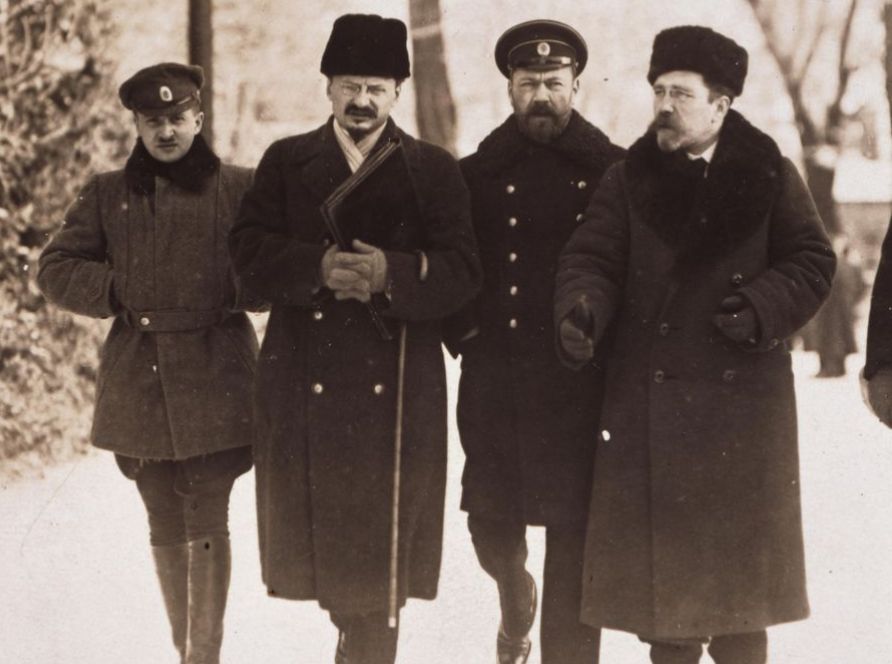
“A declaration of that kind would make it impossible for Social Democracy to preserve its face in the eyes of its own partisans. That declaration would immediately split the present majority and drive Social Democracy as a whole, the greater section of the Liberals and possibly a certain number of the Centre party into an attitude of opposition to the Government, which would make it impossible to carry on the government. The Imperial Chancellor is therefore endeavouring to persuade the Reichstag to realise for itself that the preliminary conditions of the resolution have ceased to exist and that Germany ought to shake off that chain with which it has bound itself. If this procedure succeeds, it will be possible for Social Democracy to maintain its contact and to keep up its co-operation with the government. We need that co-operation as long as war continues for, if Social Democracy, treated badly by the government withdraws from co-operation, it loses at that very moment, any desire to advocate the intentions of the government before its electors and especially before the trade unions, and even has no possibility to do so. The latter will then altogether drift into the hands of the Independents, and the danger of strikes etc. will become imminent…
“We must therefore keep them to the point and should not forget that, in spite of everything, the Russian example is acting on our country also and may lead to evil consequences unless the bad elements are kept in check by their own leaders…
“The transformation of the Right wing of Social Democracy into a national Labour party will be frustrated for all time to come if the government occasions a breach at the present moment.”
That testimony not only shows how the social democratic leaders used to fool the workers in common with the government, but also the position of power it held in its relation to the government. If they really meant the peace resolution so earnestly as they boasted to the whole people, they also were in a position to drive the government into a fateful crisis on account of the Brest peace and to compel it to yield. They did nothing of the sort. The “Vorwärts” stated on February 18th 1918 that the action for peace had altogether failed. Peace with the Ukraine had given offence to Poland and made it Germany’s enemy. Instead of peace, three fresh wars came into being, one in Finland, another in Courland, the third in the Ukraine. The newspaper then raises the question: Why should further war-credits be granted? The following answer reveals the whole moral depravity of social democracy:
“An opposition without activity is an absurdity and sheer idleness, an oppositional action however, can only be of an extra-parliamentary nature. Is there any possibility of changing the course of foreign policy into a different direction which corresponds more with the interest of the German people than that steered hitherto, by means of an extra-parliamentary action? None but he who answers this question in the affirmative and denies that the Reichstag has the right to exercise a decisive influence on politics, may stand up for a tactical measure which will then be more than a cowardly way of escape.”
Those contemptible idle words naturally (mean nothing more nor less than: We are quite willing to be overpowered. But they meant even more. It is easy to understand that the government started an agitation against the Bolsheviki at the time when the violation of Russian roused the indignation of the masses of German workers. The “Norddeutsche Allgemeine Zeitung”, the organ of the government, published articles about “Russian anarchy”. The social democratic Press which had up to that time courted the favour of the Bolsheviki, immediately joined in the tune. Under the catch-word of “Bolshevism”, Friedrich Stamper published, in the “Vorwärts” of February 24th 1918, an article of revolting baseness. He did not find words against the peace of conquest of the German Government, but he poured forth the following repulsive effusion against the Soviet Power:
“It was an awful thing to witness with what light-heartedness they yielded up Russian territory, how they pushed away one country after the other with a negligent movement of the hand, how they repeated with unchanged equanimity: even to its separation from Russia. Never would German Social Democracy have acted in that way had it been in a similar position! Those socialists who think themselves very up-to-date, do not show the slightest understanding for the necessity of keeping together vast economic domains. Those German Social Democrats who feared that the Balkanisation of the East would be a danger to all the peoples concerned, including the German people which is nearest to their hearts, were actually driven to despair by the behaviour of the Bolsheviki. There was every reason to say: Well, if the Bolsheviki and the German annexationists are united in their views what are we, the German social democrats to do against it?
“This is how the Bolsheviki have wrested one weapon after the other from the hands of German social democracy. We maintained: “Russia is still a Power.” We received the answer: But there is not a single man at the front!” We said: “You are conjuring up a fresh war of revenge.” We received the answer: “The Russians are not French, their national feeling is not developed.” We argued: “Russia could not bear the loss of the Baltic provinces.” We received the answer: “The Russians themselves relinquish those provinces!” We said: “We will not admit that the achievements of the Russian revolution are destroyed.” We received the answer: “Look close at, those achievements, one socialist group in that country is firing at the other socialist group.”
“The Bolsheviki, still fail to realise that they have promoted imperialism, that they have put difficulties in the way of any real fight against it. They are constantly starting at their one illusionary and useless measure: the revolutionary mass strike.
“German social democracy never regarded the mass strike as a means of carrying out revolution at one blow, still less as a means of terminating the war. It has been repeated over and over again at the international socialist congresses that, as the revolutionary mass strike cannot break out in all the countries at the same time and with equal force, it will threaten, above all, those countries in which it is put into effect first and with the greatest vigour. In Russia, the correctness of this assertion has been confirmed.
“The German people does not care to be the next on that path.”
On February 27th, the “Vorwärts” stated with a perceptible sigh of relief:
“The overthrow of the Bolshevist Governnient can be foreseen as the result of that peace treaty.”
All that however had already been surpassed by an article written by Otto Braun, a member of the party executive, today Prime Minister of Prussia, published in the “Vorwärts” of February 15th. In that article, the methods which social democracy later knew to apply in such a masterly manner, in its alliance with the anti-Bolshevist league, were used for the first time. It ran as follows:
“They are killing democracy and replacing it by energy and brute force. They are gagging the public opinion in a way which must rouse the envy even of the most bruta! servants of the Tsar and are throwing large numbers of their own comrades into prison even though they only tactically deviate in their views.
“They are forcing everything that offers resistance to the ground by force of arms with the help of the soldiers who are still devoted to them. The rule of that unbridled Bolshevist military rabble should however be condemned in the same way as is the rule of violence of the Tsarist soldiers. In any case, it cannot last.
“The chaos in the economical and political field must necessarily become gradually worse and must finally lead to a collapse of that unnatural socialist rule by the sword.
“The ways and doings of the Bolsheviki in Russia have nothing in common with socialism nor with democracy, they are, on the contrary, a case of the most brutal putschism and anarchy.
“This is why we must draw a thick, visible line of separation between Bolshevism and ourselves.”
These things were even too much for the Vienna “Arbeiter- Zeitung”, the sister of the “Vorwärts. The first maintained that the opinion expressed by Braun, a social democrat, was hardly different from that of any narrow-minded bourgeois and reactionary person.
“His thick line is therefore probably at the same time a document of the moral and mental condition of many a comrade in the German Empire at the present moment.”
The social democratic Press continued its agitation. It broke off, however, on the very same day on which the Soviet Government signed the peace treaty. Thereupon the tussle with the Independents about the question as to who was next to the Bolsheviki, began once more. That anti-Bolshevist interlude had therefore been an offensive carried on by the German Government with the object of unburdening itself at the moment when it intended to resume the fight against Soviet Russia.
There were, it is true, still a few last Mohicans left who wanted to take the “peace policy” of social democracy seriously, but they were drawn into a violent dispute about words with the majority of the social democratic leaders. The discussion began when Stampfer, in a correspondence article in March 1917, stood up for the consent to the predatory peace of Brest by the Reichstag fraction, on the grounds that the Russians should not draw the conclusion that they were at liberty to begin war afresh. This was said by the same man who, a few weeks later, stated in the “Vorwärts” that, at three decisive moments, German policy had taken a different route from that chosen by social democracy, and who had continued as follows:
“Those three moments were Austria’s ultimatum to Serbia, the declaration of the unrestricted submarine war and the conclusion of peace at Brest-Litovsk. That policy which we combated, resulted in the situation in which we are at the present time. There is indeed no other issue from it than one by force. We have been promised that we should be taken along that path to a victorious end, and have been told that the end was near…We are joining in the march, we are contributing to the costs, we are sharing the hopes, but we state that those bear the responsibility for the result who have taken upon themselves the leadership of the State.”
We could give further quotations. It suffices to exhibit these “labour leaders”, these serfs who, while drunk, boast and swagger over the misdeeds of their masters! A vote was taken on the peace treaty in the social democratic Reichstag fraction, 25 votes were given in favour of accepting the treaty, 29 for abstention from voting, and only 12 for its rejection. Finally, the social-democratic Reichstag fraction decided to abstain from voting. They agreed to the peace with the Ukraine.
3. The Campaign against revolutionary Russia.
The extension of power in the East acquired by German imperialism through the peace of Brest, was more apparent than real. With regard to Germany’s political situation as a whole, it was fatal. It prompted the peoples of the Entente once more to persist in the alleged war of defence, as that peace in the East had given clear evidence of the voracity of German imperialism. In most of the neutral countries, feeling had not been favourable from the beginning. Conditions then got worse along the whole line, because no one felt safe in view of this sabre-rattling. Holland and Denmark felt themselves threatened, not without serious reasons, considering that strategical plans had been worked out against them. A conflict arose with Sweden about the Aland Isles.
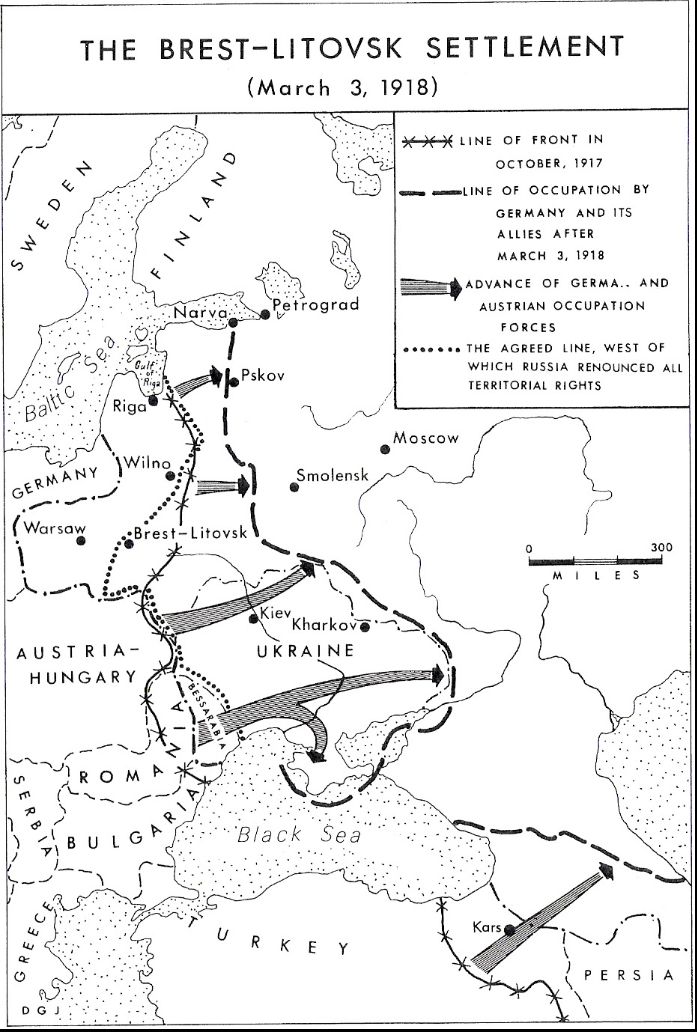
Even in the ranks of its own allies, the conclusions of peace led to critical complications. The Bulgarians had a feeling of being deceived by peace concluded with Roumania a short time after Brest. The Poles who had, from the beginning, joined the allies with the intention of playing false to them, were offended by the Cholm territory being ceded to the Ukraine. Towards the middle of the month of February, the Polish auxiliary troops broke away from the German front. A brigade was defeated and disarmed. The Haller brigade fought its way through to Archangel and afterwards joined the front of the Entente in the West. It was only possible for German militarism to maintain its position in Poland, a friendly country, by means of the most rigorous dictatorship. In order to crown things, the absurd campaign against the Russian revolution was begun. That campaign added a good deal to the final break-down of the German military force.
As a matter of fact, the Peace Treaty of Brest-Litovsk had not brought about real peace in the East. Peace with the Ukraine had always been a mere fiction. Being concluded with a government which had, in reality, already been swept away by the popular rising, it had first only served the purpose of bringing the Russian negotiators into an awkward position and making them pliable. Not content with this, German imperialism, in its hatred of the revolution, wished to cut a vast area out of the Soviet Republic. Peace with the Rada was used as a pretext towards that end. The country was then conquered for that marionette of the German military. In Germany, a few divisions of Ukrainian prisoners of war were collected with which to support the German war of conquest. When they arrived at the front, they melted away in the sun of the Communist propaganda and it was finally necessary to disband them. War was carried on in the Ukraine with all the cruelty which distinguishes the Whites in any civil war.
The same occurred in the Baltic Provinces. We have before us an order of General von Kirchbach, Commander-in-Chief of the German troops in Lithuania and Esthonia, which runs as follows:
“I order that all the Bolshevist agitators and leaders of the Red Guard be kept as hostages under the strict supervision, and that merciless revenge be taken for the death of any Latvian, Esthonian or German killed by the Boisheviki.”
The revolutionary troops, of course, were not able to resist the organised military power of the Germans as long as civil war with the Czechoslovakians and other White troops chained the forces of the Soviet Republic. Even German militarism, however, did not succeed in really winning over the Ukraine. The power of the Rada ceased where the space swept by the German guns ended, and the indignation against the “liberators” grew throughout the country in such a way that even between the Rada and the German conquerors dissensions assumed a more and more acute form. This led to the coup d’état on May 1st, 1918, organised by General Eichhorn who deposed the Rada government, had its members thrown into prison and nominated Heiman Skoropadsky dictator.
The fights in the Ukraine were carried on by Germans and Austrians in common. At the same time, the Turks advanced from the South towards the Caucasus, immediately after the Brest Peace Treaty, with the support of German troops. In April they occupied Batum. In May, the Georgian Mensheviki divided the Trans-Caucasian Federation, declared waron Aserbeijan and Armenia and called in the help of the Germans. German troops were landed in Poti on May 25th, and Djenkeli, a Menshevist, concluded an agreement with General Lossow, the leader of the monarchist military revolt in Bavaria in 1923, on the basis of which the navy and the railways of Georgia were transformed into the hands of the Germans for the whole period of the war, according to a written convention, whilst the Menshevist Government was, in reality, placed under the guardianship of the German generals. The latter were thankful to the Georgians for their carrying on civil war in alliance with the Mensheviki. Baku, where the Bolsheviki maintained their power for months, was occupied by the Turks towards the middle of September. The German troops advanced from the Caucasus towards North Persia. They occupied Tabriz. The Supreme Command, intoxicated by megalomania, even planned to advance to India, in order to overthrow Great Britain’s power there.
German imperialism, not satisfied with that, undertook a campaign against Red Finland. Even at the time of the Tsar, Finnish activists had joined the German army. They were collected into a united troop and trained for the fight in Finland. When the power in Finland had passed into the hands of the workers and peasants in the winter 1917/18, the German army supplied the Whites who were headed by Mannerheim and Svinhufvud, with war material and arms. Two divisions were placed at their disposal together with the trained Finnish cadres. At the beginning of April, they crossed the Gulf of Finland and defeated the Red Guards in a murderous campaign. The German military, in common with the Finnish Whites had already arranged to set the Red Guardists, whom they had taken prisoners and for whom they did not have a sufficient number of starvation-camps as they did not die rapidly enough, to forced labour in German factories or in the rear of the Western front. They only abandoned that intention for fear that the German workers and soldiers might be infected with Bolshevist germs.
During all those sanguinary campaigns, from Finland down to Persia, the German Government still kept up the pretence of friendly relations with the Soviet Government, as though nothing were happening. After the attempt of the social revolutionaries on Mirbach’s, the Ambassador’s life, Hertling, the Imperial Chancellor, made a speech in the Reichstag on July 11th, which contains the following passage:
“We take our stand on the basis of the Peace of Brest- Litovsk and wish to see that peace effected in a loyal manner. That is the will of the German Government and it is supported therein by the German Supreme Command… “We do not want a fresh war with Russia…
“Our position is thus that we are loyally negotiating with the present Russian Government, that we are not undertaking anything which is likely to injure the authority of the present Russian Government, but that we are keeping our eyes and ears open in order not to be wronged and taken by surprise by a sudden change of conditions in that country.”
What was behind the peculiar wording of that declaration? The intention was to wipe away by means of the loyal peaceableness which was repeated ad nauseum, the blood German imperialism was shedding in streams in the civil war against the revolution. Herr Hertling, when he spoke of the eyes and ears being kept open in order to avoid being taken by surprise by an overthrow of the government in Russia, forgot to mention the hands by which they had already tied themselves to the Russian counter-revolution according to agreement. What, then, were the peculiar negotiations hinted at with such obscure insinuations? A fresh peace of Brest-Litovsk was being prepared for. The difficult situation of the Soviet Government was turned to account for a fresh plundering. Lithuania and Esthonia, the possession of which had been explicitly guaranteed to the Russian Government in Brest-Litovsk, were wrenched away from it; 6 milliards of gold mark were extorted from Soviet Russia and other acts of oppression imposed on it. That additional clause to the convention was signed on August 27th 1918.
What were the aims concealed behind that infamous policy? The object of the advance into the Ukraine was to open Russia’s granary to the Central Powers. The Rada had made promises of golden streams of corn. Those hopes came to nought. Only in August 1918, at the very moment when the military collapse of the Central Powers began, the supply of food was set on foot. It was of no importance with regard to provisioning in the summer of 1918.
“Half as much as was imported from former Russia with the help of the military official apparatus, was introduced by smuggling. We would have achieved the same results until the next harvests, by promoting free trade and smuggling, especially in respect to the supply of cattle and horses, which we achieved by means of the occupation.” (Deputy Deermann at the executive committee of the Reichstag for investigation into the war.)
In that respect, the campaign into the Ukraine therefore proved a complete failure).3 The intention was to get petroleum and benzine from the Caucasus by force of arms. Only in September did the Germans succeed in occupying Baku. The German war machine did not have the benefit of a single drop of petroleum. Germany’s intention to feed its own war machinery through the fresh war against the country of the revolution was absolutely wrecked.
That war against revolution was of decisive significance. The Prussian military and bureaucracy possessed enough political understanding and, above all, class-consciousness to realise that, after the demonstration of force of the world war, the Prussia of the Junkers was unable to hold its own against revolutionary Russia. The driving force was their hostility to Bolshevism.
Even in the Spring of 1918, General Hoffmann had entered into connections with Durnovo, the son-in-law of Grand Duke Paul. Negotiations were also entered upon with other monarchist groups, further with the White Don Government of Kaledin; the latter was also supported by troops. Hoffmann’s scheme, as he describes it himself, was to advance along the line of Smolensk-Petrograd, of proclaiming a new government and appointing Grand Duke Paul vice-regent of the empire for the Czarevitch. Hoffmann is of the opinion that his troops would have sufficed to achieve these plans.
It is probable that this plan was not attempted because of the other plan of advancing into India. The plans of armed intervention beyond the campaigns carried on from Finland down to Persia, i.e. an intervention aiming at the overthrow of the Workers’ and Peasant Government, were not settled with this. In the month of July, plans were being hatched at the Head-Quarters as to how a fresh monarchist Russia should be arranged. The plan was contemplated to cede Polish territory to the new Tsarist Russia in order to create an irredenta in that country and thus weaken it from the very beginning. In August 1918, when the strength of German militarism already began to fail, the Supreme Command–whom the gods wish to destroy they first render mad–had prepared for an expedition to Petrograd with the object of overthrowing the Soviet Power. General von der Goltz, the dictator of Finland, writes with regard to that, in his book “My Commission in Finland and in the Baltic Provinces” as follows:
“Looking back, we cannot but deplore that the plan of a military expedition against Petersburg along both sides of the Gulf of Finland, supported by the navy at Kronstadt, fixed for August by order of the Supreme Command, was postponed in compliance with the wishes of the Foreign Office, for the reason that Germany was to receive 6 milliards in gold in accordance with the additional clause to the Brest Peace Treaty—6 milliards which we were afterwards obliged to yield up!–Germany’s future in the East was relinquished for contemptible money! That attack would have inspired the 8th army, which was found wanting during the revolution, with a new spirit, and we would have been in a quite different position in October and November 1918, both with regard to home policy and to foreign policy, had we taken possession of the whole Baltic Sea including Petersburg, formed an alliance with the Russian groups with leanings towards the Right and removed Joffe from Berlin.
“That action had been discussed with Lieutenant-General von Estorff, commander of the troops on the South of the Gulf, under whom my own troops also were placed some time afterwards, and with Vice-Admiral Bödecker; things had been reconnoitered and prepared for in such a way that only the catch-word was needed to begin with the advance on foot and by rail. Together with my excellent first staff-officer, von Falkenhorst, awaited daily the telegraphic order to advance alas in vain!
“Negotiations with the leaders of the Right Russian parties had already been entered on in July with Prince Volkonsky, ex-president of the Duma, who had proved to me, by a memorial presented to the Tsar in February 1914, that the Russian Right had been opposed to war against Germany. Those negotiations had been continued, without committing the parties, by myself with Prince Volkonsky, with Alexander Tropoy, the Russian ex-minister and with the Grand Duke and Grand Duchess Cyril, with the knowledge of the Supreme Command and of the Foreign Office. In addition to this, several officers belonging to my staff, kept up negotiations with a number of Russian monarchists and officers.”
The fresh campaign against Russia, directly after the Peace of Brest, was started at the very moment when Ludendorff was preparing for his offensive against France which, as is well known, ended with partial victories and finally with a complete defeat. Those campaigns, inspired by despair, could in themselves not lead to a victory of the Central Powers. It is, however, a fact that the counter-revolutionary campaign against Soviet Russia played an essential role in their military collapse. In March 1918, when the attack in the West began, far more than a million of German soldiers were still in Russia. To these, the Austrian troops must be added. Almost a third of the stock of horses of the German army was retained in the East. Even in October, the German troops still numbered more than 600,000 men.
Those divisions, composed of militia and of the last reserve were certainly not equal to the fight at the Western front, but they might have formed an essential support in the rear of that front. Repeated negotiations between the Government and the Supreme Command took place with regard to the withdrawal of the front in Russia. In vain. Even in October, in view of the collapse of the Central Powers, the Government could not make up its mind to quit the Russian territory. The dread of Bolshevism prevented any decision which seemed reasonable from the military point of view.
To this must be added the “wearing down” of the German troops in Russia. Bolshevism is an infectious disease against which no imperial army which comes into contact more proof. The longer the campaign against Russia lasted, “unreliable” did the troops become. Divisions which had been sent from the East to the West, proved incompetent. It was in vain that quarantine-stations were established in which to disinfect the soldiers from the Bolshevist bacillus. They took the dangerous poison home and to the Western front. All these factors contributed largely towards the collapse of the imperialist machinery of war. This is how the counter-revolutionary actions on the territory of the Russian Workers’ revolution broke the neck of German imperialism.
What attitude did the social democratic leaders take with regard to all these things? They were visited by most acute vacillations. At the moment when the general situation was unfavourable, they lamented over the foolishness of the Brest Peace and over the crime committed against the Russian revolution. As soon, however, as victory was carried off in some place or other, their enthusiasm soared up, as can be read in the “International Correspondence” in February 1918, after peace negotiations had been broken off:
“Hostilities having been resumed, the German troops are advancing in the East with lightning speed. The prophesy that the armies of Russia have lost entirely all capability of resistance, proves true in an unexpected degree. Thousands of guns and immeasurable quantities of other war material, of which the Supreme Command can make good use at the Western front, are falling into our hands, almost without fighting.”
Wilhelm Jansson, in the “Glocke”, agitated for intervention in Finland and applauded it enthusiastically. When war was finally settled, it was Herr Scheidemann who put the idea in the minds of the members of the German Government, to have the luggage of the Russian Embassy in Berlin burst open by accident, into which a box containing pamphlets had been introduced in an underhand way. The first step taken by the “Socialist Government” of Ebert, Scheidemann, Haase, was its decision against the country of the revolution, in favour of Wilson, against Lenin.
Notes
1. Payer’s concern was quite superfluous. Social Democracy was fettered to the German chariot with iron chains. The “Vorwärts” wrote the following answer to Trotzky’s declaration:
“German Social Democracy is firmly convinced that it is best serving the interest of the German people by its peace policy. It is therefore prepared to use every influence it possesses in order to put that peace policy into effect. The idea, however, that the German working class is able to seize the power by force in order to come to the assistance of Russia, is a delusion. An undertaking of that kind would not only be hopeless, but would also clash with the democratic principle (!) and be dangerous in view of the fact that the state of war in the West still existed.” The “Freie Presse” in Leipzig wrote on February 17th 1918: “The Bolsheviki ought to conclude peace and not to instigate revolution in Germany.”
The worst things Mr. Payer could expect from those quarters was a few superfluous phrases, but no deeds.
2. The German army administration dispatched a transport of corn to Vienna, in spite of the lack of food in their own country, thus preventing Czernin from concluding a separate peace with Russia.
3. General von Kuhl declared at the executive committee for investigation into the war that an exploitation of the Ukraine had not been possible because the war had not lasted long enough. A man of most sensitive feeling!
International Press Correspondence, widely known as”Inprecorr” was published by the Executive Committee of the Communist International (ECCI) regularly in German and English, occasionally in many other languages, beginning in 1921 and lasting in English until 1938. Inprecorr’s role was to supply translated articles to the English-speaking press of the International from the Comintern’s different sections, as well as news and statements from the ECCI. Many ‘Daily Worker’ and ‘Communist’ articles originated in Inprecorr, and it also published articles by American comrades for use in other countries. It was published at least weekly, and often thrice weekly.
PDF of issue 1: https://www.marxists.org/history/international/comintern/inprecor/1928/v08n08-feb-16-1928-Inprecor-op.pdf
PDF of issue 2: https://www.marxists.org/history/international/comintern/inprecor/1928/v08n09-feb-23-1928-Inprecor-op.pdf
PDF of issue 3: https://www.marxists.org/history/international/comintern/inprecor/1928/v08n11-mar-01-1928-Inprecor-op.pdf

