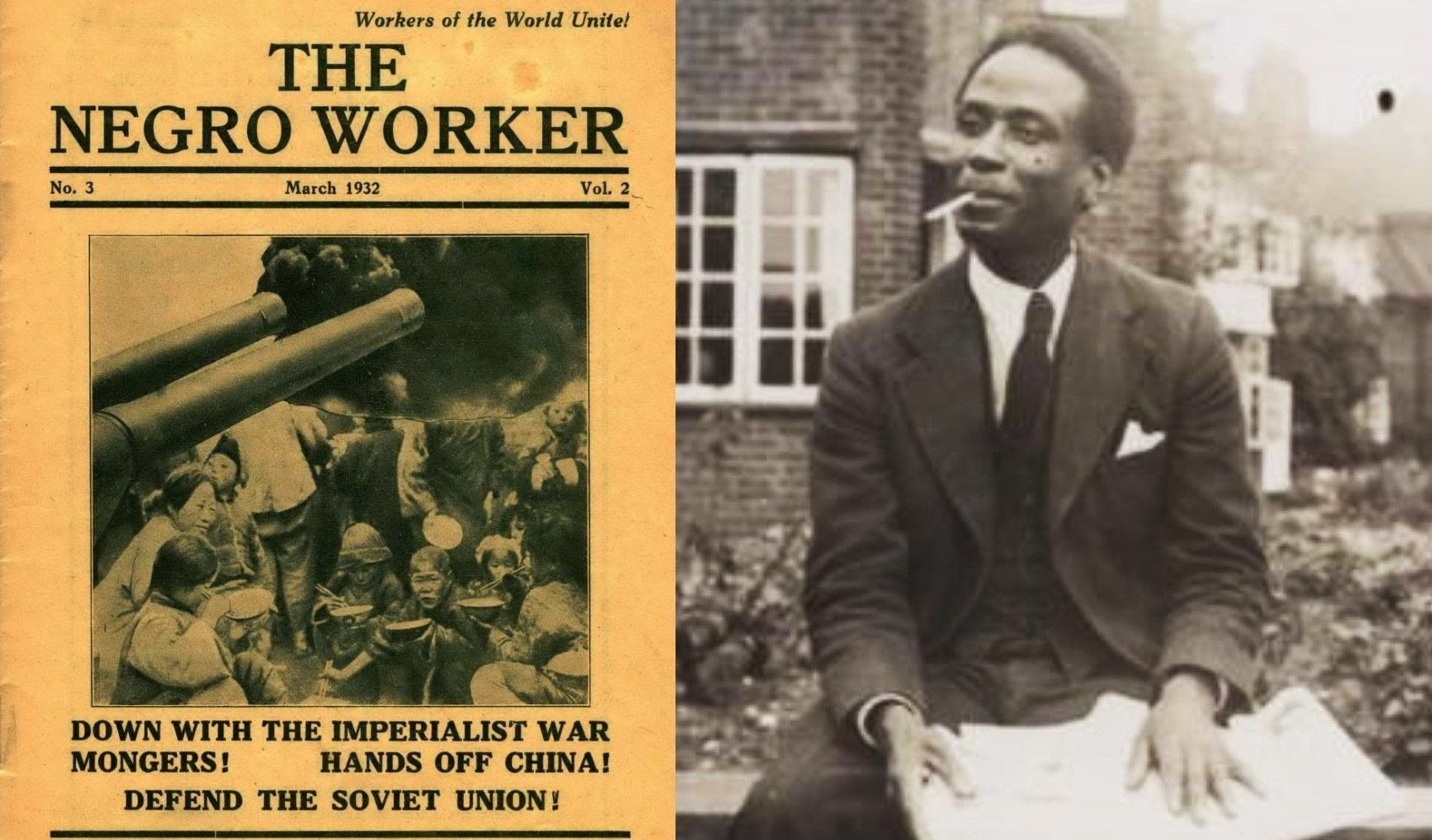
Padmore analyzes the sharp rise in conflicts among imperialist powers for control of China in the aftermath of the Japanese Empire’s invasion and occupation of Manchuria.
‘War in the East’ by George Padmore from The Negro Worker. Vol. 3 No. 2. March, 1932.
While the representatives of the various imperialist powers are mouthing pacifist phrases in Geneva, bloody warfare is going on in the East. These events confirm our warnings that the imperialists, by means of the Kellogg Peace Pact and the League of Nations Covenant are feverishly preparing to plunge the working class into another world war. Although there has been no formal declaration of war, the Japanese imperialists have not only been carrying on open warfare against the Chinese workers and peasants in Manchuria since September 1931, but they have recently landed 50,000 troops in Shanghai, armed with the most deadly devices of modern warfare, which they are using to massacre defenseless men, women and children. Already thousands of Chinese workers and their families have been slaughtered and the native section of Shanghai has been completely destroyed. While all of this is going on, the imperialists cynically declare to the world that there is no war. But the Chinese workers and peasants know different.
Out to Loot China.
Although the Japanese imperialists have adopted the most aggressive attitude, they are not the only ones carrying on the war. Great Britain, America, France, Italy and the other imperialist powers are all interested in the events in China.
Because of the world economic crisis which has thrown more than 40 million people out of work in America and Europe, and created the greatest hardship among the workers, the capitalists, in order to stave off revolution are preparing to plunge humanity into another world war. In this way they hope to get rid of the unemployed problem, by mobilizing the majority of the jobless and sending them to the front as cannon-fodder, while a few will be given jobs in manufacturing ammunition with which the workers in the various imperialist armies will be killing each other off. Furthermore, this will also enable the capitalists to increase their profits which the crisis has partly affected. Already these human vampires who gamble upon the wholesale murder of workers and their families are beginning to reap a rich harvest. Raw materials, such as wheat, cotton, sugar, hides, chemicals and all kind o! metal for warfare which were on the decline up to a few months ago have suddenly gone up on the stock exchanges, while the manufacturers of ammunition in America, France, England;, Germany, Chechoslovakia etc., are busy working night and day, preparing the deadliest weapons of destruction. These weapons together with poison gases, bombs and disease germs, will not only be used by the opposing armies, but will be let loose upon whole civil populations.
Attack Against Soviet Russia.
While the capitalists are arming against each other in order to redivide the world they are secretly trying to agree among themselves on a program of action for an attack upon Soviet Russia. Since the Soviet Union is the only country under a workers’ government, where there is no unemployed and where the toilers are building up a socialist system which is an inspiration not only to the working class in the capitalist countries but to the colonial toilers in India, in China, in Africa, and elsewhere, they would like to drown this country in streams of blood. Already the Japanese imperialists who have stolen Manchuria from the Chinese workers and peasants, have set up a puppet government under their control in order to use this as a jumping off ground to invade the Soviet Union. Since the American, British, French and other capitalist powers have no great economic interests in Manchuria they are all prepared to support the Japanese imperialists in their war preparations against the Soviet Union. That is the reason why all of the European and American imperialist powers, headed by the League of Nations were urging the Japanese on in their robber campaign in Manchuria. But the Japanese militarists, having completely annexed this rich territory which covers an area of over 200,000 square miles with a population of over 20 million people—suddenly turn their attention to China proper. And under the lying excuses of suppressing anti-Japanese societies in Shanghai, openly directed the most brutal and barbarous attack upon unarmed and defenseless workers and their families in the Chinese section of Shanghai. Although the Chinese capitalists and bankers, headed by that arch-traitor Chan-Kai-Shek were quite prepared to betray their country and to turn it over to the invaders, the Chinese soldiers and the workers, under the leadership of the Communist Party, are putting up a heroic resistance.
As soon as the Japanese landed their troops in Shanghai, the other imperialist powers, especially America, Great Britain and France who were supporting Japan in her annexation policy in Manchuria and her provocations against the Soviet Union, also began to send war ships and soldiers to Shanghai. They are afraid that Japan, not satisfied with Manchuria, is out to overrun the whole of China. And since they have hundred of millions of dollars invested in Shanghai and other great Chinese ports, such as Hankow, Nanking—this conflicts with their own interests.
British Investments
Each of these powers has built up a network of concessions and interests. Each has its own special spheres of influence. Each has carried out a long policy of exploitation, that leads inevitably to the present stage of naked war against the workers and peasants of China.
The oldest and most firmly established of the imperialist Powers in China is Great Britain. The British sphere of influence is South China, and especially the Yangtse Valley.
Ninety years ago Hong Kong was stolen from China in the first opium war. The second opium war led to the acquisition of a large tract of mainland opposite. The murder of a missionary in 1893 was used as an excuse to seize the port of Wei Hai Wei.
More important has been the “peaceful” economic penetration—carried out in many cases under the guns of the gunboats on the Yangtse River.
At least £40,000,000 was invested in Chinese railways. The total amount of loans to China since 1896 has been £110,000,000.
For British banks in China have a capital of £80,000,000. Of these, the Hong Kong and Shanghai Bank ranks among the great banking institutions of the world.
Apart from loans, British property in China is estimated at from £250,000,000 to £300,000,000. British capitalism owns 3,200 miles of railways, over a third of the entire Chinese railway system.
It owns coal mines that produce 3,000,000 tons of coal a year.
It has its own postal and telegraph system, and controls important shipping interests. There are ten British daily papers published in China, and some 15,000 British subjects have their homes there.
British imperialism has in recent years felt itself restricted by the pro-American policy of the bourgeois National Government.
Like other imperialist Governments in China, it fears the growing strength of the Chinese Soviet Government. Hence the support accorded to Japan in its seizure of Manchuria (which forms a precedent for the seizure of the Yangtse region by Great Britain), and its war-like policy in relation to the U.S.S.R.
Yankee Interests
The United States of America came upon the Chinese scene later than either of its rivals.
The United States is, however driving ahead for the mastery of China. It is striving to unite China, or a considerable part of it, under the bourgeois Nanking Government of China, in order, through that Government, to convert the whole of China into its colony.
American capitalism has made heavy loans to the Nanking Government. Apart from these loans American investments in China amount to about £660,000,000 and its share in trade is about 20 per cent. There are 10,000 American citizens living in China.
French Share
“The interests of France, though still considerable, are smaller than any of the above Powers.
They lie chiefly in the three southern provinces adjoining French Indo-China. This area forms a definite “sphere of influence”, and in the event of a general partitioning of China the French would probably attempt to occupy this area.
France has a settlement at Shanghai lying alongside of the International Settlement. There are about 2,500 French residents in China,
French loans to China total £70,000,000, and French capital controls 1,800 miles of Chinese railways. On the other hand the trade between France and China only amounts to four per cent of the total trade of China.
The French imperialists have made a considerable loan to Japan in recent months and are supplying Japan with considerable quantities of munitions.
Japan’s Penetration
“Japan’s sphere of influence is mainly in Manchuria, though there are extensive and growing Japanese interests in Mongolia and the Yangtse valley.
The Russo-Japanese war led to the acquisition of extensive rights in Southern Manchuria. The recent military occupation merely placed a seal upon an already existing economic penetration carried out with extreme thoroughness.
This is what is meant when the capitalist Press speaks of “legitimate Japanese interests existing in Manchuria”.
Japanese penetration of China has been largely carried on through the bankers, and Japan holds 62 per cent, of the capital of all foreign banks in China. There are £55,000,000 of Japanese loans to China, of which just half is invested in railways.
Of the 60 mining concessions held by Japan in China 53 are in Manchuria. Of the large number of industrial concerns owned by Japanese capital, 80 per cent are in or near Manchuria. These include a number of big cotton mills and the largest railway works in China.
Japanese shipping interests, with 30-40 ships engaged in river and coastal trade, are second only to those of Britain.
In addition to Japanese interests in Manchuria Japan shares the control of the International Settlement at Shanghai with Britain and the United Slates. It is this Settlement that has been used as a base in the recent Japanese attacks on the workers of Shanghai.
There are a quarter of a million Japanese subjects resident in China. The vast bulk of these are in Manchuria, where they form the advance guard of the imperialists.”
Soviet Russia
In marked contra-distinction to these imperialist robbers is Soviet Russia, the only country which has no imperialist designs in China or any other part of the world. First of all, the Soviet Union is a workers’ country, and the vanguard of the anti-imperialist front. The Czar’s government, like all the other imperialist powers, had shared in looting China, The Czar and the same cut-throat-bands of generals, capitalists and landlords who are today helping the Japanese in making war against the workers and peasants of Manchuria and China, had a number of concessions and a sphere of interest in Mongolia. They were some of the most brutal oppressors of the Chinese toiling masses. Immediately after the revolution in 1917 the Soviet government of workers, peasants and red soldiers renounced all of these concessions and extra-territorial rights, and entered into new treaties with the Chinese Government, recognizing them as a free and sovereign people. If the Soviet Union had imperialist designs, as the capitalist slanderers and their lackeys try to make out, it would not have freely revoked its sphere of influence in China.
Today, while the Chinese masses are combining against the robbers, it is to Soviet Russia that they turn as a source of help and inspiration for the Soviet Government now rapidly developing in China.
Class against Class
These conflicting economic interests have created such deep-rooted jealousies between Japan and America, England and France, that they are unable to get together upon a common agreement for dividing up China. Each is afraid that the other will get too much. Nevertheless, since they all are afraid of the increasing growth of the Chinese Soviet power, which alone can drive all the imperialist robbers out of the country, they are prepared to refrain from open war upon each other so as to give Japan every opportunity to suppress the revolutionary Chinese workers and peasants, especially their Red Army.
Therefore, it is the duty of the Negro workers, who are today groaning under the bloody rule of imperialism in Africa, in America and the West Indies to support the heroic struggles of their Chinese brothers, and to defend the Soviet Union, the greatest champion and leader of the liberation fight of all oppressed peoples.
Stop all transportation of troops and ammunition to the East!
Demand the withdrawal of all imperialist forces from China!
Demand all the money which the capitalists are spending upon war to be used for feeding the unemployed workers and their starving families!
Negro, White and Indian toilers, form a united front with your Chinese class brothers!
First called The International Negro Workers’ Review and published in 1928, it was renamed The Negro Worker in 1931. Sponsored by the International Trade Union Committee of Negro Workers (ITUCNW), a part of the Red International of Labor Unions and of the Communist International, its first editor was American Communist James W. Ford and included writers from Africa, the Caribbean, North America, Europe, and South America. Later, Trinidadian George Padmore was editor until his expulsion from the Party in 1934. The Negro Worker ceased publication in 1938. The journal is an important record of Black and Pan-African thought and debate from the 1930s. American writers Claude McKay, Harry Haywood, Langston Hughes, and others contributed.
PDF of full issue: https://www.marxists.org/history/international/comintern/negro-worker/files/1932-v2n3-mar.pdf

