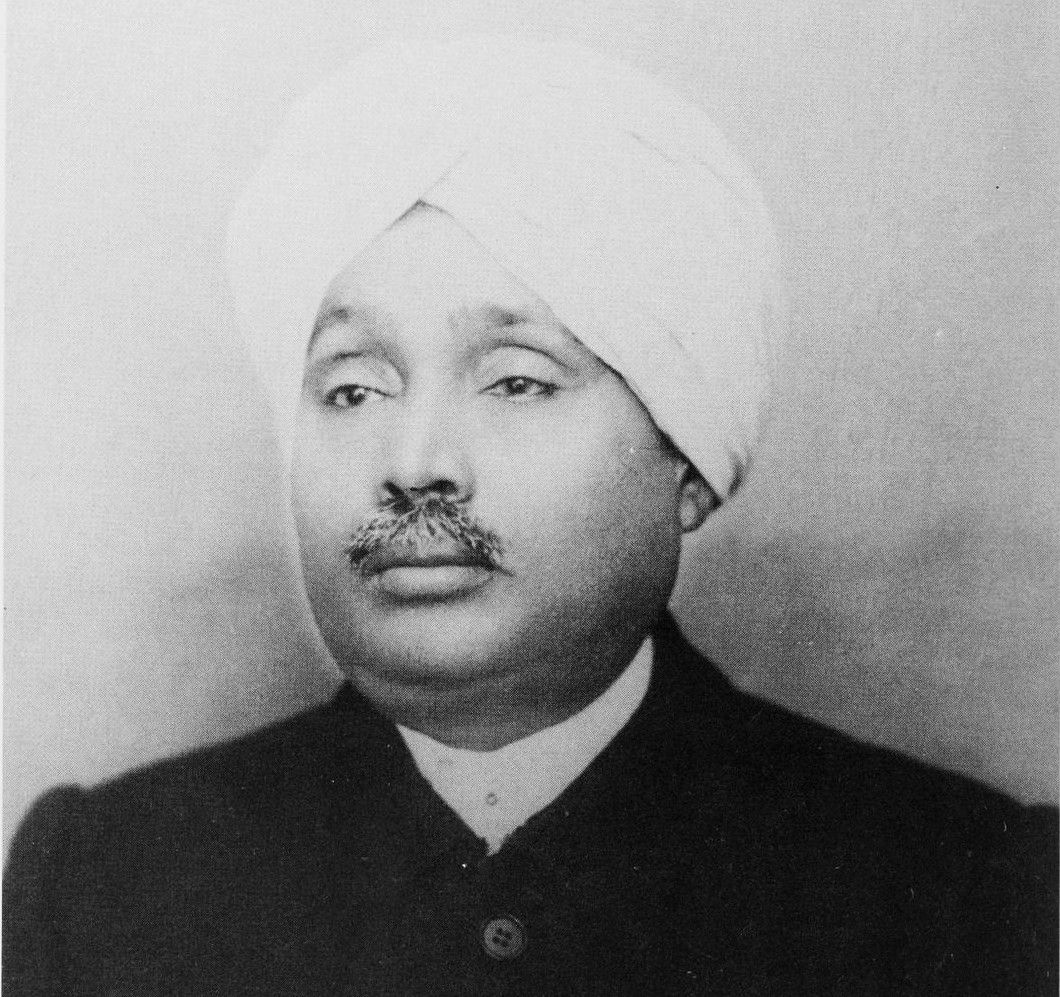
Lala Lay Pat Ray was badly beaten during October 30, 1928’s police attack on an anti-Simon Commission protest in Lahore, where the 63-year-old had been personally singled out for assault by the British police superintendent. The leading revolutionary nationalist and labor leader, who lived years in U.S. exile, succumbed to his injuries on November 17.
‘The Murder of Lala Lay Pat Ray’ by Magarab from International Press Correspondence. Vol. 8 No. 89. December 13, 1928.
The death of Lala Laj Pat Raj was due, according to Reuter, to heart failure, but according to the press interview given by his son his death was due to deliberate murder on the part of imperialism in order to suppress the radical independent movement of India. According to a Lahore telegram in the “Bombay Chronicle” of October 30th, a large crowd had assembled outside the railway station to demonstrate against the Simon Commission. The police made special attacks upon the leaders, selecting them out individually for this purpose, and Lala Laj Pat Raj, who became the special object of their attention, was severely injured. The telegram states:
“The Simon Commission arrived here this afternoon by special train. The arrival and departure at all stations were private and police precautions were taken all along the line. The entire Lahore station area was closely guarded by the police and barbed wires were used to keep out the demonstrators. Demonstrators numbering several thousands, headed by Lala Laj Pat Raj, took up a position against the barbed wires, carrying black flags and crying: ‘Go back Simon’. The police charged the unarmed crowd, in spite of its non-violent character, injuring Lala Laj Pat Raj and other leaders like Hans Raj, Dr. Gopi Chand and Dr. Satya Pal.”
The same evening a huge protest meeting, attended by over 15,000 people, of whom more than half were workers from local factories and workshops, was held in the Lahore municipal gardens. Lala Laj Pat Raj, though severely wounded, attended the meeting and described the attack.
The nationalist world of India is extremely indignant at these murderous tactics of imperialism, and this has considerably strengthened the boycott of the Simon Commission.
The injuries sustained by Lala Laj Pat Raj proved to be more serious than was at first supposed. He was also suffering from lung trouble contracted in prison in 1924, and his general health being weak he finally died as a result of his injuries.
Lala Laj Pat Raj had become the object of attack by British imperialism because he was one of the most class-conscious bourgeois leaders in the Indian nationalist movement. He had succeeded in forming a strong nationalist bloc against imperialism in the Indian Legislative Assembly.
Lala Laj Pat Raj was about 50 years of age. He was a lawyer by profession and entered the nationalist movement thirty years ago. For the last 26 years he was the centre of the radical nationalist movement for Indian independence. He was twice in prison on account of his activities in 1907 and in 1922-24. During the imperialist war he was compelled to go to the United States in order to escape the persecution of the British police in India. He was a writer of considerable ability and has left behind him a number of scientific works relating to Indian politics and economics, among them being “England’s Debt to India”. He was President of the Special Session of the Indian National Congress held in Calcutta in 1920. He was also a well-known social reformer and did a great deal for the abolition of the caste system, the enlightenment of Indian womanhood and the spread of elementary education among the masses.
Since his return from the exile in the U.S.A. he was active in the organisation of the trade union movement of India. He was President of the First All-India Trade Union Congress held at Bombay 1920. In 1925 he attempted to start an Indian Labour Party, but he was not successful in this. Lala Laj Pat Rai, however, regarded the Indian labour movement from the philantropic bourgeois standpoint which wishes to utilise it for its own ends. He was undoubtedly a stubborn enemy of the revolutionary mass movement and the Communists. In spite of this he opposed and succeeded in defeating the imperialist “Anti-Bolshevik bill” introduced into the Central Legislative Assembly in October last and aiming at giving extra power to the police to crush the Communist movement and the labour movement in general.
The Indian proletariat strongly condemns this deliberate and brutal murder of Lala Lai Pat Raj and calls upon the world revolutionary proletariat to take action against the bloody reign of imperialism.
International Press Correspondence, widely known as”Inprecorr” was published by the Executive Committee of the Communist International (ECCI) regularly in German and English, occasionally in many other languages, beginning in 1921 and lasting in English until 1938. Inprecorr’s role was to supply translated articles to the English-speaking press of the International from the Comintern’s different sections, as well as news and statements from the ECCI. Many ‘Daily Worker’ and ‘Communist’ articles originated in Inprecorr, and it also published articles by American comrades for use in other countries. It was published at least weekly, and often thrice weekly. Inprecorr is an invaluable English-language source on the history of the Communist International and its sections.
PDF of full issue: https://www.marxists.org/history/international/comintern/inprecor/1928/v08n89-dec-13-1928-inprecor-op.pdf

