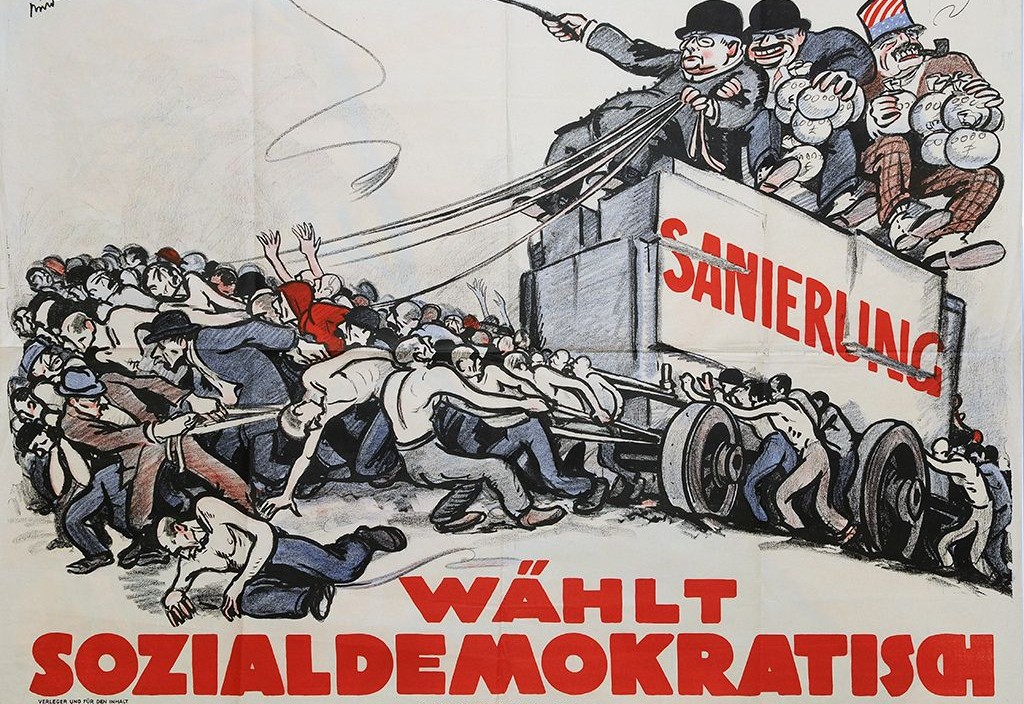
Paul Fröhlich, in 1924 a leading Marxist journalist, Communist member of the Reichstag, and serving on the central leaderships of both the German Communist Party and Comintern, brings his considerable political experience and acumen in analyzing the S.P.D.’s post-May, 1924 election which saw the party’s retreat in power since 1919’s victories. While still the largest in the state, with well over one million members, 169 daily papers, and six million votes (20% of those cast), nevertheless the S.P.D. was barred from the new coalition government. Taking stock of its decisions and current situation, the S.P.D., was deeply divided over participation in past and future ‘coalition’ governments and the Party’s decision to support Germany paying reparations stipulated by the Dawes Plan.
‘The Party Congress of the German Social Democrats’ by Paul Fröhlich from International Press Correspondence. Vol. 4 No. 36. June 26, 1924.
Writing in a bourgeois paper over the Social Democratic Party Congress which assembled on the 11th of June, Scheidemann states, that the Congress, contrary to all the other German parties has demonstrated the unshaken unity of the Socialist Party of Germany. The Party Congress certainly gives this impression. But it must be asked from whence comes this unity. It is characteristic that it is the first Congress held since the Nuremberg Unity Congress of 1922. In a time of tremendously stormy development of the political conditions in Germany, the highest authority of the S.P. of Germany has been kept from coming together for two years, although its convocation was repeatedly demanded by very strong groups. When the Party Congress assembled, nobody had more than a mere academic interest in it. The governmental policy has always evoked the fiercest differences in the Party. At present the Party stands outside the government. As it was not even asked whether it would take part in it, Hermann Müller, Sollmann, Hilferding etc. have suddenly become fierce class-war fighters, even in the eyes of those who once designated them as betrayers and assassins of the proletariat. The heavy defeat in the elections has not succeeded in evoking a penetrating criticism of the policy of the Party, but only the plea: let us draw our ranks closer together, let us overlook the past, otherwise we shall not only become disintegrated but will experience complete collapse. For the rest, it is to be observed that at no time has a keen opposition arisen in the Party itself. It was only the effect of outside stimulus. The more energetic the Communist attack upon the S.P. of Germany has been and the stronger its effect has been on the masses, so much the more deeper has been the process of decay in the S.P. of Germany. If this Party today can create the impression of being fairly united, the cause of this is to be attributed to a very perceptible lack of activity on the part of the C.P. of Germany. It is necessary to understand these signs of the time, as they are a serious warning.
But these facts also prove what is really behind this unity of the S.P.G. It is no sign of power; the satisfaction displayed is no sign of consciousness of strength; it expresses the satisfaction felt over the fact that the stinking depths of the foul morass have not been stirred up.
The most eager effort of the Party Congress was to avoid disturbing the foul spots of the policy of the Party. In this Party there have existed for over a year and a day two tendencies, which fiercely combat each other. In this Party, which regards parliamentary action as everything, sharpest antagonism developed in the Republic and in the various states, which even expressed themselves in the voting in Parliament. In Saxony the fraction in the Landtag is actually split, a portion of the fraction is against the ministers of their own Party, But the Party Congress prevented the opposition from setting forth its standpoint even in the form of a full speech in reply to the political report of the Party Executive. The reason for this, said Otto Wels, is: “The Party Congress has refused to grant a counter-speaker to the opposition as it feels that it would not serve the unity of the Party nor help to clarify our ideas, if all the world is invited to witness the fact that the unity is only a sham and that now, as heretofore, two tendencies exist. The Party Congress refuses to regard the opposition as a body possessing equal rights.” Therefore smother it over! And The Party Congress knew what it had to expect from this opposition. It has fully justified all expectations.
It was therefore no wonder that in all these important questions: coalition-policy, reparation questions, interior organization, no attempt was made to investigate thoroughly and to draw clear conclusions. Neither side attempted to do this. There merely remained a miserably shallow babbling, so that one even feels loath to state what arguments were used. How was the clique of leaders even able to venture to justify their deeds! How could the opposition venture to get to the bottom of the matter! Any thorough examination would have led to the recognition that we are in the middle of a period of open revolutionary struggles, that the urgent question is: which class is to rule! The official leaders of the S.P.G. are in favour of the rule of the bourgeoisie; they draw all the logical conclusions therefrom, even including Seeckt and the machine guns; but to state this openly and frankly is more than they dare, for in that case they would also lose the workers, who are accustomed to pay more attention to words than to deeds. The docile left, however, is terribly afraid of the revolutionary fight. Therefore they must take care to avoid a clear insight into political and social affairs. Therefore they must do everything to shield their counter-revolutionary leaders. And this they do precisely when they criticise them. It is then they seek to create the impression that the social-democratic policy is based on the class war. They express themselves as satisfied when the coalition policy is declared to be a question of tactics and not of principle–which is as much as to say that under no circumstances will the S.P.G. enter in a government when the bourgeois parties will not have them.
By this means the way to the bourgeoisie was kept free and one could even wish that Scheidemann’s complaint as to the way in which the S.P.G. had been overlooked on the occasion of the formation of the last Government will reach the ears of Stresemann and Marx. Against the Communists, however, the way was completely barred. This was unnecessary, but at the same time characteristic. And the left elements from Saxony could only stammer out a few paltry words against this. In order to emphasise this shutting off from the Communists, it was at the same time decided, against very few votes, that participation in the “International Workers’ Relief” is “incompatible” with membership of the S.P.G. Kurt Rosenfeld and Mathilde Wurm hastened to announce their withdrawal from the “I.W.R.”, at the same time using certain pretexts for taking this step in order to keep up appearances before the throne of Hermann Mueller.
In the Saxon conflict, in which it was believed that the blood of the workers would yet divide the Saxon left from the party Executive and the Social Democratic ministerial heroes, a complete understanding was arrived at. The crime against the proletariat played no part in this question. Nor did the Saxon left stumble over such “trifles”. But the question of competency was settled. As is known, the Saxon left party leadership had forbidden the Landtag fraction to participate in a bourgeois government. As a result there was a split in the fraction. The rule of the parliamentarians over the Party, which in practice had already existed for a long time, was now formally sanctioned. “The decision as to formation of governments, choice of ministers and other questions of parliamentary tactics in the various states rests with the Landtag fraction concerned.” As salve to a wound: If thought fit, the opinion of the party leaders of the state in question shall be consulted. The parliamentary fractions have to submit to the decisions of the provincial party conferences. But the Berlin Party Executive can veto the decisions.
This is an absolute and crushing defeat of the left. In the future the open counter-revolutionaries in the party leadership will hold all the trumps in their hands.
Taken all in all it is a perfect and undisputed victory of the Ebert, Hermann Mueller, Wels’ clique. The left has been beaten on all points. The courageous left, however, acknowledged this beating by unanimously adopting this decision.
The future line of policy of the party? One knows that the S.P.G. dare not look beyond the next step. For them there is only the question of the experts’ report. And the whole party is in favour of this strangulation of the German working class by International capital. It fell to Hilferding to theorise over this question, and it was immediately to be seen that here one had to do, not only with a cowardly opportunism, but with a conscious, counter-revolutionary policy. Who could have expected otherwise than that Hilferding would praise the MacDonald Government to the skies, that–in spite or because of its anti-labour policy?–he regarded it as the most effective champion of the class war? No one is surprised that he sees in it a guarantee for the “pacification” of the world. For years he has proclaimed that the world war has converted capitalism to vegetarianism. But the reasons, therefor! Here, unexpectedly, MacDonald appeared in the eyes of Hilferding as the henchman of the English imperialists. England has stuffed her maw to the full in the war. Her imperialist appetite is satisfied, therefore she can conduct a conservative foreign policy of the balance of power. She needs peace in order to digest her prey, to plunder her colonies. MacDonald therefore is anxious for peace and hence it is a socialist policy to look to imperialist England with her Labour Government. But as the agreement of the capitalist tigers among themselves logically leads to a common fight against Soviet Russia, it comes about that Hilferding also makes a vicious attack on Soviet Russia and warns the German government “not to allow itself to become enmeshed in Russian policy.” This earned him the thunderous applause of the Congress. And when Paul Levi ventured to remark, purely from the bourgeois standpoint, that sooner or later the Russian state would exercise an enormous influence on the neighbouring countries, someone interjected: The Dissmann people want to fraternise with the Asiatics and African Negroes. This clearly indicates the level of the Congress and the future course of the S.P.G.
In conclusion, a reference must be made to the membership figures. According to the official report, the party, after the amalgamation which took place in October 1922, numbered 1,400,000 members. At the conclusion of the past year it had 1,260,000 members. It has therefore lost about 10 per cent (140,000) of its members. It is true that Scheidemann stated that in Berlin in the first quarter of this year the party lost 20 per cent of its members. Whether this is a local or a general phenomenon it is impossible to say. In any event as an organization-machine, the party is still powerful and, as such, still wields considerable influence over the workers a fact which the revolutionary movement is continually learning. This organizatory strength is to be explained by several facts. When comparison is made with the Communist Party of Germany it must be remembered before all that the S.P.G. is free from all persecution and that it is not compelled continually to build up afresh the destroyed portions of its organization. In addition, the S.P.G. possesses a favourable organization basis in the small towns and in the rural districts, owing to its occupation of the official positions. It has over 169 daily papers at its disposal, which are never suppressed and which conduct a shameful campaign against the Communists precisely when the Communist party of Germany is defenceless. All these facts go to explain the membership figures of the S.P.G. But there is no need for it to flatter itself too much on this account. On the other hand, herein lies a stimulus to more intensive work in order to win away these masses from the Socialist party, which has once again openly proclaimed its counter revolutionary character.
International Press Correspondence, widely known as”Inprecorr” was published by the Executive Committee of the Communist International (ECCI) regularly in German and English, occasionally in many other languages, beginning in 1921 and lasting in English until 1938. Inprecorr’s role was to supply translated articles to the English-speaking press of the International from the Comintern’s different sections, as well as news and statements from the ECCI. Many ‘Daily Worker’ and ‘Communist’ articles originated in Inprecorr, and it also published articles by American comrades for use in other countries. It was published at least weekly, and often thrice weekly. Inprecorr is an invaluable English-language source on the history of the Communist International and its sections.
PDF of full issue: https://www.marxists.org/history/international/comintern/inprecor/1924/v04n36-jun-26-1924-inprecor.pdf
 Revolution's Newsstand