An overview of the U.S. co-operative movement, strongest in the Upper Midwest and among Finnish immigrant communities.
‘The Co-operative Movement in the United States’ from The Daily Worker Magazine. Vol. 3 No. 28. February 13, 1926.
The December issue of “Die Genossenschaft im Klassenkampf,” bulletin of the co-operative section of Comintern, reviews the co-operative movement in the northern states of the United States. Under the title “The Co-operative League of the Northern States,” the review says:
THE “American Co-operative League” organized in 1915 and holding its fourth congress in New York in 1924 still includes only a small minority of the co-operatives in the United States. In 1924 it only had 337 co-operatives as members. In order to improve the possibilities for the unification of the Consumers’ Co-operatives and for their ideological influence thru the central league throughout the extended territory of the United States, there were created in the last few years a series of sub-leagues which take in a group of nearby states. At the present time there exists sub-leagues for the consumers’ co-operatives in the northern states, central and eastern states.
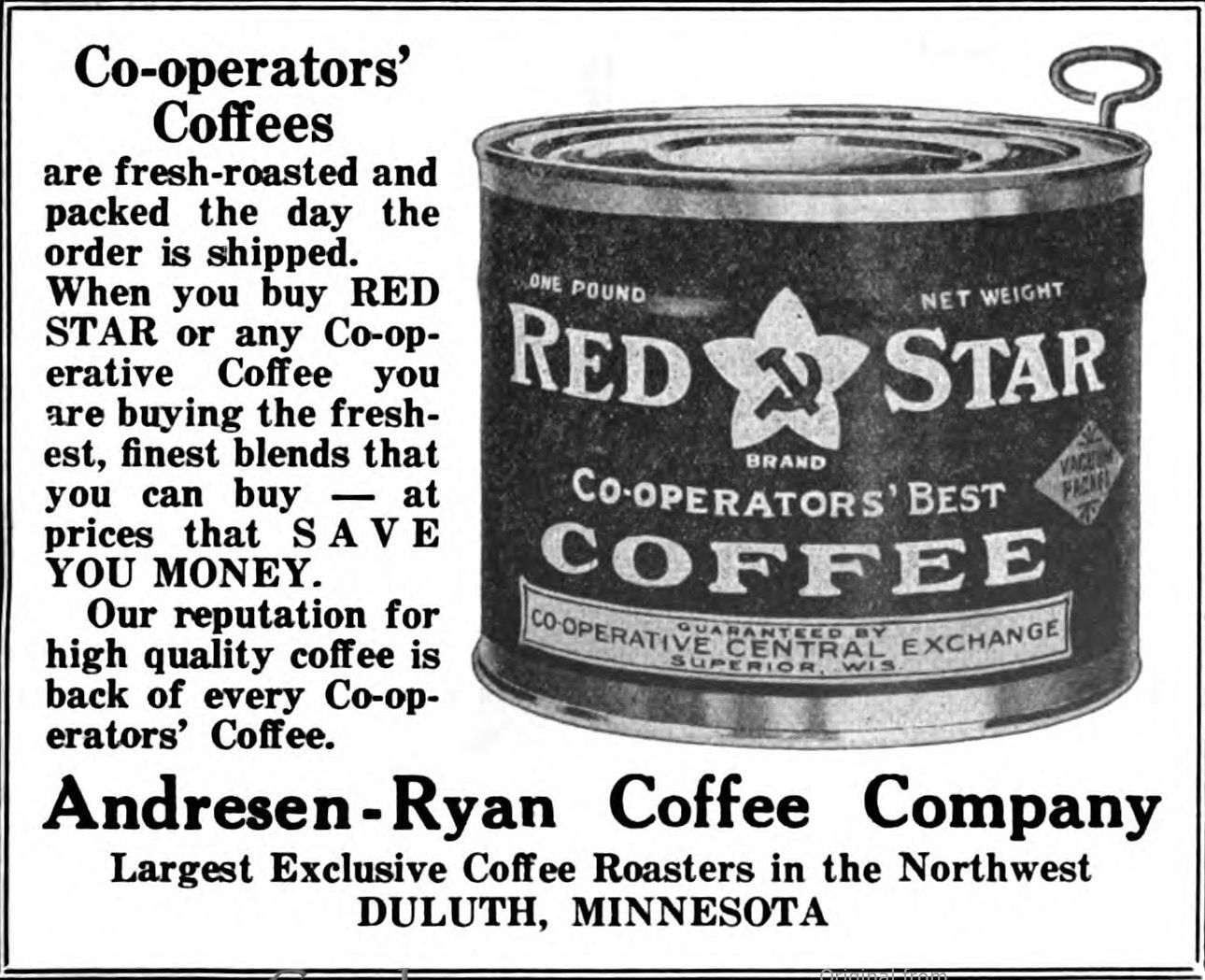
The largest and most important of the sub-leagues is the “northern states co-operative league,” which this year made the first attempt to issue a year book (Northern States Co-operative League, Year Book, Minneapolis, 1925, 114 pages. Year Book 1925 of the Consumers’ Co-operative League of the Northern States of America.). This league has existed since 1922 and has its seat in Minneapolis, Minn. It extends to about ten membership organizations in the states of Minnesota, Wisconsin and Michigan. The kernel of the league appears to be the Co-operative Central Exchange, in Superior, Wis. This is a wholesale buying society, made up of 41 primary consumers’ unions which can show a total membership of somewhat more than 10,000 members. The great majority of the membership are Finnish workers and farmers.
The second largest organization of the league is. the Franklin Diary Cooperative, that can count 5,300 members and also has a center in Minneapolis. The Year Book contains a survey of the account and of the activities as well as the statistical material of the organizations affiliated to the sub-league. It also includes a number of articles dealing with matters of principle and history, about the co-operative movement in general and about the co-operative relations in America in particular. In reading through this little book we cannot help getting the impression that after the moral and economic failures of pre-war times and of the war years, the consumers’ co-operative movement in the United States, in the northern states at least, has since 1919-1920 begun to beat out new paths. With great effort and energy has there been begun a new construction of a real consumers’ organization of the workers and farmers. Beginning on a small scale, the last five or six years has seen significant economic and cultural successes. Wherein lies the mystery of this success?
Let us see how the year book answers this question? Under the head” of “The Secret of Success of the Co-operatives” we read on page 74:
“The basis of the co-operative movement lies in the social contradictions of the present society. Naturally the starting point is to provide better and cheaper goods for the workers and farmers organized in the co-operatives. Therefore the co-operatives must organize their business end according to most effective methods.
“But, the business methods may be the best, and still the slogan for better and cheaper goods cannot be realized to such an extent as hoped for. The co-operative very soon finds out that its ability to reduce prices, to effect any great material savings to its members, is limited.
“During the last half century capitalism has developed from small shops and private business enterprises to enormous big industries, trusts, and even in the retail field to centralized chain stores, department stores, etc. The highly developed capitalism concentrates its power through the big banks and thru the capitalist state.
“The co-operatives which have to fight on the workers’ and farmers’ side very soon realize that their main enemy is not the unorganized small business, but the whole capitalist system. The fight for better living conditions becomes a fight against the capitalist system.
“A co-operative store that is run purely, as a business venture, no matter how effective its business methods are, no matter how good its customers may happen to be, will find that immediately when they get into financial difficulties their seemingly ‘good’ customer will desert them to look for a ‘better’ and cheaper store. Therefore, it is necessary for the life and development of the co-operative that it uses such methods which will make the customers in reality feel and know that this is their own store, a part of themselves under all conditions.
“And what are these methods which will make the co-operative to be closer to the working people? As we already pointed out, the fight for better living conditions ultimately becomes a fight against the capitalist system. Here lies the secret of the success of the co-operatives. By taking part in the workers’ and farmers’ fight against capitalism, the co-operatives connect themselves with the masses. Through the partaking of their everyday struggles, the co-operatives in a practical way show that they are not only purely business establishments, but that they are a part of the working class movement against capitalism.
“This will give strength to the co-operatives. The masses not only see a ‘better’ store, but they realize through practical experience that it is one of their own weapons with which to fight. And then the co-operative will not only live, but grow in power and influence under all conditions.”
Eskel Ronn; the director of the already mentioned wholesale society, the Co-operative Central Exchange in Superior, writes another article for the Year Book:
“Cures headaches, rheumatism, asthma, consumption, tuberculosis, hernia, scarlet fever, mumps, piles, housemaid’s knee, and all other diseases known or unknown to the medical profession.”
“This patent medicine advertisement always occurs to me when I hear some of our good co-operators advance the theory that co-operation is the “cure-all” that will abolish all the social diseases and ills of mankind and lead us to that promised land, the ‘co-operative commonwealth.”
“It is plainly evident that present society is composed of two opposing classes, namely the working class, and the capitalist class, whose interests are diametrically opposed to each other. There is no compromising between them. There can be no friendship between them, nothing but constant conflict. In this class conflict the co-operative movement is a mighty weapon in the hands of the workers. A very brief study of the history of the co-operative movement will soon disclose the fact that it’s during the struggles of the workers on the industrial field that they have organized co-operative enterprises.
“It is the co-operative enterprises which have been born amidst the turmoil of laborers’ struggles that mean something in this great movement. It is they who work unceasingly for the ultimate aim of the co-operative movement. It is they who are not satisfied with more paltry dividends. They are the builders of a new system of society.”
A contribution of Dr. Warbasse, the president of the American Co-operative League, is on the other hand, conceived more in the spirit of the “patent medicine co-operator.” According to this, the entire distribution is and then also the entire production will gradually pass into the hands of the organized consumers and all this through co-operative organization.
The secretary of the American Co-operative League, Mrs. Agnes Warbass, devotes an article investigating the reason why the co-operative movement in Europe has developed better than in America. She sees the cause of this in the fact already emphasized by other authors, that in America the dollar hunt masters the psychology of large sections of the working class masses. They do not think of making their relations better; they are always on the lookout to find better relations, To the natural question how to make these relations better, Mrs. Warbass gives only a very vague reply. She cites as an example the success of the live young co-operative organizations of the northern states. They have already told the secret of their success in other places in the Year Book.
The first Year Book of the Northern States of the Co-operative League is a wealth of evidence to us that even in the land of the dollar, the revolutionary class consciousness of the co-operative are beginning to awake. We can only congratulate the northern States Co-operative League on the issuance of this excellently prepared little book.
The Saturday Supplement, later changed to a Sunday Supplement, of the Daily Worker was a place for longer articles with debate, international focus, literature, and documents presented. The Daily Worker began in 1924 and was published in New York City by the Communist Party US and its predecessor organizations. Among the most long-lasting and important left publications in US history, it had a circulation of 35,000 at its peak. The Daily Worker came from The Ohio Socialist, published by the Left Wing-dominated Socialist Party of Ohio in Cleveland from 1917 to November 1919, when it became became The Toiler, paper of the Communist Labor Party. In December 1921 the above-ground Workers Party of America merged the Toiler with the paper Workers Council to found The Worker, which became The Daily Worker beginning January 13, 1924.
PDF of full issue: https://www.marxists.org/history/usa/pubs/dailyworker/1926/1926-ny/v03-n028-supplement-feb-13-1926-DW-LOC.pdf

