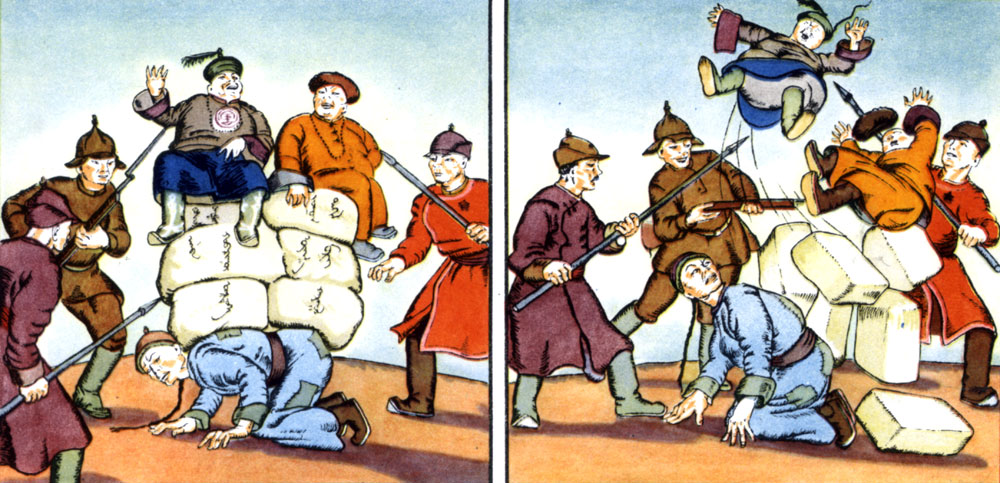
The victory of Mongolia’s Revolution in 1921, throwing off Chinese imperial rule and that of the local Khanate created new conditions in the formerly feudal, and contested, Central Asian nation. In 1924 the Mongolian People’s Republic was established. Its obstacles and its accomplishments below.
‘Mongolia and the Imperialists’ by S. Natzov from International Press Correspondence. Vol. 6 No. 47. June 17, 1926.
The national liberation movement of Mongolia which broke out in the year 1921 and which was prepared and led by the Revolutionary People’s Party, was a movement of the broad masses of the Arats (shepherds) of Mongolia who for centuries had been under the cruel yoke and subjected to the exploitation of foreign and native despots: Chinese mandarins and Mongolian feudals.
The movement was called forth by the following concrete circumstances which have arisen in Mongolia in the last ten years:
First, the violent abolition of the independence of Outer Mongolia by the Chinese militarists, led by the leader of the Anfu Club, General Siuj Shi Chan and the setting up of a regime of cruel military dictatorship in Mongolia by these militarists.
Secondly by the occupation of Mongolia by Russian monarchists and counter-revolutionaries in the shape of the hordes of white bandits of Baron Ungern who realised the political plans and predatory aims of Japanese imperialism.
The national emancipation movement of the working masses of Mongolia have been heroically striving to fulfil these tasks, hand, to drive the foreign invaders from the country and on the other hand to abolish the feudal, theocratic order and to set up a democratic form of state.
In the course of the last five years the working people of Mongolia have been heroically striving to fulfil these tasks, and which they have in fact to a considerable extent already fulfilled. In the first place the country is finally freed from the despotic rule, both of the Chinese occupation troops and of the white bandits of Baron Ungern, secondly a number of social and democratic reforms have been carried out, which have not only liberated the Mongolian people from feudal bondage, but also from the economic enslavement of foreign commercial and loan capital.
Thus the feudal-theocratic order has been finally abolished: the basis of a new republican order has been created by democratising the State apparatus; the natural resources of the country have been converted into national property; the treaties and agreements violently imposed by the imperialist States have been declared to be invalid; a uniform economic policy is concentrated in the hands of the State; all the nonworking elements have been deprived of the right to vote, this applies equally to the former princes and the clergy, to the traders and money lenders who live on other people’s work and from rent etc.
The real results of these gains are: a general improvement in the economic well-being of the country; the commencement and development of co-operatives and industry: improvement of the financial situation and increase of the State budget.
Before all, there is to be noted the increase in cattle breeding. According to the figures of the year 1918 there were in the whole of Outer Mongolia, including the district of Kobdo, 3,404,988 head of horned cattle, but according to the figures for the year 1924 the number amounted, excluding the district of Kobdo, to 4,159,263 head.
The cancellation of the debts to China plays a considerable role, as according to the statements of various investigators, 50% of the national wealth of Mongolia belonged to Chinese commercial and money lending capitalists.
The government of the Mongolian People’s Republics at present faced by the following three urgent tasks for the further improvement of cattle breeding: a) extension of veterinary institutions, b) organising of model farms for cattle breeding and c) gradual transference to improved farming etc.
In the sphere of land cultivation an improvement is also to be seen. In recent times there has been a partial settling down of the population in some districts. The question of organising agricultural co-operative societies is being approached. It is true they are only in their first stages and are still few in number, but in spite of this their appearance proves that the population are not only striving to improve their political situation, but also wish to establish an economic basis for their political gains. The government organs interested in developing land cultivation, are adopting serious measures for improving the State supply of seed. The State supply of seed will, in a few years, form the best means of agitation for persuading the population to go over to land cultivation.
Up to recent years the entire Mongolian market was it the hands of Chinese and Anglo-American capital. When the Chinese were politically defeated, they continued their economic rule in Mongolia by their trading activity. The Mongolian People’s Government, right from the beginning, sought for measures in order to weaken the influence of commercial and money-lending capital. For this purpose national co-operative societies were founded, the Mongolian Central People’s Co-operative Society (Monzenkop).
The Monzenkop was founded in the year 1921 with 70 share-holding members and a ground capital of 14,000 dollars. At present the ground capital of the Monzenkop amounts along with the advances of the government, to about 5 million dollars. The total turn-over of the Monzenkop in the year 1924 amounted to 16 million dollars, of which 533,876 dollars 19 cents represented net profit.
In order to work up the products of Mongolian economy on the spot and to manufacture a number of products which had previously been imported from abroad, a tannery and a felt shoe factory were established: likewise a confectionery factory and other undertakings. All these undertakings are said to produce products to the total value of 754,150 dollars. There thus exist the beginnings for the development of industry.
In order to secure the state revenue a customs reform has been carried out, a national currency has been introduced and the taxation system regulated. A commercial and industrial bank has been established for the regulation of trade and the improvement of the money circulation, the total capital of which amounts at present to 2,500,000 dollars.
The total state budget is growing every year. It increased from 4,700,000 Lan (a Lan is nearly three shillings) in the year 1923 to 8,800,000 in the year 1924 and to 10,700,216 Lan in the year 1925. In 1923 there was a deficit of 420,000 Lan, in 1924 one of 184,000 Lan, while the year 1925 showed a surplus of 885,000 Lan.
These are the practical achievements of the five years of national revolutionary struggle of the working people of Mongolia.
But these achievements of the Arat masses of Mongolia are distorted in the bourgeois press of all capitalist countries and represented to the public in an obviously distorted manner. The imperialists everywhere raise a great outcry that Mongolia is occupied by troops of the Soviet Union, that “Red Imperialism” is triumphant in Mongolia and such like things.
It requires a shameless insolence and an unashamed cynicism to compare the policy of Tsarist Russia, which had as its aim the enslavement of the working masses of Mongolia, with the policy of the Soviet government which since the first days of the existence of the Soviet power, has had, as its one and sole aim, a disinterested and sympathetic attitude to the national liberation movement of the peoples of the East.
The imperialists cannot reconcile themselves to the fact that there exists and is developing a free Mongolia, for this fact serves as an example and a stimulus for the further development of the national liberation movement among the suppressed peoples of the East.
No legends and no fables will be able to check the further development of the national liberation movement of the peoples of the East, including the shepherds of Mongolia, and no power in the world will be able to bolster up the shaken rule of the imperialists in Asia.
International Press Correspondence, widely known as”Inprecor” was published by the Executive Committee of the Communist International (ECCI) regularly in German and English, occasionally in many other languages, beginning in 1921 and lasting in English until 1938. Inprecor’s role was to supply translated articles to the English-speaking press of the International from the Comintern’s different sections, as well as news and statements from the ECCI. Many ‘Daily Worker’ and ‘Communist’ articles originated in Inprecor, and it also published articles by American comrades for use in other countries. It was published at least weekly, and often thrice weekly.
PDF of full issue: https://www.marxists.org/history/international/comintern/inprecor/1926/v06n47-jun-17-1926-Inprecor.pdf

