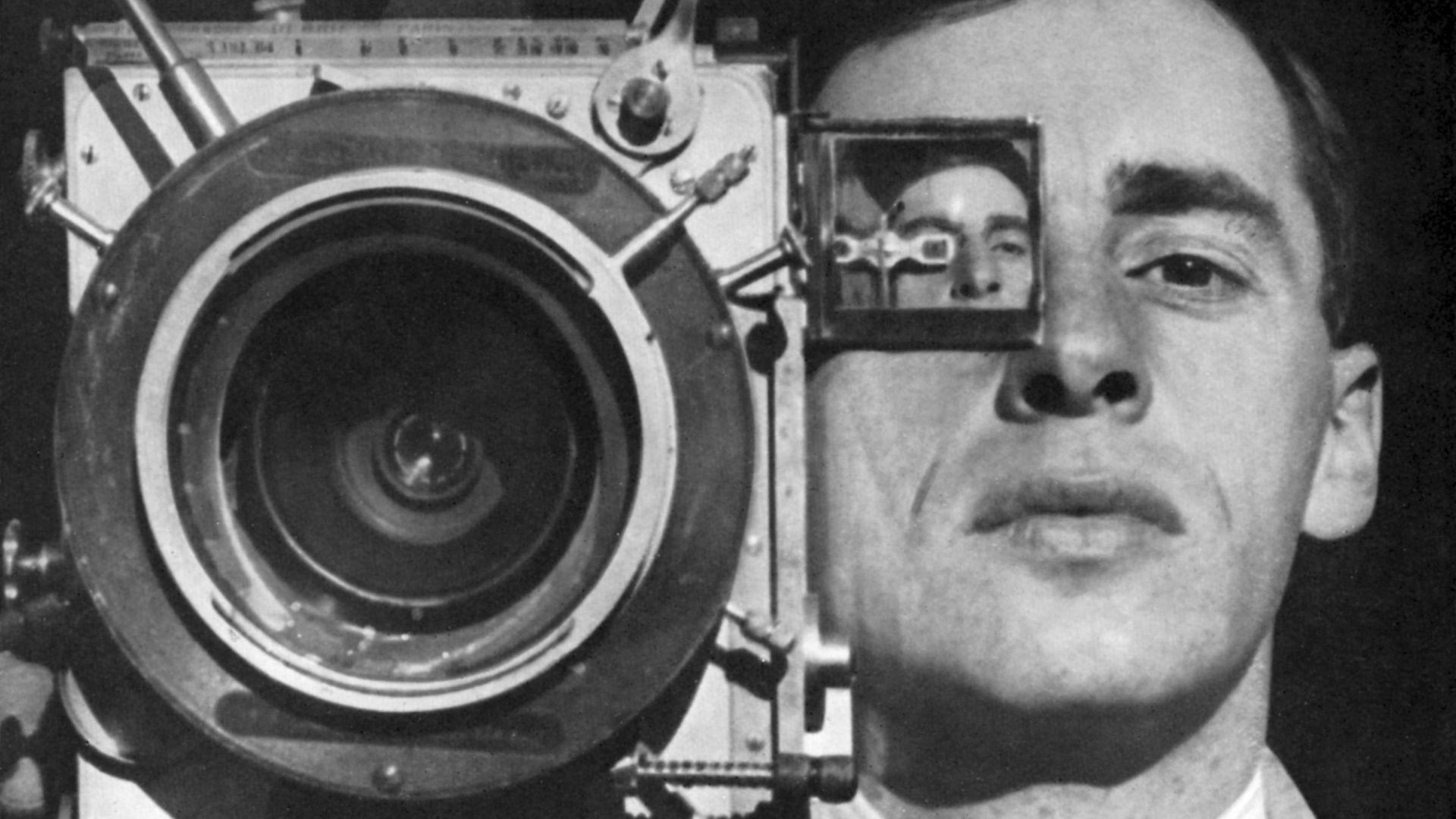
Provincetown Playhouse veteran and director of the New Playwrights Theatre, the Lithuanian-born Communist writer Emjo Basshe was an early New Masses film critic, here with a look at what remains a remarkable experience in cinema, Dziga Vertoff’s 1929 Man with a Movie Camera
‘The Man with the Camera’ by Emjo Basshe from New Masses. Vol. 5 No. 5. October, 1929.
THE MAN WITH THE CAMERA. A Sovkino Production. Director: Dziga Vertoff. Cameraman: Kauffmann. Film Guild Cinema.
At this very moment, a hot afternoon in September, I am not advocating Revolution. I have no desire to languish in one of Hoover’s jails nor do I want to see this magazine banned from the mails by Burleson’s successor. Therefore I expect the reader to read between the lines: Russia had a revolution. The Russian theatre is the finest in the world. The Russian cinema has reached a point within a few years which may be truly called amazing. Russia at present is not rich. Operations cost money. The Soviets would not mind if they made, say a million dollars on every movie they produced. They need the money for schools, for new factories, for irrigation systems, for dynamoes, tractors, motors. They have, as we have seen, great actors and directors. They have cameras. They have writers who can concoct pretty good scenarios. Why then no Hollywood there? Why don’t they make a couple of hundred million dollars? Hollywood is doing it and has done it for years.
Well, I guess it’s because they have had a Revolution there. Or perhaps they don’t know what the public wants…or they have no actresses who are willing for the sake of publicity, to marry cast off dukes, princes or lapdogs.
Instead their directors experiment. They live in one room apartments, have no wolfhounds, butlers, yachts, Rolls-Royces, valets or Spanish castles. They experiment. The Man with the Camera. The director states that there are no actors in this film. What he means is that we have no rehearsed, made-up, cajoled, mannered, pushed, poised actors. No cardboard settings. No Klieg lights. But life without a veil, without a guide, without shutters. (And no propaganda here Mr. Government. Don’t be afraid, no one’s going to hurt your little god, your sweet little home or upset your ever-so-guarded equilibrium).
The cameraman wakes up to catch his city sleeping…a girl moves in her bed…early traffic stirs in the street, shutters open, the city preens itself for the day ahead…the girl bathes and dresses, the streets are washed…all things that move in the early city fog are caught on the film and then:
We see ourselves in the theatre…the film cutter…the projector. The cameraman goes on again…no shutters for him. He is out to see Life in a great city…all…pains of childbirth twist a woman’s body on a hospital cot…pains of death twist the faces of mourners: a corpse deposited in the ground. The city moves on and we follow. A couple being married. The triumphant carriage rolls along. A couple getting a divorce. No carriage. A girl’s angry face flashes for a second before us—the camera caught her asleep on a park bench. Wealthy fingers in the hands of a manicurist…working girls’ fingers making and filling cigarette boxes. Obvious contrast probably but it was not meant for that…the camera wants only contrast movements…so…the working girl laughs and shows her skill with flying fingers—fingers against time…dancing fingers…fingers embracing everything about them. The manicured nails turn slowly for our inspection.
Eyes open camera eyes open camera shutter open. Factory scenes, whistles blowing…time to stop work…out in the streets we go…mingle with peasants marketing…with promenaders…with picnickers home from an outing…tourists. Trees in the wind. An accident. Ambulance. A fire. Fire engines. The camera clicks on. The camera is high in the air…in the midst of traffic…running here and there. Nothing must escape him. Symphony of a city, laughing, yelling, swearing, building…moving: what would happen if it stopped? Obligingly the camera shows us:—a horse is running…camera stops…horse stops—feet in the air. The audience roars. A crowd of women laughing…their faces are frozen by the camera. Traffic halts: a still born city waiting for its time. Camera clicks and the city moves again.
No titles. No million dollar appropriations. No full page advertisements. No phrases out of Barnum’s corpse: greatest show in the world singing, talking, sounding, barking, screeching, hissing. Just an experiment by a Russian director and his cameraman trying to find out what can be done with a camera and a will to create.
We are not hard to please. We are pro-Russia, pro-Vertoff, pro-Kaufmann, pro-beauty. We ought to be deported.
EMJO BASSHE
The New Masses was the continuation of Workers Monthly which began publishing in 1924 as a merger of the ‘Liberator’, the Trade Union Educational League magazine ‘Labor Herald’, and Friends of Soviet Russia’s monthly ‘Soviet Russia Pictorial’ as an explicitly Communist Party publication, but drawing in a wide range of contributors and sympathizers. In 1927 Workers Monthly ceased and The New Masses began. A major left cultural magazine of the late 1920s and early 1940s, the early editors of The New Masses included Hugo Gellert, John F. Sloan, Max Eastman, Mike Gold, and Joseph Freeman. Writers included William Carlos Williams, Theodore Dreiser, John Dos Passos, Upton Sinclair, Richard Wright, Ralph Ellison, Dorothy Parker, Dorothy Day, John Breecher, Langston Hughes, Eugene O’Neill, Rex Stout and Ernest Hemingway. Artists included Hugo Gellert, Stuart Davis, Boardman Robinson, Wanda Gag, William Gropper and Otto Soglow. Over time, the New Masses became narrower politically and the articles more commentary than comment. However, particularly in it first years, New Masses was the epitome of the era’s finest revolutionary cultural and artistic traditions.
For PDF of full issue: https://www.marxists.org/history/usa/pubs/new-masses/1929/v05n05-oct-1929-New-Masses.pdf

