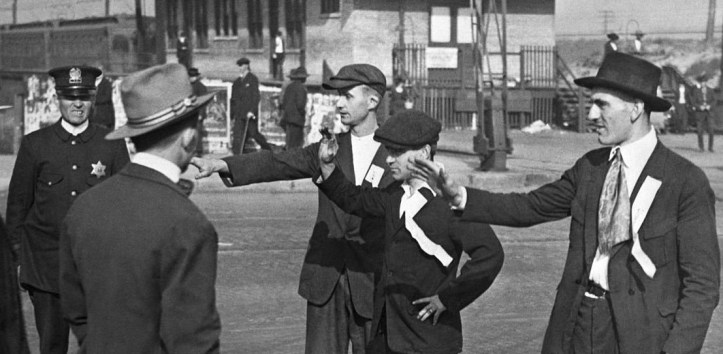
Organizing the working class on the job as it actually is required an entirely different model than that presented by the American Federation of Labor as the workers’ movement of a century ago faced as profound changes as we do in the labor process. Austin Lewis, though a ‘cockroach lawyer’ (his words), was a leading early theorizer of industrial unionism in the Socialist movement.
‘Can the A.F. of L. Organize the Unskilled?’ by Austin Lewis from Industrial Worker. Vol. 4 No. 36. November 28, 1912.
The question of unorganized unskilled labor, or, as the phrase runs, “migratory laborers,” is agitating the minds of the leaders of the American Federation of Labor to an ever-increasing degree. It forms the stock subject of discussion in the conventions and is eternally putting up its head at the meetings of the local councils. Even the well-organized building trades are not exempt from anxiety and the smaller crafts are always in a more or less ludicrous state of alarm at the unwelcome incursions of the outer barbarians into their preserves.
This is a new phenomenon. It is but a very short time since the so-called unskilled was a mere pariah, concerning whom the dignified and well-established trades could afford to be remote and supercilious. His struggles were unheeded, his sufferings were not marked, for the superior workingman is not one whit more humane than other superior persons. He will let you suffer, always provided that you suffer quietly and do not trench upon his well-fenced preserves. Mere humanity has affected the mind of the superior craftsman no more than it has touched the sympathies of the upper bourgeois or the aristocrat. We are all brothers under our skins; no one class will put itself out for the sorrows of another, unless those sorrows interfere with its own well-being, or itself is in danger of being driven into the ranks of the suffering class.
Both these essential prerequisites of sympathetic action, however, are notoriously present today in the matter of the migratory unskilled. The despised unskilled is today the great encroacher upon the field of the skilled organized. The home guard is threatened by the invasion of the nomads, and hence a very lively interest is being taken in the doings and in the organization of these nomads. The crafts are going to pieces under the pressure of machine development and the specialization process; hence the position of the craftsmen becomes more and more desperate, and the dread of the migratory more and more intense. In fact, a well-known manufacturer in Portland, Oregon, stated that for hard and concentrated work he preferred the so-called tramp, who had conserved his energies by not working too hard. But it would be a waste of space and energy to dwell upon the strategic position which the migratory workers occupy today, as the readers of this are, by actual experience, much better qualified experts than is the writer.
These are the circumstances under which the A. F. of L. has recently come to take an interest in the organization of the migratory workers. The steps to an organization of this element are, moreover, diverting even if slightly unscientific.
Some two years ago I ventured to call attention to the fact that either the A. F. of L. would fail to organize the migratory workers or, if it succeeded to any extent in organizing them, the introduction of the new element would revolutionize the great organization, for the latter is quite incompatible with the inclusion of such a nimble lightning change artist in the matter of labor power as is the migratory. And the leaders of the craft organization are already awaking to the fact that in the matter of migratory organization they have caught a tartar.
At the California State Federation of Labor Convention in October, Paul Scharrenberg, the secretary, who had taken much personal interest in this particular question, related the difficulties under which the organization of the migratory laborer necessarily proceeded. He stated that one fundamental difficulty lay in the fact that the members of the skilled crafts would not strike on behalf of the unskilled. That is a pretty admission for a great labor official, and hardly tends to encourage the payment of dues by those unskilled who are to be allowed to belong to an organization which confessedly will not support them. Of course, skilled workmen will not strike on behalf of unskilled. To do so would be a piece of pure altruism which our poor humanity attains only under peculiar and dramatic circumstances. The skilled will strike on behalf of the unskilled only when they are compelled to do so–that is, when the unskilled have attained such an organization as to compel the cessation of work of the skilled, and not before.
The A. F. of L. has succeeded in organizing a certain number of migratory workers on specific jobs and for immediate and temporary purposes, but so far its efforts to make anything like an organization of this class of labor as such has been very far from a success.
In fact, where it has partially succeeded, any real attempt on the part of the so-called unskilled to better their conditions meets rather with the disapproval than the assistance of those who are professedly organized with them. I have in mind a group of unskilled in the building trades here who are struggling for a there dollar wage scale and are receiving a stepmother’s blessing from the organization to which they belong. The incompatibility of their inclusion in the organization is painfully apparent to the men themselves.
It would seem that a centralized form of organization can hardly be applied to these men. Organization, with autonomous group action, organization on the specific job would seem to meet the circumstances of their case more effectually. Here, however, we open up a wider vista of discussion than can be well considered in this article.
The Industrial Union Bulletin, and the Industrial Worker were newspapers published by the Industrial Workers of the World (IWW) from 1907 until 1913. First printed in Joliet, Illinois, IUB incorporated The Voice of Labor, the newspaper of the American Labor Union which had joined the IWW, and another IWW affiliate, International Metal Worker.The Trautmann-DeLeon faction issued its weekly from March 1907. Soon after, De Leon would be expelled and Trautmann would continue IUB until March 1909. It was edited by A. S. Edwards. 1909, production moved to Spokane, Washington and became The Industrial Worker, “the voice of revolutionary industrial unionism.”
PDF of full issue: https://www.marxists.org/history/usa/pubs/industrialworker/iw/v4n36-w192-nov-28-1912-IW.pdf

