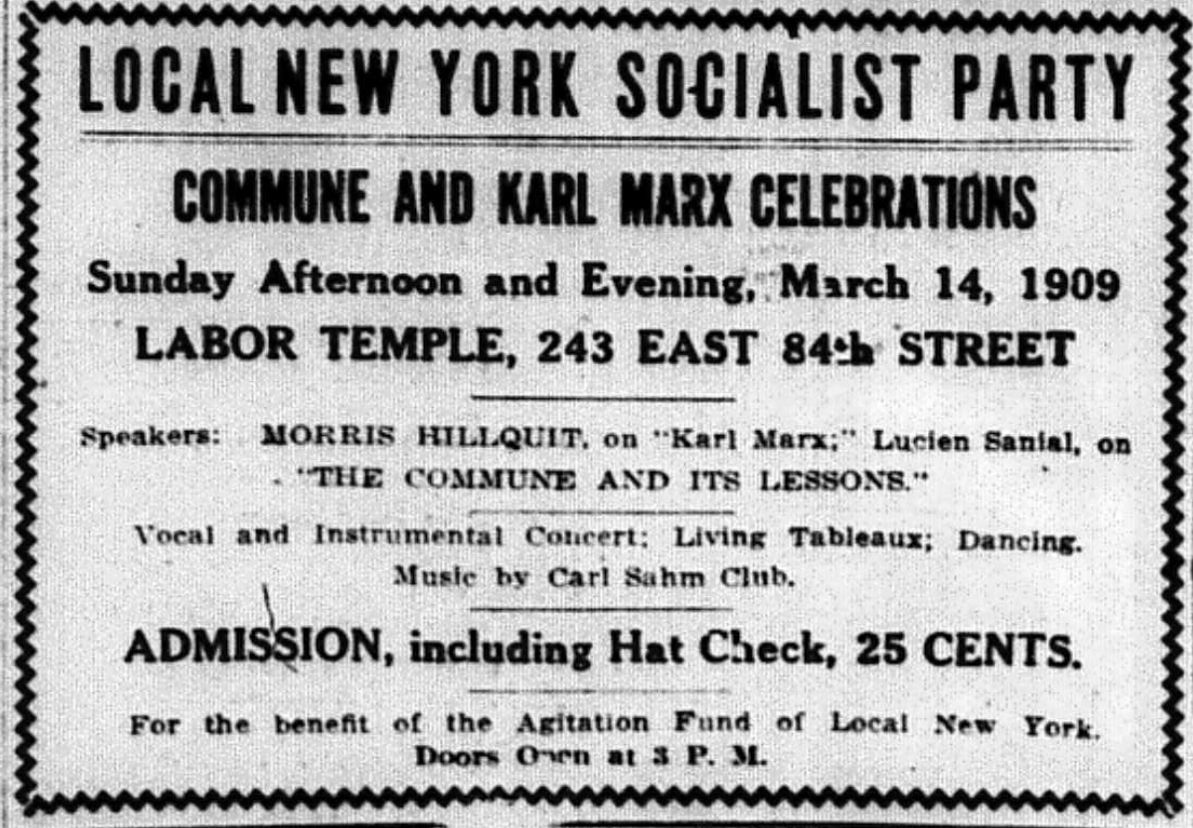
The New York Call reports on Socialist Party commemorations for Karl Marx, many combined with those for the Commune, in the New York City area on the twenty-sixth anniversary of his March 14, 1883 death.
‘Socialists Celebrate Karl Marx and the Commune’ from The New York Call. Vol. 2 No. 62. March 13, 1909.
GRAND CELEBRATION.
Socialists Commemorate Marx and the Commune Next Sunday.
Judging from the general interest shown by the working class of this city the Commune and Karl Marx celebration, to be held next Sunday afternoon and evening, in the Labor Temple, 243 East 84th street, under the auspices of Local New York of the Socialist party, will be the greatest affair of its kind ever seen here. The tickets are going like hot cakes and everybody is enthusiastic over the chance to celebrate the epoch-making events to be commemorated and at the same time spend an enjoyable evening.
There will be vocal and instrumental concerts; living tableaux: dancing galore and music by the famous Carl Sahm Club. Among the able speakers rho will explain the meaning of the celebration are: Morris Hillquit, who will talk on “Karl Marx,” and Lucien Sanial, who will speak on “The Commune and Its Lesson.” Altogether the day will be a memorable one. The doors will open at 3 o’clock.
***
Meeting Honors Karl Marx.
Speaker Pay Honor to His Memory Meeting Held by 6th Assembly District Socialists.
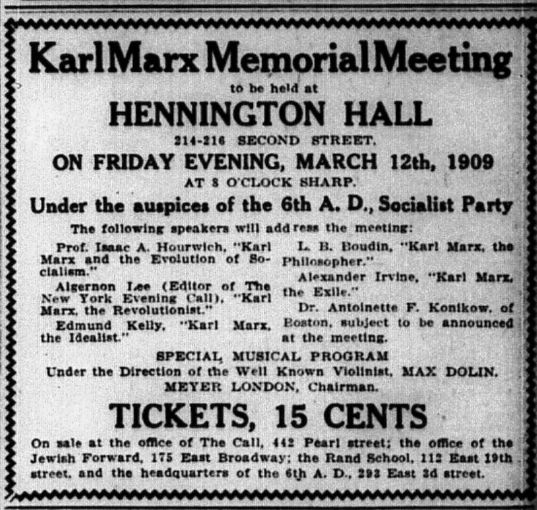
The twenty-fifth anniversary of the death of Karl Marx was commemorated by the 6th Assembly District of the Socialist party at a meeting held last night at Hennington Hall. 214 2d street. About 600 people attended.
Professor Isaac A. Hourwich spoke on “Karl Marx and the Evolution of Socialism”: Algernon Lee, editor of The Evening Call, on “Karl Marx, the Revolutionist”: Edmond Kelly, on “Karl Marx, the Idealist,” and Alexander Irvine, on “Karl Marx. The Exile.” Meyer London acted as the chairman. Professor Hourwich said the greatest merit of Karl Marx was the application of the theory of evolution to the study of society. The application of this theory, he said, paved the way for scientific Socialism.
Found Socialism Utopian.
He said that Marx found Socialism a purely utopian philosophy advocated by various schools with conflicting ideas. Yet, in spite of all this, Marx placed Socialism on such solid scientific ground that he ought to be ranked with the greatest scholars of the nineteenth century.
Mr. Lee said Marx was the scientific analyst of the revolution, and that he studied the laws of its development as he worked in it. He said the Communist Manifesto, the work of Marx and Engels, is as much the manifesto of the Socialist party of the world in 1909 as it was of the Communist party in 1848.
The speaker told of the valuable contribution of Marx to the interpretation of the revolutionary events of his time. He referred to Marx’s correspondence to the New York Tribune and to various German newspapers.
From Defeat to Defeat.
Marx’s teachings, Mr. Lee said, showed that the proletariat will not march from victory to victory until it becomes supreme, but from defeat to defeat, and with the experience gained thereby will strike the final successful blow for its emancipation.
Mr. Kelly said that every true idealist must be a revolutionist because it is only through revolution that ideals can be attained. Karl Marx, was such an idealist, he said.
The speaker quoted several passages of the Communist Manifesto to show that Marx was against the capitalist system because it crushed the finer things of humanity. Marx, he said, had his feet planted on solid ground and his head among the stars.
Described Marx’s Exile.
Mr. Irvine touchingly described the scene of Marx’s exile in London. Marx, he said, was the industrial Christ, who was not allowed to reside in Germany, France, Belgium and Holland, and who finally found refuge in London. There he and his family lived in two small rooms, always bordering on destitution.
The speaker related many of the stories told by Marx, showing his bigness of heart and splendid character. He told of the scenes of Marx, his children and fellow exiles walking through the streets of London as they went to some park to get away from the foul air in London’s slums.
Mr. Irvine said it may be the irony of fate that “the grandchildren of the men who occupied the industrial christ will build monuments to his memory.”
Several excellent musical selections were played during the evening hy Max Dolin, violinist, and N. Saslavsky. pianist.
***
NEW YORK SOCIALISTS CELEBRATE TOMORROW.
Will Pack Labor Temple in Honor of Karl Marx and the Paris Commune Great Enthusiasm.
Tomorrow an event will take place which will have a twofold interest for the Socialists of New York as an appropriate celebration of the heroic struggle of the French proletariat and a Karl Marx memorial. In addition this celebration will be used for the purpose of raising funds to replenish the treasury of Local New York of the Socialist party, which is at present entirely exhausted.
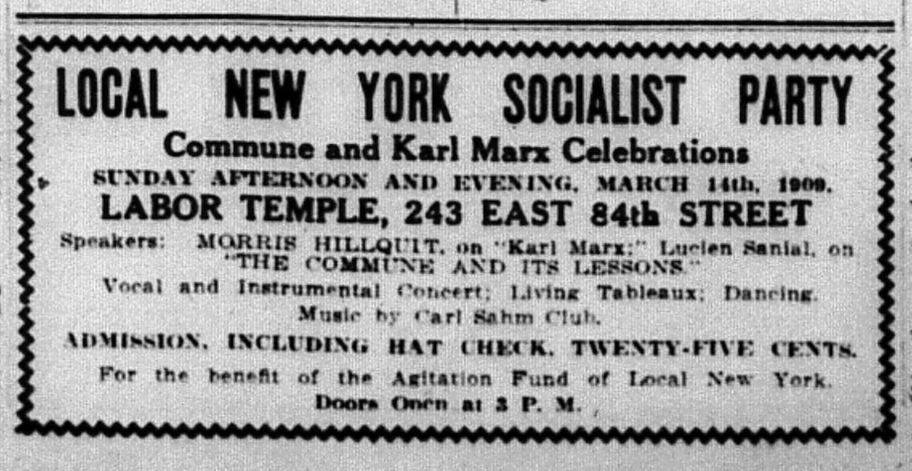
The event will take place at the Labor Temple, 243 East 84th street, and will consist of a meeting, concert and dance, beginning at 3 p.m. and lasting until midnight. The speakers for the occasion will be Morris Hillquit, who will speak on “Karl Marx and His Teachings,” and Lucien Sanial, who will speak on The Commune and Its Lessons.” Few speakers in New York are so well qualified to speak on the subjects assigned to them as those mentioned. Both are eloquent and will make the occasion a most enthusiastic demonstration. Moses Oppenheimer will act as chairman and will, in the name of the executive committee, present to the Eighth Assembly District the district banner, to which it is entitled by having polled the largest number of Socialist votes in proportion to the voting population of the district.
The musical program will be rendered by the well-known Carl Sahm Orchestra. In addition the following have volunteered their services: Miss Amia C. Parkes, who will render on the violin “The Legend,” by Wiernawki, and “Romanza Andaluza,” by Sarassate; Mrs. Caroline Van Name, who will sing “Sons of Labor,” by J.M. Peacock; “Freedom Awakening,” music by Caroline Van Name, words by Thomas Cooper; Miss Elizabeth Cheskin, who will render on the violin “Berceuse,” by Jocelyn.
The Musical Section of the Labor Temple will also render a few numbers with its well-known string orchestra. The first part of the program will be concluded with a living tableau arranged by the members of the Dramatic Section of the Labor Temple. The evening will be given up entirely to dancing, and a large orchestra has been secured for that purpose.
The Local holds only two festivals during the year and both have always been complete successes. It is confidently expected that the celebration this time will exceed in attendance and enthusiasm all previous affairs as the Local is badly in need of funds, and the Socialists will avail themselves of this opportunity to help realise a large surplus which will enable the party to carry on a lively agitation during the next few months. The admission, including hat check is only 25 cents, and tickets are on sale at all party headquarters, and at the box office on Sunday. The doors will be open at 3 p.m., and the program will begin at 3:30 p.m.
***
SOCIALISTS HOLD BIG MEMORIAL MEETINGS.
Karl Marx and the Communards of ‘71 Honored by Thousands of New York Workers.
Thousands of Socialists in Greater New York and vicinity attended meetings yesterday, at which the twenty-sixth anniversary of the death of Karl Marx and the thirty-eight of the Paris Commune were appropriately commemorated and every one of them left the meeting places with their minds made up to keep up the battle for freedom until the great ideals for which Marx and the Communards fought should become a living reality and the Socialist Republic should assure to every worker Liberty, Equality and Fraternity.
Local New York County held its meeting in the Labor Temple, and more than a thousand persons cheered the able speeches of Morris Hillquit and Lucien Sanial, and the excellent musical program. In Brooklyn the Labor Lyceum was filled by a crowd of enthusiasts, who heartily enjoyed the speeches and music of the able talent that helped make the celebration arranged by the 19th and 20th A.D. branches of the Socialist Party and Branches 4, 75 and 166, of the W.S. and D.B.F., a complete success. In Hoboken the Dramatic Section of Local Hudson County presented that excellent German farce, “Ein Rabenvater.” to an audience that filled the new Imperial Hall, and which spent the rest of the evening in dancing and singing. Streih’s Hall, Yonkers, was crowded by the Socialists of Westchester County, and a speech by Britt Gearity was well received. Besides these big affairs almost every subdivision of the Socialist Party in the city held memorial meetings, so that, all in all, the day was fittingly observed.
At 4:30 P.M. Chairman Oppenheimer called the meeting in the Labor Temple, 243 East 84th street to order and in a few brief remarks stated the reasons why Socialists honor Karl Marx and the Commune. He then Introduced as the first speaker the veteran French-American Socialist, Lucien Sanial, who spoke on “The Commune and Its Lessons.”
Speech of Sanial.
The Paris Commune, according to Mr. Sanial, was the climax of a long smothered desire for liberty, not a very definite idea, but one that was noble and worthwhile, and which would be realized when the Socialist movement finally triumphed, as he had recently told Eugene V. Debs in answer to a request to describe liberty in fifty words. But, although, the Communards did not know that all real liberty was based on economic security, they fought bravely for their ideal, and were worthy of honor by all lovers of freedom.
The speakers then referred to the work of the women Communards, and assured the hearers that every great social movement was brought about by the help of women. In proof of this, he cited a number of notable examples, beginning with Joan of Arc and ending with Louise Michel “Woman was the first slave,” said he, “and she must fight together with the man to free the working class, and all the world from slavery of every kind.”
Mr. Sanial then showed how Marx, in founding the old Workingman’s International, had so terrified Napoleon that he had made war with Germany in order to side track their movement that threatened soon to become a mighty power, and thus the conditions that caused the workers of Paris to proclaim the Commune came about. Marx saw that Napoleon was the greatest reactionist in Europe, and realized that he must be set aside before the working class could make much material headway.
The speaker described the horrors of the massacre of the Communards by the Versaillais troops by the orders of that human monster, Thiers. but declared that all this blood had not been shed in vain, as the German army camped outside the walls of Paris had carried back home the germs of thought, which, combined with those of the Internationalists and disciplined by the teachings of Marx, were destined to form a Socialist movement that caused the overthrow of Bismarck, the Iron Chancellor, and now counted its adherents by the millions throughout the entire civilized world.
Turning to condition in this country, Mr. Sanial asserted that the present crisis of unemployment was due to the fact that the capitalist of America, when they became creditors instead of debtors in the markets of the world about ten years ago, began planning to capture the world’s trade, and to do this it was necessary to form big trusts, improve their machinery, and lower wages: the first two things were easily done, and the third was now to be brought about by the fact that millions of men were out of work because of the stagnation of industry, resultant upon the failure of so many financiers who had speculated with the thousands of millions of dollars advanced by the people who had made profit out of the workers during the period of so-called prosperity.
The steel trust was setting the pace in cutting wages, and would soon be followed by other industries. If the workers resisted they must look out for the militia and regulars which President Taft was no doubt willing to use to help break strikes, as he had planned to increase their number to 600,000 men when he was Secretary of War. The only hope for the working class, concluded the speaker, was the taking possession of the government by means of the political power, and then establishing the Co-operative Commonweal.
Hillquit’s Speech.
Mr. Hillquit spoke on “Karl Marx and His Teachings,” and began by saying that Socialists were not hero worshipers, and ordinarily did not have time to stop and pay tribute to their great men. Nevertheless, although no individuals ever made great social movements, being rather the results of such movements themselves, it was well to take time to honor the memory of one who had received but little consideration at the hand of his contemporaries, although he had performed the greatest work of modern times. Even the working class, for whose benefit this great work was done, had been slow to honor Marx.
At last, however, as we see prophecies of Marx being fulfilled before our very eyes and his theories accepted as the guiding star of more than 10,000,000 voters throughout the world, people were waking up the fact that his work in furnishes the working class with a solid foundation upon which to fight the class struggle was beyond estimate. Future generations would build monuments to his memory, and his birthday would be a great international holiday. Already It was being recognized that Marx’s slogan, “Working men of all countries unite, you have nothing to lose but your chains, you have a world to gain,” was of more value in promoting peace and harmony among the nations than a hundred peace conferences.
“Marx,” concluded Mr. Hillquit, “set in motion a movement that elevate every man, woman and child on the globe, and for that reason he was the greatest benefactor of mankind. We Socialists can only pay our debt of gratitude to him by resolving to follow his lofty example. If we live up to that resolution we shall see his ideal become a reality in our own time, and the Co-operative Commonwealth will be the culmination of the noble teachings of Karl Marx.”
The rest of the program, consisting of music by Mrs. Caroline Van Name, Miss Anita Parkes, Miss Elisabeth Cheakin, the Carl Sahn Orchestra, and the Musical Section of the Labor Temple: living tableau by the Dramatic Section of Labor Temple, and the presentation of the district banner to the 26th A.D. for having cast the highest percentage of Socialist votes at the election, all passed off very smoothly, and afterward the large hall cleared for dancing, which lasted till long after midnight.
The New York Call was the first English-language Socialist daily paper in New York City and the second in the US after the Chicago Daily Socialist. The paper was the center of the Socialist Party and under the influence of Morris Hillquit, Charles Ervin, Julius Gerber, and William Butscher. The paper was opposed to World War One, and, unsurprising given the era’s fluidity, ambivalent on the Russian Revolution even after the expulsion of the SP’s Left Wing. The paper is an invaluable resource for information on the city’s workers movement and history and one of the most important papers in the history of US socialism. The paper ran from 1908 until 1923.
PDF of full issue: https://www.marxists.org/history/usa/pubs/the-new-york-call/1909/090313-newyorkcall-v02w062.pdf

