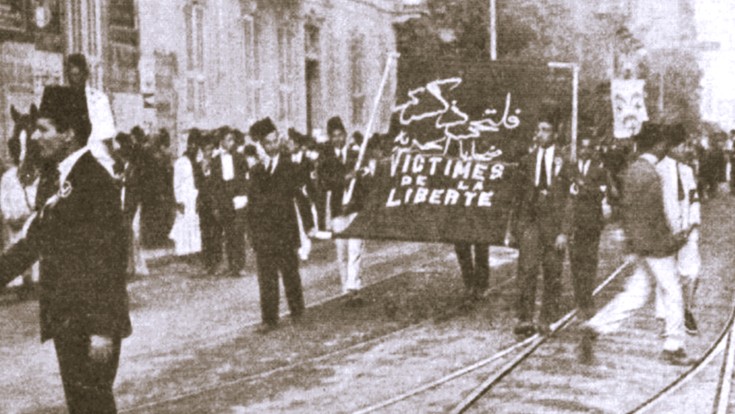
A series of articles, mostly by Joseph Berger, on the clampdown on the Egyptian labor movement leading to the death of one of the leading Third Internationalists in the Arab world, comrade Antoine Maroun. Born in the Bekka Valley, Maroun went to law school in Beirut settling in Alexandria around 1900. An early Socialist, there he defended workers. Becoming fully involved in Egypt’s labor movement, which had begun in earnest after the 1919 Revolution, in 1921 he co-founded the first Egyptian Trade Union Federation with Hosni al-Arabi, who became its Secretary-General, and in 1922 the C.P. was formed. Arrested along with other leading Communists and unionists after a series of strikes and confrontations, with the new National government movement responding by outlawing the workers’ and Communist movement. Already ill at his September, 1924 trial, in prison Maroun protested against poor treatment culminating in a hunger strike of prisoners, which lead to his death on August 1, 1925.
‘Persecutions of Communists in Egypt and Death of Anton Maroun’ International Press Correspondence. September 4, 1924-August 27, 1925.
Communist Persecutions in Egypt and Palestine by Joseph Berger. September 4, 1924.
Soon after the entrance of the government into power. Zaghlul Pasha began to persecute the communist movement in Egypt. Occasion for it was given by a strike wave in Alexandria, which otherwise was of a purely economic character. The striking factory workers demanded the recognition of the Trade Unions, the fixing of working hours, rise in wages etc. That did not prevent the factory owners, of course, from representing the strikes as “the fruits of Bolshevist propaganda”, and calling in the aid of the government against the communist intrigues. The government hurried up with their aid, and had all the leaders of the Communist Party, who were known to them, arrested, and ordered the closing of the Party clubs, and the confiscation of the property of the Party. A number of the workers were soon put on their trial, and the verdicts ran to several months arrest. The leaders were kept in prison, and all protests and appeals for the hastening on of the trial, or at least for provisional release on bail, were unavailing. The Egyptian government found it more convenient to let the Communists languish in prison without trial, and purposely delayed the inquiry longer and longer.
At the same time the police began a regular hunt for “individuals suspected of Communism”. The newspapers were able every day to report new arrests which had practically no foundation, and were only the results of malicious denunciations. In the police campaign against our Egyptian comrades, those police spy elements took a preeminent part, which formerly, under the Tsarist regime, performed the same work in Russia, and now, being fled to Egypt as members of the White Guard Wrangel army, wished to take their revenge on the revolutionary movement. The Egyptian police, on the model of the Okhrans (Tsarist Secret Police), set themselves, without further ado, above such details as the inviolability of letters, domestic authority, and other democratic rights guaranteed in Zaghlul Pasha’s constitution, as soon as it was a question of tracking down communist conspirators.
There was a particularly sharp hunt after foreigners. The government could simply, without a trial, make use of their authority to turn troublesome foreigners out of the country. Besides the Communist Party, the “Confédération des Syndicats”. which stands on the principle of the R. I.L.U., was declared illegal, and so gave the police possibilities of new arrests and persecutions.
Within the last few weeks, the Communist persecutions have come to a temporary stop, probably because the police are directing particular attention to the so-called “nationalist conspiracy”, to which, nominally, the attack on Zaghlul Pasha is attributed, The foreign Communists were deported, after the visas of the governments concerned had been obtained for their passports those who are Egyptian subjects, set free for the time being, the trials being arranged for November at first and then, on the protest of the Public Prosecutor, for September.
A special law concerning the control of the immigrants from Russia, Bulgaria, Turkey and Armenia, together with stricter police control of those set free, is to prevent a new development of the Communist movement in Egypt.
The official press of Zaghlul Pasha, but in particular the organs of the English and French governments, which praised the draconic suppression by Zaghlul Pasha of the labour movement, as a clever and useful measure, and encouraged further persecutions, sum up with satisfaction the liquidation of the Communist movement”, and base the moral justification of the Communist hunt as follows: “It may be in other lands that the time is ripe for Communism; here in Egypt, where industry is only in a stage of development, every trace of class war is detrimental to the progress of production. If production does not develop, the working class will never be powerful Thus the Communists and class-war supporters altogether, are not only the enemies of the country, of society and of progress, but above all, of their own class, of the working class…” When we keep it mind that Egyptian comrades have no press at their disposal, with which to come out against these demagogic arguments, and that these “theoretical” bases are woven out of a mass of calumnies and “flesh-creepers” on Communism and Communists, we can imagine to some extent the social atmosphere in which the C.P. of Egypt must carry on its fight.
In Palestine the persecutions of our comrades began after the entrance of MacDonald’s government. Here the instigation on the part of the Jewish-chauvinist (Zionist and Poale-Zionist parties has contributed a great deal to the handing over of the communists to the hands of the police. About six weeks ago in Haifa, the club of the “Workers’ Faction” which had existed legally for more than a year, was closed by the police. (Only a few weeks earlier the Workers’ Faction (Section of the R.I.L.U.) had been excluded from the General Labour Organization). On the occasion of a protest meeting against the closing of the club, seven workers were arrested. A few days later the proceedings against these workers took place. Although the Arab judge did not even know what “Bolshevism” meant, they were sentenced by him “as belonging to a Bolshevist organization,” to one month’s imprisonment and deportation. The verdict had in fact been sent down to the judge cut and dried, and therefore it is quite comprehensible why he did not allow the defendants a word of defense, and did not even verify their names. In prison also those arrested were dealt with according to “special orders”, that is, as political prisoners, worse than criminals. They were ruthlessly beaten till they were bloody, and had to perform the vary heaviest work under unhygienic conditions, while any complain led to an aggravation of their condition.
Although appeals were lodged against the unheard-of verdict, the police refused to set free the workers even after the completion of their time. Telegrammes and letters, which informed the Labour Minister Thomas, Colonial Secretary, of the shameful deeds of his officials, remained unanswered, just as in the first days the appeal to the intellectuals of Palestine. Only the news of the mishandling to which the arrested men were subjected, set public opinion in the country moving a little. The doctors, professors and engineers were of the opinion that one could perhaps protest against Poland and Roumania, and at the very worst against German reaction, but not against the pioneer of civilization, the most progressive of governments, the government of MacDonald. The terrible treatment of the prisoners reported by witnesses unfortunately reminded one very much of the descriptions of conditions in Poland or Finland. An appeal which only set out the facts, was promptly confiscated.
The persecutions are being continued intensively. A few days ago the club of the Workers’ Faction in Jerusalem was closed. Printed matter, particularly in Arabic, even harmless appeals for Trade Union organization, was seized. Almost daily, single members of the Workers’ Faction are arrested, and house searches undertaken. The orders of the police amount to the stifling of the Communist movement in Palestine. In such a state of affairs the Communist Party of Palestine must call for the active help of the Communist Party of Great Britain, since only the working people of England can put a stop to the persecutions of the workers in the colonies which are carried on under the auspices of the Labour Government.
***
The Persecution of the Egyptian Communists by Joseph Berger. October 29, 1924.
On the 27th September 1924 there was commenced in the Egyptian Law Court in Alexandria the trial of the leaders of the Communist Party of Egypt. In all, eleven comrades were accused: Husni el Arabi, Anton Maroun, Sheikh Safouan, Abdul Fath, El Shabath Ibrahim, Abdel Hafez Awad, Mohamed Ibra him el Samkari, Shaaban Hefez, Abdel Hamid Samra, Mohamed el Shagir and two comrades who could not be found by the police; therefore the proceedings took place with the presence of nine or the accused. Each of these had already spent from four to six months in prison while awaiting trial and some of them had only been let out on bail a few weeks previously.
The charge against the nine communists, which was brought forward by the representative of the Attorney General of Egypt, stated: the accused were charged with having organised a conspiracy for the purpose of overthrowing the Egyptian government and setting up the Soviet Anarchy (!) in its place. The import of the charge, as well and the events which preceded the trial, were the following: The occupation of factories in March of this year, the intervention of the government, the sharp persecution of the communists and the breaking up of a communist conference. Further, the personal sympathy which the accus especially comrades Husni el Arabi, Anton Maroun and She Ibrahim enjoyed among broad circles of the Arabian public caused a tremendous attendance of the public at this trial.
Quite at the beginning of the trial the prejudice of the court against the accused showed itself. Comrade Anton Maroun, who was medically certified to be ill and not capable of standing trial, was brought before the judges in a sick condition and the proposal of the defence that the proceedings be postponed was not complied with.
The first two days were devoted to the cross-examination of witnesses. No less than 38 witnesses were brought forward on behalf of the prosecution. A police official claimed to have heard with his own ears how comrade Maroun, who was a representative of the workers during the big strike, said to the workers:
“You are treated like mere cattle, the capitalists suck your blood, you must fight for better conditions…” The manager of one of the factories involved in the strike also stated of Comrade Maroun that “he could have broken the strike by a mere word; the workers had unlimited confidence in him”. Other witnesses stated that the Communist Party is against religion; Husni el Arabi was charged with having said this openly. Finally, it is worthy of note that one of the witnesses for the prosecution was asked by the defence whether it was correct that the Egyptian government had sent him to London in order to study there the methods of the fight against communism. The witness replied in the affirmative. Ingram Bey had spent several months in England for this purpose.
On the third day of the proceedings the speeches for the prosecution and for the defence were to begin. The cross-examination of the witnesses had increased the interest of the public in the trial and the court building was literally besieged. Then the prosecution proposed to the court, that in order to secure a peaceful hearing of the trial the trial be continued behind closed doors. The protests of the defence were in vain. The public had to leave the court and the further proceedings were carried on in secret.
On the 6th of October the President of the court, Ahmed Taleat Pascha pronounced judgment upon the communists. It is a class sentence in its most blatant form, which places the government of Zaghlul Pacha on a level with the white governments in Europe. Six of the accused (Husni el Arabi, Anton Maroun, Ibrahim Shehat and Scheich Abdul Fath, as well as the two absent accused) were each condemned to three years hard labour. the rest to six months, which, however, they had already almost served while awaiting trial. The sentences were immediately carried out. The result of the secretly conducted proceedings had a depressing effect upon the great crowd which had gathered in order to hear the verdict. It was generally regarded as an expression of vindictive justice.
On the other hand the bourgeois press raised a great howl of triumph, especially the organs of the English and French governments “One must know how to draw the moral from this sentence” wrote the “Bourse”, “it is sufficiently severe to condemn communist principles and to show the leaders of the strike movement that that which has occurred in Alexandria has incurred the penalty of the law. In this connection we may point to the recent strike in Maassarah (a big cement factory near Cairo in which 700 workers went on strike for six weeks until the intervention of the government put an end to the strike in favour of the factory owner; the factory is an English undertaking. J.B.). and it is time that all those who are responsible for this strike were brought up for trial.”
Arabian workers are condemned to hard labour by Zaghlul Pacha, and the French and English capitalist press triumphs. Zaghlul however, speaks in the name of the Egyptian people and of the Egyptian workers. The “condemned” communist movement in Egypt will do its best to unmask as quickly as possible this two-faced policy.
***
To the Central Committee of the Egyptian Communist Party and to the Fighters for Communism Incarcerated in Egyptian Prisons. November 27, 1924.
The first “national” government of the pseudo-independent Egypt, the government of the “father of the country”, Zaghlul Pasha which abhors the labour movement which has sprung up in Egypt does not wish to be outdone by its predecessors, the lackeys and agents of British imperialism in its repressive measures against the working class.
Scared by the March strikers in Alexandria and other Egyptian towns, when the workers forcibly took possession of factories and workshops in order to compel the capitalists to make concessions, the government has decided to put an end to the open activity of the Communist Party and of the independent trade unions. Closing of all Party premises, hundreds of raids and arrests of working class leaders, deportation from Egypt of “undesirable” elements, establishment of yellow trade unions such are the measures being adopted by the present government in its fight against the growing communist movement.
Having failed to frighten you by threats or to make you renegades by the promise of well paid posts, the government has incarcerated you, the leaders of the young Egyptian proletariat, after a trial which was nothing but a farce, as the government not only prohibited the publication of the speeches of the accused, but even the publication of the speech of the official counsel for the defence.
In order to break down your spirit, which did not give way under the brutality of the sentence three years imprisonment, the government has added insult to injury by classing you together with ordinary criminals.
You have accepted the challenge and, at the risk of your health and of your very life, you have compelled the government by a 23 days’ protest hunger strike to change your prison regime.
Zaghlul and his government are posing as the defenders of the Egyptian people and as fighters for the independence of Egypt against British imperialism, and at the same time they inflict terrible hardships on you, who are not only members of the Egyptian Communist Party and the best representatives of the people, but staunch and irreconcilable opponents of imperialism.
Why? Because the government is, of course, trembling for the privileges of landowners and capitalists against whom the Egyptian Communist Party has declared war.
But the hopes of Zaghlul will be nullified. Even by the most brutal persecution of individual communists, he will not succeed in destroying the movement which is deeply rooted in the impoverishment and the exploitation of large sections of workers and peasants. The place of the scores of comrades who have fallen out of the ranks will be soon taken by hundreds and thousands of other fighters as staunch as those who have fallen. Thus the fight will be continued with increased vigour until an end will have been put to the inhuman yoke of capitalists and landowners in Egypt and throughout the world.
It is this faith in our final victory which puts courage into the hearts of the Egyptian fighters and gives them strength to carry on the struggle even behind prison walls
The Executive Committee of the Communist International is filled with admiration for the struggle carried on by you, our Egyptian comrades.
The Executive Committee of the Communist International is welcomes all true fighters for Egyptian independence, and calls upon the workers of Egypt and the Sudan to carry on their heroic fight for emancipation from the yoke of world imperialism with the same energy and courage. We can assure you of the support of the international proletariat.
All honour and glory to the brave fighters now in prison. Long live the Egyptian Communist Party which has produced such staunch revolutionaries.
Long live the victory of the workers throughout the world. The Executive Committee of the Communist International. 20. November 1924.
***
Further Communist Arrests in Egypt by Joseph Berger. June 25, 1925.
In September 1924, Egypt was the scene of a Communist trial. Zaglul Pasha, who was at that time at the head of the government and at the pinnacle of his power, wished to show to the English how well he was able to maintain order. All the accused were condemned to imprisonment with hard labour. The Egyptian reaction rejoiced: Communism in Egypt is now dead and buried; “all” the leaders are arrested, “all” organisations dissolved and “all” communist nests cleared out.
Zaglul Pasha had scarcely carried out this task for British imperialism when there came the end of Zaglul’s glory. Driven from the government, threatened and humiliated, the Party of Zaglul has today become the victim of that Bankers’ clique which is devoted to England and to whom Zaglul Pasha, thanks to his weak and ambiguous policy, gave the possibility of taking over power. This clique the Zivar Pasha Ministry is preparing to deliver a decisive blow to the Egyptian nationalists. No means of incitement and calumny appears too vile for this Ministry, which is supported by English bayonets, in order to exterminate all revolutionary and freedom-loving elements still remaining in Egypt. It is therefore a matter of course that the rage of these betrayers of the Egyptian people is directed first of all against that organisation which appears to them to be the most dangerous: The Communist Party of Egypt.
In spite of the heavy blows which the Communist Party had already suffered in the previous year, in spite of espionage and attacks, the Egyptian Communist Party had recovered with surprising rapidity. New forces were streaming to it, the revolutionary mood among the workers and the advanced intelligentzia, which was visibly strengthened by the British acts of violence, caused the slogans of the communists to meet with an enthusiastic response. The trade unions, under communist influence, revived again and, along with the brother Party of Palestine and Syria, the basis was created for a wide field of activity in the Near East.
The Egyptian police were obliged to intervene before the “danger” became too great. By means of an expensive system of provocateurs and spies, they concocted a monstrous communist “conspiracy”. On the 31st of May and the days following numerous arrests of communists took place. In all, 17 persons have been imprisoned up till now the majority of them being natives, among them being journalists, officials and workers. As the police were at a loss to bring forward concrete charges, the various government organs resorted all the more eagerly to insinuations of the vilest sort. From the most minute descriptions of “Moscow Emissaries”, up to piquant details concerning the complicity of the English communists and the Soviet government, there was not lacking one of the features which distinguish reactionary incitement throughout the world.
In fact, it even seems as if the entire grandiose action aimed just as much at creating an impression abroad as appeasing the native bourgeoisie. Feverish search has been made for proofs as to the subversive activity of Russian agents in British spheres of influence. Zivar Pasha is now in a position to bring forward everything Chamberlain’s heart desires: Communist “conspiracies”, mysterious “Eyes of Moscow”, English delegates, and even a whole trunk full of documents! The thing is so artfully contrived that it is the easiest thing in the world to use it as a means against the hated Soviet government.
And not only this. The fact that two of the arrested journalists are members of the staffs of prominent Zaglulist newspapers, suffices in order to involve the Zaglul party in the affair. It is pointed out at the same time that the communists, like the Zaglulists, were connected with that group of terrorists, the members of which carried out the assassination of the governor of the Sudan, Sir Lee Stack, in November last year and who were condemned to death for the same in a trial which has just been concluded. The aim which is being pursued in seeking to prove these connections is only too obvious.
By such means, and with the help of the Egyptian bourgeoisie and brutal police terror, the English hope to throttle the revolutionary movement in Egypt.
***
Anton Maroun. August 27, 1925.
The Communist Party of Egypt has to mourn its first victim: on the 1st of August comrade Anton Maroun died in the prison hospital as a result of a hunger strike.
Comrade Maroun, a lawyer of Arabian Syrian nationality, had always taken a keen interest in the Egyptian labour movement. After the war, when the great revolts against English imperialism commenced in Egypt, he devoted his entire powers to organising labour unions. The Egyptian Trade Union Federation, which was affiliated to the R.I.L.U. elected him as secretary. At the same time Comrade Maroun was very active in the Communist Party. In 1924 Comrade Maroun was arrested, along with the other members of the Central Committee of the C.P. of Egypt. The long period in prison while awaiting trial and the abominable treatment which was meted out to the political prisoners, undermined his health to such an extent, that during the trial in September last year the medical experts certified that he was not capable of undergoing the trial. Notwithstanding this, he was condemned to three years hard labour. Soon after being sentenced, comrade Maroun was compelled, along with the other condemned communists, to carry out a prolonged hunger strike in order to gain something approaching human treatment. This injured his health still further. In spite of this, Comrade Maroun flatly rejected the offer of king Fuad to grant him a “pardon”, and preferred to share the fate of the other condemned comrades. The prison administration thereupon sought to take revenge on comrade Maroun for his inflexible attitude; he was exposed to every possible petty persecution and torment, which caused him once again to enter on a hunger strike. Comrade Maroun remained on hunger strike for six weeks. The Egyptian prison authorities did nothing to meet the demands of the hunger strikers; not a word concerning the strike, penetrated to the ears of the public. It was not until six days after comrade Maroun’s death that the government published a short communication as to the fact.
“Public opinion” in Egypt passes over in silence this act of murder on the part of the Egyptian Hangman’s government. But the young Egyptian labour movement will never forget the martyr death of comrade Maroun.
International Press Correspondence, widely known as”Inprecorr” was published by the Executive Committee of the Communist International (ECCI) regularly in German and English, occasionally in many other languages, beginning in 1921 and lasting in English until 1938. Inprecorr’s role was to supply translated articles to the English-speaking press of the International from the Comintern’s different sections, as well as news and statements from the ECCI. Many ‘Daily Worker’ and ‘Communist’ articles originated in Inprecorr, and it also published articles by American comrades for use in other countries. It was published at least weekly, and often thrice weekly.
PDF of issue 1: https://www.marxists.org/history/international/comintern/inprecor/1924/v04n63-sep-04-1924-Inprecor-loc.pdf
PDF of issue 2: https://www.marxists.org/history/international/comintern/inprecor/1924/v04n76-oct-29-1924-Inprecor-cpgb.pdf
PDF of issue 3: https://www.marxists.org/history/international/comintern/inprecor/1924/v04n81-nov-27-1924-Inprecor-loc.pdf

