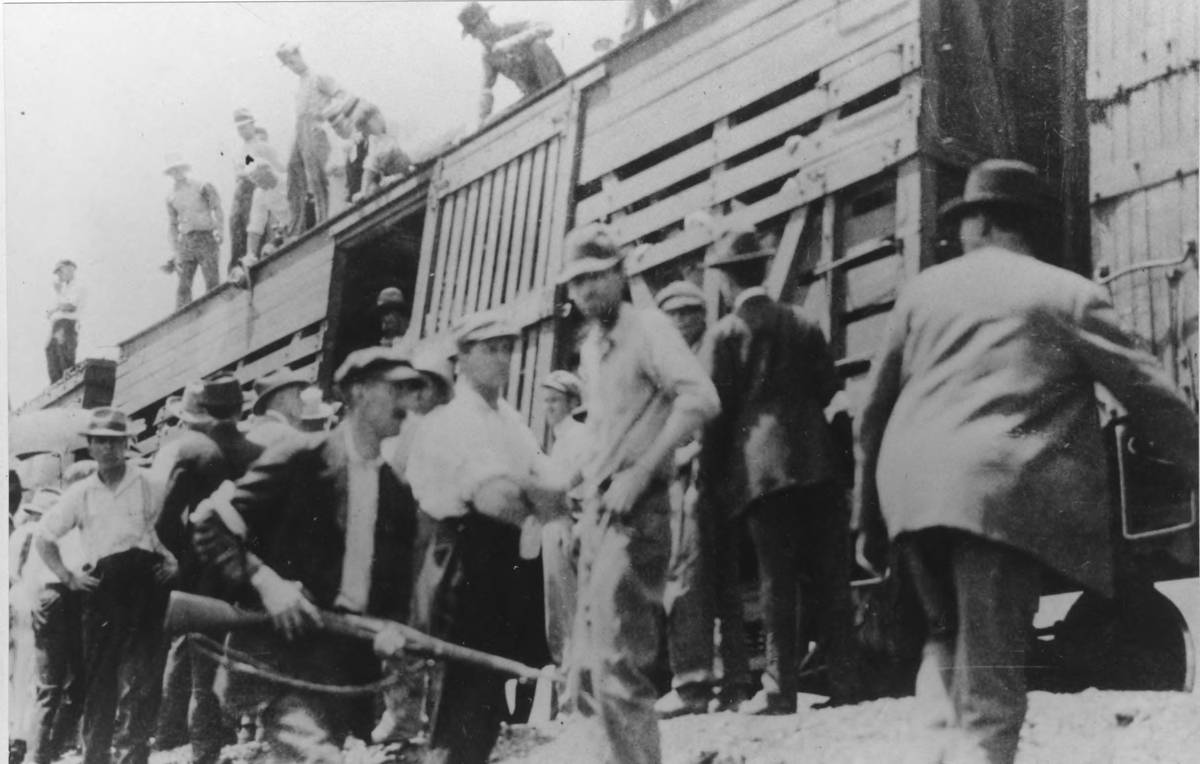
A background into one of the strikes in the Summer of 1917 that met with severe repression, in this case the deportation of hundreds of union miners to the desert. An exemplary leader until the end, Frank Little, with Grover Perry, organized the Metal Mine Workers Industrial Union through a strike of of multi-national copper miners in Bisbee, Arizona.
‘Conditions Which Led to the Bisbee Strike’ by A.S. Embree from Industrial Worker. Vol. 2 No. 41. November 10, 1917.
A good deal has been written about the Bisbee strike and deportation, but very little about what preceded the strike and led up to it.
Greed for still greater profits was reflected by the speedup system. During the summer, fall and winter of 1916 shift bosses on opposite shifts in all the shafts, competed against one another, each trying to excel the other’s output. The easy going shifter could not hold his job. The result was a constant nagging of miners to break more ground, and of muckers to get all the ore in sight into the chutes before the and of the shift. Timbermen who were. expected to keep the ground safe had their helpers taken away whenever more men were needed on the muck pile to clean up before the end of the shift. It was a common practice to blast a pound at lunch time to provide more muck for the last half of the shift, compelling the men to work for hours in powder smoke and gas rising from the muck caused by the powder.
So-called one man piston machines are in use in the Warren district, but it is common knowledge among miners that no piston machine made is light enough to be handled and operated by one man and do the work expected without taking all the energy one man can spare and a little more. Hence, the demand for two men on a machine.
Raises are run from one level up 100 feet to the next or from subway or same section of a slope to the level above. Work in a raise is extra dangerous as a slip may mean a fall of many feet. Gas accumulates readily in a raise and a miner may be overcome before he is aware of the presence of gas. It was a common practice to send one man to work alone in a raise and if overcome by gas, if lucky enough to escape a fall, there was a good chance of him lying unconscious for several hours before discovered by a shift boss. This frequently happened. It is hard to resuscitate a man who has been overcome by gas for several hours. Hence the demand for two men in a raise.
A shift boss who is being urged to break a record must pass the nagging along to his shift, with interest, or quit his job. Continual nagging gets on the nerves of all. For months before the strike 90 per cent of the men working underground were discontented and ready for an outbreak. There would inevitably have been a strike in Bisbee this past summer if there had been no union of any description in the district. The breaking point had been reached.
But the union was there. And all through the winter it registered the growing discontent of the workers. From a membership of about 400 last fall, it grew at the rate of from 60 to 100 new members a week. The defection from Moyer’s union added greatly to its strength.
In May the whole district knew its power. And the whole district knew then, almost subconsciously, that a strike was inevitable. No plans were made for a strike, however; the work of the Metal Workers was the building up of the union.
On June 15th was held the convention of Metal Workers Industrial Union No. 800, I.W.W. The last day of the convention, Sunday, the 17th, the calling of a strike in Bisbee was first debated. The mud diggers present were almost unanimously in favor of an immediate strike. It looked as if they would have their way. But Frank Little made a sane, common sense talk advising against immediate action. He wanted a delay of from one to three months at least. Grover Perry sided with Little and several local men took the same stand. It was agreed to postpone the strike. But on the following Sunday, the 24th, miners came to our afternoon meeting en masse, determined to vote for a strike at once. Butte was on strike, they said; why wait longer and perhaps fare worse? In the crowded hall there was not a dissenting vote when a motion was made and put to vote that an executive committee of five, and five alternates be elected from the floor; that the committee be instructed to frame, demands and present them to the companies; and that the committee be given power to call a strike as soon thereafter as they saw fit, without referring back to a vote of the membership.
The committee met that evening; again on Monday evening and again on Tuesday morning. Demands were drawn up: Abolition of physical examination–the blacklist. Two men in all raises. No blasting during shift. Abolition of all contract and bonus work. Abolition of sliding scale; flat minimum scale of $6 per shift for all men working underground, flat minimum scale of $5.50 for all men working on top. No discrimination against any member of any organization.
These demands have been admitted by many officials of the companies to be reasonable and just. But they were presented by the I.W.W., that was the hitch. If six of the demands had been dropped and the smallest presented, the answer of the companies would have been the same.
Sherman, the Copper Queen (Phelps-Dodge Corporation) manager tore the written demands in strips, threw the strips in the waste basket and insulted the committee. The manager of the Calumet & Arizona could not be found. Shattuck of the Shattuck-Arizona would not receive demands from the I.W.W.

A hall meeting Tuesday afternoon fully endorsed the action of the committee. They were night shift men. The committee told them to work that night, as there was not time to get out a picket line. Two thousand attended a mass meeting at the city park that evening and enthusiastically endorsed the committee. Four hundred new members were enrolled. The night was spent getting the pickets ready, for their posts in the morning.
The result proved what was said above. The breaking point had been reached. More than 80 per cent were with us. And in three days 93 per cent of the mud diggers were on strike. A writer in the Mining and Engineering Journal referred to the “comedy” of the Arizona strikes in that thousands of men apparently sane and sensible laid down their tools at the bidding of a few outside agitators. That writer took his tip from the Copper Queen press. But Chas. Merz, in the New Republic, hit the mark as far as Bisbee is concerned when he wrote: “The opportunity of the I.W.W. leader depends upon the existence of a situation in which the workers have been so harshly exploited by an autocratic management that they are ready for a revolt.”
Our Mexican fellow workers played a strong part in the strike and are entitled to even greater credit than the English speaking-strikers. Only a handful were members of the union. This was partly because of previous experience with the W. F. of M. and a taste of the double cross and partly because their wages were so low that $2.50 was almost a prohibitory initiation fee for them.
The Mexicans were employed at top work. The wages for common labor (and it was all common) were from $2.15 to $2.50. Where the American family found it hard to make both ends meet on $5.00, the Mexican, buying in small quantities from the company store, rarely drew down any real money on pay day. Living in shacks, never more than forty-eight hours from hunger, the strike was a very serious problem for them. But they came out almost to a man, and there were fewer defections from the Mexicans than from any other nationality. The demands called for more than 100 per cent increase in their wages, while the demand for the underground work was only 10 per cent increase.
The I.W.W. will not discriminate against any worker on account of his nationality.
I have tried to make clear that the strike was not “called” by any one. It was a revolt against working conditions underground which had become unbearable. The copper press, after shrieking for days that half a dozen outside agitators had called the strike, contradicted itself by howling that the Austrians had engineered the strike in order to hamper the government.
Perhaps 400 Austrians and Serbians were employed. Very few of them, not more than 40, belonged to the I.W.W. Most of them, however, had formerly been members of the W.F.M., and their experience of the double cross in that organization made them suspicious of all unions. Not more than half a dozen were present at the meeting on June 24th. But they walked out with us, glad to fight for better conditions. With the Finns and the Russians, they were true to their class. 80 per cent of these Austrians were Croatians who are of the Serbian race and whose sympathies and money went to the allies, as evidenced by their large purchase of Liberty Bonds and their Red Cross donations.
For once in an I.W.W. strike the main “agitators” were native Americans, miners who had lived and worked in the Warren District for years. And these native Americans all through the strike and their sojourn at Columbus were as true to their class as their fellow workers of other nationalities. Truly we are making progress.
The Industrial Union Bulletin, and the Industrial Worker were newspapers published by the Industrial Workers of the World (IWW) from 1907 until 1913. First printed in Joliet, Illinois, IUB incorporated The Voice of Labor, the newspaper of the American Labor Union which had joined the IWW, and another IWW affiliate, International Metal Worker.The Trautmann-DeLeon faction issued its weekly from March 1907. Soon after, De Leon would be expelled and Trautmann would continue IUB until March 1909. It was edited by A. S. Edwards. 1909, production moved to Spokane, Washington and became The Industrial Worker, “the voice of revolutionary industrial unionism.” A victim of finances and internal disputes, the IW ceased publication in 1913, only to be revived in 1916 and surviving as a weekly, sometimes more, until 1931. Easily among the most important working class newspapers in U.S. history and an essential resource on the wobbly, and larger radical labor experience.
PDF of full issue: https://washingtondigitalnewspapers.org/?a=d&d=IWW19171110

