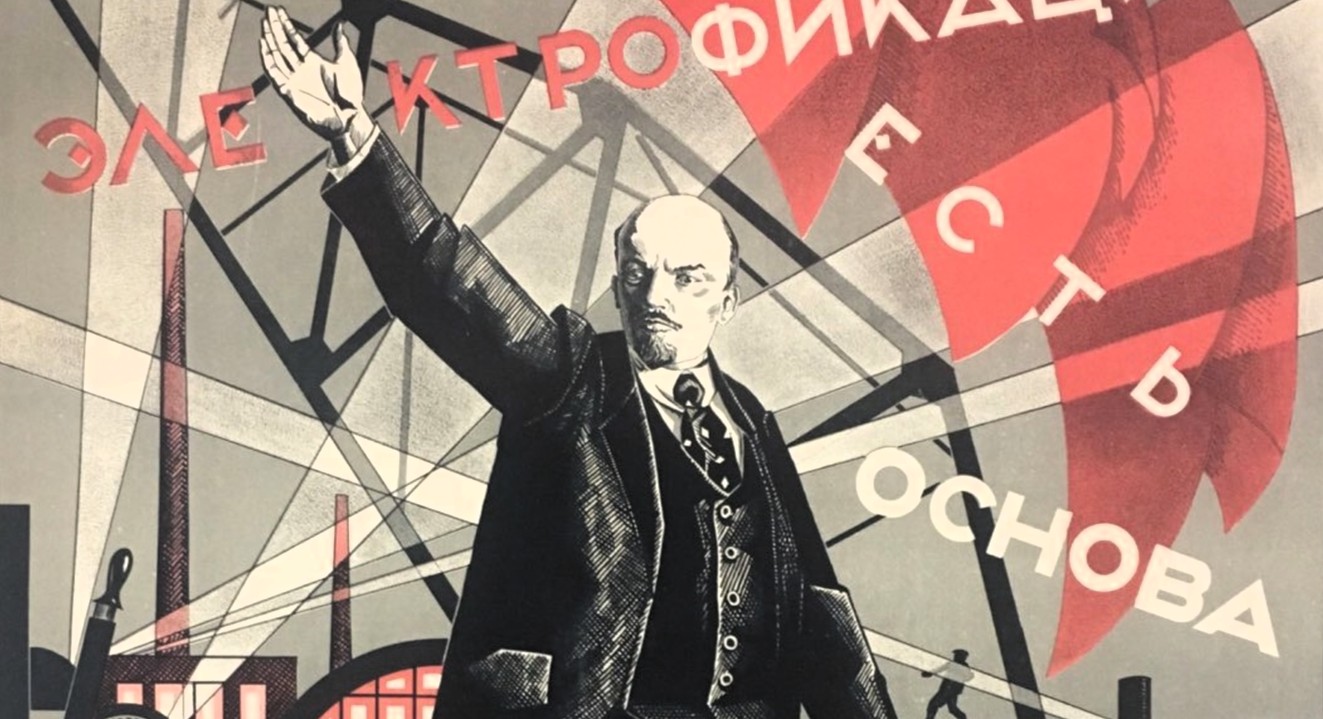
Nikolay Milyutin reflects on Lenin’s post-revolution economic work after his January, 1924 death. Milyutin was born in 1889 in St. Petersburg to a fishing family. Closely associated with the political history of that city, he joined the RSDLP in 1904, participating in Bloody Sunday and the 1905 Revolution. In 1908 he joined the Bolshevik faction. While working odd jobs in the city he studied architecture, when in 1912 he became active in the clerks’ union, starting his career as a Bolshevik trade unionist. Drafted into the Czar’s Army in 1916, he would become a Soldier’s Deputy to the Petrograd Soviet in 1917, leading a Red Guard attachment he quite literally stormed the Winter Palace in October. After the revolution, even as he fought in the Civil War, he was engaged almost entirely in planning and economy. A member of the Supreme Economic Council along with Lenin, being the Commissar for Finances from 1924 and working closely with Rykov as Chair of the Small Council of People’s Commissars until leaving his positions in 1930 with Rykov’s fall as a ‘Rightist’. However, he seems to have largely avoided participating in the factionalism of the 1920s. Becoming a leading city planner during the Five Year Plans, he increasingly moved into academic work on architecture; Though not a victim of the Purges, in 1937 he was relieved of his posts except for the somewhat honorific “Deputy People’s Commissar for Education,” for his continued work on architectural projects. Studying under Moises Ginzburg, he finally finished his PhD at Moscow Architectural Institute on “The Marxist Theory of Socialist Settlement,” shortly before his death of cancer in October, 1942 at 52.
‘Lenin as an Economic Leader’ by Nikolay Milyutin from Soviet Russia (New York). Vol. 9 No. 4. April, 1924.
Lenin as a Practical Worker
Lenin was at once the deep theoretician and the great practical worker. A master of modern science, with an expert grasp of the theories of Marxism, he knew also how to direct and control the masses, and he was able to look at every question from a practical point of view.
In all his work, Lenin showed extraordinary patience in the collection of facts. Even when he was seriously ill, he was preparing material on the question of the scientific organization of labor; as an incident in this work, he requested his friends to draw up a complete list of books and articles which had been published on this question in Russia and abroad. Thanks to the pains he took in collecting the necessary material, his practical activities always rested on a sure foundation of principle.
As a practical worker his most notable and distinctive characteristics may be given as follows. Ability to formulate every question in all its aspects. Intense realism and ability to grasp the mood of the masses. Decisiveness, and determination in carrying out decisions when taken. Ability to select, organize, and train able assistants. The habit of giving a clear, frank account of work done; he never concealed mistakes.
Lenin as the Leader in Economic Policy
In the sphere of economic policy, Lenin followed a definite line, manoeuvering his forces skilfully in the complicated maze of our economic relations.
There is a generally accepted opinion that Lenin did not foresee the New Economic Policy, but was forced to adopt it as a result of the difficult conditions of 1921. But his articles and speeches from 1917 to 1923 show that Lenin, with his usual consistency, followed a definite economic policy in accordance with the conditions of the transition period. The general aims throughout the periods of military communism and of the new economic policy were the strengthening of the power of the workers and peasants, the development of economic life, and the final establishment of socialism.
At the Third Soviet Congress, in January, 1918, Lenin said:
“We only know one road which a proletarian revolution must traverse. Having captured the enemy’s positions, we must learn to wield power by experience. We must learn from our mistakes. We do not in the slightest underrate the difficulties of our task. In introducing control by workers we wanted to show that we recognized only one method–reconstruction from below, so that the workers should themselves choose a new basis of economic conditions. From workers’ control we went on to the creation of the Supreme Economic Council. Only this measure (together with the nationalization of banks and railways, which will be realized within the very near future) will make it possible for us to start building up a new Socialist economy. We are perfectly aware of the difficulties confronting us, but we affirm that a real Socialist is only he who attempts the task relying on experience and on the instinct of the masses.”
With these words he marked out, in essentials, the programme of our economic activity. From 1918 onwards the nationalization of enterprises proceeded at a brisk pace. The Soviet Government machinery could not keep pace with this development, and Lenin consistently pointed out its defects.
During 1918, 1919, and 1920 the food position in the towns was extremely serious. Lenin initiated and saw carried through the policy of centralization of food production. In June, 1918, he declared:
“All reserves of grain must be collected so that they can be properly distributed in the places in need of them.”
Within this general policy, Lenin also marked out immediate economic measures–the securing of the cooperation of the workers, the utilization of specialists, the establishment of the premium bonus system, etc.
In 1921, with our victory on the military front and change of economic policy, a new era began. Lenin, as usual, advanced very cautiously. In an early discussion with him we talked only of the “local market.” Later, as usual, he considered the question in all its implications. The foundation of the new economic policy was laid down by him in his pamphlet on the Agricultural Tax, and in his speech to the Eleventh Congress of the Russian Communist Party. He pointed out how the establishment of peace worked a radical change in the relations between the workers and peasants. He stressed the basis of the new economic policy as follows:
“We are building up our economy in contact with the peasantry. We must keep on shaping it and reshaping it so that there will always be a close relation between our social work and the work in which every individual peasant is engaged. Our aim must be to establish this relation, and to prove to the peasant by our deeds that we are starting from something which he can easily understand, and which is realizable at the present moment in spite of his poverty. This must be the foundation of our whole economic policy.”
Lenin has marked out the lines of our economic policy for many years ahead. Thanks to his comprehensive, far-sighted genius, our economic policy stands on a firm, practical and theoretical basis. Our successes in the economic sphere during the last year fully confirm the accuracy of his vision.
Lenin and the Trade Unions
Under the new economic policy, as Lenin showed, the struggle between the capitalist forces and the workers became more intense though under a different form than in the civil war. For the workers to win, there was needed the active participation of the millions of workers and peasants themselves.
This was the problem put by Lenin in 1919 at the Second All-Russian Congress of Trade Unions. For its solution he looked to the trade unions, which he considered, should play the most important part in economic administration. Their general task he outlined at the Eighth Soviet Congress in the following words:
“The trade unions are the organizations of the ruling class in society, but they are not State bodies. They are rather educative organizations, a school for the administration of industry, a school for Communism. In the system of the dictatorship of the proletariat they are in a position, as it were, between the Party and the State power.”
Lenin and the Government Apparatus
Lenin attached enormous importance to the actual machinery of government. He was interested in its details, trying as far as possible to bring forward as active participants in the most prominent positions the most able workers and peasants. Above all, he fought tooth and nail against all tendencies towards bureaucracy. He demanded that everyone in a responsible position should be directly responsible for the work of his department, and should not be content with the mere passing of paper resolutions. From the first he took the closest part in the work of the Supreme Economic Council, and consequently stood at the head of the Council of Labor and Defence, which united all economic administrative activity.
The question of the organization of the State machinery already occupied his attention in 1918. He returned to the question continually, and one of his last public statements again concerned this question, his criticism of the Workers’ and Peasants’ Inspection in 1923. He pointed out that the defects of our machinery were rooted in the past, which, though overthrown, was not yet out-lived, and that we must therefore struggle continually to overcome old, bad traditions.
Lenin, perhaps more than anyone else, realized how much our whole State organization suffered from lack of experience and from the shortage of experts. “We must once for all,” he said, “give up our former prejudices and invite all necessary specialists to come and work for us.” He was never tired of pointing out that the new system of society could not be built simply by the hands of the Communists without attracting to the work the necessary experts. All his comrades know how much time Lenin gave to this question; how he would tear himself from most important daily work in order to talk over matters personally with this or that specialist.
Lenin not only directed and controlled the economic policy, he not only mapped out on a wide general scale the direction of the economic life of the country and the construction of our State machine, but he took direct practical part in every detail of this work. Only his super-natural ability for work could withstand all the many-sided tasks which he carried out.
Soviet Russia began in the summer of 1919, published by the Bureau of Information of Soviet Russia and replaced The Weekly Bulletin of the Bureau of Information of Soviet Russia. In lieu of an Embassy the Russian Soviet Government Bureau was the official voice of the Soviets in the US. Soviet Russia was published as the official organ of the RSGB until February 1922 when Soviet Russia became to the official organ of The Friends of Soviet Russia, becoming Soviet Russia Pictorial in 1923. There is no better US-published source for information on the Soviet state at this time, and includes official statements, articles by prominent Bolsheviks, data on the Soviet economy, weekly reports on the wars for survival the Soviets were engaged in, as well as efforts to in the US to lift the blockade and begin trade with the emerging Soviet Union.
PDF of full issue: https://www.marxists.org/history/usa/pubs/srp/v9n04-apr-1924-6-hi-res-srp.pdf
 Revolution's Newsstand