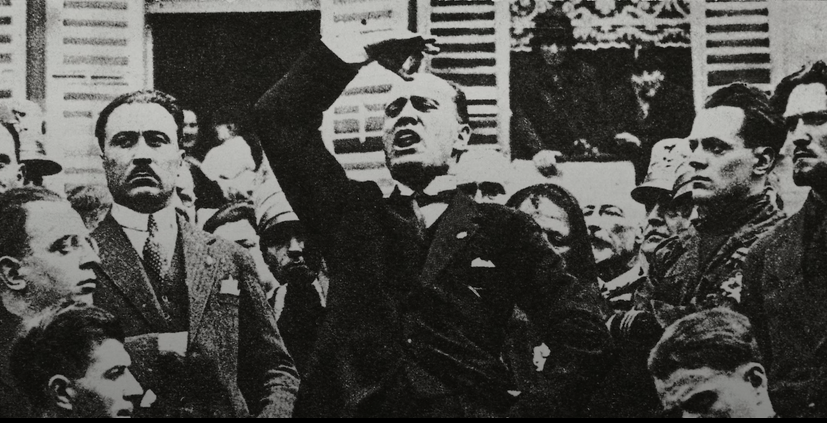
A valuable analysis of the first years of Mussolini’s rule by one of the Comintern’s early theorizers of European fascism. Hungarian Communist and advisor to its short-lived Soviet government, Julius Spitz fled to Italy in 1919 where he was a Comintern representative in the Italian party. After Mussolini’s 1921 victory, Aquila moved to Berlin where he joined the KPD and worked with Willi Münzenberg. A Comintern specialist in Italian affairs and editor on Rote Fahne, much of his work was on fascism. After 1933 he had his wife Valentina Adler (daughter of Alfred) went to Moscow where he worked in the office of Karl Radek. Arrested in 1937 during the Purges he and Valentina were sent to a labor camp in the Soviet Far East where she died in 1942 and he in 1943.
‘The Sixth Anniversary of Fascism in Italy’ by Giulio Aquila (Julius Spitz) from International Press Correspondence. Vol. 8 No. 79. November 9, 1928.
I.
Italian Frontier, October 26th, 1928.
The occupation of the factories by the workers in Northern Italy and of several estates by the agricultural workers and peasants in the South (August/September 1920) marked the height of the revolutionary wave of the early post-war period in Italy. After the evacuation of the occupied factories and estates, which was enforced by the reformist party and trade union leaders, in accordance with their subsequently admitted secret pact with Giolitti, through deceit and threats of open resistance to the institution of proletarian rule, the decline set in rapidly. An independent Communist Party was not yet in existence, and the half measures of the “left-wing” Social-Democratic leaders, who still did not want to have anything to do with a purposeful organisation of the revolutionary forces, led to disastrous consequences.
The political and organisatory destitution of the proletariat and the lack of a purposeful revolutionary party left the way clear for reaction. The fairy tale that Fascism is the consequence of the circumstance that Labour went “too far” is being abandoned even by such right-wing Social-Democrats as Pietro Nenni. The fact is that it was after the evacuation of the factories that the bourgeoisie gave its fullest support to the previously insignificant Fascist group of Mussolini. The newly established Communist Party (January 1921) could not possibly reorganise the revolutionary ranks with the speed which the situation demanded. The proletariat, disorganised through the treachery of the reformists and the no less treacherous half-heartedness of the “left wing” Social Democratic leaders, could consequently not put up the requisite resistance. The Fascist movement swelled under the pseudo-radical, petty-bourgeois, “anti-capitalistic” slogans and constantly pressed forward against Labour and the poor peasantry to the accompaniment of bloody terror, supported and protected in every way by the machinery of State.
The year 1922 saw the triumph of the Fascist bands, which triumph ended in the latter part of October of the year 1922–over the ashes of hundreds of demolished and burned-out trade-union buildings, party premises and co-operative stores and over the corpses of many hundreds of workers and peasants–the so-called “March on Rome” and with the taking over of the government by Mussolini and the reinstating of big capital as the absolute ruler of the country.
On October 27th Mussolini issued the order to all the Fascist formations in the country “to march on Rome”. In every locality they occupied the police headquarters, barracks, railway stations, post offices, town halls, etc., without meeting any resistance whatever from the State. On the next day, October 28th, the Facia Ministry, which had in the meantime retired but still carried on the government business, proclaimed a state of siege; but the king refused to put his signature to the decree and the state of siege was, therefore, suspended an hour after it was declared. The national association of industrialists had, in the meanwhile, telegraphed from Milan to the king demanding that Mussolini should be nominated prime minister immediately. The nomination took place on October 29th and Mussolini hastened from Milan to Rome in the saloon car of a special train, where the extremely radical “republican” greeted the king with the words: “Your Majesty! Your most humble servant stands before you!”
On October 31st the government composed of “personalities” of the Fascist, Nationalist, Liberal, and Democratic parties, and of the Catholic People’s Party (centre) was formed. Mussolini wanted to take the reformists, too, into his government, and, in the name of the reformist leaders, Baldesi officially promised his entry into the government. But the radical underlings of Mussolini, with Farinacci at their head, protested against taking the Social-Democrats into the government, and Mussolini finally had to give way to them.
II.
Six years of Fascist rule have brought about a huge change in Italy. Not the “Revolution”, which the Fascist Press is still trying to convince the world is actually complete or, at least, partially accomplished, without, however, meeting with credulity from any passably reasonable being: the “unification of the whole nation” on the basis of class peace. No; quite the contrary. The six years of Fascist rule have given to the class struggle in Italy an unparalleled bitterness and raised it to a higher level: They have not only split up the Italian nation into two camps, separated by a gulf which cannot be spanned, but they have made everybody in Italy conscious of this gulf: on the one hand, the small minority of exploiters ruling through the intermediary of Fascism on the other hand, the overwhelming majority of the exploited who are chained down through the intermediary of Fascism.
Therein lies its weakness, which impresses Fascism with the sign of death; but therein also lies its present strength, which must first of all be broken by the revolutionary proletariat. Fascism is a rule by violence on the part of the bourgeoisie. But this it is only from a general standpoint, insofar as it secures or tries to secure for all exploiters a profit out of the exploited. If, however, we take a closer look, if we examine the policy of the Fascist government in all its detail, we then recognise that Fascism is particularly the rule by force on the part of big capital or, more exactly, domination of high finance and of industrial big capital in alliance with agricultural interests. In practice this means that Fascism assures a profit out of the exploited to all exploiters in town and country, but within the camp of the exploiters protects chiefly the interests of big capital even against the interests of the lower and middle strata of the bourgeoisie itself. In other words, it fosters in every way possible the accumulation of big capital, even at the cost of small and medium capital.
The logical consequence of this glaring fact is that these lower and middle strata of the Italian bourgeoisie, aye, at times even of certain groups of big capitalists, whose interests are also sacrificed to those of the paramount strata of big capital, are even today anything but “enthusiastic Fascists”.
Upon this phenomenon Italian Social Democracy of all shades (Maximalists, Turatians) is setting up its policy. It goes even a “slight” step further and stupidly maintains that Fascism is the rule of a handful of daring criminals, who “oppress and exploit all classes: the proletariat and petty bourgeoisie of both town and country, as well as the whole of the bourgeoisie; but our Social-Democratic leaders do not bother about such “trifles”. In reality their hope lies with those middle and lower strata of the bourgeoisie as also with the monarchy, or with the officers’ corps whom they implore to “introduce” “Democracy” again in place of Fascism. In return they offer, for their part, to curb the revolutionary forces of the proletariat, either by soft-soaping the workers by means of a coalition government or by suppressing every armed movement among the proletariat, if this should be necessary.
This “real” policy of Social Democracy, which aims at a well-meaning rescue of the capitalist “order”, is wrecked upon the granite rocks of reality. On account of the economic and political conditions, the whole of the Italian bourgeoisie in spite of all individual dissatisfaction actually sees in the Fascist regime, in the brutal oppression of the exploited, the only guarantee of profits. And though the Fascist regime has become and must be a mere synonym for the capitalist regime, the reverse would mean that the breaking up of the Fascist regime, in the present state of affairs, would amount to a breaking up of the capitalist order of society in Italy. The fear of this danger makes it impossible for those who are not particularly satisfied with the Fascist government or even for the dissatisfied strata of the Italian bourgeoisie to toy with the thought of “abolishing” the Fascist regime. On the contrary, this common danger causes them to back up Fascism “like one man” as soon as the regime appears to be menaced.
Naturally, this does not hold good for all times and not for all eternity. If the revolutionary forces in the country become so strong and so well organised that they represent a more or less immediate danger to the Fascist and, consequently, also to the capitalist regime, all those strata of the bourgeoisie and probably also a great portion of the big bourgeoisie will discover a marked inclination in themselves towards “anti-Fascism” and advocate “Democracy” with glowing enthusiasm, in order to make one more attempt to rescue the bourgeois order of society. It is not the curbing of the growing revolutionary forces of the Italian proletariat, nor the appeal to the bourgeoisie to “abolish” the Fascist regime voluntarily, it is not the bourgeoisie, but solely the revolutionary pressure of the proletariat and of all toiling strata in town and country that can and will overthrow the Fascist regime.
Does this mean that the proletarian revolution, the dictatorship of the proletariat may succeed Fascism in Italy? No, this does not yet mean so much. The fall of the Fascist regime will involve a shock to the capitalist order of society in Italy. But only a shock. Whether the Italian bourgeoisie in conjunction with the reformists and the church will stave off for a while longer the collapse of the bourgeois order of society by means of “Democracy”, aye, by means of a military dictatorship, or whether the shock to the bourgeois order of society can be converted by the proletariat into the collapse of the bourgeoisie depends as does the precipitation of the overthrow of Fascism upon how far and at what pace the vanguard of the Italian revolutionary proletariat, the Communist Party of Italy, succeeds in overcoming all democratic, Social-Democratic and petty bourgeois-pacifist illusions among the decisive strata of the Italian proletariat and peasantry and leading the proletariat and peasantry to the fight for the overthrow of Fascism and of the bourgeoisie.
The C.P. of Italy is moving indefatigably and dauntlessly towards this objective. This is the explanation of the pitiless persecution of Communists by Fascism and the bourgeoisie; hence the executions and the hundreds of years of imprisonment; but all this will not avail to obstruct the march of the Communist Party of Italy.
International Press Correspondence, widely known as”Inprecorr” was published by the Executive Committee of the Communist International (ECCI) regularly in German and English, occasionally in many other languages, beginning in 1921 and lasting in English until 1938. Inprecorr’s role was to supply translated articles to the English-speaking press of the International from the Comintern’s different sections, as well as news and statements from the ECCI. Many ‘Daily Worker’ and ‘Communist’ articles originated in Inprecorr, and it also published articles by American comrades for use in other countries. It was published at least weekly, and often thrice weekly. Inprecorr is an invaluable English-language source on the history of the Communist International and its sections.
PDF of full issue: https://www.marxists.org/history/international/comintern/inprecor/1928/v08n79-nov-09-1928-Inprecor-op.pdf

