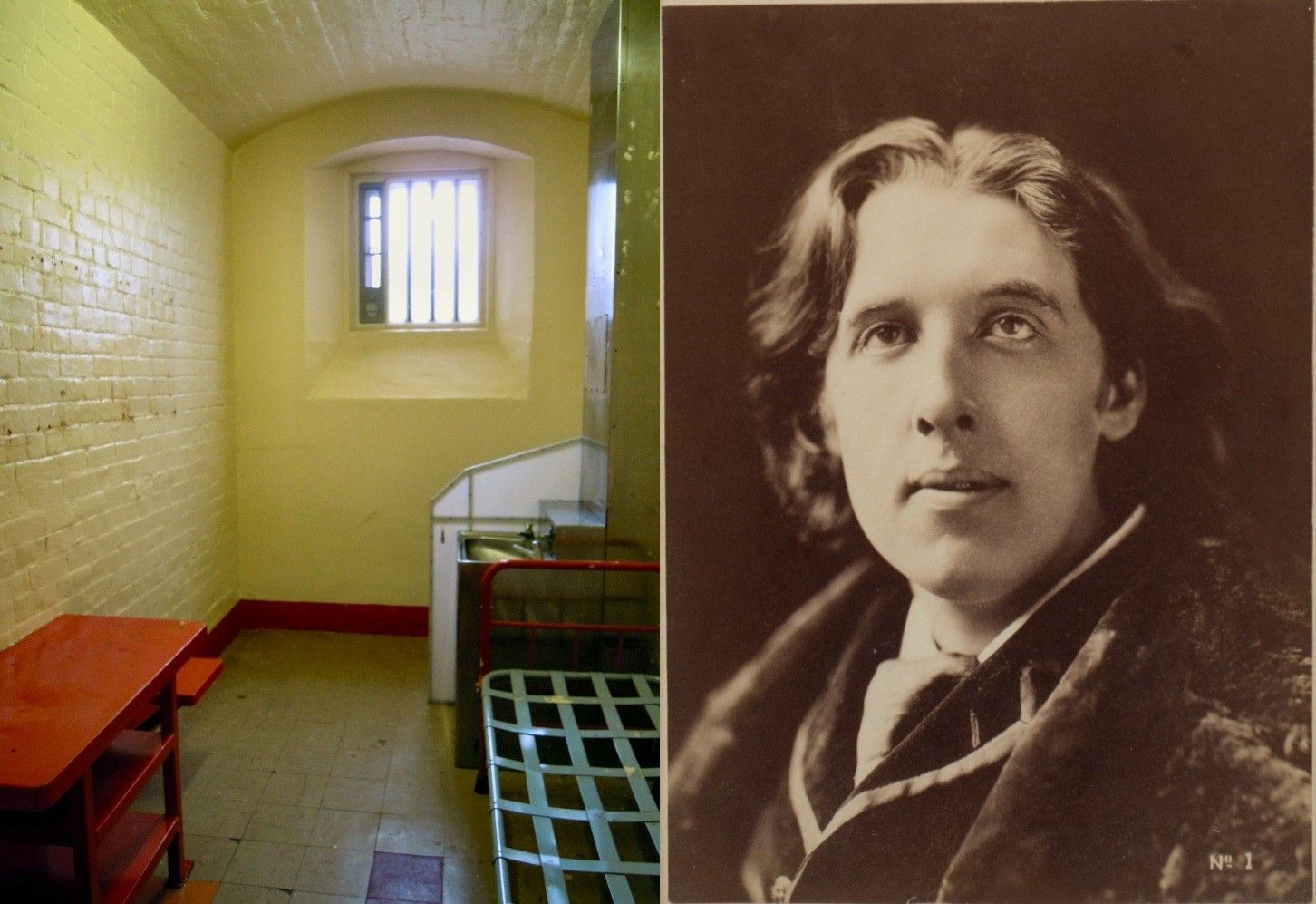
Going to prison will inevitably effect, change, all who spend time, but it is often hard to predict how those jailed will respond to being locked up. From his larger “De Profundis”, first written as a letter to his lover Lord Alfred Douglas while in prison for his sexuality, Oscar Wilde begins to come to terms with life in prison and the stigma to be attached to him.
‘The Ennobling Influence of Sorrow’ (1897) by Oscar Wilde from Mother Earth. Vol. 1 No. 5. July 1906.
WHEN first I was put into prison some people advised me to try and forget who I was. It was ruinous advice. It is only by realizing what I am that I have found comfort of any kind. Now I am advised by others to try on my release to forget that I have ever been in a prison at all. I know that would be equally fatal. It would mean that I would always be haunted by an intolerable sense of disgrace, and that those things which are meant for me as much as for anybody else—the beauty of the sun and moon, the pageant of the seasons, the music of daybreak and the silence of great nights, the rain falling through the leaves, or the dew creeping over the grass and making it silver—would all be tainted for me, and lose their healing power and their power of communicating joy. To regret one’s own experiences is to arrest one’s own development. To deny one’s own experiences is to put a lie into the lips of one’s own life. It is no less than a denial of the soul.
For just as the body absorbs things of all kinds, things common and unclean no less than those that the priest or a vision has cleansed, and converts them into swiftness or strength, into the play of beautiful muscles and the moulding of fair flesh, into the curves and colors of the hair, the lips, the eye; so the soul in its turn has its nutritive functions also, and can transform into noble moods of thought and passion of high import what in itself is base, cruel, and degrading; nay, more, may find in these its most august modes of assertion, and can often reveal itself most perfectly through what was intended to desecrate or destroy.
The fact of my having been the common prisoner of a common gaol I must frankly accept, and, curious as it may seem, one of the things I shall have to teach myself is not to be ashamed of it. I must accept it as a punishment, and if one is ashamed of having been punished, one might just as well never have been punished at all. Of course there were many things of which I was convicted that I had not done, but then there are many things of which I was convicted that I had done, and a still greater number of things in my life for which I was never indicted at all. And as the gods are strange, and punish us for what is good and humane in us as much as for what is evil and perverse, I must accept the fact that one is punished for the good as well as for the evil that one does. I have no doubt that it is quite right one should be. It helps one, or should help one, to realize both, and not to be too conceited about either. And if I then am not ashamed of my punishment, as I hope not to be, I shall be able to think, and walk, and live with freedom.
Many men on their release carry their prison about with them into the air, and hide it as a secret disgrace in their hearts, and at length, like poor poisoned things, creep into some hole and die. It is wretched that they should have to do so, and it is wrong, terribly wrong of society that it should force them to do so. Society takes upon itself the right to inflict appalling punishment on the individual, but it also has the supreme vice of shallowness, and fails to realize what it has done. When the man’s punishment is over, it leaves him to himself; that is to say, it abandons him at the very moment when its highest duties towards him begins. It is really ashamed of its own actions, and shuns those whom it has punished, as people shun a creditor whose debt they cannot pay, or one on whom they have inflicted an irreparable, an irredeemable wrong. I can claim on my side that if I realize what I have suffered, society should realize what it has inflicted on me; and that there should be no bitterness or hate on either side.
Of course I know that from one point of view things will be made different for me than for others; must, indeed, by the very nature of the case be made so. The poor thieves and outcasts who are imprisoned here with me are in many respects more fortunate than I am. The little way in gray city or green field that saw their sin is small; to find those who know nothing of what they have done they need go no farther than a bird might fly between the twilight and the dawn; but for me the world is shrivelled to a hand’s-breadth, and everywhere I turn my name is written on the rocks in lead. For I have come, not from obscurity into the momentary notoriety of crime, but from a sort of eternity of fame to a sort of eternity of infamy, and sometimes seem to myself to have shown, if indeed it required showing, that between the famous and the infamous there is but one step, if as much as one.
Still, in the very fact that people will recognize me wherever I go, and know all about my life, as far as its follies go, I can discern something good for me. It will force on me the necessity of again asserting myself as an artist, and as soon as I possibly can. If I can produce only one beautiful work of art I shall be able to rob malice of its venom, and cowardice of its sneer, and to pluck out the tongue of scorn by the roots.
And if life be, as it surely is, a problem to me, I am no less a problem to life. People must adopt some attitude towards me, and so pass judgment both on themselves and me. I need not say I am not talking of particular individuals. The only people I would care to be with now are artists and people who have suffered: those who know what beauty is, and those who know what sorrow is: nobody else interests me. Nor am I making any demands on life. In all that I have said I am simply concerned with my own mental attitude towards life as a whole; and I feel that not to be ashamed of having been punished is one of the first points I must attain to, for the sake of my own perfection, and because I am so imperfect.
Then I must learn how to be happy. Once I knew it, or thought I knew it, by instinct. It was always springtime once in my heart. My temperament was akin to joy. I filled my life to the very brim with pleasure, as one might fill a cup to the very brim with wine. Now I am approaching life from a completely new standpoint, and even to conceive happiness is often extremely difficult forms. I remember during my first term at Oxford reading in Pater’s “Renaissance”—that book which has had such strange influence over my life—how Dante places low in the Inferno those who wilfully live in sadness. I knew the church condemned accidia, but the whole idea Seemed to me quite phantastic, just the sort of sin, I fancied a priest who knew nothing about real life would invent. Nor could I understand how Dante, who says that “sorrow remarries us to God,” could have been so harsh to those who were enamored of melancholy, if any such there really were. I had no idea that some day this would become to me one of the greatest temptations of my life.
While I was in Wardsworth prison I longed to die. It was my one desire. When after two months in the infirmary I was transferred here, and found myself growing gradually better in physical health, I was filled with rage. I determined to commit suicide on the very day on which I left prison. After a time that evil mood passed away, and I made up my mind to live, but to wear gloom as a king wears purple: never to smile again: to turn whatever house I entered into a house of mourning: to make my friends walk slowly in sadness with me: to teach them that melancholy is the true secret of life: to maim them with an alien sorrow: to mar them with my own pain. Now I feel quite differently. I see it would be both ungrateful and unkind of me to pull so long a face that when my friends came to see me they would have to make their faces still longer in order to show their sympathy; or, if I desired to entertain them, to invite them to sit down silently to bitter herbs and funeral-baked Meats. I must learn how to be cheerful and happy.
The last two occasions on which I was allowed to see my friends here, I tried to be as cheerful as possible, and to show my cheerfulness, in order to make them some slight return for their trouble in coming all the way from town to see me. It is only a slight return, I know, but it is the one, I feel certain that pleases them most. I saw R—— for an hour on Saturday week, and I tried to give the fullest possible expression of the delight I really felt at our meeting. And that, in the views and ideas I am here shaping for myself, I am quite right is shown to me by the fact that now for the first time since my imprisonment I have a real desire for life.
There is before me so much to do that I would regard it as a terrible tragedy if I died before I was allowed to complete at any rate a little of it. I see new developments in art and life, each one of which is a fresh mode of perfection. I long to live so that I can explore what is no less than a new world to me. Do you want to know what this new world is? I think you can guess what it is. It is the world in which I have been living. Sorrow, then, and all that it teaches one, is my new world.
I used to live entirely for pleasure. I shunned suffering and sorrow of every kind. I hated both. I resolved to ignore them as far as possible: to treat them, that is to say, as modes of imperfection. They were not part of my scheme of life. They had no place in my philosophy. My mother, who knew life as a whole, used often to quote to me Goethe’s lines—written by Carlyle in a book he had given her years ago, and translated by him, I fancy, also—
“Who never ate his bread in sorrow,
Who never spent the midnight hours
Weeping and waiting for to-morrow,—
He knows you not, ye heavenly powers.”
I absolutely declined to accept or admit the enormous truth hidden in them. I could not understand it. I remember quite well how I used to tell her that I did not want to eat my bread in sorrow, or to pass any night weeping and watching for a more bitter dawn.
I had no idea that it was one of the special things that the Fates had in store for me: that for a whole year of my life, indeed, I was to do little else. But so has my portion been meted out to me; and during the last few months I have, after terrible difficulties and struggles, been able to comprehend some of the lessons hidden in the heart of pain. Clergymen and people who use phrases without wisdom sometimes talk of suffering as a mystery. It is really a revelation. One discerns things one never discerned before. One approaches the whole of history from a different standpoint. What one had felt dimly, through instinct, about art, is intellectually and emotionally realized with perfect clearness of vision, and absolute intensity of apprehension.
I now see that sorrow, being the supreme emotion of Which man is capable, is at once the type and test of all great art. What the artist is always looking for is the Mode of existence in which soul and body are one and indivisible: in which the outward is expressive of the Inward: in which form reveals. Of such forms of existence there are not a few: youth and the arts preoccupied with youth may serve as a model for us at one moment: at another we may like to think that, in its subtlety and Sensitiveness of impression, its suggestion of a spirit dwelling in external things and making its raiment of earth and air, of mist and city alike, and in its morbid Sympathy of its moods, and tones, and colors, modern landscape art is realizing for us pictorially what was realized in such plastic perfection by the Greeks. Music, in which all subject is absorbed in expression and cannot be separated from it, is a complex example, and a flower or a critical simple example, of what I mean; but sorrow is the ultimate type both in life and art.
Behind joy and laughter there may be a temperament, Coarse, hard and callous. But behind sorrow there is always sorrow. Pain, unlike pleasure, wears no mask.
Truth in art is not any correspondence between the essential idea and the accidental existence; it is not the resemblance of shape to shadow, or of the form mirrored In the crystal to the form itself; it is no echo coming Tom a hollow hill, any more than it is a silver well of Water in the valley that shows the moon to the moon and Narcissus to Narcissus. Truth in art is the unity of a thing with itself: the outward rendered expressive of the inward: the soul made incarnate: the body instinct with spirit. For this reason there is no truth comparable to sorrow. There are times when sorrow seems to me to be the only truth. Other things may be illusions of the ye or the appetite, made to blind the one and cloy the other; but out of sorrow have the worlds been built, and at the birth of a child or a star there is pain.
More than this, there is about sorrow an intense, an extraordinary reality. I have said of myself that I was one who stood in symbolic relations to the art and culture of my age. There is not a single wretched man in this Wretched place along with me who does not stand in Symbolic relation to the very secret of life. For the secret of life is suffering. It is what is hidden behind everything. When we begin to live, what is sweet is so sweet to us, and what is bitter so bitter, that we inevitably direct all our desires towards pleasures, and seek not merely for a “month or twain to feed on honeycomb,” but for all our years to taste no other food, ignorant all the while that we may really be starving the soul.
I remember talking once upon this subject to one of the most beautiful personalities I have ever known: a woman, whose sympathy and noble kindness to me, both before and since the tragedy of my imprisonment, have been beyond power and description; one who has really assisted—me, though she does not know it, to bear the burden of my troubles more than any one else in the whole world has, and all through the mere fact of her existence, through her being what she is—partly an ideal and partly an influence: a suggestion of what one might become as well as a real help towards becoming it; a soul that renders the common air sweet, and makes what is spiritual seem as simple and natural as sunlight or the sea: one for whom beauty and sorrow walk hand in hand, and have the same message. On the occasion of which I am thinking I recall distinctly how I said to her that there was enough suffering in one narrow London lane to show that God did not love man, and that wherever there was any sorrow, but that of a child in some little garden | weeping over a fault that it had or had not committed,—the whole face of creation was completely marred. I was | entirely wrong. She told me so, but I could not believe her. I was not in the sphere in which such belief was to be attained to. Now it seems to me that love of some kind is the only possible explanation of the extraordinary amount of suffering that there is in the world. I cannot conceive of any other explanation. I am convinced that there is no other, and that if the world has indeed, as I have said, been built of sorrow, it has been built by the hands of love, because in no other way could the soul of man, for whom the world was made, reach the full stature of its perfection. Pleasure for the beautiful body, but pain for the beautiful soul.
When I say that I am convinced of these things I speak with too much pride. Far off, like a perfect pearl, one can see the City of God. It is so wonderful that it seems as if a child could reach it in a summer’s day. And so a child could. But with me and such as me it is different. One can realize a thing in a single moment, but one loses it in the long hours that follow with leaden feet. It is so difficult to keep “heights that the soul is competent to gain.” We think in eternity, but we move Slowly through time; and how slowly time goes with us who lie in prison I need not tell again, nor of the weariness and despair that creep back into one’s cell, and into the cell of one’s heart, with such strange insistence that one has, as it were, to garnish and sweep one’s house for their coming, as for an unwelcome guest, or a bitter Master, or a slave whose slave it is one’s chance or choice to be.
And, though at present my friends may find it a hard thing to believe, it is true none the less, that for them living in freedom and idleness and comfort it is more easy to learn the lessons of humility than it is for me, who begins the day by going down on my knees and Washing the floor of my cell. For prison life with its endless privations and restrictions makes one rebellious. The most terrible thing about it is not that it breaks one’s heart—hearts are made to be broken—but that it turns one’s heart to stone. One sometimes feels that it is only with a front of brass and a lip of scorn that one can get through the day at all. And he who is in a state of rebellion cannot receive grace, to use the phrase of which the Church is so fond—so rightly fond, I dare say—for in life as in art the mood of rebellion closes up the channels of the soul, and shuts out the airs of heaven. Yet must learn these lessons here, if I am to learn them anywhere, and must be filled with joy if my feet are on the right road and my face set towards “the gate which Is called beautiful,” though I may fall many times in the Mire and often in the mist go astray.
Mother Earth was an anarchist magazine begin in 1906 and first edited by Emma Goldman in New York City. Alexander Berkman, became editor in 1907 after his release from prison until 1915.The journal has a history in the Free Society publication which had moved from San Francisco to New York City. Goldman was again editor in 1915 as the magazine was opposed to US entry into World War One and was closed down as a violator of the Espionage Act in 1917 with Goldman and Berkman, who had begun editing The Blast, being deported in 1919.
PDF of full issue: https://archive.org/download/mother-earth/Mother%20Earth%20v01n05%20%281906-07%29%20%28c2c%20Harvard%20DSR%29.pdf

