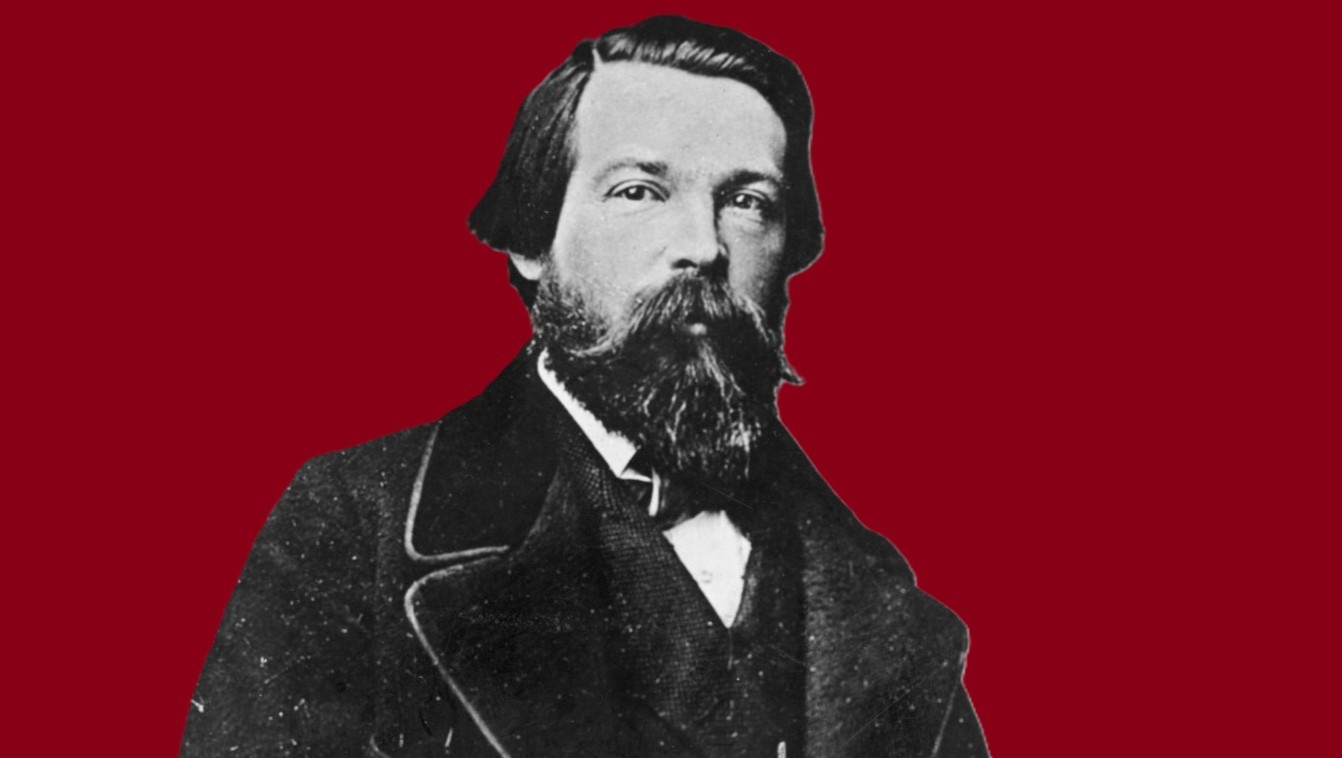
A chapter from what began as a critical review by Engels of Danish philosopher Karl Starcke’s 1885 work on Feuerbach and was first published in Die Neue Zeit in 1886, then revised by Engels in 1888 with the addition of Marx’s ‘Theses on Feuerbach’ and a contextualizing introduction as the short book “Ludwig Feuerbach and the End of Classical German Philosophy.” A major later work by Engels, its was, like all of Engels’ later work, hugely influential for that first generation of ‘Marxists’ who read it originally.
‘Idealism and Materialism’ (1888) by Frederick Engels from Selected Works. Vol. 1. International Publishers, New York. 1933.
The great basic question of all philosophy, especially of modern philosophy, is that concerning the relation of thinking and being. From the very early times when men, still completely ignorant of the structure of their own bodies, under the stimulus of dream apparitions1 came to believe that their thinking and sensation were not activities of their bodies, but of a distinct soul which inhabits the body and leaves it at death—from this time, men have been driven to reflect about the relation between this soul and the outside world. If in death it took leave of the body and lived on, there was no occasion to invent yet another distinct death for it. Thus arose the idea of its immortality which at that stage of development appeared not at all as a consolation but as a fate against which it was no use fighting, and often enough, as among the Greeks, as a positive misfortune. Not religious desire for consolation, but the quandary arising from the common universal ignorance of what to do with this soul (once its existence had been accepted) after the death of the body—led in a general way to the tedious notion of personal immortality. In an exactly similar manner the first gods arose through the personification of natural forces. And these gods in the further development of religions assumed more and more an extra-mundane form, until finally by a process of abstraction, I might almost say of distillation, occurring naturally in the course of man’s intellectual development, out of the many more or less limited and mutually limiting gods there arose in the minds of men the idea of the one exclusive god of the monotheistic religions.
Thus the question of the relation of thinking to being, the relation of spirit to nature—the paramount question of the whole of philosophy—has, no less than all religion, its roots in the narrow-minded and ignorant notions of savagery. But this question could for the first time be put forward in its whole acuteness, could achieve its full significance, only after European society: had awakened from the long hibernation of the Christian Middle Ages. The question of the position of thinking in relation to being, a question which, by the way, had played a great part also in the scholasticism of the Middle Ages, the question: which is primary, spirit or nature—that question, in relation to the Church, was sharpened into this: “Did god create the world or has the world been in existence eternally?”
The answers which the philosophers gave to this question split them into two great camps. Those who asserted the primacy of spirit to nature and, therefore, in the last instance, assumed, world creation in some form or other–(and among the philosophers, Hegel, for example, this creation often becomes still more intricate and impossible than in Christianity)—comprised the camp of idealism. The others, who regarded nature as primary, belong to the various schools of materialism.
These two expressions, idealism and materialism, primarily signify nothing more than this; and here also they are not used in any other sense. What confusion arises when some other meaning is put into them will be seen below.
But the question of the relation of thinking and being has yet another side: in what relation do our thoughts about the world surrounding us stand to this world itself? Is our thinking capable of the cognition of the real world? Are we able in our ideas and notions of the real world to produce a correct reflection of reality? In philosophical language this question is called the question of the “identity of thinking and being,” and the overwhelming majority of philosophers give an affirmative answer to this question. With Hegel, for example, its affirmation is self-evident; for what we perceive in the real world is precisely its thought content—that which makes the world a gradual realisation of the absolute idea, which absolute idea has existed somewhere from eternity, independent of the world and before the world. But it is manifest without more ado that thought can know a content–which is from the outset a thought-content. It is equally manifest that what is here to he proved is already tacitly contained in the presupposition. But that in no way prevents Hegel from drawing the further conclusion from his proof of the identity of thinking and being that his philosophy, because it is correct for his own thinking, is therefore the only correct one, and that the identity of thinking and being must prove its validity by mankind immediately translating his philosophy from theory into practice and transforming the whole world according to Hegelian principles. This is an illusion which he shares with well-nigh all philosophers.
In addition there is yet another set of different philosophers—those who question the possibility of any cognition (or at least of an exhaustive cognition) of the world. To them, among the moderns, belong Hume and Kant, and they have played a very important role in philosophical development. What is decisive in the refutation of this view has already been said by Hegel—in so far as this was possible from an idealist standpoint. The materialistic additions made by Feuerbach are more ingenious than profound. The most telling refutation of this as of all other philosophical fancies is practice, viz., experiment and industry. If we are able to prove the correctness of our conception of a natural process by making it ourselves, bringing it into being out of its conditions and using it for our own purposes into the bargain, then there is an end of the Kantian incomprehensible “thing-in-itself.” The chemical substances produced in the bodies of plants and animals remained just such “things-in-themselves” until organic chemistry began to produce them one after another, whereupon the “thing-in-itself” became a thing for us, as, for instance, alizarin, the colouring matter of the madder, which we no longer trouble to grow in the madder roots in the field, but produce much more cheaply and simply from coal tar. For three hundred years the Copernican solar system was a hypothesis with a hundred, a thousand or ten thousand chances to one in its favour, but still always a hypothesis. But when Leverrier, by means of the data provided by this system, not only deduced the necessity of the existence of an unknown planet, but also calculated the position in the heavens which this planet must necessarily occupy, and when Galle really found this planet, the Copernican system was proved. If, nevertheless, the Neo-Kantians are attempting to resurrect the Kantian conception in Germany and the agnostics that of Hume in England (where in fact it had never ceased to survive), this is—in view of their theoretical and practical refutation accomplished long ago—scientifically a regression and practically merely a shamefaced way of surreptitiously accepting materialism, while denying it before the world.
But during this long period from Descartes to Hegel and from Hobbes to Feuerbach, the philosophers were by no means impelled, as they thought they were, solely by the force of pure reason. On the contrary, what really pushed them forward was the powerful and ever more rapidly onrushing progress of natural science and industry. Among the materialists this was plain on the surface, but the idealist systems also filled themselves more and more with a materialist content and attempted pantheistically to reconcile the antithesis between mind and matter. Thus, ultimately, the Hegelian system represents merely a materialism idealistically turned upside down in method and content.
It is, therefore, comprehensible that Starke in his characterisation of Feuerbach first of all investigates the latter’s position in regard to this fundamental question of the relation of thinking and being. After a short introduction, in which the views of the preceding philosophers, particularly since Kant, are described in unnecessarily ponderous philosophical language, and in which Hegel, by an all too formalistic adherence to certain passages of his work, gets far less than his due, there follows a detailed description of the course of development of Feuerbach’s “metaphysics” itself, as this course was reconstructed out of the sequence of those writings of this philosopher which have a bearing here. This description is industriously and carefully elaborated, only, like the whole book, it is loaded with a ballast of philosophical phraseology by no means everywhere unavoidable, which is the more disturbing in its effect the less the author keeps to the manner of expression of one and the same school, or even of Feuerbach himself, and the more he interjects expressions of very different schools—especially of the tendencies now rampant and calling themselves philosophical.
The course of evolution of Feuerbach is that of a Hegelian—a never quite orthodox Hegelian, it is true—into a materialist; an evolution which at a definite stage necessitates a complete rupture with the idealist system of his predecessor. With irresistible force Feuerbach is finally forced to the realisation that the Hegelian pre-mundane existence of the “absolute idea,” the “pre-existence of the logical categories” before the world existed, is nothing more than the fantastic survival of the belief in the existence of an extra-mundane creator; that the material, sensuously perceptible world to which we ourselves belong is the only reality; and that our consciousness and thinking, however supra-sensuous they may seem, are the product of a material, bodily organ, the brain. Matter is not a product of mind, but mind itself is merely the highest product of matter. This is, of course, pure materialism. But, having got so far, Feuerbach stops short. He cannot overcome the customary philosophical prejudice, prejudice not against the thing but against the name materialism. He says: “To me materialism is the foundation of the edifice of human essence and knowledge, but to me it is not what it is to the physiologist, to the natural scientist in the narrower sense, for example, Moleschott, and necessarily so indeed from their standpoint and profession, the building itself. Backwards I fully agree with the materialists; but not forwards.”
Here Feuerbach lumps together the materialism that is a general world outlook resting upon a definite conception of the relation between mater and mind, and the special form in which this world outlook was expressed at a definite stage of historical development, viz., in the eighteenth century. More than that, he confuses it with the shallow and vulgarised form in which the materialism of the eighteenth century continues to exist today in the minds of naturalists and physicians, the form which was preached on their tours in the ‘fifties by Buchner, Vogt and Moleschott. But just as idealism underwent a series of stages of development, so also did materialism: With each epoch-making discovery even in the sphere of natural science it has to change its form; and after history also was subjected to materialistic treatment, here also a new avenue of development has opened.
The materialism of the last century was predominantly mechanical, because at that time, of all natural sciences, mechanics and indeed only the mechanics of solid bodies—celestial and terrestrial—in short, the mechanics of gravity, had come to any definite close. Chemistry at that time existed only in its infantile, phlogistic form. Biology still lay in swaddling clothes; vegetable and animal organisms had been only roughly examined and were explained as the result of purely mechanical causes. As the animal was to Descartes, so was man a machine to the materialists of the eighteenth century. This exclusive application of the standards of mechanics to processes of a chemical and organic nature—in which processes, it is true, the laws of mechanics are also valid, but are pushed into the background by other and higher laws—constitutes a specific but at that time inevitable limitation of classical French materialism.
The second specific limitation of this materialism lay in its inability to comprehend the universe as a process—as matter developing in an historical process, This was in accordance with the level of the natural science of that time, and with the metaphysical, i.e., anti-dialectical manner of philosophising connected with it. Nature, it was known, was in constant motion. But according to the ideas of that time, this motion turned eternally in a circle and therefore never moved from the spot; it produced the same results over and over again. This conception was at that time inevitable. The Kantian theory of the origin of the solar system! had been put forward but recently and was regarded merely as a curiosity. The history of the development of the earth, geology, was still totally unknown, and the conception that the animate natural beings of today are the result of a long sequence of development from the simple to the complex could not at that time scientifically be put forward at all. The unhistorical view of nature was therefore inevitable. We have the less reason to reproach the philosophers of the eighteenth century on this account, since the same thing is found in Hegel. According to him, nature, as a mere “alienation” of the idea, is incapable of development in time—capable only of extending its manifoldness in space, so that it displays simultaneously and alongside of one another all the stages of development comprised in it, and is condemned to an eternal repetition of the same process. This absurdity of a development in space, but outside of time—the fundamental condition of all development—Hegel imposes upon nature just at the very time when geology, embryology, the physiology of plants and animals, and organic chemistry were being built up, and when everywhere on the basis of these new sciences brilliant foreshadowings of the later theory of evolution were appearing (e.g., Goethe and Lamarck). But the system demanded it; hence the method, for the sake of the system, had to become untrue to itself.
This same unhistorical conception prevailed also in the domain of history. Here the struggle against the remnants of the Middle Ages blurred the view. The Middle Ages were regarded as a mere interruption of history by a thousand years of universal barbarism. The great progress made in the Middle Ages—the extension of the area of European culture, the bringing into existence there of great nations, capable of survival, and finally the enormous technical progress of the fourteenth and fifteenth centuries—all this was not seen. Consequently a rational insight into the great historical inter-connections was made impossible, and history served at best as a collection of examples and illustrations for the use of philosophers.
The vulgarising peddlers who in Germany in the ‘fifties busied themselves with materialism by no means overcame the limitations of their teachers. All the advances of natural science which had been made in the meantime served them only as new proofs against the existence of a creator of the world; and, in truth, it was quite outside their scope to develop the theory any further. Though idealism was at the end of its tether and was dealt a death blow by the Revolution of 1848, it had the satisfaction of seeing that materialism had for the moment fallen lower still. Feuerbach was unquestionably right when he refused to take responsibility for this materialism; only he should not have confounded the doctrines of these hedge-preachers with materialism in general.
Here, however, two things must be pointed out.
First, during Feuerbach’s lifetime, natural science was still involved in a process of violent fermentation—which only during the last fifteen years has reached a relatively clear conclusion. New scientific data were acquired to a hitherto unheard-of extent, but the establishing of interrelations, and thereby the bringing of order into this chaos of discoveries following closely upon each other’s heels has only quite recently become possible for the first time. It is true that Feuerbach had lived to see all three of the decisive discoveries—that of the cell, the transformation of energy and the theory of evolution named after Darwin. But how could the lonely philosopher, living in rural solitude, be able sufficiently to follow scientific developments in order to appreciate at their full value discoveries which scientists themselves at that time either contested or did not adequately know how to make use of? The blame for this falls solely upon the wretched conditions in Germany, in consequence of which cobweb-spinning eclectic fleacrackers had taken possession of the chairs of philosophy, while Feuerbach, who towered above them all, had to rusticate and grow sour in a little village. It is therefore not Feuerbach’s fault that the historical conception of nature, which had now become possible and which removed all the one-sidedness of French materialism, remained inaccessible to him.
Secondly, Feuerbach is quite correct in asserting that the exclusively natural-scientific materialism was indeed “the foundation of the edifice of human…knowledge, but…not…the building itself.” For we live not only in nature but also in human society, and this also no less than nature has its history of development and its science. It was therefore a question of bringing the science of society (i.e., the sum total of the so-called historical and philosophical sciences) into harmony with the materialist foundation, and of reconstructing it thereupon. But it did not fall to Feuerbach’s lot to do this. In spite of the “foundation,” he remained here bound by the traditional idealist fetters, a fact which he recognises in these words: “Backwards I…agree with the materialists; but not forwards!” But it was Feuerbach himself who did not go “forward” here, in the social domain, who did not get beyond his standpoint of 1840 or 1844. And this indeed was again chiefly due to this isolation—which compelled him, who, of all philosophers, was the most inclined to social intercourse, to produce thoughts out of his solitary head instead of in amicable and hostile encounters with other men of his own calibre. Later we: shall see in detail how much he remained an idealist in this sphere.
It need only be added here that Starcke looks for Feuerbach’s idealism in the wrong place. “Feuerbach is an idealist; he believes in the progress of mankind” (p. 19). “The foundation, the substructure of the whole, remains nevertheless idealism. Realism for us is nothing more than a protection against wrong paths, while we follow our ideal trends. Are not compassion, love and enthusiasm for truth and justice ideal forces?” (P. viii.)
In the first place, idealism here means nothing but the pursuit of “ideal” aims. But these necessarily have to do at the most with Kantian idealism and its “categorical imperative,” but Kant himself called his philosophy “transcendental idealism” by no means because he dealt therein also with moral ideals, but for quite other reasons, as Starke will remember. The superstition that philosophical idealism is pivoted round a belief in moral, i.e., social, “ideals,” arose outside philosophy, among the German philistines who learned by heart from Schiller’s poems the few morsels of philosophical culture they needed. No one has criticised more severely the impotent “categorical imperative” of Kant—impotent because it demands the impossible, and therefore never attains to any reality—no one has more cruelly derided the philistine sentimental enthusiasm for unrealisable ideals purveyed by Schiller than the complete idealist Hegel. (See, for example, his Phenomenology.)
In the second place, we cannot get away from the fact that everything that sets men acting must find its way through their brain—even eating and drinking, which begins as a consequence of the sensation of hunger or thirst transmitted through the brain, and ends as a result of the sensation of satisfaction likewise transmitted through the brain. The influences of the external world upon man express themselves in his brain, are reflected therein as feelings, thoughts, instincts, volitions—in short, as “ideal tendencies,” and in this form become “ideal powers.” If, then, a man is converted into an idealist because he “follows ideal tendencies” and admits that “ideal powers” have an influence over him—then every person who is at all normally developed is a born idealist and how, in that case, can there still be any materialists?
In the third place, the conviction that humanity, at least at the present moment, moves on the whole in a progressive direction has absolutely nothing to do with the antithesis between materialism and idealism. The French materialists equally with the deists’ Voltaire and Rousseau held this conviction to an almost fanatical degree, and often made the greatest personal sacrifices for it. If ever anybody dedicated his whole life to the “enthusiasm for truth and justice”—using this phrase in the good sense—it was Diderot. If, therefore, Starcke declares all this to be “idealism,” this merely proves that the word materialism has lost all meaning for him—as has also the whole antithesis between the two standpoints.
The fact is that Starcke, although perhaps unconsciously, in this makes an unpardonable concession to the traditional philistine prejudice against the word materialism resulting from the long-continued defamation by the priests. By the word materialism the philistine understands gluttony, drunkenness, lust of the eye, lust of the flesh, arrogance, cupidity, avarice, miserliness, profit-hunting and stock-exchange swindling—in short, all the filthy vices in which he himself indulges in private. By the word idealism he understands the belief in virtue, universal philanthropy and in a general way a “better world” of which he boasts before others, but in which he himself at the utmost believes only so long as he is going through the depression or bankruptcy consequent upon his customary “materialist” excesses. It is then that he sings his favourite song, “What is man?—Half beast! Half angel!”
For the rest, Starcke takes great pains to defend Feuerbach against the attacks and doctrines of the vociferous lecturers who today go by the name of philosophers in Germany. For people who are interested in this afterbirth of German classical philosophy this is a matter of importance; for Starcke himself it may have appeared necessary. We, however, will spare the reader this.
1. Among savages and lower barbarians the idea is still universal that the human forms which appear in dreams are souls which have temporarily left their bodies; the real man is therefore held responsible for acts committed by his dream apparition against the dreamer. Thus B. Imthurn found this belief current, for example, among the Indians of Guiana in 1884. [Note by F. Engels.]
PDF of full book: https://archive.org/download/k.-marx-selected-works-in-two-volumes-vol.-1/K.%20Marx%3B%20Selected%20Works%20in%20Two%20Volumes%20-%20Vol.%201.pdf

