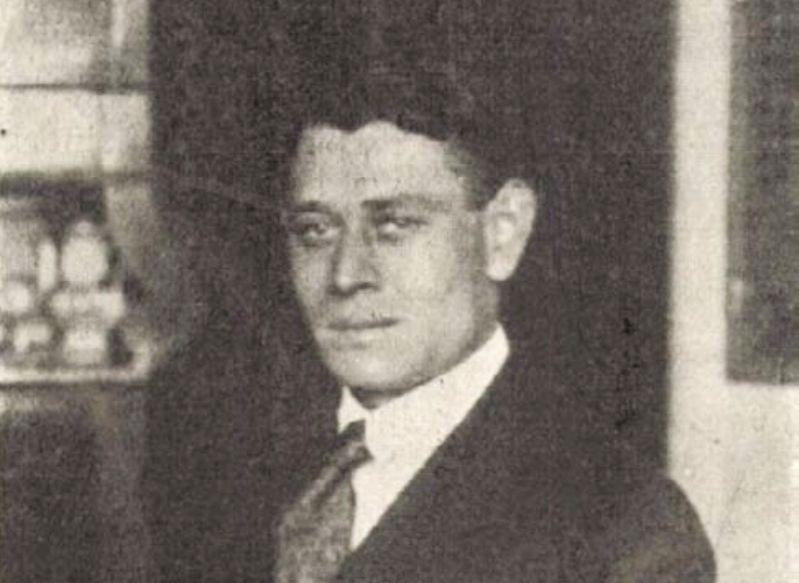
Desiring to make a workers’ media to directly compete with the capitalist media, not simply comment on it requires whole institutions of research, news gathering, and distribution to hope to be effective. A leading journalist of the Comintern, already with a vast experience on the needs of working-class journalism. Going on to have the full, fascinating, and tragic life of a revolutionary, Magyar was born Lajos Milhofer in 1891 to a Hungarian-Jewish family of small shopkeepers in the village of Istvándi. After to school he moved to the nearby city of Pecs, where he joined the Socialist movement and began his career in journalism for local newspapers. In 1912 he moved to Budapest where he became a correspondent, under the Magyar pseudonym, for the newspaper Világ, covering the Balkan Wars and World War One. Returning to Hungary from Vienna to participate in the 1918 Revolution, he would become a non-partisan member of the Budapest Soviet, for which he served as a press officer and head of the journalists’ union during 1919’s short-live Hungarian Soviet Republic. Arrested in Horthy’s counter-revolution, it was in prison that Magyar became a Communist. In early 1922 he was released in exchange for White Hungarian prisoners held by Soviet Russia, and arrived in Moscow that March. In Soviet Russia he joined the Russian C.P. and continued his journalism, working for TASS as its correspondent in Germany during 1923, and back to Moscow where he headed Pravda’s foreign department until 1926. Like many exiled Hungarians, Magyar also worked for the Comintern, where he collaborated closely with Zinoviev and became increasingly interested in Chinese history and politics, particularly its agriculture. Learning the language, in September 1926 Magyar was made press attaché for the Soviet’s embassy in Beijing and then the Shanghai consulate where he also intensively studied the history of Chinese farming. It was there he helped in the armed defense when the consulate was attacked by White Guardist in the counter-revolution of 1927. Returning to Moscow 1928, this Jewish kid from a small Hungarian village worked for the International Agrarian Institute and finished his “The Economics of China’s Agriculture,” which was also published in Chinese. In 1929 he shifted to working primarily for the Comintern as deputy of the Eastern Secretariat of the E.C.C.I. and a leading voice on the national-colonial revolution, with the Near East and Persia taking much of his attention. While continuing to study and publish on China, Magyar also worked for Inprecorr, living in Paris as its correspondent there in 1931-2. Returning to Moscow and the Comintern’s Eastern Department while also teaching at the Communist University of the Toilers of the East. While living in Moscow he was elected to the city Soviet. He would there be caught up in the first great wave of the Purges that followed the killing of Leningrad leader Sergei Kirov on December, 1 1934. Giving money to aid the family of his arrested co-worker from the Eastern Department, Georgy Safarov, Magyar would himself be arrested by the end of the year. First charged with being part of Zinoviev’s opposition, he was held for two years before eventually being found guilty of participating in Heinz Neumann and Béla Kun’s “anti-Soviet bloc.” Confessing in prison and also giving names, unlike many, Lajos Magyar refused to plead guilty for what he did not consider a crime when he faced the judges on November 2, 1937. He was executed shortly afterwards. ‘Rehabilitated’ in 1956, it was largely due to the work of his first wife the actress and Hungarian cultural figure Blanka Pejchi, that his work was published in Hungary again, with the country’s top journalism prize being named for Magyar in 1986. Clearly a person of wide interests and abilities, Magyar was the author of a vast amount of material in a host of languages. Some of his books published in addition to his “Economics” include “Balkans at War,” “The Hungarian Revolution: Experiences at the Headquarters of the Revolution,” with Eugen Varga “The World Economic Crisis and the End of Capitalist Stabilisation,” “The Current State of the Chinese Revolution”, “Essays on the Economy of China,” “The Soviet Movement in China,” “From the Canton Commune to the Chinese Soviets,” the posthumous “Late Scholarly Works” not produced until the 1960.
‘The Problem of Getting the News’ by Lajos Magyar from The Daily Worker. Vol. 2 No. 132. June 16, 1925.
The weakest side of the communist press is undoubtedly its informatory side. We are not concerned with the question of whether our press keeps its working class readers well or badly informed in the journalistic sense. We are not concerned with the various journalistic methods of dishing up information. But the fact remains that in point of actual information we are weak, extraordinarily weak. Our press is young, we have but few qualified collaborators at our disposal, our press is financially weak, depends solely upon the penny of the workers, refuses to share the wages of corruption which form the main source of income of the bourgeois and social democratic press. But information, news, in a capitalist state of society these are a commodity, they cost money, and money is scarce in our press undertakings.
It is thus easily comprehensible that our press is badly off with regard to information, and that we cannot compete with the great guns of the bourgeois (and social democratic) press. We should be the victims of a delusion if we were to assume ourselves capable of competing. It is not the case, and will not be the case for a long time to come. With the exception of the press of the Soviet Union, whose information service, if not exactly brilliant, is at least better organised than that of the press of our Western (to say nothing at all of our Eastern) Parties, our news service is not only in a very sorry condition, but we have no communist foreign news service whatever. And this is the pivot upon which the whole matter depends. It is here that we must apply the lever if we are to accomplish anything.
The position must be faced openly, and the fact recognised that we possess no communist news service.
The bourgeoisie is thoroughly well aware of the value of information. The information service of the world is organised at the present time in such a manner that even the communist press is dependent for information on bourgeois sources. There is simply no other source of information. It is true that the “Rosta” furnishes information referring to the Soviet Union, and overcomes incredible difficulties in the determined effort to fulfil its task. But for news from all other countries we are dependent on the bourgeois telegraphic agencies.
These bourgeois news agencies which represent as a general rule the most reactionary of capitalist groups, are under the control of the governments, or are frequently enough more reactionary in tendency than even the governments. This is the case in England, where the Reuter agency is completely in the hands of the South African diamond fields and gold mines, and of the groups of capitalists possessing large interests in India. It is again the case in France, where the Havas agency works hand in hand with the right wing of the bloc national.
Information from abroad is thus furnished by news agencies under the control of either reactionary capitalist groups or of their governments. In both cases the news agencies are influenced and inspired by the governments in questions of foreign politics. There is no need to point out the effect this is bound to have on the nature of the information imparted. Facts are passed over in silence, misrepresented, exaggerated, in accordance with the requirements and interests of the governments and ruling groups concerned. Even in Marx’s lifetime this was so much the case that he was able to write in a letter to Kugelmann that the capitalist press of today is capable of creating legends and myths within a few weeks or months. And the up-to-date legends of the capitalist press are as well adapted to supporting the interests of the up to date ruling class as the legends of the ancients and of the middle ages were adapted to maintaining the interests of the rulers of those days. Midges are represented as elephants, and elephants as midges, according to requirements.
The most dangerous part of it is that the news service of the world is so organised that the French, English, German, and other telegraphic agencies not only serve the ends of the French, English, German, and other governments, but the interests of all the governments of the world. This fact is but little recognised, and it is worthwhile to throw some detailed light upon it. The most powerful news agencies of the world form a single concern, known under the name of the associated Telegraphic Agencies. The following agencies are members of this organisation:
Reuter (England), Official News Office (Austria), Agence Telegraphique Belge (Belgium), Agence Telegraphique (Bulgaria), Rihaus Buros (Denmark), Agenca Fabra (Spain), Finisko Notirburo (Finland), Agence d’Athene (Greece), Niederlande Telegraaf Agentschat (Holland), Agence Telegraphique Hongrois (Hungary), Agence Stefani (Italy), Norsk Telegrammburo (Norway), Agence Telegraphique Polonaise (Poland), Havas (France), Havas (Portugal), Orient Radio (Roumani), Swedish Telegraph Agency (Sweden), Agence Suisse (Switzerland), Tscheteka (Czechoslovakia), Agence d’Antolie (Turkey), Agence d’Avala (Yugoslavia), Elta (Lithuania), Esta (Estonia), Latvian Telegraph Agency (Latvia), Associated Press (North America), Havas (South America), Reuter (China) Wolff (Germany), Kokissai (Japan).
This list is sufficient evidence that this organisation spreads its ramifications all over the world. All these news agencies have contracts with one another. On the terms of these agreements these agencies “exchange” news with one another, each agency reserving the right in the first place of refusing to publish certain news, and secondly of having news whose publication and dissemination appear of special importance circulated, accompanied by a special notice, at the expense of the agency. In actual practice this agreement means that the Wolff office, Reuter, Havas, Stefani, etc. remit to Germany, England, France, Italy, etc. only such news of Yugoslavia as the Yugoslavian government wishes to be published, and whose publication does not run counter to the interests of the governments of the countries concerned. The formulation, standpoint, and journalistic political treatment of events is left to each individual agency. Thus we learn nothing about Japan except what the Japanese government wishes us to learn, and that in a form and elucidation which appears desirable to the Japanese government. And this does not apply to Japan only, but to the whole world.
It may of course be pointed out that these are not the only agencies in the world; there are a number of other and independent agencies. In the United States there is the United Press, in England the Exchange Company, in France the “Radio” and “San Fil”, in Germany the Telegraphic Union, etc. But these agencies are again associated in cartels; some of them are even more reactionary than the members of the great concern, and they are in any case one and all bourgeois agencies.
Some feeble efforts have been made towards founding agencies better representing working class interests. Thus the “Federated Press’ was formed in America, but its lack of capital scarcely permits it to compete with the great agencies. And in Germany there is the “social democratic parliament service”, which has of late made the attempt to organise a foreign service. But these organisations are but weak, and the “social democratic parliament service” is naturally social democratic.
Up to now the Communist Parties have made no attempt at forming independent agencies for the news service. The German C.P. forms a praiseworthy exception to this rule, for it has founded the “Communist Press Service”, which at least reports the events of the German labour movement from their original sources. The telegraphic agency of the “Inprecorr” took up this work lately, but has so far been obliged to confine itself to reporting information on the most important events in the labour movement, on Party life in Soviet Russia, on the White terror, etc.
At the present time the communist press is thus dependent on the bourgeois sources for information regarding the most important events taking place in the labour movement of the West, and even for information on the revolutionary movement in the East. The fact that some few communist organs here and there possess their own reporters makes no difference to this, or at least very little.”
What have we to do? It would be exceedingly simple to issue a slogan. We must have our own communist organisation, communist telegraphic agency. But every prerequisite is lacking. At the present time our press cannot raise the money required by such an organisation and its running expenditure. We must of course strive towards the final goal of a communist news service. But we shall not attain this goal all at once, and meanwhile we must manage somehow. The following suggestions may be made for transitional measures:
1. We must continue to make use of the bourgeois sources of information. It must however not be permitted to make use of the news material supplied by the bourgeois agencies without elucidating it in such a manner as to render its real import clear to the workers. The comrades working up this’ material for our newspapers must themselves be thoroughly informed on questions of foreign politics. Otherwise we may continue in the future, as in the present, to permit our communist press to act as a channel for the propaganda of bourgeois governments.
2. Every Party must begin at once with the organisation of an inland information service, commissioned to report on the labour movement of the country.
3. The Parties must coordinate their information services, and the larger Parties must endeavour to send reporters to the more important among the neighbouring countries.
4. The editors of the central organs of the larger Parties must organise a daily exchange of information (with the aid of the “Inprecorr” telegraphic agency).
5. The “Inprecorr” telegraphic news agency must be extended.
The measures here proposed are by no means exhaustive, and do not lead rapidly to our goal. But they are at least capable of realisation, and they lead none the less to the goal, though slowly,–to the emancipation of the communist press from bourgeois influence. It is exceedingly difficult to solve this problem. Here we have merely drawn the rough outlines of the question, and briefly indicated the lines upon which it may be solved.
The problem must however be solved, if we are to have a Bolshevist press.
The Daily Worker began in 1924 and was published in New York City by the Communist Party US and its predecessor organizations. Among the most long-lasting and important left publications in US history, it had a circulation of 35,000 at its peak. The Daily Worker came from The Ohio Socialist, published by the Left Wing-dominated Socialist Party of Ohio in Cleveland from 1917 to November 1919, when it became became The Toiler, paper of the Communist Labor Party. In December 1921 the above-ground Workers Party of America merged the Toiler with the paper Workers Council to found The Worker, which became The Daily Worker beginning January 13, 1924.
PDF of full issue: https://www.marxists.org/history/usa/pubs/dailyworker/1925/1925-ny/v02b-n132-NYE-jun-16-1925-DW-LOC.pdf

