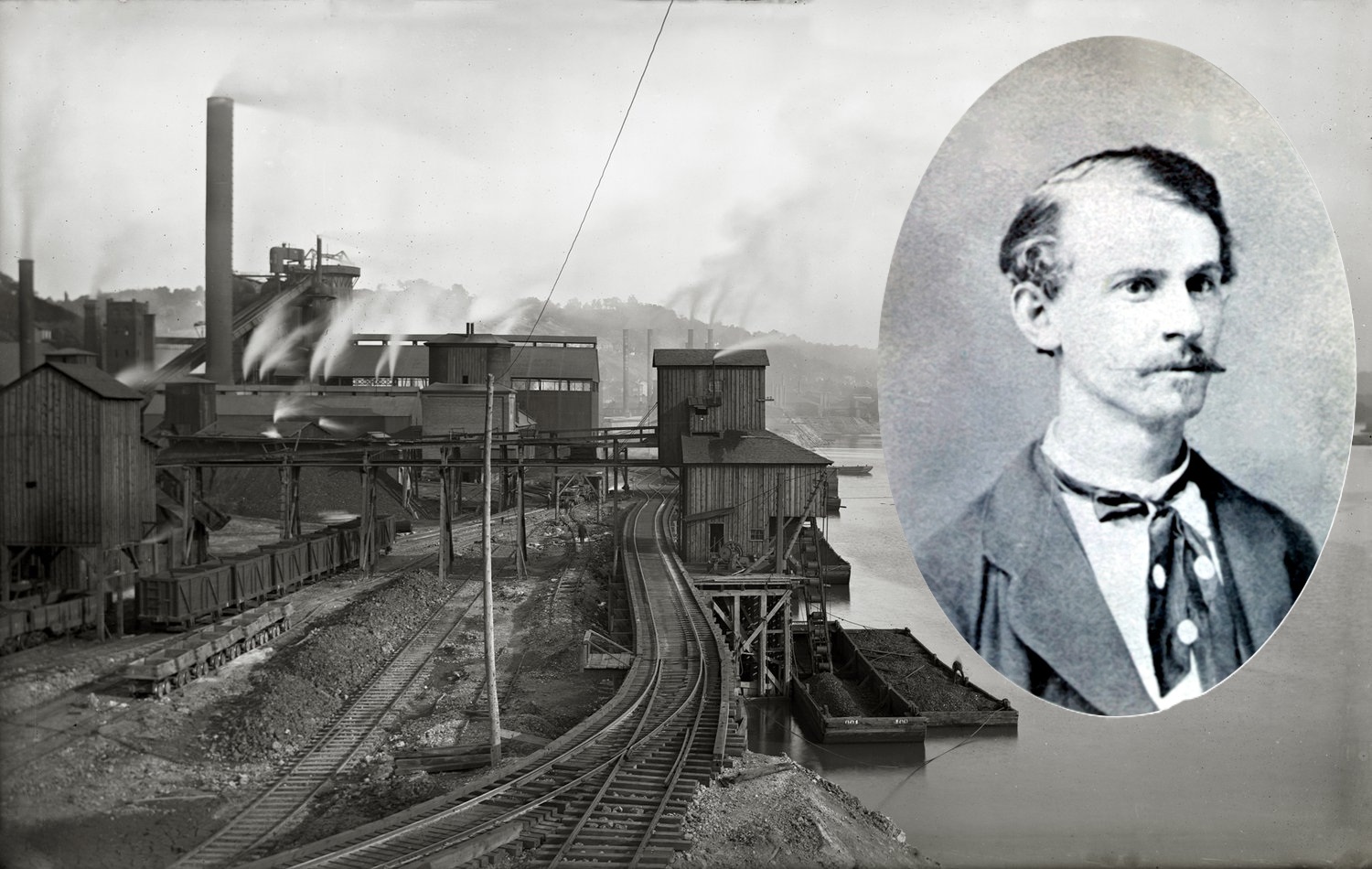
‘Pennsylvania: Natural Wealth and Artificial Poverty’ by Albert R. Parsons from The Alarm (Chicago). Vol. 2 No. 13. February 6, 1886.
The published letters by Albert Parsons home to Chicago’s Alarm from his agitational tours on behalf of the International Working People’s Association are among the finest glimpses of our proletarian ancestors to be recorded. With his acute class perspective and his natural confidence, Parsons’ letters are a wealth of social history; full of illuminating details, lost working class characters, and cultural observations. Here, just months before Haymarket he travels through the west Pennsylvania’s explosion of industry.
‘Pennsylvania: Natural Wealth and Artificial Poverty’ by Albert R. Parsons from The Alarm (Chicago). Vol. 2 No. 13. February 6, 1886.
The Paradise of the Labor Exploiter, the Hell of his Miserable Victim–How the Wage-Slaves are Evicted, Locked Out, Imprisoned, Starved, and Murdered.
Comrades:
Since writing my last report in the Alarm I have spent ten days among the wage-slaves of Pennsylvania. One mass-meeting was held at Coal Center and another at Elizabeth, on the Monongahela river. Coal Center is located fifty miles above Pittsburgh, in the Monongahela valley. From Coal Center to Pittsburgh is one continuous coal mine of almost inexhaustible quantity. The country is beautiful with its valleys, mountains, and river, and is said by those who claim to know to be almost as picturesque as Switzerland. The soil is of the richest character; the great hills abound with coal, iron, stone, oil, natural gas. The river is navigable, and bounded on either side of its bank by a railroad. The climate is delightful and healthy, the water pure. With all these natural conditions of abounding wealth which only requires the magic touch of labor’s hand it would be reasonable to expect that its inhabitants were prosperous and happy. But, alas for our boasted, so-called modern civilization! Amid this unlimited natural wealth there is the most extreme poverty and intense misery, and what is true of this region I find to be the same deplorable condition wherever I go.
In Alleghany City, a place of great wealth, and in Pittsburgh and elsewhere the gaunt faces of misery, hunger, and woe meet one on every hand. Pennsylvania is the richest State in the American Union, and Pittsburgh and the region around about is its center. The invested capital of this State is mainly engaged in employing labor at productive work. Here are the mines, mills, and factories of America, and, of course, the class distinctions of wage-slaves and capitalistic masters, of proletariat and bourgeoisie, the most clearly visible and well-defined. Here the operations of the modern commercial system, which produces for profit only, holds supreme sway, and its effects upon the people are visible on every hand, viz. : the colossal wealth of the idle few, the agonizing poverty of the industrious many. The system of private ownership and control of capital, which makes of the propertyless a dependent, hireling class, subjecting them to the selfish whims and greed of the privileged few who possess the legal right to own and control the labor product of the laborers, has full play in the “common (?) wealth of Pennsylvania.” Shoeless children, who dare not leave their miserable shanties, sometimes called “homes,” to go to school or to work over the ice or through the snow, are to be seen everywhere. Thinly clad, emaciated, care-worn women, bowed down with drudgery and anxiety, meet you on all sides. Miserable, wretched, poverty-stricken men, young in years, stalwart in frame, yet old in gait and shrunken with misery, greet your eyes at every turn. Crammed and filled are the work-houses, prisons, poor-houses, police stations, charity societies, penitentiaries, and the “Potter’s Field.”
“Rattle their bones over the stones,
They’re only poor workmen whom nobody owns.”
Look on that picture, then on this, viz.: Palatial mansions, everything that wealth can supply, licentious luxury, profligacy, idleness, and corruption among the “successful enterprisers” who have exploited, degraded, and enslaved their fellow-men.
There is fierce conflict, internal warfare on every side, raging between the privileged and disinherited. Strikes are met with lock-outs; bread riots are met with police clubs, bayonets, and gatling guns; the “pious fraud” plies his vocation and threatens the rebellious slaves with eternal damnation and the wrath of God when oppression compels them to disregard the “law and order” of their earthly masters; the poor-houses and prisons are filled with the unfortunates whose inability to find employment makes them objects of Governmental care, and dungeons and prison cells are crammed with wage-slaves who have “conspired” against starvation wages, and thus violated the “organic law” of the capitalistic system. Everything is done by contract. The labor exploiters prepare a “free contract” for their wage-slaves to sign as a condition precedent to employment, which they are at perfect liberty to sign or starve! And this “freedom of contract” is held inviolate by the courts and Judges of capitalism.
The report of the superintendent of the Bethel home in Pittsburgh, a semi-charitable institution where a bed or a meal can be had for 5 cents, made his annual report a few days ago to the public that 25,276 tramps were provided for in this institution the past year. And only one institution heard from! Ten thousand miners and coke-makers are on a strike for a 10 per cent. advance of their starvation wages in the Connellsville region, contiguous to this city, and the mine and coke czars have issued their ukas ordering them to vacate their tenements, and the police and militia are under arms, awaiting the word of command from the Government to evict the rebels, dispossess them of their miserable shanties at the point of a bayonet, and cast the helpless women and innocent children out into the snow. Shades of Irish landlordism! your blighting shadow has fallen upon America as well. First robbed and then evicted because they are dissatisfied with the robbers. And it is said that Americans are to be employed in the place of these ungrateful “foreigners.” If the foreigner is no longer satisfied with the blessings of this “free country,” why, the “American sovereign is to be employed in his place,” say the capitalists. But will the experiment prove a success? May not American sovereigns and freemen also discover that patriotism is a very poor substitute for bread? We shall see.
The men at the Edgar Thompson steel works at Braddock, a Pittsburgh suburb, had to strike against twelve hours exhausting labor. What then? Over 100 men, armed with 14-repeating Winchester rifles, and about forty deputy Sheriffs, armed to the teeth, were employed by the company to preserve “law and order.” These, with the aid of the Very-Rev. Father Hickey, of that place, induced the “ungrateful” wage-slaves to return to their slavery. Ungrateful, I say, because do not capitalists claim that they furnish the working class with bread, and that if it were not for them and their business enterprises the workers would starve! “The ungrateful wretches must be kept orderly and quiet,” say the bosses.
The flood-gates of poverty have been turned loose. Hard times; no work; hard work and poor pay, describes the situation, and to maintain their legal right to control the natural rights of others the property-holding class are strengthening the police, increasing the army, recruiting the militia, building new jails, work-houses, poor-houses, and enlarging the penitentiaries. Entrenched behind “organic law,” church and State, sustained by bayonets, maintain the supremacy of our capitalistic “law and order” regime.
Of course, the wage-slaves, the proletarians, are not indifferent to the conditions that surround them. They have massed their forces in labor organizations, principally the Knights of Labor and trades unions. But these labor organizations have built their house upon a foundation of sand, which the wind, rain, and storm of poverty now descending upon it will wash away. In fact, the foundation seems to be gone already, and the impending wreck of the whole structure is at hand. They do not and cannot regulate the work-hours; they do not and cannot keep up wages or provide employment to the enforced idle. Any labor organization which cannot do this for its members is of no value to them whatever. These organizations are at cross-purposes with themselves. They fight the effects of a system, but defend and protect the system itself. Result: failure.
Socialism is soon to become the trustee of these bankrupted capitalistic labor organizations, which are now being weighed in the balance and found wanting. Out of their ashes, Phoenix-like, will arise the new social regime. On their ruins Socialism will erect the mansions of “Liberty, Fraternity, Equality,” which shall endure forever, for Socialism gives homes to the homeless, land to the landless, liberty to the slave, wealth, happiness, and prosperity to all! Necessity, the mother of invention, will compel the wage-slaves of all nations to turn to Socialism as their only savior.
At Coal Center, on the Monongahela river, we held successful and important mass-meetings of citizens and miners. Before my arrival I was threatened with being rotten-egged and mobbed, so thoroughly and skillfully had the capitalistic politicians and priests worked up a sentiment of hatred toward the detested Anarchists. But it proved a boomerang to recoil upon themselves, for after the people heard me present the claims of Socialism they showed me every possible courtesy, taking me to the best tavern and paying for my board bill, and assuring me that they intended to send for me to return among them soon, when they would get the whole country around there to turn out and hear Socialism.
In Monongahela City no hall could be had for love or money, and hence no meeting, as the weather was too cold for an open-air address.
At Mansfield, Pa., myself and a few Pittsburgh comrades held a very well-attended mass-meeting among the citizens of that suburb. After my address an English miner rose and said that he was a God-fearing man and a Christian; that Socialism was Christianity. He had a family of six children, and his wages for the past two weeks’ work was $4! I interrupted him to inquire if he had not made a mistake, when several other miners present corroborated what he said, and stated that some of them got even less than that sum. The English miner continued, and said that they were robbed unmercifully by false weight of coal and at the infamous truck stores. Said he: “I would rather die on the battle-field than to continue to live as I am.” He said he would join the International, but it was opposed to God. Man suffered because of sin. God commanded us to work six days, but the bosses made us work seven in the week. All we had to do was to obey God and “love thy neighbor as thyself.”
This miner was told in reply that the command to work six days was absurd and impossible, because on certain portions of the earth the days were six months long. That to obey God was certain slavery, for had he not said: “Servants, obey your masters and be obedient to those placed in authority over you”? And as for loving one’s neighbor as one’s self, how could there be peace on earth and good will to those who were engaged in robbing and killing us? The English Government held its sway over Ireland because the Catholic church commanded obedience to the scriptures. The Irishman has the choice of obeying God and slavery, or disobedience and liberty. Which? To abandon the world to the robbers and seek a paradise beyond this life, among the unknown and unknowable, was to let go the bird in the hand and chase the one in the bush. No doubt ministers of the gospel would be opposed to this earthly paradise, which an observance of nature’s law would give to all, because it would abolish sin and his occupation as a soul-saver would be gone.
The meeting was well received, but here, as elsewhere, the men are too poor, having been on long strikes and out of work and money, to subscribe for the Alarm.
Last Saturday evening in the Jane Street Turner hall, on the south side of Pittsburgh, a large mass-meeting greeted us in response to the following announcement made in hand-bills:
Workingmen’s mass-meeting at Turner hall, Jane street, S. S., to-night. The workingmen and citizens of the south side will hold an indignation meeting on Saturday evening, January 30, at 7:30 o’clock, to denounce the use of police and military to overawe strikers, and also to take action in regard to the introduction of labor-saving machinery in our iron, steel, and glass industries. Every workingman and woman should be present. Free discussion. Everybody invited.
The Committee.
The hall was filled, and, on motion, F. M. Gessner, editor of the American Glass-Worker, a weekly trade journal published in Pittsburgh, was made Chairman. He said, substantially:
“LADIES AND GENTLEMEN: No one seems disposed to introduce the gentleman who speaks to us to-night, but my courtesy to strangers bids me to do it. The workingmen of Pittsburgh should be here in thousands, but possibly because the victims of oppression in the coke regions now being driven into slavery at the bayonet point are Hungarians, there is prejudice against them. Well, be it so. So much the worse for us and our organizations that the cause of these people is ignored by us, and it is left for the hated and despised Anarchists and Socialists to step boldly to the front in their behalf. The unwelcome truth calls for heroes. The poor Hun is being crushed and only the hated Anarchist comes to his rescue. Are we doing our duty? Let the hated Anarchist roll his drum to-day, but in the long roll I believe our organization will stand in line and every man answer ‘Aye.’ I am not here as an Anarchist, for I do not clearly yet understand their position. But the time has come for the utterance and acceptance of the truth, however unwelcome it may be to some. I ask your courteous attention to what Mr. Parsons, of Chicago, has to say.”
I discoursed to the audience for about two hours, and was cheered throughout to the echo, and at the conclusion of my speech the following resolutions were adopted unanimously by the large audience present, which was composed mainly of Americans:
Resolved, By this mass-meeting of workingmen of Pittsburgh, that the employment of police and militia to suppress strikes and compel working people to submit to starvation wages paid by monopolists and capitalists, as witnessed in the recent struggle of the miners on the Monongahela river, the rolling-mill men at Braddock, and the coke-workers of the Connellsville region and elsewhere, demonstrates that the employers of labor rely upon force to compel obedience to their dictation; it therefore becomes the bounden duty of all workingmen who value their life, liberty, and happiness to arm and prepare themselves to successfully resist the oppressions of their capitalistic masters.
Resolved, That the monopolistic or private control of recent inventions in labor-saving machinery, together with the use of natural gas in the manufacture of iron, steel, and glassware, has destroyed the means of subsistence of tens of thousands of wage-workers by rendering their labor superfluous; therefore, it is our bounden duty, in order to live and enjoy liberty, to take the means of human subsistence out of the control and ownership of private individuals and place them where they by natural right belong, viz.; into the hands of society for the free use of all, thus destroying forever the monopolistic system of private capital in the means of life, which breeds the curse of poverty, ignorance, intemperance, disease, crime, and vice.
Resolved, That it is the conviction of this mass-meeting that the time has arrived when the workingmen of America must arise and proclaim, and maintain by any and all means, their inalienable right to life, liberty, and the pursuit of happiness.
I cannot close this brief report without calling attention to Pennsylvania, and Pittsburgh, its industrial center, as the natural cradle of the social revolution. Here, as nowhere else in America, the growth and development of the capitalistic system of mass-production has prepared the way by precept and example for the transition from the old to the new civilization. All the conditions exist for the rapid and stalwart growth of the revolutionary proletariat. There is but one thing lacking, viz.: leaders. The trades unions and Knights of Labor have organized the wage-workers for amelioration, which can never come. The leaders of these bodies are still chasing the ignis fatuus of politics, and the further they go the deeper they sink into the quagmire of the political swamp, until the cry already comes out of the gloom: “Help, help!” It is my deliberate judgment that one-half the talent, energy, and means expended in Pittsburgh that has been in Chicago would give the revolutionary movement ten members where it now has one. But unfortunately the Socialistic propaganda here has neither an American, German, or other organizer and agitator; no press, and consequently but little vitality. The harvest is great, but the harvesters are few. There is great probabilty of another trades union riot here like that of 1877. These are the inevitable social eruptions which make Socialism a necessity.
I leave here to-day for Canton, O., thence to Massillon, Mansfield, Columbus, Hocking Valley, Springfield, O., and back to Chicago. Salut.
The Alarm was an extremely important paper at a momentous moment in the history of the US and international workers’ movement. The Alarm was the paper of the International Working People’s Association produced weekly in Chicago and edited by Albert Parsons. The IWPA was formed by anarchists and social revolutionists who left the Socialist Labor Party in 1883 led by Johann Most who had recently arrived in the States. The SLP was then dominated by German-speaking Lassalleans focused on electoral work, and a smaller group of Marxists largely focused on craft unions. In the immigrant slums of proletarian Chicago, neither were as appealing as the city’s Lehr-und-Wehr Vereine (Education and Defense Societies) which armed and trained themselves for the class war. With 5000 members by the mid-1880s, the IWPA quickly far outgrew the SLP, and signified the larger dominance of anarchism on radical thought in that decade. The Alarm first appeared on October 4, 1884, one of eight IWPA papers that formed, but the only one in English. Parsons was formerly the assistant-editor of the SLP’s ‘People’ newspaper and a pioneer member of the American Typographical Union. By early 1886 Alarm claimed a run of 3000, while the other Chicago IWPA papers, the daily German Arbeiter-Zeitung (Workers’ Newspaper) edited by August Spies and weeklies Der Vorbote (The Harbinger) had between 7-8000 each, while the weekly Der Fackel (The Torch) ran 12000 copies an issue. A Czech-language weekly Budoucnost (The Future) was also produced. Parsons, assisted by Lizzie Holmes and his wife Lucy Parsons, issued a militant working-class paper. The Alarm was incendiary in its language, literally. Along with openly advocating the use of force, The Alarm published bomb-making instructions. Suppressed immediately after May 4, 1886, the last issue edited by Parson was April 24. On November 5, 1887, one week before Parson’s execution, The Alarm was relaunched by Dyer Lum but only lasted half a year. Restarted again in 1888, The Alarm finally ended in February 1889. The Alarm is a crucial resource to understanding the rise of anarchism in the US and the world of Haymarket and one of the most radical eras in US working class history.
PDF of full issue: https://dds.crl.edu/item/54016
 Revolution's Newsstand